The American Dream Was Sold for Parts: How Bernays, Consumerism, and Corporate Capture Broke It
The American Dream was never a house and a job. It was an aspiration, deliberately broken into pieces: sold to you at home through Edward Bernays and consumerism, and stripped for parts abroad through oil and corporate capture. Here is how it was done, and who did it.
TL;DR
The American Dream once meant growth and fair opportunity for everyone. Edward Bernays built methods to link hidden wants to products. Marketers used these methods to shrink the Dream into a priced checklist: degree, job, house, goods. Mobility fell after 1940 because gains stopped being shared, not because growth stopped. The same tactics justified coups abroad that protected corporate interests. We must replace the priced checklist with unownable goals like capability, dignity, and belonging.
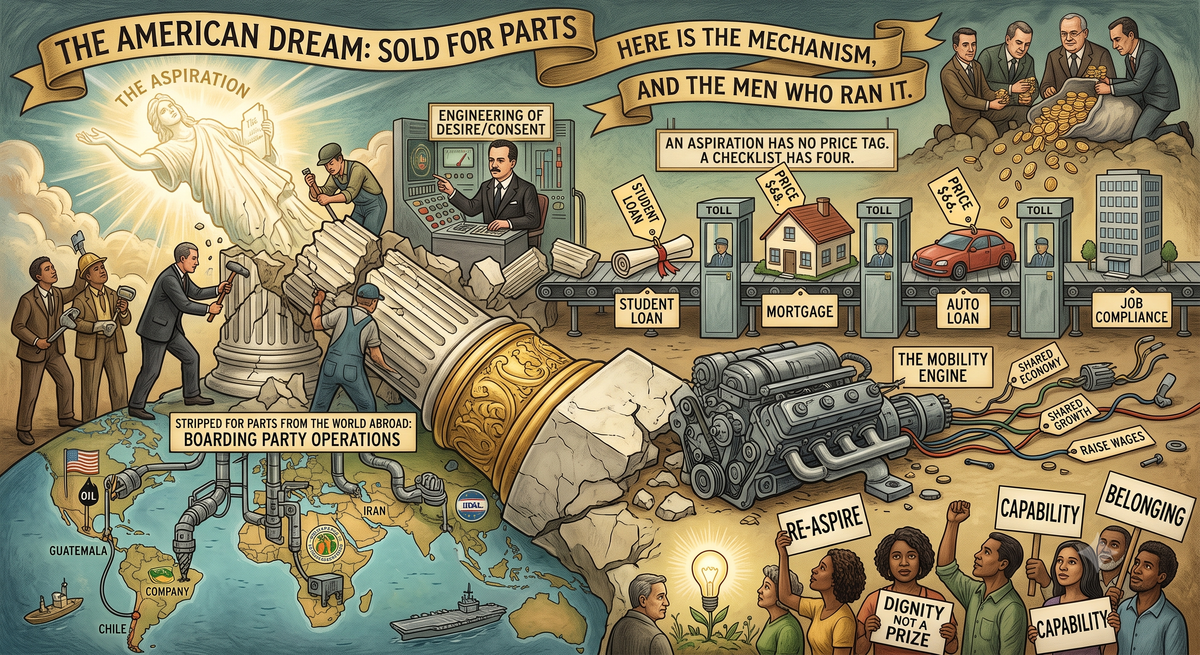
The Dream was never a house and a job. It was an aspiration, and it was taken apart on purpose: sold to you in pieces at home, and stripped for parts from the world abroad. Here is the mechanism, and the men who ran it.
Ask most people what the American Dream is and you will get a list. Go to school. Get a job. Buy a house. Be happy. Notice that every item on that list has a price, and every price has a lender or a seller standing next to it. That is not an accident. That is the finished product of a century of work.
Because the Dream did not start as a list. When James Truslow Adams put the phrase into wide use in 1931, he meant something you cannot buy: a life that grows fuller and richer for everyone, with opportunity measured by what a person can actually do, not by the accident of who their parents were. Two things live inside that sentence. One is personal, the chance to become what you are capable of becoming. The other is structural, the promise that your birth will not set your ceiling. The version we were left with keeps a shrunken piece of the first and quietly deletes the second. This is the same edit that turned the Boston Tea Party, an anti-monopoly raid against a government-backed corporation, into a vague story about "taxes." Keep the harmless half. Amputate the half that points at power. I have written about that raid elsewhere. This is the larger pattern it belongs to.
The man who taught a country to want
You cannot understand how an aspiration became a shopping list without meeting Edward Bernays.
Bernays was Sigmund Freud's nephew, and he took his uncle's ideas about buried desire and turned them into a sales method. In 1923 and again in 1928, in books he was bold enough to title Crystallizing Public Opinion and Propaganda, he laid out the theory plainly: understand what a crowd secretly wants, then attach that want to whatever you are selling. He called it the engineering of consent, and its commercial twin, the engineering of desire.
His most famous job shows the trick in miniature. In the late 1920s the American Tobacco Company wanted to sell cigarettes to women, who mostly did not smoke in public. Bernays did not argue that tobacco was pleasant. He staged a group of women lighting cigarettes in the New York Easter parade and fed the press a story that they were lighting "torches of freedom." He sold women a feeling, liberation, and shipped a product inside it. He did the same for automobiles, converting a machine into a symbol of success, modernity, and personal identity so that buying a car became buying a self.
Sit with that move, because it is the whole essay. Take an open, unpriceable human longing, to be free, to be respected, to matter, and bind it to a specific thing you can put on a shelf and ring up. Once you can do that at scale, you can convert almost any aspiration into almost any purchase. Including the biggest aspiration a nation had.
An aspiration has no price tag. A checklist has four.
Watch what happens when you run Bernays's move on "a fuller, richer life for everyone."
It becomes: the degree, the job, the house, the stuff that signals happiness. And every one of those four now has a toll booth bolted to it. The degree comes with tuition and a loan. The job is a market that prices your compliance. The house is a mortgage. The happiness is an endless aisle of proxies you can buy on credit. The concretizing and the monetizing are not two steps. They are one step. You had to make the Dream concrete in order to make it a market, because nobody can sell you "become who you are capable of being," but anybody can sell you a house.
There is a reason this substitution went almost entirely unnoticed, and it is not stupidity. It is training. An aspiration is not a fact you store. It is something you have to rebuild for yourself every time, by reasoning about what "better" even means and then arguing yourself toward it. A checklist is just a list, and a list is the one thing a memorize-and-recite education is built to hold. I have argued elsewhere that the machine won the memory contest, that we spent generations training people to store and recite instead of to reason and rebuild. This is the bill for that. A population trained only to recall can hold "school, job, house." It cannot hold the aspiration those items replaced, because the aspiration was never a stored item. So when the swap happened, there was nothing to compare the new version against. You cannot miss an abstraction you were never equipped to keep.
That is how you cripple a dream without anyone raising an alarm. You do not have to argue people out of the real thing. You just have to make sure they were never taught to hold it, and then hand them a smaller version that fits in the space that is left.
Then they unbolted the engine
For about two decades after the war, the checklist mostly worked, and this is the part an honest account cannot skip. The degree, the job, and the house were genuinely within reach for a wide swath of people, wages rose, and a real majority did end up better off than their parents. The concrete Dream was not a lie at the start. It was a real, broadly delivered version of the promise. Which is exactly why keeping it, unchanged, after its engine broke, is the betrayal.
Here is the engine. Raj Chetty and his colleagues measured the most basic form of the Dream, the odds that a child grows up to out-earn their parents. For children born in 1940, those odds were about ninety percent. For children born in the 1980s, they had fallen to about fifty percent. A coin flip. And the crucial finding, the one that names the crime, is why. It was not that the economy stopped growing. Their own counterfactuals show that if you kept today's slow growth but shared it the way the mid-century economy did, you would recover most of the loss, while pumping up growth without changing the distribution barely moves it. The pie kept getting bigger. The slices simply stopped being handed out. The mobility that made the checklist reachable was not lost. It was diverted.
Diverted by whom, and how, is a story of specific choices, of financial rules rewritten so that the gains of a growing economy pooled at the top. I have told one chapter of it, the repeal of Glass-Steagall and the people who voted for it and never left power. The through-line is corporate capture: the steady conversion of a shared economy into a set of private toll roads. The checklist stayed on the billboard. The road underneath it was quietly sold.
This is the first death of the Dream. Not loud. Not announced. An engine unbolted while the dashboard kept glowing.
The same tool, turned on the world
Now the part that hurts, because it is where the Dream stopped being only ours to lose.
For a century, the American Dream was the world's dream. People in every country wanted to come here, and even the ones who never could kept the idea as a kind of North Star: the place where what you could do mattered more than where you were born. That was a real and precious form of soft power, and it was earned.
Then the same toolkit that sold cigarettes at home got pointed outward. Follow Bernays one more time. The man who branded cigarettes as freedom also worked for the United Fruit Company, and he ran the propaganda campaign that helped manufacture American support for the 1954 overthrow of Guatemala's elected government, after that government dared to reclaim farmland from the corporation. The engineer of desire became the engineer of consent for a coup. Same method. Bigger product.
And Guatemala was a sequel. The template was written the year before, in Iran. In 1951 Iran's parliament, under its elected prime minister Mohammad Mossadegh, voted to nationalize an oil industry that a British corporation, the Anglo-Iranian Oil Company (today BP), had run for decades while refusing to let Iran even audit the books. Read that grievance again, because you have heard it before: a foreign, state-backed corporation holding a monopoly on a people's own resource and denying them a look at the ledger. It is the Boston Tea Party's complaint, transplanted. In 1953, British intelligence and the American CIA ran Operation Ajax, paid the mobs and the newspapers, removed Mossadegh, and restored the Shah. The public justification was the Cold War, the fear of a communist Iran, and that fear was real to some. But the CIA's own analysts had judged a communist takeover unlikely, and the outcome tells you what the operation was actually protecting: Western control of the oil was restored, and as a condition of the deal, five American oil companies were handed a share of the spoils they had never had before. The monopoly was broken only to be re-divided among the people who broke it.
Mossadegh was no flawless democrat, and the story had real Cold War texture, not just barrels of oil. But the pattern that starts here is undeniable, because Washington repeated it. Iran in 1953. Guatemala in 1954. Echoes in Chile and beyond. There is a dark joke now, told all over the world, that if your country discovers oil you should expect an American carrier group off your coast by morning. The joke overstates the speed and it overstates how often it is only about oil. But a joke that lands in that many languages is not nothing. It is folk memory of a real pattern, the memory of a country that too often showed up not as the beacon it advertised but as the boarding party.
So the world stopped dreaming and started flinching. The beacon and the boarding party cannot be the same flag for long before people believe the boarding party. The blowback is written into the history: the 1953 coup is widely understood to have helped produce the 1979 revolution and the decades of hostility that followed. We did not just lose the Dream at home by pricing it. We discredited it abroad by weaponizing it. This is the second death, and it is the one the rest of the world attended.
What was actually stolen
Line the two deaths up and they are the same act.
At home, they took an aspiration and sold it back to you in parts, one purchase at a time, then quietly diverted the engine that made the parts affordable. Abroad, they took the same aspiration, the beacon, and stripped it for parts, one intervention at a time, wherever there was something profitable under the ground. Inward, the Dream was concretized so it could be sold. Outward, it was concretized so it could be extracted. The unifying move, the only move, is this: convert a dream into an extraction. Take something that was supposed to be more than the sum of its parts, and reduce it to exactly its parts, because parts have a price and a dream does not.
That is what was stolen. Not the house. The house was only ever a symbol, and for a while a good one. What was stolen is the thing the house was standing in for: a shared aspiration big enough that a whole country, and much of the world, could aim at it together and never quite reach the end of it.
A dream more than the sum of its parts
You cannot fix this with a bigger checklist. A larger house, a fancier degree, a better job is still the sold version, still priced, still hoardable, still capturable by whoever can corner the mechanism. Every concrete Dream is a Dream that a well-positioned few can eventually own the toll roads to. That is not a flaw in this particular checklist. It is a flaw in checklists.
The way out is to re-aspire, and to denominate the new Dream in things that cannot be cornered. There are such things. Capability, the ability to learn anything and become someone who can walk into any field and make it yours, is non-rival: my learning does not subtract from yours, and no one can buy up the supply. Dignity secured as a right, a floor under every life so that survival stops setting the terms, cannot be competed away once it is a right rather than a prize. Belonging, the state of being genuinely needed by other people, actually grows when it is shared, and cannot be hoarded, because you cannot stockpile being relied upon. A Dream priced in capability, dignity, and belonging is a Dream with no toll booth to sell, because there is no way to attach a vendor to becoming, to mattering, or to a right.
That is what "more than the sum of its parts" means in practice. Not a vaguer dream. A dream whose value literally cannot be reduced to parts, because its parts grow rather than deplete when they are shared, and so there is nothing there to sell you back.
The American Dream was not lost. It was sold for parts, at home and abroad, by people who understood exactly what they were doing. But a thing that was sold can be refused, and a thing that was taken apart can be built again, this time out of materials that do not come with a price tag. The first act of refusing is the hardest and the cheapest: learning, again, how to hold an aspiration in your head, so that the next time someone hands you a shopping list and calls it a dream, you can feel the difference.
Two levers, not a new checklist
Rebuilding the Dream is not a matter of wanting it back. It takes structural counter-capture: mechanisms that make extraction harder and participation easier, built into the machine so they hold when nobody is watching. Two levers do most of the work, and they pull on each other. Civic literacy. Broad-based ownership.
Start with literacy, because it is the cheaper of the two and the one they took from you first. Run the Trivium Spiral on the world and it hands you three tools. Grammar: name what is actually in front of you, precisely, before anyone names it for you. Logic: test how the parts connect, and catch the fallacy hiding in the pitch. Rhetoric: act on what survives the testing, anchored in virtue rather than appetite. A population trained that way does not just swallow symbols. It interrogates the checklist. It notices when "success" has been quietly rewritten as debt you carry for a house, and it notices when a speech about freedom is a cover story for someone's oil. That is not education reform in the abstract. It is a direct defense of the public square, and it can be built the way we already build adult skills: short civic modules, the size of a micro-credential, that treat manipulation itself as a subject you master, the way you would master a trade. The Founders said it plainly. An informed citizenry is the last check on concentrated power. Skip this step and capability and dignity are just stories waiting to be captured by whoever writes the next campaign.
Ownership is the same idea, moved from the mind to the balance sheet. Spread the stakes on purpose: employee stock ownership plans, cooperative conversions, universal capital accounts, funded where they can be through pipes we already own, like Social Security infrastructure or public banking. When workers actually hold a piece of the thing they build, the incentive to rewrite the rules for extraction gets weaker, because now they would be rewriting those rules against themselves. Mobility stops getting siphoned upward and starts circulating where people live. This is Adam Smith's old line between productive labor and rent-seeking, and it is the anti-cronyism spirit of the Tea Party in economic form. And it is not a hope. The evidence is already in: firms with real employee ownership tend to hold onto their people, produce more, and ride out downturns better than the ones that do not. In an age where AI is compressing the number of jobs, a stake is what keeps the Dream from collapsing into a zero-sum scramble over what is left.
Put the two together and they feed each other. Citizens who can see clearly demand ownership models and defend them. Ownership disperses the power that would otherwise buy the schools and the airwaves, and it pays for the institutions that keep people literate. Neither one is a cure, and neither is a new checklist to hand you. What they share is the property that matters: both are non-rival. Your ability to think does not shrink mine. Your stake in the enterprise does not shrink mine. That is the whole point. They rebuild the structural half of the promise Adams named, the fair chance regardless of birth, while leaving the unpriceable half, the becoming, exactly where it belongs. Untouched, and yours.
This is the shape of the problem. The build order for the alternative, the floor, the learning, the shared capital, is the argument of the rest of this work, and of the book.
Frequently Asked Questions
Did Edward Bernays invent the American Dream checklist?
Bernays did not invent the Dream, but he pioneered the method that shrank it into a checklist. He learned from his uncle Sigmund Freud how to find hidden desires and attach them to products. Marketers later used this same method to link the broad Dream to a priced list: degree, job, house, and goods.
What did James Truslow Adams originally mean by the American Dream in 1931?
Adams meant a life that grows fuller and richer for everyone. He also meant that opportunity should depend on ability, not on the accident of birth. Later versions kept only the personal growth part and dropped the promise about fair opportunity.
Why did economic mobility fall after 1940 in the United States?
Raj Chetty's research shows mobility fell from about 90 percent for children born in 1940 to about 50 percent for those born in the 1980s. The cause was not slower economic growth, since the economy kept growing. The cause was that gains stopped being shared the way they were in the mid-century economy.
How did Bernays's methods get used outside the United States?
Bernays worked for the United Fruit Company and ran propaganda that helped justify the 1954 overthrow of Guatemala's elected government. This followed a similar pattern from Iran in 1953, when British and American intelligence removed Prime Minister Mossadegh after he nationalized oil owned by a British corporation. Both operations protected corporate profits while claiming to fight communism.
What really was stolen from the American Dream?
The house, job, and degree were never the real Dream, only symbols of it. What was stolen is the larger aspiration those symbols stood for: a shared goal big enough for a whole country and much of the world to aim at together. Replacing priced goals with unownable ones like capability, dignity, and belonging can restore it.