The Boston Tea Party Was an Anti-Monopoly Raid
TL;DR
The Tea Act of 1773 made tea cheaper, not more expensive. It gave the British East India Company a monopoly and tax breaks. This hurt small merchants and colonial businesses. Young tradesmen destroyed the monopoly's tea to protest corporate power over government. The Boston Tea Party was an anti-monopoly protest, not a tax protest.
The version most Americans learned in school goes like this: colonists were furious about a tax on tea, they cried "no taxation without representation," they threw the tea into the harbor, and from that angry refusal of taxes, the Revolution was born.
Almost every part of that story is wrong.
Start with the detail that breaks the whole narrative: the Tea Act of 1773 lowered the price of tea in the colonies. It made tea cheaper than it had been in years. Cheaper than the smuggled Dutch tea local merchants were selling. Cheaper than nearly anything else on the docks.
People don't destroy bargains. So what were they destroying?
What the Tea Act actually was
The Tea Act wasn't about tea, and it wasn't about taxes. It was a corporate bailout.
The British East India Company, the largest corporation on Earth at the time, was drowning in debt. Parliament rescued it by handing it three special privileges in the American colonies: a monopoly on tea sales, tax breaks that let it undercut every competitor, and the right to bypass colonial wholesalers entirely.
Run through what that meant on the ground. Every small merchant, dockworker, smuggler, and shopkeeper who handled tea for a living was gutted overnight. The message to every small business in the colonies was identical: you cannot compete with our friends in London. Not because they're better. Because we wrote the rules for them.
Who actually boarded those ships
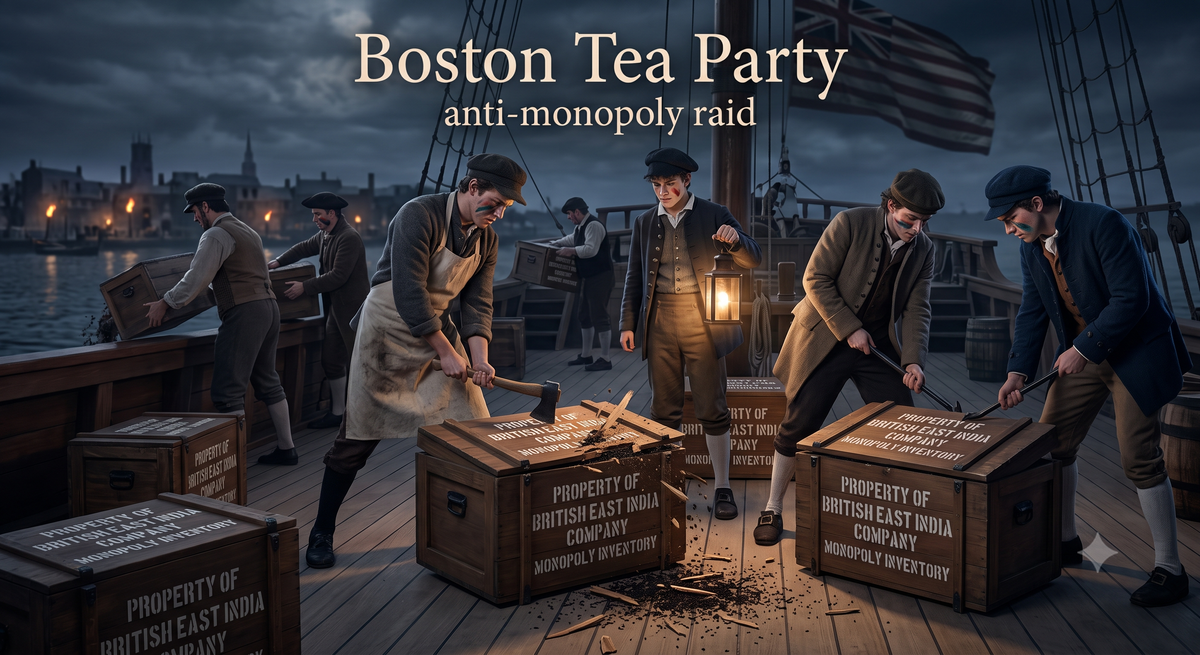
The men who climbed onto those ships in December 1773 weren't bored aristocrats or an anti-tax mob. Of the roughly 168 known participants, fewer than nine were over forty. They were young carpenters, blacksmiths, shoemakers, sailors, printers, coopers, and farmers. Some were teenagers.
These were the "Makers" that Adam Smith talked about, those that created, produced, traded time for money, not the "Takers" that was the East India Trading Company, exploited loop holes and tax breaks to extract profit...
They destroyed 342 chests of tea, swept the decks clean, harmed nothing else, and went home.
That is not a riot. That is a surgical strike against a corporate takeover. They didn't attack the crews. They didn't loot the ships. They destroyed one thing: the monopoly's inventory.
The pattern this reveals
Once you see the Boston Tea Party as an anti-corporate uprising, the whole founding falls into a different pattern.
The Revolution wasn't started because Americans hated government. It was started because they understood that when a corporation owns the government, ordinary people have no rights. That is the lesson our modern political vocabulary has most thoroughly forgotten, on every side of the aisle.
The Founders feared concentrated power in any costume. A king could threaten liberty. So could a corporation. So could a wealthy family. So could a mob. The Constitution wasn't built to weaken government in general. It was built to spread power so widely that no single faction could grab it.
And they wrote that fear into hard policy. In the early 1800s, states routinely revoked corporate charters when companies acted against the public interest. Pennsylvania alone revoked at least 19 charters between 1814 and 1857. A bank that defrauded customers could lose its right to exist. The corporation was a privilege granted by the public, not a permanent right.
Even Adam Smith, the man modern rhetoric has recast as the patron saint of unrestricted capitalism, was on the raiders' side of this fight. He opposed chartered monopolies and joint stock companies like the East India Company by name. His whole project was to free markets from monopolists, not to free monopolists from markets.
The definition we were given
John Adams, drafting the Massachusetts Constitution in 1780, wrote down what all of this was for:
"Government is instituted for the common good; for the protection, safety, prosperity and happiness of the people; and not for the profit, honor, or private interest of any one man, family, or class of men."
That's not a hope. It's a definition. A government that serves a class instead of the common good is, by Adams's own terms, not a legitimate government. The men in the harbor understood that a full seven years before he wrote it down.
So here is the question worth sitting with on the Fourth of July, whatever your politics: which side of Boston Harbor does your country stand today? Are the rules written for the people who build, plant, code, weld, teach, heal, and repair? Or for the those that exploit and extract like modern equivalents of the East India Company?
If you suspect you know the answer, the next question is what a pathway back actually looks like. Not a complaint. Not a fantasy. A sequenced, costed plan.
That's the book I published this week. It's called From Moral Algorithm to Ordered Liberty: A Citizen's Pathway, and it begins exactly where this essay ends: with the tools for thinking clearly about what was taken and the five reforms, in load-bearing order, that take it back.
Section One is free, for signing up on this site. Read the method first. Then decide if the rest earns your ten dollars.
Frequently Asked Questions
Did the Tea Act of 1773 raise the price of tea?
No, the Tea Act lowered the price of tea in the colonies. It made East India Company tea cheaper than smuggled Dutch tea and other local options.
Who took part in the Boston Tea Party?
About 168 people took part, and fewer than nine were over forty years old. They were mostly young tradesmen, including carpenters, blacksmiths, shoemakers, sailors, printers, coopers, and farmers, some still teenagers.
What did the participants destroy during the Boston Tea Party?
They destroyed 342 chests of tea belonging to the British East India Company. They harmed no crew members and did not loot the ships or take any other cargo.
Why did colonists target the British East India Company specifically?
Parliament gave the company a monopoly on tea sales, tax breaks, and the right to bypass colonial wholesalers. These privileges let it undercut and ruin local merchants, dockworkers, and smugglers overnight.
Did the Founders believe corporations posed a threat similar to kings?
Yes, the Founders feared concentrated power in any form, including kings, corporations, wealthy families, or mobs. States acted on this fear; Pennsylvania alone revoked at least 19 corporate charters between 1814 and 1857 for acting against the public interest.