Andy’s Frozen Custard vs People
Springfield’s Andy’s Frozen Custard $32 million bond fight raises a bigger question: should taxpayers fund long tax abatements for profitable local brands, or demand clear public returns first?
TL;DR
Andy's Frozen Custard asks Springfield for a $32 million Chapter 100 bond deal. The deal gives tax breaks, not cash, for a new headquarters. Critics say the company should pay its own way. Supporters say the city must keep growing companies from leaving. Springfield needs a clear public test to judge the deal fairly.
Andy’s Frozen Custard, the $32 Million Bond, and Springfield MO’s Test of Civic Fairness
Springfield’s debate over Andy’s Frozen Custard is not really about frozen custard.
It is about a deeper public question: when should a city help a private business grow, and when does that help become corporate welfare?
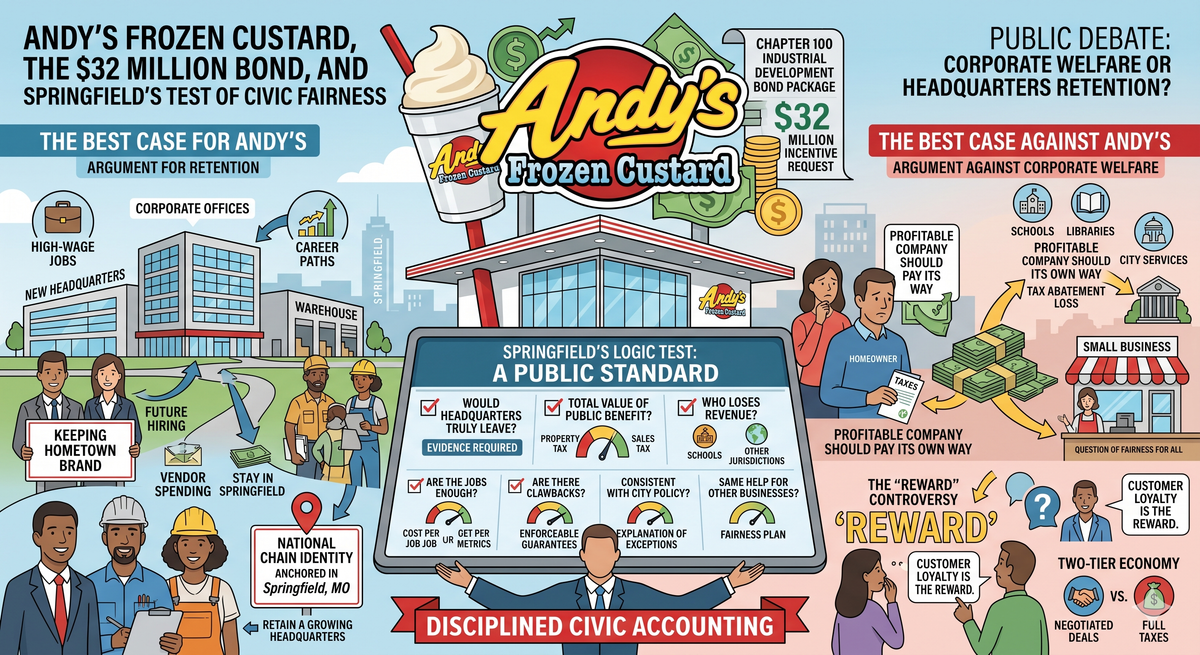
The controversy began after Andy’s Frozen Custard sought a $32 million Chapter 100 Industrial Development Revenue Bond package connected to a proposed new headquarters campus in Springfield, Missouri. Public reporting from KY3 described the proposed project as a new headquarters site near East Division Street and North LeCompte Road. The proposal reportedly includes multiple office buildings, warehouse space, retention of existing corporate jobs, and creation of a smaller number of new full-time jobs.
The emotional spark came from comments reported by Springfield Daily Citizen reporter Ryan Collins, where CEO Andy Kuntz framed the proposed incentive as something like a “reward” after decades of operating in Springfield. In public comments, many residents read that not as gratitude, but as entitlement. They argued that Andy’s has already been rewarded through decades of customer loyalty, premium-priced sales, local goodwill, and private profit.
The result is a local debate that has become a miniature version of a national argument: should public finance be used to support private expansion, or should profitable companies pay their own way like everyone else?
The Facts First
A Chapter 100 bond is not the same thing as the city handing a company $32 million in cash.
Under Missouri’s Chapter 100 structure, a city or county can issue industrial development bonds and use the structure to support a qualifying business project. Depending on how the deal is written, the public entity may temporarily own the project property and lease it back to the company. That structure can allow tax benefits, including property tax abatement and possible sales tax exemptions on construction-related purchases.
That distinction matters. Supporters are correct when they say the headline can mislead people if they think Springfield is simply writing Andy’s a $32 million check.
But opponents are also correct that the benefit is still public value. A property tax abatement means schools, libraries, county services, city services, and other local taxing jurisdictions may receive less than they otherwise would from the improved property. It may not be a cash grant, but it is still a public financial concession.
That is the core issue.
The real question is not whether the financing tool is legal. The real question is whether the public return is strong enough to justify the public sacrifice.
The Best Case for Andy’s
The strongest argument for the proposal is straightforward.
Springfield should fight to keep successful local companies. Andy’s is a hometown brand that grew into a national chain. A headquarters is not the same as a single retail location. Headquarters jobs tend to pay better, create professional career paths, support vendor relationships, and anchor a company’s long-term identity in a city.
From that view, the city is not merely helping Andy’s build an office. It is trying to keep a growing corporate headquarters in Springfield.
Supporters can argue that if Andy’s moves its headquarters elsewhere, Springfield may lose more than a few office jobs. It may lose future hiring, executive presence, charitable giving, business travel, vendor spending, and civic identity tied to a company that began in the region.
There is also a practical competition argument. Economic development does not happen in a moral vacuum. Other cities and states offer incentives. If Springfield refuses every incentive while competing cities offer abatements, Springfield may slowly train growing companies to leave once they reach a certain size.
A supporter might say:
“This is not a giveaway. It is a tool cities use to keep jobs, keep companies, and compete with other communities. If Springfield wants to be more than a low-wage service economy, it has to retain companies that can grow.”
That argument should not be dismissed. Cities do need employers. Cities do need headquarters. Cities do need local companies that grow into national brands.
The pro-Andy’s case is strongest when it is framed as retention of a hometown headquarters, not as a personal reward for ownership.
The Best Case Against Andy’s
The strongest argument against the proposal is also straightforward.
A successful private company should finance its own expansion unless the public receives a clear, measurable, enforceable return.
That is where the public anger comes from. In public comments, residents repeatedly asked why homeowners, small businesses, workers, and customers must pay full taxes while a profitable company asks for special treatment. Many saw the proposal as another example of ordinary people carrying the cost while wealthy owners receive the benefit.
The “reward” language made this much worse.
For many citizens, the reward for building a successful business is the business itself: profits, brand value, expansion, personal wealth, customer loyalty, and community respect. Asking for a long tax abatement after receiving decades of local support can sound like asking the same community to pay twice.
Opponents also raise a fairness problem. If Springfield bends its own usual standards for one company, other companies learn the same lesson: threaten to leave, and the city may negotiate.
That creates a dangerous public pattern.
The larger and more mobile a company becomes, the more bargaining power it has. The smaller and more rooted a business is, the less help it gets. Over time, that can create a two-tier economy.
One tier pays the full cost of local government.
The other tier negotiates a discount.
A critic might say:
“If Andy’s is successful enough to expand, it should be successful enough to pay taxes. Public tools should serve the public first, not become loyalty rewards for private companies.”
That argument should not be dismissed either. Public revenue is not free. Every abatement has an opportunity cost. The money not collected from one project must either be made up elsewhere, cut from services, or justified by future gains.
The Logic Test
The debate should not turn on whether people like Andy’s custard.
It should turn on whether the deal passes a clear public test.
1. Would the headquarters truly leave without the incentive?
If the city claims the project is at risk of moving elsewhere, that claim needs evidence. The public should know whether other cities made formal offers, what those offers included, and whether Springfield is matching a real threat or reacting to a negotiating position.
A business does not need to reveal every private detail. But if public value is being requested, the public deserves enough information to judge the claim.
2. What is the total value of the public benefit to Andy’s?
The public needs a plain-language number.
Not just the bond amount.
The public should see the estimated value of property tax abatement, sales tax exemptions, payment in lieu of taxes, job commitments, wage commitments, and expected public return by year.
The right question is:
“What does Andy’s receive, what does the public give up, and what does the public get back?”
3. Who loses revenue?
Property tax does not only affect City Hall. It can affect schools and other local taxing jurisdictions. That means every affected public body should be clearly identified.
If the deal reduces future school revenue, that must be stated plainly.
If payment in lieu of taxes offsets that loss, that must be shown plainly.
No vague language should be accepted.
4. Are the jobs enough?
Retaining existing jobs has value. Creating new jobs has value. High-wage jobs have special value.
But the number of jobs matters.
If the proposal creates only a limited number of new positions, then the abatement must be judged against that reality. A 25-year public concession for a small number of new jobs requires a strong explanation.
The city should calculate public cost per retained job, public cost per new job, and public cost per dollar of payroll.
5. Are there clawbacks?
Any public incentive should include enforceable clawbacks.
If job targets are missed, wages fall below promises, the headquarters relocates, the property is sold, or the company fails to meet its obligations, the public should recover value.
A promise without enforcement is not a public contract. It is a press release.
6. Is the deal consistent with city policy?
One public commenter claimed that Springfield’s standard industrial development bond policy is much more limited than the requested structure. If the proposal exceeds normal policy, the city should say so directly and explain why this project deserves an exception.
Exceptions are sometimes justified.
Hidden exceptions destroy trust.
7. Would the same help be available to other local businesses?
This may be the most important fairness question.
If similar help is available only to companies large enough to hire lawyers, consultants, and lobbyists, then the policy favors power.
If the city wants to support business growth, it should explain how smaller local businesses can access proportional help. Otherwise, the public will see the deal as another case of government helping the already powerful.
The Rhetorical Failure
The biggest mistake in this controversy may not be the financing structure itself.
It may be the way the request was framed.
A company asking for public help should lead with gratitude, humility, and numbers.
Instead, the public heard “reward.”
That word shifted the moral frame. It made the proposal sound less like a public investment and more like a personal entitlement.
A better message would have sounded like this:
“Springfield built Andy’s with us. We are asking for help because we want to keep our headquarters here, grow here, and create long-term value here. We understand public incentives must be earned, so here are the jobs, wages, guarantees, clawbacks, and public returns we are willing to put in writing.”
That message would not satisfy every critic. But it would show respect for the public.
What This Reveals About Springfield
The public comments show a deeper loss of trust in local economic development.
People are tired of being told that tax breaks for companies are investments while public spending on ordinary people is treated as a burden.
They are tired of hearing that cities must compete for business, while residents are never allowed to compete for relief from their own rising costs.
They are tired of seeing public tools used for private leverage.
At the same time, Springfield also faces a real economic challenge. The city cannot build a strong future if every growing company leaves. It cannot rely only on low-wage service work, nostalgia, and shrinking industrial memory. It needs headquarters, advanced employers, local ownership, skilled jobs, and business growth.
Both truths can exist at the same time.
Springfield needs business growth.
Springfield also needs public fairness.
A Fair Path Forward
Springfield should not approve or reject the proposal based on anger alone.
It should apply a public standard.
A fair deal would include these conditions:
- Full public cost-benefit report
The city should publish a readable report showing total public cost, expected public return, yearly tax effects, and the effect on each taxing jurisdiction.
- Shorter or reduced abatement unless extraordinary benefit is proven
A long abatement should require major public return. If the project does not produce major new employment, major redevelopment, or major infrastructure benefit, the incentive should be scaled down.
- Mandatory clawbacks
If Andy’s does not meet job, wage, headquarters, or investment commitments, public benefits should be reduced or recovered.
- School and taxing-jurisdiction protection
Affected public bodies should not be quietly forced to absorb the cost. Their losses, offsets, and positions should be public.
- No special exception without a written reason
If the requested deal exceeds standard city policy, the city should explain the exception in writing before approval.
- A local small-business fairness plan
If Springfield can create tools for large companies, it should also create smaller, proportional tools for local businesses that cannot threaten to leave.
- Community benefit agreement
Andy’s should commit to measurable local benefits. These could include local hiring, internships, workforce partnerships, support for schools, local vendor use, public infrastructure support, or neighborhood impact protections.
The Bottom Line
The pro-Andy’s side is right that Springfield should want successful hometown companies to stay, grow, and create good jobs.
The anti-deal side is right that public incentives must not become rewards for private success after the public already helped create that success.
The answer is not anti-business anger.
The answer is disciplined civic accounting.
Springfield should support business growth when the public return is clear, enforceable, and fair. But if a profitable company asks for a long tax advantage while ordinary residents and smaller firms pay full freight, then the burden of proof belongs to the company and City Hall.
The real question is not whether Springfield loves Andy’s.
The real question is whether Andy’s and Springfield can make a deal that is fair to everyone who helped build it.
Sources Mentioned
- Springfield Daily Citizen reporting and interview by Ryan Collins.
- KY3 reporting on the proposed Andy’s Frozen Custard headquarters bond package.
- Missouri Department of Economic Development information on Chapter 100 industrial development bonds.
- Public comments from Springfield-area residents discussing the proposed incentive package.
Frequently Asked Questions
What is Andy's Frozen Custard asking Springfield for?
Andy's Frozen Custard seeks a $32 million Chapter 100 Industrial Development Revenue Bond package. The deal supports a new headquarters campus near East Division Street and North LeCompte Road. It includes office buildings, warehouse space, and some new jobs.
Does the $32 million bond mean Springfield gives Andy's cash?
No, the city does not hand Andy's $32 million in cash. Under Chapter 100 rules, the city may temporarily own the project property and lease it back to the company. This structure allows property tax abatement and possible sales tax exemptions.
Why are some Springfield residents angry about this deal?
CEO Andy Kuntz called the incentive a 'reward' for decades of operating in Springfield. Many residents saw this as entitlement, not gratitude. They argue Andy's already profited from customer loyalty and local goodwill, so it should pay full taxes like everyone else.
What is the strongest argument in favor of the incentive deal?
Springfield should fight to keep successful local companies before they move elsewhere. A headquarters brings better-paying jobs, vendor relationships, and long-term civic identity. Other cities offer similar incentives, so refusing to compete could push growing companies away.
What questions should Springfield answer before approving this deal?
The city should confirm whether Andy's would truly leave without the incentive, and show the full value of tax breaks given. It should identify which taxing jurisdictions lose revenue, and whether enforceable clawbacks exist if job promises are broken. It should also explain if smaller local businesses can get similar help.