America Has Forgotten What Made It Great
From the Boston Tea Party to today, America’s dream has been captured by corporate power. Its renewal depends on solidarity, truth in education, transparency, accountability, and a voice for all people.
TL;DR
The founders feared concentrated power in government and in business. John Adams said government must serve the common good. Adam Smith attacked monopolies and warned that high profits signal a dying society. Early American laws rewarded makers who create wealth. Over time, corporate power grew and tilted the American Dream away from ordinary people.
A Primer on the Dream We Built, the Dream We Lost, and the Dream We Can Still Recover
This article is the entry point to a longer future civic education project, including a one-hour course and a documentary film. It can be read on its own as a complete argument, or used as preparation for the deeper materials.
The Story We Got Wrong
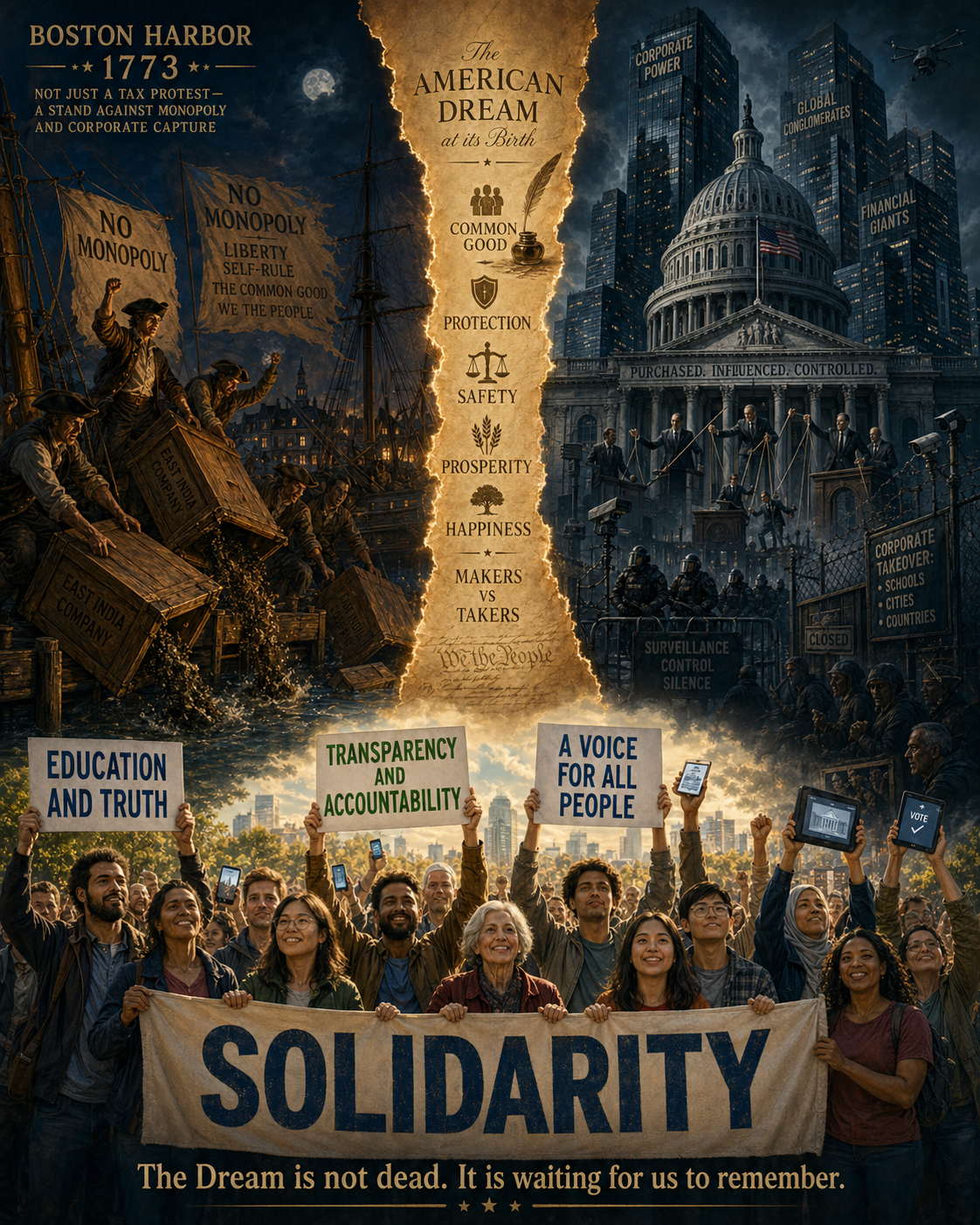
On the night of December 16, 1773, a few hundred young men climbed onto three ships in Boston Harbor and destroyed about $1.7 million worth of tea. We have been telling the story wrong ever since.
The version most Americans learned in school goes something like this. The colonists were furious about a tax on tea. They cried "no taxation without representation." They threw the tea overboard as a protest against high prices and royal overreach. From this angry refusal of taxes, the American Revolution was born.
Almost every part of that story is wrong.
Start with the simplest fact. The Tea Act of 1773 actually lowered the price of tea in the colonies. It made tea cheaper than it had been in years. Cheaper than the smuggled Dutch tea that local merchants like John Hancock were selling. Cheaper than nearly anything else on the docks.
So why did anyone destroy a bargain?
The answer reveals a different country than the one in our textbooks. The Tea Act was not really about tea, and it was not really about taxes. It was a corporate bailout. The British East India Company, the largest corporation on Earth at the time, was deeply in debt. Parliament rescued it by handing it three special privileges in the American colonies. A monopoly on tea sales. Tax breaks that let it undercut every competitor. The right to bypass colonial wholesalers entirely.
This destroyed the small merchants, dockworkers, smugglers, and shopkeepers who handled tea as part of their living. It told every small business in the colonies the same thing. You cannot compete with our friends in London.
The men who climbed those ships were not bored aristocrats. Of the roughly 168 known participants, fewer than nine were over the age of forty. They were young carpenters, blacksmiths, shoemakers, sailors, printers, coopers, and farmers. Some were teenagers. They destroyed 342 chests of tea, swept the decks clean, harmed nothing else, and went home. This was not a riot. It was a precise act of resistance against a corporate takeover.
Once you see the Boston Tea Party as anti-corporate protest, the rest of the founding falls into a different pattern. The Revolution was not started because Americans hated government. It was started because they understood that when a corporation owns the government, ordinary people have no rights. That is the lesson we have most thoroughly forgotten.
This article is an attempt to remember.
What John Adams Actually Believed
Seven years after the Tea Party, in 1780, John Adams sat down to write a constitution for Massachusetts. The document he produced is the oldest written constitution still in active use anywhere in the world. The United States Constitution was modeled on it. Article VII contains one of the most important sentences ever written about the purpose of government.
"Government is instituted for the common good; for the protection, safety, prosperity and happiness of the people; and not for the profit, honor, or private interest of any one man, family, or class of men."
Read that sentence three times. Slowly. Notice what Adams is doing. He is not making a suggestion. He is naming the only legitimate reason for government to exist. A government that serves "any one man, family, or class of men" instead of the common good has lost its right to exist. Adams believed the sole responsibility of government was to protect human rights. Not corporate rights. Not class privilege. Not royal authority. Human rights. That was the whole job.
This idea did not come from nowhere. Adams was drawing on a tradition more than two thousand years old. The Roman statesman Cicero had written salus populi suprema lex esto, which translates to "the welfare of the people shall be the supreme law." Adams knew Cicero by heart. So did Jefferson. So did Madison. The founders studied the Roman Republic the way modern lawyers study old court cases. They believed Rome had fallen when it forgot this principle.
The intellectual tradition behind their work was called classical republicanism, and it held three core beliefs. A republic must serve the common good, not private interests. Citizens must have civic virtue, meaning they must put the public good ahead of private gain when the two collide. Concentrated wealth and power are dangerous, because they corrupt both rulers and citizens. These were not abstractions. They shaped the Declaration of Independence, the state constitutions, and the federal Constitution that followed.
A small but telling detail: when Jefferson wrote the Declaration, he based the famous line on John Locke, who had spoken of "life, liberty, and property." Jefferson deliberately replaced "property" with "the pursuit of happiness." He was making a statement. The American government would not exist to protect rich people's stuff. It would exist to help every person live a good life.
This philosophy showed up in concrete policy. In the early 1800s, states routinely revoked corporate charters when companies acted against the public interest. A bank that defrauded customers could lose its right to exist. A turnpike company that overcharged travelers could be dissolved. Pennsylvania alone revoked at least 19 corporate charters between 1814 and 1857. The corporation was a privilege granted by the public, not a permanent right. When the Homestead Act passed in 1862, it gave 160 acres to any family that would farm the land for five years, eventually distributing 270 million acres across about 1.6 million claims. The principle was not "anyone with money can buy what they want." It was "land in the hands of working people serves the common good." Massachusetts passed the first state law mandating free public schools in 1827, on the explicit grounds that a republic needs educated citizens or it collapses into mob rule or oligarchy.
Today you will hear politicians and business leaders argue that government's only job is to "stay out of the way." You will hear them claim the founders feared all government and wanted maximum freedom for private power. This is not what the founders believed. They feared concentrated power, in any form. A king could threaten liberty. So could a corporation. So could a wealthy family. So could a mob. The Constitution was not designed to weaken government in general. It was designed to spread power widely, so that no single faction could capture it.
Adams understood the danger as clearly as anyone. He wrote that liberty cannot survive when wealth and power become too concentrated, because "power always follows property." The richer one class becomes, the more it dominates the government. The more it dominates the government, the richer it becomes. The cycle ends in tyranny unless citizens break it.
He was warning us about exactly the country we now live in.
The Most Misunderstood Economist in History
In 1776, the same year as the Declaration of Independence, a Scottish moral philosopher named Adam Smith published The Wealth of Nations. The two documents share a common spirit, because they share a common enemy. Monopoly power backed by government privilege.
This is not the Adam Smith you learned about. The Adam Smith of modern political rhetoric is a kind of patron saint of unrestricted capitalism, invoked to defend whatever the largest corporations want to do. People quote his phrase "the invisible hand" as if it justifies letting the strongest crush the weakest. They treat him as the father of a philosophy that says markets are sacred and government is the enemy.
This is one of the great con jobs of modern economics. Smith would have hated almost everything done in his name.
A few facts most people never hear. Smith mentioned the "invisible hand" exactly three times in his entire body of work. It was a minor metaphor, not a central doctrine. He spent more pages attacking merchants and manufacturers than defending them. He supported progressive taxation, public education, public infrastructure, and strict regulation of banks. He opposed chartered monopolies, joint stock companies like the East India Company, and any form of merchant collusion.
Here is what he actually wrote about businessmen meeting together:
"People of the same trade seldom meet together, even for merriment and diversion, but the conversation ends in a conspiracy against the public, or in some contrivance to raise prices."
Smith's whole project was to free markets from monopolists, not to free monopolists from markets. He believed real competition required a strong public power that would break up cartels, prevent collusion, and stop the rich from rigging the rules. The famous "invisible hand" only works when the deck is not stacked. When it is, the hand picks the pockets of everyone who is not in on the game.
In Book I, Chapter IX of The Wealth of Nations, Smith made an observation that should send a chill down the spine of any honest American reader. He wrote:
"But the rate of profit does not, like rent and wages, rise with the prosperity and fall with the declension of the society. On the contrary, it is naturally low in rich, and high in poor countries, and it is always highest in the countries which are going fastest to ruin."
Read that carefully. Smith is saying that when profits are unusually high, a society is dying. Not thriving. Dying. A healthy economy has wages and rents that move with prosperity. Profits, in Smith's view, should be modest. They should be the reward for honest work and real innovation, not the main event. When you see a country where profits are sky-high and wages are stagnant and rents are crushing people, you are looking at a country "going fastest to ruin."
In 1980, U.S. corporate profits were about 6 percent of GDP. By 2024, they had reached around 12 percent of GDP. Worker compensation as a share of GDP fell over the same period. Smith would recognize what he was seeing.
Running through all of Smith's work is a distinction modern thinkers have given cleaner names. Makers are those who create real wealth. They apply labor, skill, tools, trade, and improvement to the world. They build, plant, sew, code, weld, teach, heal, write, design, repair, ship, and serve. Makers leave the world richer than they found it. Takers are those who extract wealth they did not create. They collect rent on land they did not improve. They run monopolies that block competition. They use political privilege to get what others must earn. They invent artificial scarcity to drive up prices. They control gateways to things they did not build.
Every healthy society needs to reward makers and limit takers. Every dying society does the opposite.
The early United States, for all its terrible failures and contradictions, was deliberately designed to reward makers. The Homestead Act gave land to those who would work it. The Land Grant Colleges Act of 1862 created public universities to teach farming, engineering, and trades. The Patent Office, established in 1790, protected inventors. The post office, written into the Constitution itself, connected makers across vast distances. The interstate commerce clause stopped states from rigging trade against each other.
And then, slowly, as the country grew rich, the takers began to organize.
The Dream Was Real
The American Dream is often dismissed today as a myth, a piece of marketing, a story the powerful told to keep ordinary people working hard. There is some truth to that critique. The Dream was always more available to some than others, and the gap between the promise and the reality has been wide and at times monstrous.
But the Dream was also real. It was built on purpose. It was built by deliberate policy choices that rewarded makers and restrained takers, and we should be honest about both how it worked and what destroyed it.
The promise was simple. Everyone has the right to play the game. The game has rules. If you follow them, you will succeed. It was never the promise that everyone would get rich. It was the promise that the game would not be rigged.
For roughly forty years after World War II, that promise was closer to true than it had ever been before, or has been since. Slavery had ended a century earlier. The labor movement had won the eight-hour day, the weekend, child labor laws, and workplace safety rules. The Sherman Antitrust Act of 1890 had broken up the worst monopolies. The progressive income tax came in 1913, and so did the Federal Reserve. The New Deal of the 1930s added Social Security, the FDIC, the National Labor Relations Act, and the Glass-Steagall Act, which separated commercial banks from speculative banks. The post-war years brought the GI Bill, the Federal Housing Administration, the interstate highway system, and the Bretton Woods financial order.
These policies created the strongest middle class the world had ever seen. The top marginal income tax rate under Eisenhower, a Republican, was 91 percent. Union membership reached around 35 percent of the workforce in the 1950s. Productivity and wages rose together. A working-class father could often support a family on one income, buy a house, put kids through college, and retire with dignity. None of this happened by accident. It happened because the country had figured out, partially and imperfectly, how to reward makers and restrain takers.
The arrangement was not perfect. It was not equally available to Black Americans, to women, to immigrants, to anyone outside the dominant story. The civil rights and feminist and labor movements that followed were necessary precisely because the Dream had been kept from too many people. But the answer to "the Dream was incomplete" is not "the Dream was a lie." The answer is to finish what the founders started. To extend the Dream until it actually covers everyone.
We were building toward that. And then we stopped.
How the Takers Captured Everything
In 1971, a corporate lawyer named Lewis Powell wrote a confidential memo to the U.S. Chamber of Commerce. It was titled "Attack on American Free Enterprise System." Two months later, President Nixon nominated Powell to the Supreme Court. The memo argued that American business was under siege from consumer advocates, environmentalists, labor unions, and college campuses. It called for a coordinated, long-term, well-funded counterattack. Powell wrote that business needed to "buy" the universities, the courts, the media, and the political process.
This memo is the moment the modern corporate takeover begins.
Within a few years, a network of corporate-funded think tanks emerged. The Heritage Foundation in 1973. The Cato Institute in 1977. The Manhattan Institute in 1977. They had a unified message. Less regulation, lower taxes on the wealthy, weaker unions, government that "gets out of the way" of business. They produced position papers, talking points, talk show pundits, and policy templates. Over the following decades, they built what amounted to an alternative intellectual infrastructure for the country, one funded by and serving concentrated corporate wealth.
When Ronald Reagan took office in 1981, his administration carried out the Powell Memo's plan at scale.
Antitrust enforcement collapsed. From 1900 to 1980, the federal government had brought regular antitrust cases against corporate monopolies. Reagan's Justice Department adopted a new doctrine, often called the "consumer welfare standard." Under this rule, monopolies were fine as long as prices stayed low. The government essentially stopped enforcing the Sherman Antitrust Act in any serious way. Corporate mergers exploded.
The Fairness Doctrine was killed. From 1949 to 1987, broadcast media were required to present multiple sides of controversial issues. The Reagan FCC repealed the rule in 1987. Within a few years, partisan talk radio took over the AM dial. Within twenty years, cable news had split into siloed echo chambers. The decline of shared public reality begins here.
Unions were broken. When air traffic controllers struck in 1981, Reagan fired all 11,345 of them and banned them from federal service for life. The message to corporate America was clear. The government will help you break unions. Union membership had been around 20 percent of the workforce when Reagan took office. By 2023, it was around 10 percent.
Taxes on the wealthy were slashed. The top marginal income tax rate in 1980 was 70 percent. Reagan cut it to 50 percent in 1981 and to 28 percent in 1986. The lost revenue was made up partly through cuts to public services and partly through borrowing.
Financial regulation was loosened. Glass-Steagall, the law that had separated commercial banks from investment banks since 1933, was weakened during the 1980s and finally repealed under Bill Clinton in 1999. The 2008 financial crisis was the predictable result.
The capture continued under both parties. Two later events show how thorough it became.
In 2010, the Supreme Court ruled in Citizens United v. FEC that corporations are people for purposes of political speech, and that money is speech. Corporations and wealthy donors gained the right to spend unlimited amounts on elections through Super PACs. Within a few years, a handful of billionaires had become the most powerful political force in American life. In the 2024 election cycle, total political spending exceeded $15 billion.
In 2014, Princeton professor Martin Gilens and Northwestern professor Benjamin Page published a study in Perspectives on Politics that should have ended any honest debate about the state of American democracy. They examined 1,779 policy decisions made between 1981 and 2002, and they tested whose preferences actually shape government policy. Their conclusion was stark. "Economic elites and organized groups representing business interests have substantial independent impacts on U.S. government policy, while average citizens and mass-based interest groups have little or no independent influence."
Translated into plain English: the rich get what they want, and ordinary people get whatever the rich are willing to share. This is not a metaphor or a slogan. It is the empirical finding of the most rigorous study ever done on American policy formation.
The result is everywhere. Look at any major industry, and you see a few giant corporations dominating. Four airlines control more than 80 percent of U.S. air travel. Four banks hold roughly half of all U.S. bank assets. Three companies control most of the U.S. cell phone market. Four companies process about 85 percent of U.S. beef. Two companies control most of the U.S. eyeglass market. Three firms, BlackRock, Vanguard, and State Street, are the largest shareholders of nearly every major company in the S&P 500.
This is not capitalism. This is modern feudalism. A small number of corporate lords, sitting on top of a vast population of renters, gig workers, and debtors. The Boston Tea Party generation would recognize it instantly.
Notice the deeper pattern. The people in power do not follow the rules they wrote. They ignore the rules when their friends break them. They twist the rules to hurt their rivals. Antitrust law is on the books; the government does not enforce it. Securities fraud is illegal; major banks have paid billions in fines for crimes that never sent a single executive to prison. Insider trading is a crime; members of Congress have outperformed the stock market for years. Foreign emoluments are forbidden by the Constitution; recent presidents have openly profited from foreign governments.
Meanwhile, protest is being criminalized. Since 2017, more than 40 states have introduced bills targeting protesters. Many make it a felony to block traffic, even peacefully. Many shield drivers who hit protesters from civil liability. Many criminalize activity near "critical infrastructure," which means oil pipelines.
The country that was born from the most famous protest in history now treats protest itself as a crime.
The Reagan administration began the rollback. Every president since, in both parties, has continued it. The current Trump administration is the latest and most aggressive phase, but the pattern is bigger than any one party. It is the slow, steady capture of every public institution by private corporate power, executed through one of the most successful long-term political strategies in American history.
We have been losing for fifty years. We need to remember what winning looked like.
The Path Forward
We are not the first generation to face concentrated power. We will not be the last. But we are the generation that has to decide what comes next.
The American Dream is against the wall. To save it for one, we must save it for all. This is solidarity, and it is the most American idea ever invented. The Boston Tea Party worked because tradesmen and farmers and dockworkers and printers acted together. The abolition of slavery worked because freed Black people, white allies, religious organizations, and political reformers acted together. The Civil Rights movement worked because students, ministers, lawyers, and ordinary citizens acted together. The labor movement won the eight-hour day, the weekend, child labor laws, and workplace safety rules because workers across industries and races and regions acted together.
Power concedes nothing without a demand. It never has, and it never will. But organized people beat organized money. Every time.
We have three weapons. Each one is older than the country, and each one still works.
Education and Truth. Knowing real history, real economics, and real civics is the first defense against propaganda. A country that does not teach the truth about its own founding will be lied to by anyone in power. Teach the children. Teach the adults. Teach the truth, in plain language, until everyone knows where they came from. The article you are reading is one small attempt at this. The course and the documentary that follow are larger ones. There need to be millions more. Every classroom, every dinner table, every group chat is a place where real history can be told.
Transparency and Accountability. Power in the dark is power that abuses. Sunlight is still the best disinfectant. We need open books, open meetings, open courts, and open data. Whistleblowers must be protected. Officials must be held to the same laws as everyone else. The phrase "no one is above the law" must mean something again. This is not a partisan position. It is the bedrock of any society that does not want to slide back into oligarchy.
A Voice for All. Every person, no matter how poor or unpopular, must have a real say in the decisions that shape their lives. This protects the smallest minority from the largest majority. It also protects the largest majority from a small wealthy minority. Voice is the safety valve of every healthy democracy. When voice is cut off, when ordinary people are told their concerns do not matter, the pressure does not go away. It builds. And eventually it breaks something.
The founders had pamphlets and town meetings. We have the internet, encryption, open-source software, and instant communication. We can build new tools that make direct democracy possible at scale. We can use technology to expose corporate capture in real time, track legislation, follow money, and hold officials accountable. We can build systems that let citizens deliberate, vote, and organize without depending on corporate platforms. Some of this is already happening. Participatory budgeting projects are working in cities around the world. Cooperative ownership models are growing in housing, agriculture, and software. Open-source civic technology is giving people new ways to engage. The infrastructure of a better system is being built right now, by makers who refuse to wait for permission.
The takers built a system. Makers can build a better one. Together. In every city. In every state. In every nation. For all people. Hostile corporate takeovers of schools, cities, and countries will not be tolerated. Not on our watch.
What Comes Next
We started by saying that America has forgotten what made it great. Now you have a working sketch of what we forgot.
The Boston Tea Party was an anti-corporate protest by young, working people who refused to be crushed by the largest corporation on Earth. The founders believed the only legitimate purpose of government was the common good and the protection of human rights, and they feared concentrated wealth and power above almost everything else. Adam Smith, the supposed champion of unrestricted markets, warned that a country with sky-high profits was a country dying. The American Dream was real, and it was built by deliberate policies that rewarded makers and restrained takers. Those policies were systematically dismantled, beginning with a 1971 corporate strategy memo and continuing under every administration since. Today, an empirical study from Princeton confirms what most Americans feel in their bones. Ordinary citizens have almost zero influence on policy. The takers have captured nearly every public institution.
This is the bad news. The good news is that none of it is permanent.
History is not a one-way street. The takers won in the late 1700s, and ordinary people built a republic anyway. The takers won in the Gilded Age, and ordinary people built the Progressive Era anyway. The takers won in the 1920s, and ordinary people built the New Deal anyway. The cycle has turned before, and it will turn again. The only question is who will be ready to push when the moment comes.
Education and truth. Transparency and accountability. A voice for all people. Solidarity is the strategy. Direct democracy is the structure. Truth is the weapon. The common good is the goal.
If this article has shaken something loose in you, do not stop here. Read more. Learn more. Teach what you learn. The full course goes deeper into every section of this argument, with more sources and more historical detail. The documentary brings the same material to life in another medium. Discussion guides are available for groups who want to work through the material together. Local civic organizations need volunteers. Neighbors need conversation partners. Children need adults who can tell them the truth about their country.
The dream is not dead. It is waiting for us to remember.
We have to do this together. In all cities. In all states. In all nations. For all people.
The next chapter is ours to write.
Sources and Further Reading
On the Boston Tea Party demographics: Biographical research compiled from records held by the Massachusetts Historical Society and the Boston Tea Party Ships and Museum. See also Benjamin L. Carp, Defiance of the Patriots: The Boston Tea Party and the Making of America.
On the East India Company: William Dalrymple, The Anarchy: The East India Company, Corporate Violence, and the Pillage of an Empire.
On John Adams and the common good: Massachusetts Constitution of 1780, Part I, Article VII.
On Adam Smith: The Wealth of Nations, especially Books I and V. Read the original. The popular caricature of Smith bears little resemblance to what he actually wrote.
On the Powell Memo: Lewis F. Powell, Jr., "Attack on American Free Enterprise System," August 23, 1971. Available in full online.
On corporate capture: Martin Gilens and Benjamin I. Page, "Testing Theories of American Politics: Elites, Interest Groups, and Average Citizens," Perspectives on Politics, September 2014.
On the long history of American antitrust: Matt Stoller, Goliath: The 100-Year War Between Monopoly Power and Democracy.
On the common good as a political philosophy: Robert Reich, The Common Good.
On the original sources for classical republicanism: Cicero, De Legibus. The phrase salus populi suprema lex esto appears in Book III.
This primer accompanies a longer civic education project. The full one-hour course goes deeper into each section with extended historical detail and reflection points. The documentary film adapts the same material into visual form. All three pieces are designed to be used independently or together, in classrooms, civic groups, family discussions, or self-directed study.
The dream is not dead. It is waiting for us to remember.
Frequently Asked Questions
Was the Boston Tea Party a protest against high tea taxes?
No, the Tea Act of 1773 actually lowered tea prices in the colonies. The real issue was that Parliament gave the British East India Company a monopoly and tax breaks, letting it undercut small merchants and local businesses.
What did John Adams believe was the purpose of government?
Adams wrote in the 1780 Massachusetts Constitution that government exists for the common good, safety, and happiness of the people. He explicitly said it must not serve the profit or private interest of any one man, family, or class.
Did Adam Smith support unrestricted free markets and big business?
No, Smith attacked merchants and monopolies more than he defended them. He supported progressive taxation, public education, and strict bank regulation, and warned that businessmen often conspire against the public.
What does Adam Smith mean when he says high profits signal a society going to ruin?
Smith argued that profits stay low in healthy, prosperous societies and rise highest in societies headed toward decline. He saw high profits alongside stagnant wages as a warning sign, not a sign of success.
How did early American law distinguish between makers and takers?
Makers create real wealth through labor, skill, and innovation, while takers extract wealth through monopolies, rent-seeking, or political privilege. Laws like the Homestead Act, the Patent Office, and public land-grant colleges were designed to reward makers and limit takers.