Are you ready for the Mid Terms
The DOJ has dismantled federal election-crime enforcement before the 2026 midterms. A validated, constitutional review of what was cut and what it enables.
TL;DR
The DOJ has removed key tools that once enforced federal election-crime laws. It fired lawyers, ended election-law training, and closed a threat-response command post. At the same time, the DOJ demands sensitive voter data from nearly every state. New DOJ task forces target election officials and political opponents. These changes align with the 2026 midterm elections and raise concerns about self-policing and voter privacy.
The Dismantling of Federal Election-Crime Infrastructure: Extracted Argument, Validated Facts, and Constitutional Review
Executive Frame
The argument under examination contends that the Trump administration's Department of Justice has systematically eliminated the institutional capacity that previously enforced federal election-protection statutes, has done so quietly enough to escape major news coverage, and has done so on a timeline that aligns with the November 2026 midterm elections. The further claim is that the same institutional rearrangement that removes guardrails against federal election interference is paired with an aggressive federal posture toward state-administered voter rolls, election records, and voting equipment. The most pointed claim is that this is not negligence but preparation, and that the projection rhetoric coming from the White House about "the other side cheating" describes the actual mechanism being assembled.
What follows extracts each major idea and chain of reasoning, traces the evidence that supports or qualifies it, and examines the constitutional terrain beneath each fact.
I. The Central Claim: Federal Election-Crime Infrastructure Has Been Dismantled
The argument. Bloomberg Law reported that the DOJ has fired lawyers, ended the mandatory election-law training that prepared prosecutors and FBI personnel to handle Election Day issues, eliminated the centralized command post that coordinated federal-state election threat response, and restricted access to threat briefings for state officials. The claim is that this amounts to a wholesale removal of the federal apparatus that was designed to police federal election crimes, and that this removal happened on the eve of a high-stakes midterm.
Fact validation. Bloomberg Law's reporting (Ellen M. Gilmer) confirms each operational element of the claim. Ahead of the 2026 midterms, DOJ leaders eliminated a centralized command post, discontinued mandatory election law training for prosecutors, and restricted access to threat briefings for state officials. The training in question previously covered the nuances of federal statutes that govern election conduct, including the prohibition on sending armed federal agents to polling places. Independent reporting establishes that the Civil Rights Division, which historically supplied prosecutors who consulted on race-based voting violations, has lost roughly 70 percent of its lawyers since the start of 2025, and the Criminal Section of that Division saw most of its remaining prosecutors depart in late 2025 and early 2026 following the Renee Good shooting in Minneapolis. Pam Bondi's first-day directive on February 5, 2025, also disbanded the Foreign Influence Task Force, which had previously tracked foreign election interference.
Constitutional terrain. The Constitution does not require the federal government to maintain any particular prosecutorial unit, command post, or training program. Article II vests the executive power in the President, and the DOJ is an executive department whose internal organization is largely a matter of presidential and congressional discretion. The constitutional issue is not that these structures were dismantled. The constitutional issue is what their absence enables, because federal statutes the DOJ is sworn to enforce remain on the books. Article II, Section 3 obligates the President to "take care that the laws be faithfully executed." When an administration eliminates the institutional capacity to enforce specific statutes, particularly statutes that constrain the executive's own agents, the question becomes whether the Take Care Clause has been functionally inverted from a duty to a discretion.
II. The Statute Without an Enforcer: 18 U.S.C. § 592
The argument. John Keller, the former acting chief of the DOJ's Public Integrity Section and former lead of the Election Threats Task Force, gave Bloomberg the precise framing of the problem. There is a federal criminal statute that prohibits armed federal agents from being deployed at polling places, and the question that nobody at the Pentagon or DOJ will answer is who enforces that statute when the deployment is ordered by the federal government itself. Keller's own answer is that the DOJ will not prosecute itself. The structural point is that a referee who works for one of the teams will keep the whistle in his pocket when his own team fouls.
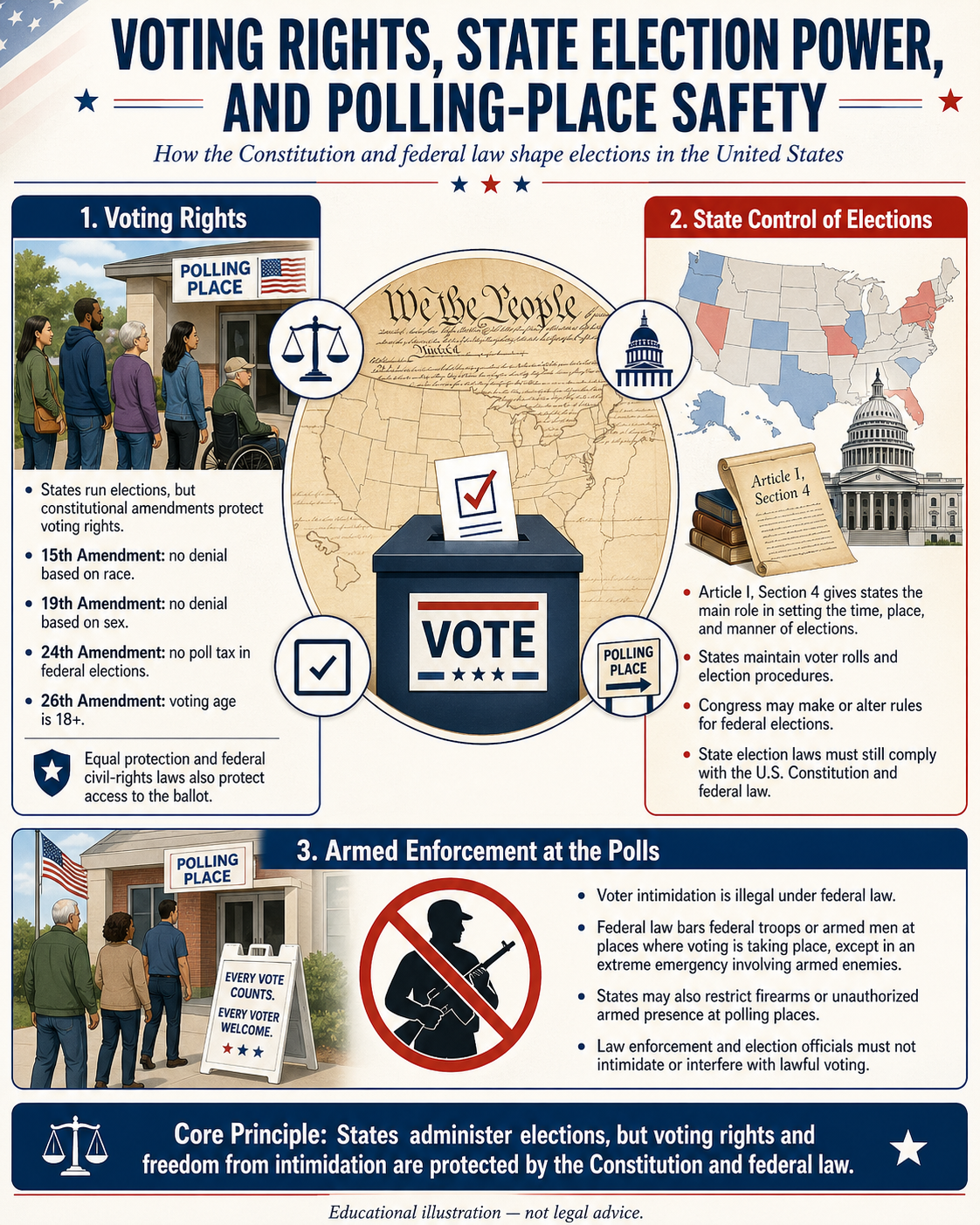
Fact validation. The statute exists and reads as Keller described it. 18 U.S.C. § 592 makes it a crime, punishable by a fine and up to five years in prison, for any officer of the Army or Navy or other person in the civil, military, or naval service of the United States to order, bring, keep, or have under his authority or control any troops or armed men at any place where a general or special election is held, unless such force is necessary to repel armed enemies of the United States. The statute also disqualifies a violator from holding any office of honor, profit, or trust under the United States. Companion statutes reinforce the prohibition. Section 593 criminalizes interference by armed forces with election officers. Section 595 criminalizes the use of official authority by federal employees to interfere with or affect a federal election. Keller's institutional concern is sound on its face. The Justice Department is the entity that brings federal criminal prosecutions, and a department that has fired the prosecutors who used to handle these cases and ended the training that taught the rest of the workforce how to recognize them is structurally indisposed to charge its own agents.
Constitutional terrain. Section 592 is a direct legislative implementation of the constitutional principle that elections are a civilian process. The Posse Comitatus Act and its surrounding statutory framework, including Section 592 and Section 593, encode the framers' deep suspicion of standing armies near the ballot box. The First Amendment right to political association, the Fifteenth Amendment's prohibition on race-based denial of the vote, and the Article I, Section 4 reservation of election administration to the states are all undermined when armed federal agents appear at polling places, because their mere presence has historically been used to suppress turnout. The statute is constitutionally robust because it operationalizes structural protections that predate and outrank any single administration's enforcement priorities. The enforcement gap Keller identifies is not a constitutional defect in the statute. It is a defect in the political mechanism that depends on the executive to police itself.
III. The Demand for Voter Rolls in Swing States and Beyond
The argument. In the months leading up to the midterms, the DOJ has demanded voter registration data from a list of states that aligns suspiciously well with the swing-state map. The list given includes Colorado, Arizona, Minnesota, Nevada, New Hampshire, New York, Pennsylvania, and Wisconsin, every one of which is consequential to a presidential count. The implication is that this data collection is preparation, not maintenance.
Fact validation. The Brennan Center confirms that at least 48 states and Washington, D.C. have received DOJ requests for their complete voter registration lists, and the DOJ has sued 30 states plus D.C. for refusing to provide their statewide voter registration lists with driver's license and Social Security numbers, including Arizona, California, Colorado, Connecticut, Delaware, Georgia, Hawai'i, Idaho, Illinois, Kentucky, Maine, Maryland, Massachusetts, Michigan, Minnesota, Nevada, New Hampshire, New Jersey, New Mexico, New York, Oklahoma, Oregon, Pennsylvania, Rhode Island, Utah, Vermont, Virginia, West Virginia, Wisconsin, and Washington. Stateline reports that the DOJ is demanding Colorado turn over all records related to the 2024 election, a sweeping request that could include ballots and voting equipment, and that DOJ is seeking driver's license numbers, Social Security numbers, and dates of birth, which are records highly protected under both federal and state law. The University of Wisconsin's State Democracy Research Initiative documents that the demands began as letters in spring 2025 and escalated into federal lawsuits filed throughout 2025 and into 2026. The empirical claim that the demands map onto swing states is true but understated. The demands are nationwide, with the heaviest legal pressure focused on states whose electoral outcomes are not foreordained.
Constitutional terrain. Article I, Section 4, the Elections Clause, provides that "the times, places and manner of holding elections for senators and representatives shall be prescribed in each state by the legislature thereof; but the Congress may at any time by law make or alter such regulations." The Fourteenth Amendment and the Voting Rights Act create federal authority to prevent racial discrimination in voting, and the National Voter Registration Act of 1993 creates limited federal oversight of voter list maintenance. None of those authorities clearly authorize a wholesale federal demand for sensitive identifying information on every registered voter in the country. The Privacy Act of 1974 and corresponding state confidentiality laws add a further layer of statutory protection over the very fields the DOJ is demanding. The constitutional question, currently being litigated in dozens of federal courts, is whether the executive can compel production of state-held personally identifying information about voters absent specific statutory authorization, and whether that compulsion violates principles of federalism that reserve election administration to the states. Several federal courts have already dismissed DOJ suits seeking this data.
IV. The New Federal Task Forces
The argument. The Brennan Center has documented three new federal election-related task forces openly aimed at investigating "perceived adversaries." A separate DOJ special assistant has been given nationwide authority to investigate election integrity cases without the usual political-pressure insulation that career prosecutors traditionally provide.
Fact validation. The Brennan Center's tracking confirms the existence of a set of new federal task forces, including the DOJ's Weaponization Working Group, the New Jersey U.S. Attorney's Office Election Integrity Task Force, and the Washington, D.C. Attorney's Office Special Unit: Election Accountability, which establish a federal law enforcement approach to elections focused on targeting voters, election officials, perceived political adversaries, and journalists. The Weaponization Working Group was created by Attorney General Pam Bondi's directive on her first day in office, February 5, 2025. The New Jersey Election Integrity Task Force was announced under acting U.S. Attorney Alina Habba and is dedicated to enforcing the President's March 2025 election executive order, key provisions of which a federal court has already temporarily blocked. The Brennan Center's assessment is that these task forces are poised to enable election interference by investigating perceived adversaries, targeting election officials, and casting doubt on election systems.
Constitutional terrain. The constitutional concern with these task forces is layered. The First Amendment protects political dissent and journalism, and a task force whose target list is described in terms of "perceived adversaries" raises the prospect of viewpoint-based enforcement. The Fifth and Fourteenth Amendments guarantee due process, which includes protection from selective prosecution motivated by political animus. The Article II Take Care Clause requires faithful execution of the laws, and a prosecutorial unit organized around the political identity of its targets rather than the substantive content of the laws strains that obligation. The Tenth Amendment and the Elections Clause are also implicated when federal task forces investigate state election officials for the manner in which they conduct elections under their reserved state authority. None of this means the task forces are unconstitutional in every application, since the federal government has legitimate election-fraud enforcement authority, but the structural design and stated targeting criteria invite as-applied constitutional challenges.
V. The Scenario: November 3rd in Pennsylvania
The argument. The chain of reasoning is illustrated through a hypothetical scenario. It is 11 p.m. on November 3rd, Pennsylvania is too close to call, and ballots are being counted in Allegheny County. A federal task force arrives armed at the count, citing a hastily produced legal memo and invoking foreign-interference language. The agents seize ballots. The question is then asked, who stops them. The answer offered is that no one stops them because the FBI Director, the Director of National Intelligence, and the federal judge on duty are all either compromised, absent, or freshly appointed by the same administration. The voicemail goes unchecked.
Fact validation. The hypothetical is hypothetical. The supporting structural conditions, however, are documented. The FBI Director, Kash Patel, has been criticized by current and former DOJ personnel for departures from established protocols. The DNI, Tulsi Gabbard, has restructured the intelligence community under a new "Director's Initiatives Group" whose stated purpose is to investigate weaponization and politicization, which inverts the traditional relationship between political appointees and career intelligence professionals. The federal judiciary has seen rapid Trump-era confirmations at the district court and circuit court levels. The Civil Rights Division's loss of 70 percent of its attorneys removes the prosecutorial layer that would historically have been activated to respond to a federal-state election confrontation. Together, these conditions describe a real institutional landscape, even if the specific Pennsylvania scenario is illustrative rather than predictive.
Constitutional terrain. A federal armed seizure of ballots in a state-run election would likely violate Section 592, Section 593, the Posse Comitatus framework, the Elections Clause, and the Fourth Amendment, the last of which protects against unreasonable seizures. State election officials and state attorneys general would have standing to seek emergency injunctive relief in both federal and state courts. The Brennan Center has produced model state legislation that creates state criminal duplicates of Sections 592, 593, and 595 precisely because federal officials are not immune from state criminal prosecution when their conduct is not authorized by federal law. The constitutional remedies exist. The practical question, which the argument correctly identifies, is whether they can be activated quickly enough to matter on a single contested election night.
VI. The Strategic Logic: Close Enough to Contest
The argument. The strategic point is that the operation does not need to win the election at the ballot box. It needs only to make the result close enough to plausibly contest. A close margin moves the dispute into courtrooms, and courtrooms are now staffed in significant part by judges appointed by the contesting administration.
Fact validation. The empirical core of this point is the documented pattern of federal judicial appointments and the documented pattern of post-2020 election litigation. Trump's first-term appointments produced roughly a third of the federal judiciary, and his second term has continued at a high pace. The 2020 cycle generated more than sixty post-election lawsuits, and the Bush v. Gore precedent from 2000 demonstrates that the federal courts can in fact decide a presidential outcome. The argument that "close enough to contest" is a viable theory of victory is supported by recent history. Whether any particular court would rule in any particular way in any particular case is unknowable in advance, but the structural availability of judicial resolution as an alternative to electoral resolution is a real feature of the system.
Constitutional terrain. Article III courts have constitutional authority to resolve cases and controversies, including election disputes. The Twelfth Amendment governs the counting of presidential electoral votes. The Electoral Count Reform Act of 2022 narrowed the grounds on which Congress can refuse to count state-certified electoral votes, which closes one of the vulnerabilities exploited in 2020. The Supreme Court's 2023 decision in Moore v. Harper rejected the most extreme version of the independent state legislature theory and preserved state court review of state election laws. These are all real constitutional guardrails. They are also guardrails that depend on the willingness of judges and legislators to apply them under pressure, which is the unresolved variable.
VII. The Projection Diagnosis
The argument. The administration's repeated public claims that the other side will cheat are read as projection, meaning that the accusation describes the speaker's own intended conduct. The illustrative metaphor offered is that if Donald Trump walks into a room and announces that the curtains are too short, someone needs to look in his pockets for scissors. The mechanical claim is that the public has been told for a year how the cheat will happen, and that the only substitution being made is the identity of the actor.
Fact validation. Projection as a rhetorical and psychological phenomenon is well documented in political communication research. The specific question of whether claims about Democratic election fraud have been substantiated is empirically settled. Multiple federal judges, including Trump-appointed judges, found no evidence of widespread fraud in 2020. The 2024 Maricopa County audit, conducted by Arizona Senate Republicans, confirmed no widespread fraud. As a matter of evidence, the public claims of widespread Democratic-side fraud are not supported. Whether the projection diagnosis is the correct explanation for those claims is interpretive rather than factual, but the asymmetry between the volume of fraud accusations and the volume of substantiated fraud is documented.
Constitutional terrain. The First Amendment fully protects political speech, including false political speech, when made by private actors and candidates. It does not protect material misrepresentations made under oath, in court filings, or in formal government action. The constitutional concern with sustained projection rhetoric is downstream rather than direct. When official communications repeatedly assert that an opponent will cheat, and when those assertions are then used to justify the deployment of federal investigative and prosecutorial resources, the chain from speech to action begins to implicate the same Take Care, due process, and equal protection concerns identified in earlier sections.
VIII. The Defense: Visibility
The argument. If the operation depends on chaos, the counter depends on clarity. The civic defense identified is multilayered. Vote early where state law allows. Vote visibly. Know the names of poll workers and the county clerk. If federal agents appear near a ballot box, generate immediate public attention, because attention is the resource that exposed and constrained interference attempts in 2020 and 2024 and remains available in 2026.
Fact validation. The empirical claim that visibility deterred or exposed interference attempts is supported by the 2024 cycle's record of bomb-threat preparation, cyberattack defense, and ballot-fire response, all of which were managed without disrupting outcomes because of preparation, public attention, and inter-agency coordination. The Brennan Center's 2026 survey of local election officials documents that 32 percent of officials reported being threatened, harassed, or abused, and that more than half worried that threats and intimidation would make it more difficult to retain or recruit election workers in the future. The visibility defense is therefore double-edged. Public attention deters federal overreach but also amplifies threats against the election workers themselves. The civic implication is that visibility must be paired with concrete protection of the workers it makes visible.
Constitutional terrain. The First Amendment protects the right to observe, document, and publicize official conduct at polling places, subject to reasonable time, place, and manner restrictions designed to protect the orderly conduct of elections. The right to record the police, established in multiple federal circuits, applies analogously to federal agents at polling places. State laws governing the conduct of poll watchers vary, and several states have tightened or loosened observer rules in recent years. The constitutional foundation for citizen visibility as a check on federal interference is strong, and it pairs with the statutory remedies in Sections 592, 593, and 595 to create a defensible legal posture for state officials who refuse to comply with unlawful federal demands at the polls.
IX. Synthesis: What the Pattern Adds Up To
The individual facts above each pass validation. The Bloomberg Law reporting on the dismantling of DOJ election infrastructure is accurate. The 18 U.S.C. § 592 prohibition on armed federal agents at polling places exists and the enforcement gap Keller identifies is structurally real. The voter-roll demands across nearly every state are documented and litigated. The new election-focused task forces are publicly announced. The Civil Rights Division losses are confirmed by multiple independent sources. The pattern of federal pressure on state election infrastructure is empirically established.
What is interpretive rather than empirical is the inference of intent. The argument treats the pattern as preparation for an election-night operation. That inference is plausible given the timing, the targeting of swing-state data, the simultaneous removal of internal DOJ guardrails, and the historical record of post-2020 contestation. It is not the only inference available. An alternative explanation is that the administration genuinely believes its own fraud rhetoric and is building the apparatus it thinks is necessary to police elections it expects to be contested. The two explanations are not mutually exclusive, and both produce similar institutional risks.
The constitutional architecture is sound. The Elections Clause reserves substantial authority to states. The criminal statutes prohibiting armed federal interference at polls remain in force. The federal judiciary, despite recent appointments, has issued multiple rulings rejecting the most aggressive federal claims, including dismissals of voter-roll lawsuits in California, Michigan, and Oregon. State attorneys general have demonstrated willingness to litigate. Civil society organizations are tracking and publishing the federal actions in real time. The defensive resources exist.
The vulnerability is operational rather than structural. The question is whether the constitutional and statutory protections can be activated at the speed required to address a fast-moving election-night confrontation, and whether the public attention necessary to activate them can be mobilized when the federal department that traditionally coordinated such response has been deliberately reduced in capacity. The argument under examination identifies that vulnerability accurately. Whether the vulnerability becomes a breach in November 2026 depends on factors that are still in motion, including the outcome of pending litigation, the staffing decisions inside the FBI and DOJ between now and the election, and the readiness of state and civil-society actors to respond in real time to whatever does or does not happen at polling places and counting centers.
Source Verification Summary
Bloomberg Law reporting confirmed. The October 2025 Ellen M. Gilmer story documents the elimination of the centralized command post, the discontinuation of mandatory election law training, and the restriction of threat briefings. John Keller is correctly identified as the former acting chief of the Public Integrity Section and former lead of the Election Threats Task Force. His quote regarding 18 U.S.C. § 592 enforcement is accurately characterized.
18 U.S.C. § 592 confirmed. The statute exists, prohibits armed federal personnel at polling places except to repel armed enemies of the United States, and carries a five-year maximum prison sentence and disqualification from federal office.
Voter-roll demands confirmed and expanded. The actual scope is broader than the eight states listed in the argument. The DOJ has demanded data from at least 48 states and D.C. and has filed lawsuits against 30 states plus D.C.
Civil Rights Division losses confirmed. Approximately 70 percent of Civil Rights Division attorneys departed in 2025, with the criminal section losing most of its remaining prosecutors in late 2025 and early 2026.
Federal task forces confirmed. The Weaponization Working Group, the New Jersey Election Integrity Task Force, and the D.C. Special Unit on Election Accountability are publicly established and documented by the Brennan Center.
Trump executive order on elections confirmed. Issued March 25, 2025, with key provisions temporarily blocked by federal courts.
Foreign Influence Task Force disbanded. Confirmed by Bondi's February 5, 2025 directives.
The factual spine of the argument is sound. The strategic interpretation is supported by the pattern of facts and is consistent with statements and actions of named officials, while remaining an inference rather than a proof. The constitutional architecture surrounding each fact remains intact on paper, with the operational vulnerability concentrated at the point of enforcement rather than the point of law.
Presentation Monologue Summary
This report evaluates whether recent federal election-enforcement changes serve democratic justice or undermine it. The uploaded document argues that federal election-crime infrastructure has been dismantled while the same federal government has expanded demands for state voter data and created new election-focused investigative structures. Recent reporting substantially supports the core institutional-risk claim: DOJ election-year coordination has been curtailed, mandatory election-law training has reportedly ended, and centralized response structures have been reduced. Courts have also rejected several broad federal attempts to obtain sensitive voter-roll data.
Under John Adams’ moral algorithm, the pattern fails because public power appears redirected away from the common good and toward factional advantage. A republic depends on election law being enforced neutrally, especially against the government itself. When the executive weakens the very machinery that would police federal election misconduct, the public cannot be assured that law is serving liberty rather than power.
Under John Rawls’ veil of ignorance, the pattern also fails. No rational citizen designing a fair election system would accept a structure where an incumbent administration can weaken neutral safeguards, collect sensitive voter data, investigate adversaries, and rely on courts only after harm may already be done. A fair system must protect the voter, the election worker, the state official, and the losing candidate equally.
Under Aristotle’s virtue ethics, the pattern fails because it does not cultivate justice, prudence, restraint, or civic friendship. It fosters suspicion and fear. A flourishing democracy requires voters and election workers to participate without intimidation, surveillance, or selective prosecution.
The strongest conclusion is not that a specific election-night seizure has been proven. That remains an inference. The stronger and more defensible conclusion is that the institutional architecture of election protection is being weakened in a way that makes abuse easier, accountability slower, and public trust more fragile.
The ethical remedy is transparency, narrow legal authority, independent oversight, protection of election workers, strict limits on federal armed presence near polls, and rapid state-federal judicial response mechanisms. The rule of law must be operational, not merely written.
Frequently Asked Questions
What did the DOJ eliminate ahead of the 2026 midterms?
The DOJ eliminated a centralized command post that coordinated federal-state election threat response. It also ended mandatory election law training for prosecutors and FBI personnel. Access to threat briefings for state officials was restricted as well.
Who enforces the law against armed federal agents at polling places?
18 U.S.C. § 592 makes it a crime for military or federal personnel to deploy armed agents at polling places, with penalties up to five years in prison. John Keller, former acting chief of the DOJ's Public Integrity Section, notes that no one has clarified who enforces this statute if the deployment comes from the federal government itself. The concern is that the DOJ will not prosecute its own agents.
How many states have received DOJ requests for voter registration data?
At least 48 states and Washington, D.C. have received DOJ requests for complete voter registration lists, according to the Brennan Center. The DOJ has sued 30 states plus D.C. for refusing to hand over lists that include driver's license and Social Security numbers.
What new federal task forces focus on elections?
Three task forces exist: the DOJ's Weaponization Working Group, the New Jersey U.S. Attorney's Office Election Integrity Task Force, and the Washington, D.C. Attorney's Office Special Unit on Election Accountability. The Brennan Center says these units target election officials, voters, political opponents, and journalists rather than focusing solely on the law's substance.
Has the Civil Rights Division of the DOJ lost staff recently?
Yes, the Civil Rights Division has lost roughly 70 percent of its lawyers since early 2025. Most remaining prosecutors in its Criminal Section left in late 2025 and early 2026 after the Renee Good shooting in Minneapolis.