Springfield’s Flock Cameras
Flock cameras may help solve crimes, but should Springfield, Missouri let a private system track innocent drivers without warrants, audits, or public control? Safety matters. So do liberty and accountability. Where should we draw the line?
TL;DR
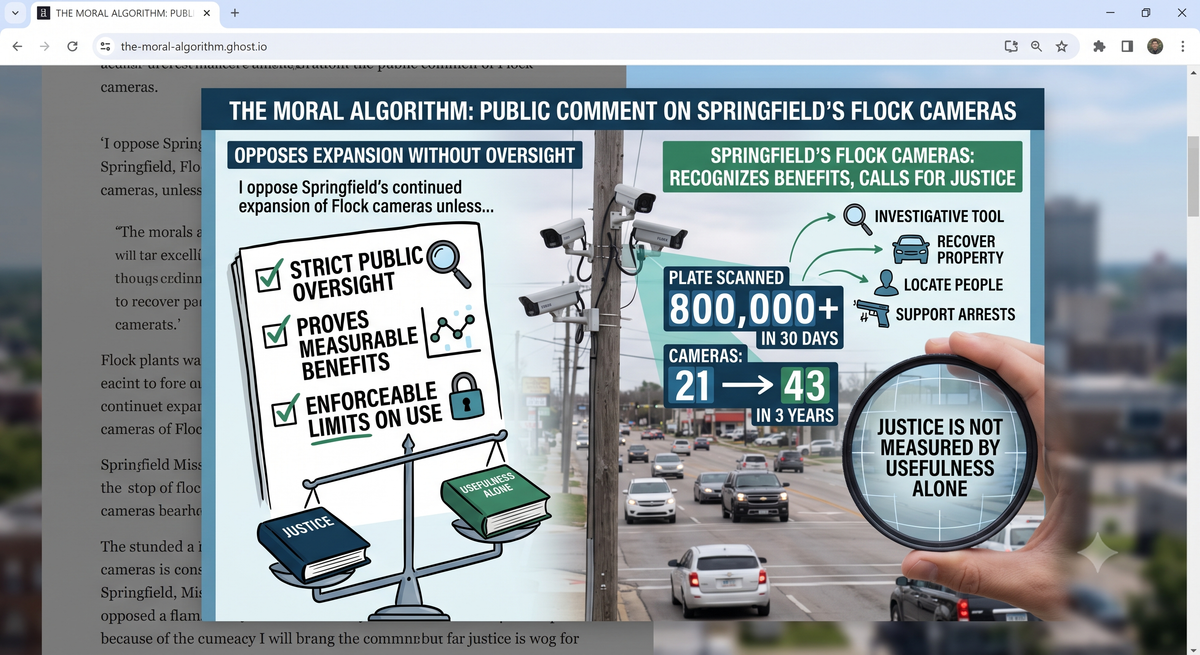
Springfield's Flock camera network grew from 21 to 43 cameras in three years. The cameras scan over 800,000 license plates every 30 days. Police say the cameras help solve crimes and find missing people. The city needs strict oversight before it expands the system further. Springfield should require audits, public reports, warrants for tracking searches, and a public vote before renewal.
Public Statement
I oppose Springfield’s continued expansion of Flock cameras unless the city first establishes strict public oversight, proves that the system provides measurable benefits, and places enforceable limits on its use.
Recent reporting states that Springfield’s Flock camera network has grown from 21 cameras to approximately 43 in just over three years. These cameras scanned more than 800,000 license plates in a recent 30-day period. Springfield police describe the cameras as an investigative tool that has helped identify vehicles connected to crimes, recover property, locate people, and support arrests. Police also state that untagged information is deleted after 30 days. (Springfield, MO)
Those benefits deserve consideration. But usefulness alone does not make a system just.
The question is not whether a camera can help solve a crime. The question is whether the city should record the movements of hundreds of thousands of innocent people and place that information inside a privately operated, searchable system.
The John Adams test
Does this power serve the common good, or does it create concentrated power without adequate public control?
Flock is a private company operating technology used for a core government function. The public does not directly control the software, security standards, system design, or future expansion of the platform.
That creates a dangerous imbalance. The company and law enforcement can see the public, but the public has limited ability to see how the system is used.
A system serving the common good must include independent audits, public reports, enforceable search rules, documented consequences for misuse, and a clear process for ending the contract.
The John Rawls test
Would we accept this system without knowing who we would be under it?
We might be a crime victim helped by the cameras. We might also be an innocent driver incorrectly linked to a vehicle, a protester attending a lawful event, an abuse survivor whose location must remain private, or a person targeted by someone with improper access.
A fair policy cannot be judged only from the position of the person protected by surveillance. It must also be judged from the position of the innocent person harmed by its misuse.
The OzarksFirst report reflects this central concern. The system has expanded rapidly, while residents continue to question Flock’s data practices and whether existing safeguards are strong enough.
The Aristotle test
What habits does this technology teach government?
A free society should investigate people because there is evidence connected to a crime.
It should not routinely collect everyone’s movements in case that information becomes useful later.
When government becomes accustomed to collecting first and justifying the search later, surveillance stops being an exceptional investigative tool and becomes part of daily government administration.
That is the wrong institutional habit for a constitutional republic.
The responsible decision
Springfield should pause further expansion and require:
- Independent audits of every search and outside request.
- Public reports showing crimes solved, missing people located, stolen vehicles recovered, false alerts, improper searches, and disciplinary actions.
- A documented case number and legitimate investigative reason for every search.
- A warrant for searches intended to reconstruct a person’s historical movements.
- No immigration, political, protest, reproductive-health, personal, or minor traffic-enforcement searches.
- No outside agency access without a specific request and documented legal purpose.
- Rapid deletion of records not connected to a legitimate investigation.
- Automatic suspension when misuse, unauthorized sharing, or serious security failures occur.
- A public sunset vote before renewal or expansion.
Until Springfield can prove that these protections exist and are enforceable, the city should not expand the system and should reconsider its relationship with Flock Safety.
Public safety matters, but government must protect people without building a system capable of tracking everyone.
This is not an anti-police or anti-technology position. It is a demand that powerful technology remain subordinate to constitutional rights, democratic control, and the common good.
That is the standard required by the Moral Algorithm and by Ordered Liberty.
Frequently Asked Questions
How many Flock cameras does Springfield operate now?
Springfield operates approximately 43 Flock cameras. This is up from 21 cameras just over three years ago.
How many license plates do the cameras scan?
The cameras scan more than 800,000 license plates in a typical 30-day period. Police say untagged information is deleted after 30 days.
What benefits do police say the cameras provide?
Police say the cameras help identify vehicles connected to crimes and recover stolen property. The cameras also help locate missing people and support arrests.
What is the main risk of the current Flock camera system?
A private company operates a core government surveillance function with limited public oversight. This creates risk of tracking innocent people without proper accountability or control.
What safeguards should Springfield require before expanding the camera network?
Springfield should require independent audits, public reporting, and documented legal reasons for every search. The city should also require warrants for historical tracking searches and hold a public vote before any renewal or expansion.