Show-Me Prosperity Fund: Missouri 2026 Ballot, Decoded
Amendment 7 builds a sovereign wealth fund and points it at Wall Street, not Missourians. A maker/taker reading of Missouri's 2026 ballot, and who it serves.
TL;DR
Missouri's Amendment 7 creates the Show-Me Prosperity Fund. The fund invests state tax money in the S&P 500 stock index. Over about 140 years, fund earnings would replace state taxes. Alaska's similar fund instead pays yearly cash to every resident. Missouri's version helps wealthy taxpayers first and sends public money to Wall Street.
By Darin Lawson Hosking
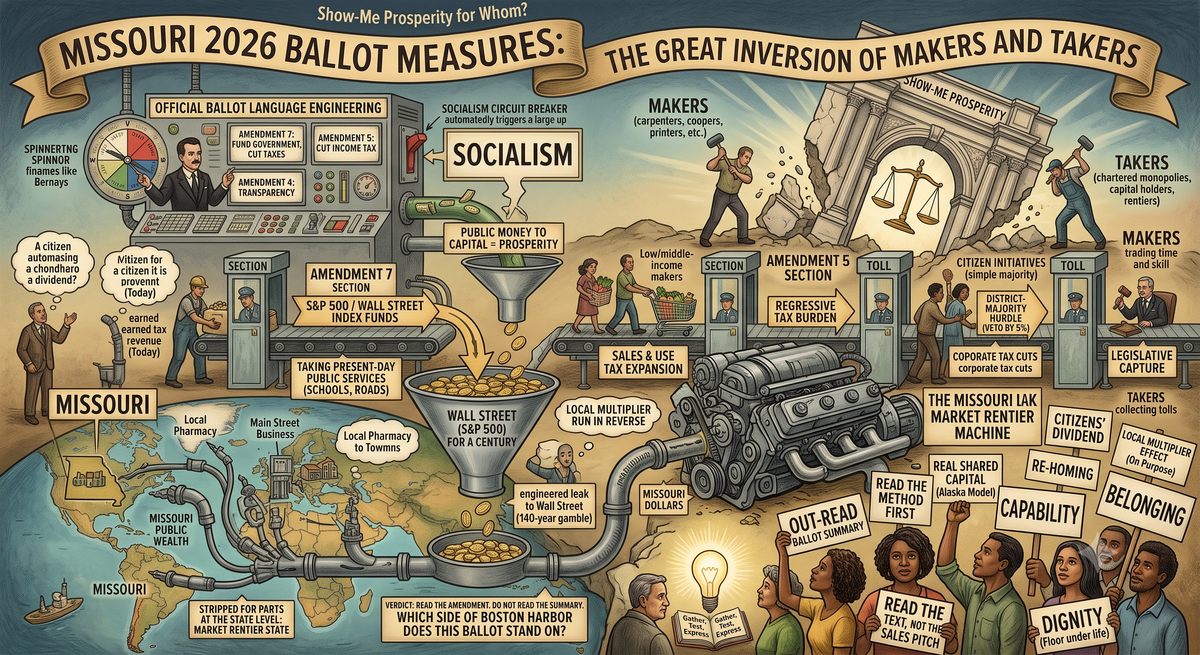
Show-Me Prosperity for Whom? Missouri's 2026 Ballot and the Great Inversion of Makers and Takers
How one amendment quietly builds the exact shared-capital machine we are trained to fear, points it at Wall Street instead of at Missourians, and wraps the whole thing in the word "prosperity" so nobody reads the fine print.
A working paper of TheMoralAlgorithm.com
The sentence that gives the game away
State Senator Adam Schnelting, the sponsor of what is now Amendment 7 on Missouri's 2026 ballot, described his plan for a state investment fund in plain terms. He wants to move state government, in his words, out of the "taker" column and into the "caretaker" column.
Sit with that word choice, because it is borrowed. The "maker versus taker" frame comes straight from Adam Smith, and I used it in these pages a few days ago to explain what the Boston Tea Party actually was. The men who boarded those ships in 1773 were makers: carpenters, coopers, printers, sailors, the people who trade time and skill for a living. The East India Company was the taker: a chartered monopoly that extracted profit through tax breaks and rigged rules it did not earn. Smith was on the raiders' side. He spent his career trying to free markets from monopolists, not to free monopolists from markets.
So when the sponsor of a tax amendment reaches for Smith's own vocabulary, a citizen trained to think should do exactly one thing: check whether the machine underneath the sentence matches the sentence. Gather the facts. Test them. Then decide.
This paper does that, across the whole 2026 Missouri ballot. The finding is uncomfortable and worth stating up front. Several of these measures are built to optimize for the holder of capital and to treat the common good as an afterthought, while the official ballot language is engineered to make each one read as its opposite. And the reason most Missourians will not catch it is the same reason the Tea Party got miscast as an anti-tax tantrum for two hundred years. We were trained to store the official story, not to test it.
Part One. The three ideas the ballot is quietly fighting
Before the amendments, three plain ideas. Hold them in your hand and the ballot stops looking like a random list and starts looking like a single argument about who the economy is for.
Makers and takers, the real version. Smith's line was never rich against poor. It was earned against unearned, productive against extractive. The maker builds, plants, codes, welds, heals, and repairs. The taker collects a toll from owning a scarce thing: a monopoly, a chartered privilege, a stream of rent. Modern political talk has flipped this on its head, aiming the word "taker" downward at the poor while the largest extractors of unearned income are recast as job creators. Reclaiming Smith's actual meaning is the whole fight, because once "taker" points at extraction again, you can see which way any given policy pumps.
Shared capital. The maker/taker gap closes structurally when the people who do the work and live in the place also own the assets that throw off the returns. Employee ownership, cooperatives, community trusts, and public wealth funds are all versions of the same move: put the return to capital and the return to labor in the same hands. This is not a fringe idea. It is the logic behind the family farm, the credit union, the rural electric cooperative, and, as we will see, the single most successful state investment fund in America.
The Local Multiplier Effect. A dollar spent with a locally owned business gets re-spent locally, on local wages, local suppliers, and local services, several times before it leaves. A dollar sent to an absentee owner is swept out of town by close of business. The measured gap is large. Civic Economics studies across North America found that on average roughly 48 percent of a purchase at a local independent recirculates locally, against less than 14 percent at a chain. The Institute for Local Self-Reliance found that one hundred dollars spent at Maine independents generated forty-five dollars of further local activity, versus fourteen dollars at a big-box store. Local independents return on the order of three times as much per dollar to the place they sit in.
Put the three together and you have a simple test for any economic policy. Does it reward making or taking? Does it spread ownership or concentrate it? Does it keep value circulating where it was created, or does it engineer the leak? A healthy economy answers make, spread, circulate. Financialization answers take, concentrate, leak. Now read the ballot.
Part Two. Amendment 7: shared capital in the wrong costume
Here is the measure that proves the whole thesis, because it takes the single most powerful tool of shared capital and points it in the wrong direction.
Amendment 7 creates the "Show-Me Prosperity Fund," a permanent public endowment written into the Missouri Constitution. The state would appropriate money into it over decades. The treasurer would invest that money, in the sponsor's own design, in exchange-traded funds that track the S&P 500. Nothing could be withdrawn until the fund's annual earnings grew large enough to replace state tax revenue, at which point the earnings would be used to eliminate state taxes, starting with the individual income tax and the corporate income tax and reaching, eventually, all of them. The sponsor has said his hope is that in a hundred or a hundred and twenty-five years, Missouri taxes its citizens nothing at all. He describes it, accurately, as a sovereign wealth fund.
He is right about the category, and that is exactly the point. A sovereign wealth fund is shared capital. It is the public owning productive assets in common and living off the return. The question is never whether such a fund is "socialist" or "capitalist." The question is who it is built to serve. And on that question, the Show-Me Prosperity Fund and the model it imitates point in opposite directions.
The fund that actually shares
Alaska has run the real version since 1976. The Alaska Permanent Fund is a constitutionally established sovereign wealth fund now worth somewhere around 83 to 86 billion dollars. Two design choices make it what it is. First, it is seeded from resource royalties, the public's cut of oil and minerals pulled from land the public owns. In the language of political economy, that is captured rent: unearned income from a natural monopoly, returned to the commons instead of pocketed by a private holder. Second, since 1982 it has paid a dividend directly to every eligible resident. The 2024 dividend was 1,702 dollars per person. The 2025 dividend was 1,000 dollars. Over its life it has averaged around 1,600 dollars a year to every man, woman, and child in the state.
Researchers describe the Alaska dividend as close to the only working example of a basic income in the United States, and they credit it with helping Alaska achieve the highest economic equality of any state in the country. That is what shared capital does when it is built to share. It takes a return the few would otherwise capture and spreads it to the many, and inequality falls.
The fund that concentrates
Now hold Amendment 7 up against that mirror, feature by feature.
| Design feature | Alaska Permanent Fund | Show-Me Prosperity Fund (Amendment 7) |
|---|---|---|
| Funding source | Royalties on publicly owned oil and minerals (captured rent) | General-revenue dollars appropriated away from current services, plus gifts |
| Primary purpose | Pay a dividend to every resident | Eliminate state taxes, beginning with income and corporate income tax |
| Who receives the benefit | Every resident, equally, every year since 1982 | Whoever benefits most from having no income or corporate tax |
| Direct payment to citizens | Yes, the defining feature | Optional, only after all taxes are gone, decades or a century out |
| Effect on equality | Highest economic equality of any state | Removes the two most progressive state taxes first |
| Where the invested money goes | Diversified global portfolio managed for the fund | The S&P 500, now roughly one-third concentrated in seven companies |
Read the funding row first, because it is the tell. Alaska's fund is fed by capturing rent that would otherwise be privately extracted. Missouri's fund would be fed by taking earned tax revenue, money that today pays for roads, courts, universities, and mental health, and routing it into the stock market for a hundred years before anyone sees a dime of benefit. One fund de-rentiers the economy. The other turns the state itself into a rentier.
Then read where the money goes. The sponsor's design puts the fund into S&P 500 index funds. I have written before about what the S&P 500 has become: as of 2026, seven companies make up roughly a third of the entire index, with a combined value above twenty-two trillion dollars. So Amendment 7 does not just fail to share capital. It takes Missouri's public money and pours it into the single most concentrated pool of private capital in human history, the exact engine of financialization this whole project was built to counter. It is the Local Multiplier Effect run in reverse at the scale of an entire state. Every dollar the fund buys of an index fund is a dollar that leaves Missouri's Main Streets and lands on Wall Street, and stays there for a century.
The arithmetic nobody puts on the yard sign
The scale required is the part the "prosperity" framing hides. To throw off enough to replace the roughly 13 billion dollars of general revenue Missouri collects in a year, the fund would need to hold something on the order of 260 billion dollars and earn 5 percent. The sponsor's own consulting math has a 250-million-dollar seed growing to a fund large enough only after roughly 140 years. This is not a tax cut you will feel. It is a hundred-and-forty-year gamble on the stock market, funded by pulling money out of present-day public services, sold to you as freedom from taxes you will pay every year until you die.
The strongest case for it, stated fairly
Honesty requires the other side. Eleven states run permanent funds, and a well-run public fund is a genuinely good idea; that is the whole reason Alaska works. A fund that stabilized Missouri's budget across boom and bust, or that seeded a real citizens' dividend, would be a serious contribution. The problem is not the tool. It is the target. Even sympathetic analysts have flagged the risk. A Cato Institute analyst noted that states with these funds use the earnings to stabilize budgets, not to abolish taxation entirely. A Tax Foundation analyst warned that a government which leans on market returns inherits the market's crashes, right when a downturn also guts everything else. And the amendment's own text quietly agrees: it includes an insolvency clause that hands the legislature full power to re-impose taxes if the fund falls short. Read that plainly. The promise is "no more taxes." The fine print is "no more taxes, unless the market disappoints, in which case the taxes come right back and you also lost a century of public investment." That is not prosperity. That is a lottery ticket the state bought with your schoolhouse.
Part Three. The word that stops the thought
Here is the move that keeps the analysis in Part Two from ever happening in most voters' heads. It is a single word, and it works like a circuit breaker.
Propose the good version of Amendment 7, the Alaska version, and listen to what happens. Say out loud: "Missouri should build a public wealth fund and pay every resident a yearly dividend, like Alaska does." Or say: "Let's fund a public option for banking, or seed every newborn with a small capital account, or guarantee the basics of a decent life." Somewhere before you finish the sentence, someone says the word. Socialism. And the conversation is over. Not answered. Over.
Now watch the asymmetry, because it is total. The same word is never once deployed against the other direction of the same machine. Nobody cried socialism when the public guarantee was welded to private speculation and the banks were bailed out in 2008, gains privatized and losses socialized. Nobody cries socialism when a city offers a chain retailer a public subsidy to move in, which is exactly the fight that produced the first Local Multiplier study, when Austin considered handing public money to a Borders bookstore. And nobody is crying socialism now, as Amendment 7 proposes to pour Missouri's public money into the S&P 500. Public money flowing up to capital is called prosperity, competitiveness, and growth. Public money flowing out to citizens is called socialism. The alarm is wired to ring in one direction only.
The polling shows how hollow the reflex is once you get past the label. Americans hold a net-negative view of the word socialism, roughly 39 percent unfavorable to 32 percent favorable. But ask about the actual policies and the numbers invert:
| The thing, when you name the policy | Support |
|---|---|
| Public housing | 57 percent |
| Government covering college tuition | 55 percent |
| Social Security, Medicare, Medicaid (favorable view) | around 79 percent |
| Opposition to cutting Medicare | 85 percent |
| Opposition to cutting Medicaid | 81 percent |
This is not new, and it is not an accident. In 1961, before Medicare existed, a young Ronald Reagan recorded a message for a campaign called Operation Coffee Cup, warning that government health insurance for the elderly would end American freedom. Medicare passed anyway, and became so beloved that the same movement now swears to protect it. The pattern is old enough to have a punchline: "keep your government hands off my Medicare." People reject the label and defend the function in the same breath, because the label was installed precisely to stop them from evaluating the function.
That is what "socialism" is doing on the 2026 ballot fight. It is not an argument. It is a device for making sure the maker/taker analysis never runs. And notice who benefits from the analysis never running: the takers. A citizen who cannot finish the sentence "we should share the capital" is a citizen who will never notice that the capital is being concentrated instead.
Part Four. Amendment 5 and the engineered leak
If Amendment 7 is shared capital pointed the wrong way, Amendment 5 is the Local Multiplier Effect turned into tax policy, in reverse.
Amendment 5 would phase out Missouri's individual income tax and authorize the legislature to expand sales and use taxes to make up the difference, potentially onto nearly any transaction, with a provision to protect school funding. On the yard sign it is "cut the income tax." In the machinery it is a shift of the tax base off of earned income and onto consumption. And that shift has a direction, because the two taxes fall on very different people.
An income tax, at graduated rates, asks the most of the highest earners. A sales tax asks the same rate of everyone but hits hardest at the bottom, because it only taxes money that gets spent, and low-income families spend all of what they make while high earners save and invest a large share, which the sales tax never touches. The data is not close. According to the Institute on Taxation and Economic Policy, the bottom fifth of earners already pay about 11.4 percent of their income in state and local taxes, the middle pays about 10.5 percent, and the top one percent pays about 7.2 percent. In 41 states, the richest residents are taxed at a lower rate than everyone else, and the most regressive systems in the country are precisely the ones with no income tax and heavy sales taxes. Florida, the national model for this approach, taxes its bottom fifth at over 13 percent of income and its wealthiest at under 3.
So read Amendments 5 and 7 together, because they are the same move at two speeds. Eliminate the income tax and the corporate income tax, the two levies that ask the most of capital and top earners. Replace the revenue with sales taxes and market returns, which fall hardest on wage earners and consumers. That is the maker/taker inversion written directly into the state's revenue code: unburden the taker, tax the maker's grocery cart. And every dollar of that regressive load is a dollar pulled out of the local circulation the multiplier depends on, taken from the family most likely to spend it at the local pharmacy and handed, by way of tax elimination, to the owners least likely to spend it in the county at all.
Part Five. Amendment 4 and the ballot itself as the weapon
There is one more measure that matters more than all the others combined, because it is about who gets to write the rules going forward.
Amendment 4 would change how citizens amend their own constitution. Today a citizen initiative passes on a simple majority of everyone who votes statewide, the way every Missouri constitutional amendment in history has passed. Amendment 4 would require, instead, a majority in every single congressional district. Run the arithmetic the way the newspapers did: a measure could win a clear statewide majority and still be defeated because it fell short in one district, meaning as few as five percent of the state's voters could veto what the other ninety-five percent approved.
This did not come from nowhere. It is the response of a legislative supermajority to a decade in which Missouri voters used the initiative to legalize marijuana, expand Medicaid, and establish abortion rights, over the legislature's objection each time. The ballot initiative is the one lever ordinary citizens hold when their representatives will not move. Amendment 4 raises that lever out of reach. It is the same lesson from the Glass-Steagall history: the people who hold the gavels write the rules so that the people cannot take the gavels back. Corporate capture and political capture are the same reflex, which is to convert a temporary majority into a permanent structure.
And here the technique that runs through the entire ballot comes into focus, because you can see it in the official language itself. Read how each measure is framed for the voter:
- Amendment 7 is titled as a fund to "support state government instead of taxing Missouri residents." The sweetener leads. The 140-year Wall Street gamble and the insolvency trapdoor are nowhere in the sentence.
- Amendment 5 is framed around requiring "local tax rate cuts without reducing school funding." The sweetener leads. The expansion of sales taxes onto everyday transactions is the payload underneath.
- Amendment 4 is presented as a measure to "make available the full text of initiative petitions" to voters, a genuine transparency nicety bundled on top of the real change, which is the district-majority hurdle that guts citizen initiatives.
- Amendment 3, the most litigated of all, opens its "yes" description by promising to "continue to ensure women's ability to access medical care" for emergencies and miscarriages, language that leads the reader gently past the actual effect, which is the repeal of a right voters approved in 2024. Whatever you believe about the underlying issue, the technique is identical to the others: lead with the reassurance, bury the payload.
This is not a partisan observation. It is a structural one, and it would be exactly as objectionable if it ran the other way. The technique is the "lead with the sweetener, bury the payload" construction, and it is the modern, legalized descendant of the two-hundred-year-old lie that the Tea Party was about a tax. The official summary is the rhetoric layer, and the rhetoric layer has been engineered. Which brings us to the only durable defense.
Part Six. The defense is a method, and the build is the point
You cannot out-argue an engineered ballot summary in the voting booth. You can only out-read it, and reading it takes a method most of us were never taught.
I have written about why. We came up through a rote system built to make us store the official version and repeat it on cue. That system just lost its entire reason to exist, because the machine now out-remembers every one of us. What it cannot do is judge. And judgment has an old name: the Trivium. Gather the facts. Test them against each other. Express what you actually found. Three steps, and they are free.
Run them on Amendment 7. Gather: it is a sovereign wealth fund invested in the S&P 500, withdrawable only after it can replace all state taxes, roughly a century out, with an insolvency clause that restores the taxes if it fails. Test: compare it to Alaska, the working model, and the differences are all in the same direction, away from the citizen and toward capital. Express: this is shared capital built to serve the holder of capital, sold under the language of prosperity and freedom. A citizen who can run that sequence cannot be moved by the summary. That is the entire ballgame, and it is why the Trivium is the first floor of everything I build.
But diagnosis without a build is just despair with footnotes. The reason to expose the wrong-way machine is to point the right-way one. Everything Amendment 7 gets backward can be gotten right:
- Real shared capital. A public wealth fund seeded from captured rent, on the Alaska model and the Georgist logic, paying a genuine citizens' dividend rather than abolishing the taxes that ask the most of capital. Same tool, pointed at the many.
- Re-Banking. Postal banking and child trust accounts, which move the point where new value enters the economy away from the financial sector's hand and toward the citizen, at birth. Structural counter-Cantillon devices, not charity.
- Re-Homing. Taking shelter back out of the speculative stream so that the most basic asset a family holds stops being a chip on someone else's table.
- The local multiplier, on purpose. Every policy that keeps a dollar circulating in the county, and every ownership structure that keeps the return in local hands, is the deliberate opposite of an amendment that ships public money to Wall Street.
That is the sequenced, costed version of make, spread, circulate, and it is the reason this site exists.
Verdict
The 2026 Missouri ballot is not a grab bag. Read through the one test that matters, who does this serve, it is a remarkably coherent document. Amendment 7 builds the machinery of shared capital and aims it at the S&P 500 instead of at Missourians. Amendment 5 shifts the tax load off capital and onto the maker's grocery cart. Amendment 4 raises the one lever citizens have left out of their reach. And every one of them is framed in official language built to read as its own opposite, with the word "socialism" held in reserve to stop anyone who starts to notice.
This is the same engine I have traced through Friedman's doctrine, Powell's manual, and the repeal of Glass-Steagall, now running at the state level and wearing Adam Smith's own vocabulary while doing the precise thing Smith spent his life fighting. The sponsor said he wants to move government from the taker column to the caretaker column. The honest reading of his own amendment is the reverse: it turns the state into a rentier and the citizen into the source of the rent.
So the question is the one I left on the table on the Fourth of July, and it belongs now to every city council member, county commissioner, school board, and organizer with a ballot in front of them. Which side of Boston Harbor does this ballot stand on? Are its rules written for the people who build, plant, code, weld, teach, heal, and repair? Or for the ones who own the toll booth?
You already know how to find out. Do not read the summary. Read the amendment. Gather, test, express. Then hand the method to the next person, because a captured public square will never demand the reform on its own.
The full sequence, the five reforms in load-bearing order, is the book: From Moral Algorithm to Ordered Liberty: A Citizen's Pathway. Section One is free for signing up on this site. Read the method first. Then decide if the rest earns your ten dollars. If you hold a local office or run a local campaign and you want the argument in a form you can put in front of a room, start with the five-step plan and take it from there.
Read the ballot like a raider.
For local officials and organizers: a one-page test to run in public
- Pull the full text, not the summary. Every measure links to its full text on the Secretary of State's page. The summary is the sales pitch. The text is the product.
- Ask the funding question. Where does the money come from, and where does it go? On Amendment 7, it comes from present public services and goes to the S&P 500. That single sentence reframes the whole debate.
- Ask the beneficiary question. If this works exactly as promised, who is measurably better off, and when? "In 140 years, whoever benefits most from no income tax" is a very different answer than "every resident, every year, starting now."
- Name the leak. For any measure, trace whether it keeps value circulating locally or ships it out. Use the multiplier numbers: roughly three local dollars of impact for every one that leaves.
- Watch for the circuit-breaker word. If someone answers a shared-capital question with "socialism," note that the same word is never used for public money flowing to capital, and return to the beneficiary question.
Sources and notes
- Amendment 7 / Show-Me Prosperity Fund (SJR 95): Missouri Secretary of State, 2026 Ballot Measures, official ballot title and fair ballot language; Missouri Senate SS/SCS/SJR 95 text (permanent public endowment; treasurer to invest in S&P 500 exchange-traded funds; no withdrawals until earnings can replace state taxes; 3 percent annual draw cap; insolvency clause restoring legislative taxing authority; optional resident dividends only after all taxes eliminated). Sponsor Sen. Adam Schnelting (R-St. Charles); "taker/caretaker" framing and 100-to-125-year horizon per Missouri Independent / The Beacon reporting. Legislative votes: Senate 22-7 (March 23, 2026), House 85-56 (May 15, 2026), per Ballotpedia. Scale estimate: roughly 260 billion dollars at a 5 percent return to replace about 13 billion in annual general revenue, per Jefferson City News-Tribune; sponsor's consultant math of a 250-million-dollar seed reaching roughly 872 billion after about 140 years at 6 percent. Cautions from Cato Institute (Tad DeHaven) and the Tax Foundation (Manish Bhatt).
- Alaska Permanent Fund: constitutionally established 1976; sovereign wealth fund of roughly 83 to 86 billion dollars; funded by oil and mineral royalties; Permanent Fund Dividend paid to residents since 1982; 2024 dividend 1,702 dollars, 2025 dividend 1,000 dollars, long-run average around 1,600 dollars; described by researchers as a working basic income and credited with giving Alaska the highest economic equality of any state. Sources: Alaska Department of Revenue; Alaska Beacon; Wikipedia summary of the peer-reviewed literature.
- Amendment 5 (HJR 173 & 174): phase-out of the individual income tax based on revenue growth, authorization to expand sales and use taxes, school-funding protection; potential new sales-tax rates from January 1, 2029. Missouri Secretary of State; Clarkston Nelson summary.
- Tax regressivity: Institute on Taxation and Economic Policy, Who Pays? 7th edition (2024): bottom 20 percent pay about 11.4 percent of income in state and local taxes, middle about 10.5 percent, top 1 percent about 7.2 percent; 41 states tax high earners at lower effective rates; states with no income tax and heavy sales taxes are the most regressive; Florida's bottom fifth pays over 13 percent versus under 3 percent for the wealthiest.
- Local Multiplier Effect: Civic Economics studies (Austin/Borders origin study and the national Indie Impact series): roughly 48 to 53 percent local recirculation for independents versus under 14 percent for chains; Institute for Local Self-Reliance Maine study (100 dollars local generating 45 dollars versus 14 for big-box); documented local multipliers commonly in the 3-to-5 range. Reclaim Democracy; American Independent Business Alliance.
- Amendment 4: congressional-district-majority requirement for citizen initiative constitutional amendments; reporting that as few as 5 percent of statewide voters in one district could defeat a statewide majority; framed as a legislative response to voter-initiated marijuana, Medicaid expansion, and abortion measures. Jefferson City News-Tribune.
- Amendment 3: repeal of the 2024 voter-approved reproductive-rights amendment (which passed with about 53 percent); official "yes" ballot language leads with medical-care access. Cited here only as an example of the shared ballot-language technique, not as a position on the underlying issue.
- "Socialism" polling: YouGov/Economist (word favorability roughly 32 percent favorable to 39 percent unfavorable; public housing 57 percent, tuition 55 percent, eliminating private insurance 52 percent); Navigator Research and AP-NORC (Social Security, Medicare, Medicaid around 79 percent favorable; 85 percent oppose Medicare cuts, 81 percent oppose Medicaid cuts). Historical note: Reagan's 1961 Operation Coffee Cup recording against Medicare.
- Market concentration / Glass-Steagall context: the seven largest firms at roughly one-third of the S&P 500 with combined value above 22 trillion dollars, per the companion working paper on TheMoralAlgorithm.com.
Released under the GNU General Public License v3.0. Attribution: TheMoralAlgorithm.com.
Frequently Asked Questions
What is the Show-Me Prosperity Fund?
It is a permanent public investment fund created by Missouri's Amendment 7. The state would invest tax money in S&P 500 index funds for decades. Once earnings grow large enough, they would replace state taxes, starting with income and corporate taxes.
How does Missouri's fund differ from the Alaska Permanent Fund?
Alaska's fund is filled with oil and mineral royalties, money the public already owns. Missouri's fund would instead take general tax revenue away from current public services. Alaska pays a yearly dividend to every resident, while Missouri's fund pays nothing to citizens for decades or longer.
How long would Missouri have to wait before seeing any benefit?
The fund would need roughly 260 billion dollars to replace Missouri's 13 billion dollars in annual general revenue. Starting from a 250 million dollar seed, the sponsor's own math suggests this could take about 140 years.
What happens if the stock market crashes after Missouri eliminates its taxes?
The amendment includes an insolvency clause letting the legislature re-impose taxes if the fund falls short. This means a market downturn could bring taxes back while the state has already lost a century of public investment.
Does investing in the S&P 500 help Missouri's local economy?
No, it does the opposite of the Local Multiplier Effect, which keeps money circulating locally. As of 2026, seven companies make up roughly a third of the S&P 500, so Missouri's public money would flow into the most concentrated pool of private capital in history, mostly leaving the state permanently.