The Machine Won the Memory Contest. Now What?
AI now out-recalls the experts, so rote schooling is dead. Machines cannot copy judgment or lived experience. The fix is old: the Trivium (gather, test, express) and the journeyman's road. Stop memorizing. Start journeying.
TL;DR
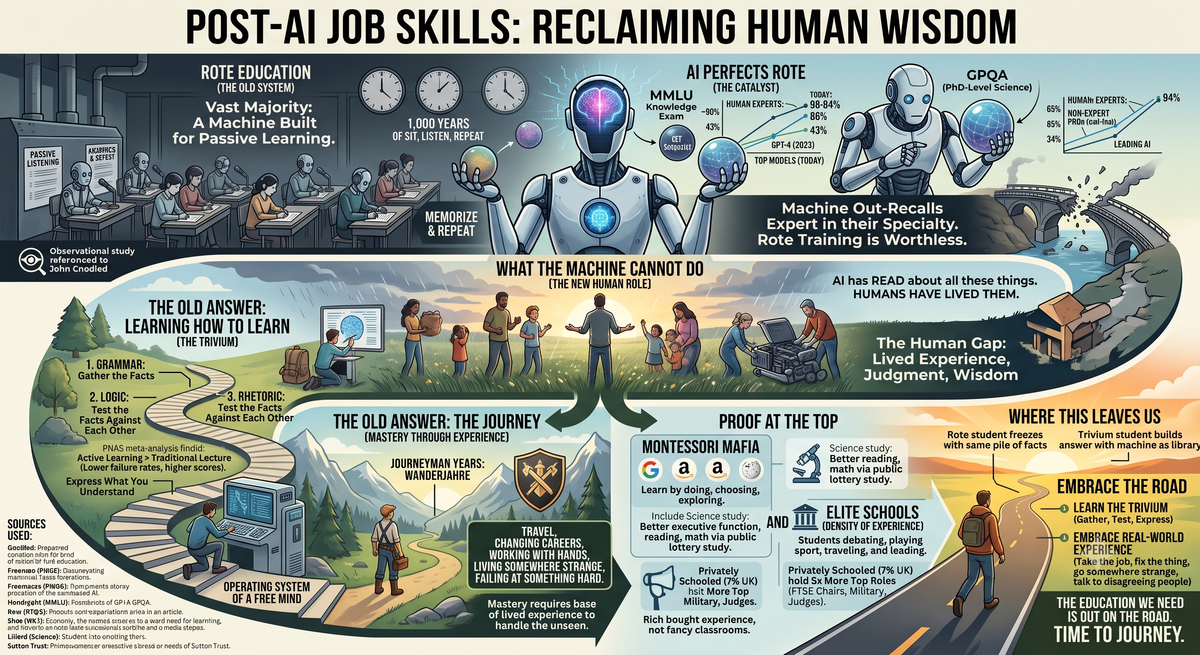
Schools trained people to memorize facts and repeat them on tests. AI now performs this task better than humans. AI scores 94 percent on hard PhD-level science tests. Humans must build judgment instead, using lived experience. The Trivium method and real-world experience build this judgment.
Post AI Job Skills
Here is the huge miss almost nobody talks about.
The vast majority of us came up through a rote education system. Memorize the material. Repeat it on the test. Move to the next grade. We called that learning. It was not. It was storage and retrieval, and we graded people on how well they could play back the tape.
This is not just a feeling. The largest on-site study of American schooling ever done, John Goodlad's "A Study of Schooling," put trained observers in more than 1,000 classrooms serving over 17,000 students. What they found was a machine built for passive listening. Goodlad spent the rest of his life asking why the teacher out-talks the children in every room, and why the dialogue only ever runs teacher to child, never child to child.
And the method is old. Universities appeared in Western Europe around the year 1050, and lecturing has been the main form of teaching ever since. Almost a thousand years of sit down, listen, repeat.
That system just met its end. Not slowly. All at once.
AI Perfected Rote
Artificial intelligence has now perfected the very skill our schools spent a century drilling into children. It remembers everything. It retrieves instantly. It never forgets a date, a formula, or a definition. No human being alive can compete with a machine in that lane, and no human being ever will again.
Here are the numbers. In 2020, researchers built a giant knowledge exam called MMLU covering 57 subjects. The best AI of that year scored about 43 percent. Human experts scored around 90. By 2023, GPT-4 scored 86 percent. Today the test is considered dead. The top models all score between 88 and 94 percent, and researchers had to retire the exam because it can no longer tell the machines apart.
So they built a harder one. GPQA asks PhD-level science questions designed so that a PhD holder outside the field, even with full internet access, scores about 34 percent. Experts inside the field score about 65 percent. The leading AI model now scores 94 percent.
Read that again. The machine now out-recalls the credentialed expert inside the expert's own specialty. We trained generations of people for exactly one contest, and a machine just won that contest permanently.
If your whole education taught you to remember and regurgitate, the machine did not just beat you. It made your training worthless.
What the Machine Cannot Do
Here is the other side, and it matters more.
AI cannot live. It cannot stand in a field at dawn and smell rain coming. It cannot lose a job, bury a friend, raise a child, or fix an engine with cold hands in February. It has read about all of those things. It has lived none of them.
That gap is where humans must now compete. Lived experience. Judgment built from years of contact with the real world. The ability to look at a situation the textbook never covered and know what to do anyway.
The problem is that rote schooling never built that ability. It could not. You cannot memorize your way into wisdom. Wisdom comes from two sources, and only two: learning how to learn, and living enough life to have something worth thinking about.
The Old Answer: Learning How to Learn
The first source has a name, and it is very old. The Trivium.
Grammar, logic, rhetoric. Gather the facts. Test the facts against each other until you understand how they connect. Then express what you understand in your own words. That is not a subject. That is a method. It is the operating system of a free mind.
A person trained in the Trivium does not need to memorize the answer, because they can build the answer. Hand them a subject they have never seen and they know what to do: gather, test, express. The machine can hand them all the raw facts in the world, and that only makes them faster. The machine becomes their library instead of their replacement.
A person trained in rote gets the same pile of facts and freezes. Nobody ever taught them what to do with facts. Only how to hold them.
The evidence backs this up. A 2014 meta-analysis in PNAS pooled 225 studies comparing traditional lecture courses with active learning, where students engage instead of just listening. Under lecture, 33.8 percent of students failed. Under active learning, 21.8 percent failed. Students in lecture halls were 55 percent more likely to fail, and exam scores ran about half a standard deviation lower. The passive method does not just bore students. It measurably breaks them.
The Old Answer: The Journey
The second source is buried in a word we still use.
Journeyman.
The word itself comes from the French "journee," meaning a day's work. A journeyman was a craftsman skilled enough to be paid by the day. But what the guilds built around that rank is the part that matters. In much of Europe, and most famously in the German trades, the journeyman years were mandatory travel. The "Wanderjahre" sent a young craftsman on the road for years, town to town, shop to shop, master to master. He saw different tools, different methods, different problems, different people. Some German trades keep this tradition alive to this day. Only after the road did anyone call him a master.
The old guilds understood something we forgot. Skill without experience is just recitation with your hands. Mastery requires a base of lived experience wide enough to handle the problem nobody has seen before. You cannot get that base sitting in one room. You have to go get it.
Travel does the same work today. So does changing careers, working with your hands, living somewhere strange, or failing at something hard. Every one of those builds the experience base the machine cannot copy.
Doubt Me? Look at Who Runs Things
If you think this is romantic nonsense, look at who sits at the top.
Start with Montessori schools, where children learn by doing, choosing, and exploring instead of sitting and reciting. The Wall Street Journal coined a name for the pattern in 2011: the Montessori Mafia. Google founders Larry Page and Sergey Brin. Amazon's Jeff Bezos. Wikipedia's Jimmy Wales. Will Wright, who built The Sims. When Barbara Walters asked Page and Brin in 2004 whether having professors for parents explained their success, they said no. They credited Montessori.
And this is not just billionaires telling flattering stories about themselves. In 2006 the journal Science published a study of a public Montessori school in Milwaukee where admission ran by random lottery. The kids who lost the lottery and went to regular schools became the control group. Same neighborhoods, same parents who wanted in. By age five, the Montessori children scored significantly better in reading and math, and better on executive function, the skill of adapting to new and harder problems. The lottery design kills the excuse that rich parents explain everything. Experience-based schooling did the work.
Now look at the elite schools, and here the British keep the best records. The Sutton Trust tracks the educational background of the roughly 5,000 most powerful people in the UK. Just 7 percent of Britons attend private schools. Yet the people at the top are 5 times more likely to have gone to one. Thirty-seven percent of FTSE 100 chief executives were privately schooled. Sixty-eight percent of FTSE 100 board chairs. Past editions found 71 percent of top military officers and half of senior judges came through the private school pipeline.
Seven percent of the population holding two-thirds of the boardroom chairs. Sit with that ratio.
And here is the part people miss about those schools. The advantage was never the fancy classroom. It was the density of experience. Debate, sport, travel, leadership roles, living away from home at fourteen. Those schools packed life-changing events into the years when most kids were packing worksheets.
The rich did not buy better memorization for their children. They bought experience. They bought the journey. Then they sent everyone else's children to sit in rows.
The Exceptions Prove the Rule
Yes, there are great teachers. Most of us can name one. The teacher who staged a mock trial, took the class outside, blew something up in the chemistry lab, or simply talked to us like our thoughts mattered. Notice what made those moments stick. Every single one was an experience, not a recitation. The great teachers were smuggling the journey into a building designed to prevent it.
For everyone else, education was a task. Something you got through. Twelve years of attendance, then a paper that said you attended.
Where This Leaves Us
So here is the plain shape of the problem.
The machine now owns memory. The test scores prove it. Humans must own judgment. Judgment comes from learning how to learn and from living a real life full of real experience. Our schools teach neither, and the failure rates show what that costs.
That has to change, and it does not have to wait for permission. The Trivium is free. It fits in a sentence: gather, test, express. Any parent can teach it. Any adult can practice it. And experience is everywhere the classroom is not. Take the job you are not ready for. Fix the thing yourself. Go somewhere that makes you uncomfortable. Talk to people who disagree with you and stay in the conversation.
The machine perfected the education we had. Good. Let it keep that prize.
The education we need was never in the building anyway. It was always out on the road.
The Trivium is only the first floor. From Moral Algorithm to Ordered Liberty: A Citizen's Pathway builds the rest: cognitive liberty, civic money, honest housing, corporate restraint, and a real democratic voice. It turns the method in this essay (gather, test, express) into a working plan for self-government you can put to use today. Free minds still need free institutions. Get the book and start building both.
Time to journey.
Sources
- Goodlad, John I. A Place Called School: Prospects for the Future. McGraw-Hill, 1984. Based on "A Study of Schooling in the United States," an observational study of more than 1,000 classrooms serving over 17,000 students.
- Freeman, Scott, et al. "Active learning increases student performance in science, engineering, and mathematics." Proceedings of the National Academy of Sciences 111, no. 23 (2014): 8410-8415. Meta-analysis of 225 studies; failure rates 33.8 percent under lecture versus 21.8 percent under active learning; exam gains of 0.47 standard deviations.
- Hendrycks, Dan, et al. "Measuring Massive Multitask Language Understanding" (MMLU), 2020-2021. GPT-3 scored roughly 43 percent at release against human expert performance near 90 percent; frontier models now score 88 to 94 percent and the benchmark is considered saturated.
- Rein, David, et al. "GPQA: A Graduate-Level Google-Proof Q&A Benchmark," 2023. Non-expert PhD holders with web access score about 34 percent, domain experts about 65 percent; leading 2026 models score above 90 percent.
- Sims, Peter. "The Montessori Mafia." Wall Street Journal, April 5, 2011.
- Lillard, Angeline S., and Nicole Else-Quest. "Evaluating Montessori Education." Science 313, no. 5795 (2006): 1893-1894. Lottery-controlled study of a public Montessori school in Milwaukee.
- The Sutton Trust. Elitist Britain 2025 (with earlier editions 2019 and 2014). Educational backgrounds of roughly 5,000 leading UK figures.
Frequently Asked Questions
How well does AI perform on tests that measure memorized knowledge?
AI now scores between 88 and 94 percent on the MMLU test, a broad knowledge exam covering 57 subjects. On GPQA, a harder PhD-level science test, the leading AI model scores 94 percent, beating domain experts who score about 65 percent.
What is the Trivium and how does it help people compete with AI?
The Trivium is an old three-part method: grammar, logic, and rhetoric. In practice this means gather facts, test them against each other, then express understanding in your own words. People trained this way build answers instead of memorizing them, so AI becomes a tool they use rather than a replacement for their thinking.
Does research support active, experience-based learning over lecture-based learning?
Yes. A 2014 PNAS meta-analysis of 225 studies found that 33.8 percent of students failed under traditional lecture courses, compared to 21.8 percent under active learning. Students in lecture halls were 55 percent more likely to fail than those in active learning environments.
Do successful people tend to come from experience-based schooling?
Many prominent tech founders, including Google's Larry Page and Sergey Brin, Amazon's Jeff Bezos, and Wikipedia's Jimmy Wales, attended Montessori schools that emphasize doing and exploring over reciting facts. A 2006 Science study using a lottery-based admission system found Montessori children in Milwaukee scored better in reading, math, and executive function by age five, even after controlling for family background.
Why do elite British schools produce so many top leaders?
According to the Sutton Trust, only 7 percent of Britons attend private school, yet the privately schooled are 5 times more likely to reach the UK's top positions. The real advantage of these schools was never memorization but a high density of real experience, including debate, sport, travel, and leadership roles.