The Trivium Method: How to Out-Learn AI in Any Field
AI perfected rote memorization, and you can't out-remember a machine. The real edge is learning to learn: the recursive Trivium, and the lived experience no AI can reach.
TL;DR
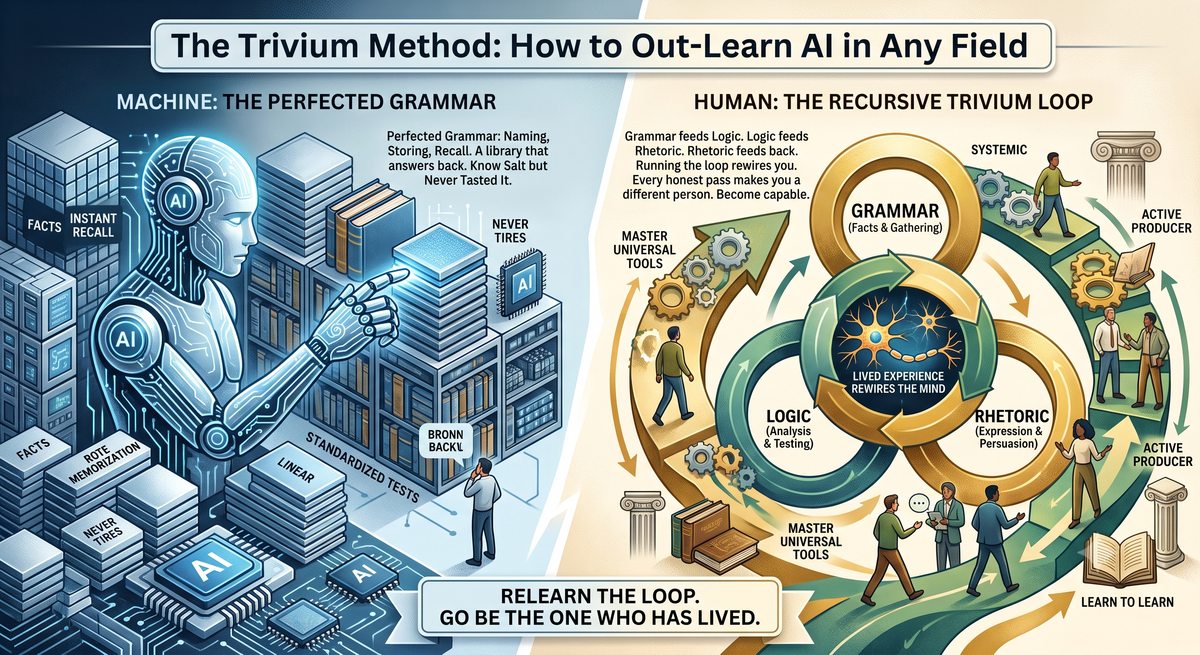
AI stores and recalls facts better than any human. Old schools trained students to memorize facts like a machine. This method no longer works today. The Trivium method offers a better way to learn. It has three steps: Grammar, Logic, and Rhetoric. Grammar means you name and store facts. Logic means you test how facts connect. Rhetoric means you share ideas with real people. This loop changes how you think over time. AI cannot do this loop, because it lacks real experience. Learn this loop, not just facts, to master any new field.
A machine now holds more facts than any human who ever lived. It recalls them in a blink. It never tires, never sleeps, never runs out of room. For the whole history of school we trained children to do a smaller, worse version of this. Memorize the list. Recite it back. Get graded on how much you stored and how cleanly you returned it.
That game is over. You cannot out-remember a machine. Stop trying.
What the machine actually mastered
The machine has perfected only the first stage of learning. The classical mind called it Grammar: the naming, the storing, the recall. AI is the finished form of Grammar. It is a library that answers back. But a library is not a scholar, and Grammar is not thought.
The old method never stopped at Grammar. It ran a loop. Grammar feeds Logic. You take what you named and you test how the parts fit, where they break, what follows from what. Logic feeds Rhetoric. You take what survived the testing and you carry it to a real person for a real purpose. Then Rhetoric feeds back. The act of using what you know changes what you are. This loop has a name. The Trivium. And it does something the machine cannot do.
Every honest pass through that loop rewires you. Learn something in your bones and you become a different person than the one who started. The machine runs the same loop ten thousand times and comes out identical every time. Strip its files and it knows nothing it earned. It has read about salt and never tasted it. Lived experience is the one input it cannot get.
This is not a new idea. It is the oldest one.
We know the loop works, because it built the minds we still quote.
Walk into an Athenian schoolyard and the first sound is boys reciting Homer, line by line, from memory. That is Grammar, and they started young. But the recitation was the floor, not the ceiling. As a boy grew, he learned to take an argument apart and test it for weak joints. Then he learned to stand up and deliver his own version, out loud, to a room. The Greeks did not stack these as three subjects on three shelves by age. They treated them as one craft, a techne, run again and again on harder material each pass. Isocrates built a whole school on it. The goal was never to store the poem. The goal was to become someone who could take any poem, any argument, any problem apart and rebuild it stronger.
The men who wrote the Constitution came out of the same machine. A colonial boy headed for college started Latin and Greek at about eight. To walk into Harvard or Princeton at fourteen or fifteen, he had to read Cicero on sight and speak and write real Latin. James Madison arrived at Princeton having already worked through Virgil, Horace, Tacitus, Herodotus, Thucydides, and Plato.
The tool that drilled it was double translation, a method the humanists lifted from Cicero and ran through the grammar schools for centuries. A boy took a passage of Cicero. He worked out its grammar and meaning. He turned it into English. Then, an hour or a day later, he put his English back into Latin without looking, and set his version beside the original. Grammar, Logic, Rhetoric, in one exercise. And the gap between his Latin and Cicero's became the next lesson. The loop fed itself. That is the whole secret. Not the Latin. The loop.
Two models, side by side
| Industrial / Modern Model | Recursive Trivium Model | |
|---|---|---|
| Primary goal | Rote memorization of subject-specific data | Mastery of the universal tools of learning |
| Cognitive path | Linear, fragmented, compartmentalized | Systemic, interconnected, recursive |
| Student output | Passive consumer of standardized tests | Active producer of logical, persuasive argument |
| Adaptability | High friction when switching domains | Rapidly self-teaching in any new field |
The machine locked the first column. You get the second.
Look hard at that table. The machine now owns the left column completely. Rote storage, standardized recall, one narrow domain at a time. It does all of it faster and cheaper than you ever could. Stop building a life out of the left column. The machine drinks that well dry.
The right column is still yours. A mind that treats every new field as one more pass through the same loop. It does not just memorize the domain. It learns the domain, tears it apart, and speaks it back. It crosses from one field to the next without starting over, because it carries the method, not just the facts.
So here is the move for the years ahead. Do not aim to become the person who knows the most about one thing. The machine knows more. Aim to become the person who can walk into anything, run the loop, and come out capable. The polymath. The multipotentialite. The renaissance mind. Learn to learn, and the specific subject stops being a cage.
This is not a call to dabble. It is a call to practice one portable skill until it is second nature: taking up something new and truly making it yours. Travel to the place instead of reading about it. Build the thing with your hands. Sit with the people who do the work. Fail at the new craft and let the failure teach you what no summary could. Each of these is Grammar you gathered with your whole body, Logic you tested against the real world, Rhetoric you earned the right to speak. Learn to love the new, because it is about to become the only thing worth being good at.
The Greeks and the Founders were not smarter than us. They trained on the loop. We trained on the list. The machine just made the list worthless.
Relearn the loop. Go be the one who has lived.
Frequently Asked Questions
Why can't humans compete with AI on memorization?
AI stores more facts than any human and recalls them instantly, without tiring or running out of space. Humans should stop trying to out-remember machines and focus elsewhere.
What is the Trivium method?
The Trivium is a three-part learning loop: Grammar, Logic, and Rhetoric. Grammar means naming and storing facts, Logic means testing how those facts fit together, and Rhetoric means sharing tested ideas with real people for a real purpose.
Why can't AI replicate what humans do with the Trivium loop?
AI repeats the loop endlessly but stays unchanged by it, since it has read about salt but never tasted it. Real lived experience is something AI cannot get.
How did historical figures like America's Founders use this method?
Colonial boys started Latin and Greek around age eight and used a technique called double translation. They translated Latin texts into English, then back into Latin from memory, checking their version against the original, combining Grammar, Logic, and Rhetoric in one exercise.
What should people focus on learning in the age of AI?
People should stop memorizing facts, since AI already dominates that area, and instead master the universal loop of learning: Grammar, Logic, and Rhetoric. This lets someone adapt quickly to any new field rather than starting over each time.