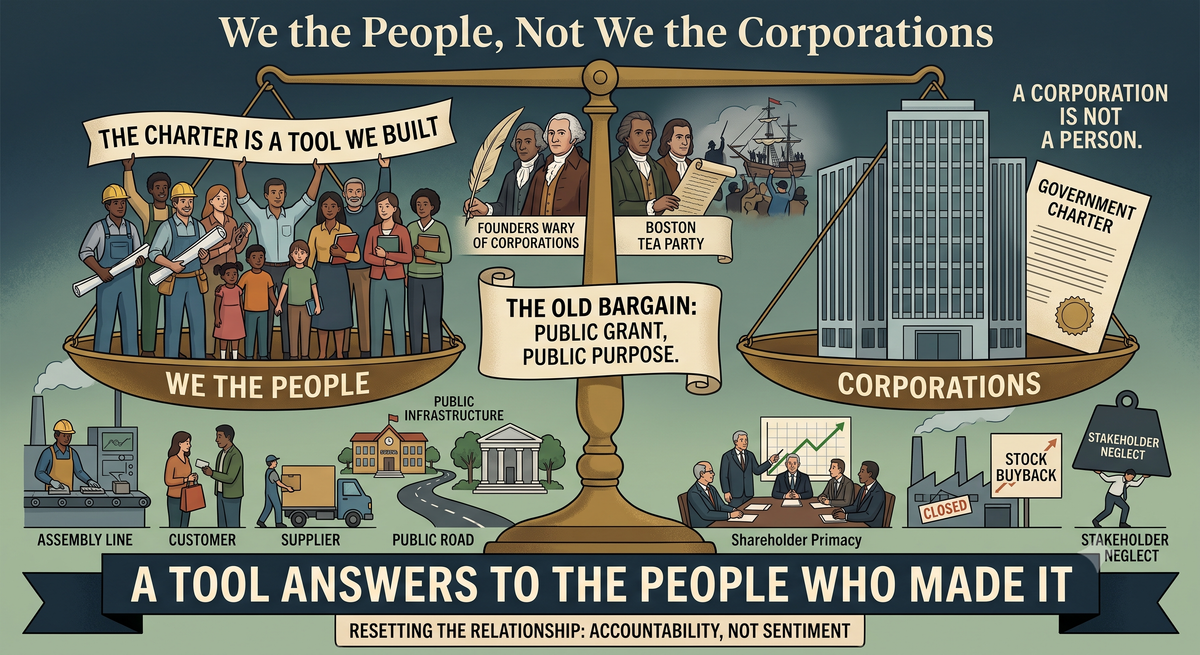
We the People, Not We the Corporations
Corporations aren't citizens. They're tools we charter, and they answer to everyone who builds them: workers, customers, communities, and the nation. Here's the case for stakeholders over shareholders, why the founders feared corporate power, and how the 1970s quietly rewrote the rules.
TL;DR
A corporation is a tool created by government charter, not a person. The public grants it special powers, like limited liability, for a public purpose. Workers, customers, suppliers, and communities all help build a company's value, not just shareholders. Around 1970, a new idea called shareholder primacy pushed aside this older balanced view. A reform plan would restore duties to all stakeholders and give large firms real accountability.
A company is a tool we built, not a citizen who rules. Here is why it owes something back to everyone who builds it, and how we can make it answer again.
Start with one plain idea. A corporation is not a person. It is a tool. We made it.
A person is born. A corporation is chartered, which means a government signs a piece of paper that brings it to life. Before that paper, it does not exist. After that paper, it can own property, sign contracts, live forever, and shield its owners from personal loss. None of that comes from nature. All of it comes from us, the public, acting through our government.
That single fact is the key to everything that follows. A thing we create to serve us is a tool. A tool is not a member of "We the People." It does not get a vote. It has no conscience. It cannot love its country or fear for its children, because it has none. It was built to do a job. And a tool answers to the people who made it.
For most of American history, that was simply understood. Somewhere in the last fifty years, we forgot it. This is the story of how, and how we might remember.
The people who founded the country were afraid of corporations
We tend to think of big business and America as old partners. They are not. The founders were wary of corporations, and for good reason. The most famous protest of the Revolution, the Boston Tea Party, was aimed at a corporation, the British East India Company, a company so powerful it ran an army and a chunk of a continent.
In the early republic, you could not just start a corporation. A legislature had to grant it a charter, one at a time, by name. The charter was narrow. It said what the company was for, usually a public job like building a bridge, digging a canal, or running a bank. It often set a time limit, capped how large the company could grow, and could be pulled if the company strayed. A corporation was treated as what it was: a public grant of special power, given for a public reason, and revocable if abused.
The privileges we now take for granted, especially limited liability, the rule that owners can lose only what they invested and no more, were understood as a gift from the public. And a gift can carry conditions. That is the old bargain. The public grants the corporation its powers, and in return the corporation serves a public purpose and stays accountable to the community that created it.
Who actually builds a company
Now to the heart of it, the argument between stakeholders and stockholders.
A stockholder, also called a shareholder, is someone who owns a share of the company and puts up money, called capital. Capital matters. But ask a simple question: who actually builds the value of a company?
The workers build it with their labor. The customers build it by paying for what it makes. The suppliers build it by providing parts and materials. And the community builds it in ways that are easy to miss. The roads the trucks drive on were paid for by the public. The schools that trained the workers were paid for by the public. The courts that enforce the company's contracts, the police that protect its stores, the patents that guard its ideas, the money everyone spends, all of it is public infrastructure the company runs on for free.
Everyone in that list has a stake in the company. That is what the word stakeholder means. The stockholder is one of them, the one who supplied capital. An important one, but one among several.
Shareholder primacy is the idea that only the stockholders truly count. Everyone else is just a cost to be reduced. Under that view, the company's one job is to make the stock price go up, and workers, customers, communities, and the country are means to that end, never ends in themselves.
Stakeholder capitalism says the opposite. Everyone who contributes has a real claim. The company owes fair dealing to all of them, not loyalty to one and a squeeze on the rest. This is not charity. It is just an honest accounting of who built the thing.
A side note from Adam Smith: makers and takers
People invoke Adam Smith, the founder of modern economics, as the patron saint of pure profit. His actual book, published in 1776, the same year as the Declaration, is more careful than that.
Smith drew a line between producing wealth and merely capturing it. He admired the maker, the person or firm that creates real value, a better product, an honest service, more grain, more cloth. He was suspicious of the taker, the one who gets rich by extracting value that others created, through monopoly, special favors, or rent. He warned, in plain words, that when merchants of the same trade get together, the conversation tends to end in a scheme against the public. He wrote that the interest of businessmen is often opposite to the interest of society, and that their proposals deserve careful suspicion.
"Makers versus takers" is the modern shorthand for Smith's distinction. A healthy economy rewards making. A sick one rewards taking. When shareholder primacy is pushed to its limit, it can reward the taking: cutting wages, squeezing suppliers, buying back stock, and financial tricks that lift the share price without building anything real. Stakeholder capitalism tries to point the rewards back toward making. Smith would recognize the goal.
How we forgot the old bargain
If the stakeholder view is so old, why does it feel new? Because a specific idea won a specific fight, and not long ago.
For the first half of the twentieth century, the mainstream view of the big corporation was closer to the stakeholder side. This was even argued out in print. In 1932, two law professors, Adolf Berle and Merrick Dodd, debated who the corporation is really for. Dodd argued that managers are trustees for the whole enterprise and its workers and public, not just the shareholders. Through the middle of the century, that broader, balancing view was the working assumption of most large American companies. The boss was expected to be a kind of steward, weighing the interests of workers, customers, community, and owners together.
Then the pendulum was pushed, hard, in the early 1970s.
In 1970, the economist Milton Friedman published a famous essay arguing that the one and only social responsibility of a business is to increase its profits for shareholders. His argument was not stupid, and it is worth stating fairly. A manager, he said, is spending other people's money, the owners' money. If he gives it away to causes the owners did not choose, he is in effect taxing them without their consent. Let the company make profit honestly, Friedman said, and let government and law handle the rest.
In 1971, a lawyer named Lewis Powell, soon to join the Supreme Court, wrote a private memo to the Chamber of Commerce. It urged American business to organize its political and intellectual power, to fund think tanks, shape universities, and press its case in the courts and the media. It became a blueprint. Over the next two decades, business built exactly that machinery.
Out of this came the era often called neoliberalism, and with it the shareholder value movement. By the 1980s and 1990s, "maximize shareholder value" had hardened from one opinion into the assumed law of business. The older, balancing view did not lose an argument on the merits so much as it was outspent and out-organized.
That is the crucial point. Shareholder primacy is not ancient. It is not natural. It is not required by economics or handed down from the founders. It is a roughly fifty-year-old idea that won a political and cultural campaign. And what one generation built, another can revisit.
Why this matters more now than ever
There is a new reason the old bargain needs restoring, and it is urgent.
The largest corporations are no longer just big companies. A few of them now command more resources than most countries. And under today's rules, a company, including one driven by artificial intelligence, can pick whichever state offers the loosest duties, incorporate there, and grow to hold more power than many nations, quickly, with no one at the national level able to hold it to account. We already got a preview when the control of a leading AI company was fought over in 2024 and 2025, and the only brakes anyone could find were two state officials and public pressure.
When a private entity gets that large, its failure is no longer a private matter. It can take the whole economy down with it. That is what "too big to fail" means, and we have paid for it before. At that scale, the list of stakeholders grows to include the most important one of all: the continued existence of the country itself.
What the reform actually does, in plain terms
The policy built on these ideas is long in its legal form, but simple in its logic. It works like a ladder, where the more power the public grants a business, the more that business owes back.
A person working under their own name carries the lightest duties. A limited liability company, which gets the shield, carries a bit more. A full corporation, which gets the shield plus permanent life and the power to gather unlimited capital, carries more still. A very large corporation must answer to all its stakeholders, not just its stockholders, and must give its workers real seats on the board. And a handful of firms so large they rival nations enter a top category where the country itself is a named stakeholder, and where they must plan for their own safe wind-down so their failure cannot hold the rest of us hostage.
To end the game of shopping for the weakest state, the largest firms would hold a single national charter, so their duties no longer depend on which state they picked.
On money in politics, the logic returns to the first idea. A corporation is a tool, not a citizen. It has no vote, so it has no business buying elections. And because a big company's stakeholders are the whole public, any dollar it spends to push one political side is a dollar spent against some of the very people it is supposed to serve. That is a conflict of interest, plainly. So corporate election spending is treated as the breach of duty it is, and, through a constitutional amendment, ended outright, while ordinary people remain free to spend and speak as they always have. To keep candidates from depending on big money in the first place, a clean public-financing option lets a candidate run on many small donations instead.
A reset, not a revolution
Here is the honest frame. None of this is a leap into something America has never known. It is closer to a restoration. It resets the understanding of the corporation that held, more or less, from the founding through the middle of the last century, and it clarifies that understanding for an age of trillion-dollar and artificial-intelligence firms the founders could never have pictured.
The fair objection deserves a fair answer. Critics of the stakeholder view, including Friedman, ask a sharp question: if a company must serve everyone, who decides the tradeoffs, and what stops a manager from calling any decision "good for stakeholders"? It is a real problem, and vague talk about "balancing" does not solve it. That is why the serious version of this reform does not rely on good intentions. It puts workers on the board so the balancing is done by real people with real stakes, and it defines the top category of firms with measurable, public standards rather than slogans. Accountability, not sentiment.
The one line to remember
A chartered company is a tool we made. It is not a member of "We the People." It has no vote and no conscience, and it was created to serve, not to rule. A tool answers to the people who built it, and everyone who builds a company, the workers, the customers, the neighbors, and the nation, has earned a say in it.
We wrote the charter. We can write the terms.
Frequently Asked Questions
Is a corporation a person with rights like a citizen?
No. A corporation is chartered by government, meaning it does not exist until a government document creates it. It has no vote and no conscience, and it was built to do a job, so it answers to the people who made it.
What is the difference between shareholder primacy and stakeholder capitalism?
Shareholder primacy holds that only stockholders count, and the company's one job is to raise the stock price. Stakeholder capitalism holds that workers, customers, suppliers, and communities all helped build the company's value, so they all have a real claim on how it acts.
Did Milton Friedman and Lewis Powell change how businesses operate?
Yes. In 1970, Milton Friedman argued that a business's only social responsibility is to increase profits for shareholders. In 1971, Lewis Powell wrote a memo urging businesses to build political and intellectual power, and by the 1980s and 1990s this helped make maximizing shareholder value the assumed rule of business.
Why does corporate size matter more today than in the past?
Some corporations now command more resources than most countries, and a firm can pick the state with the loosest rules and grow unchecked. When a private company gets that large, its failure can threaten the whole economy, making its continued stability a matter of public concern.
Should corporations be allowed to spend money on political campaigns?
No, because a corporation is a tool without a vote, so it has no right to buy influence in elections. Since a large company's stakeholders include the whole public, spending money to favor one political side conflicts with its duty to serve everyone, so this spending should be ended through a constitutional amendment.