The Broken Scorecard
Shareholder primacy is the root of neoliberalism, but it was never a law of economics. Adam Smith rejected it, early US law barred it, and the courts buried it for 60 years, until the 1980s revived it. Here is how one broken idea rewired the economy and eroded public freedom.
TL;DR
Shareholder primacy says a company must only raise profits for shareholders. Courts and scholars rejected this idea for most of the 1900s. In the 1980s, new rules revived the idea and made it the norm. Executives then got paid based on stock price alone. This caused factory closures, job losses, and weaker communities across America.
The Moral Algorithm | Civic Economics Series
Neoliberalism did not begin with a policy or a party. It began with a single idea about what a company is for: that a business exists only to maximize profit for its shareholders. Most people credit Milton Friedman's 1970 essay for that doctrine, but shareholder primacy is older, and stranger, than that. It was a defeated idea, rejected by Adam Smith, alien to early American corporate law, and beaten in the courts and law reviews for most of the twentieth century, before it was revived in the 1980s to become the engine of the neoliberal era. This is the story of how one broken idea about corporate purpose rewired the American economy and quietly changed the rules of self-government itself.
That single idea did not arrive as a manifesto. It arrived as one plain sentence, narrow enough to pass for common sense: the sole purpose of a business is to increase its profits for its shareholders, and a manager who spends the owners' money on workers, communities, or the country is betraying a trust. From that one sentence came the deregulation, the privatization, the financialization, and the fifty-year hollowing of the American working and middle class. The strangest part is that the idea was neither new nor victorious. It was dragged out of storage and handed a microphone at the exact moment a movement needed a banner. That is what changes the fight.
A doctrine that kept losing
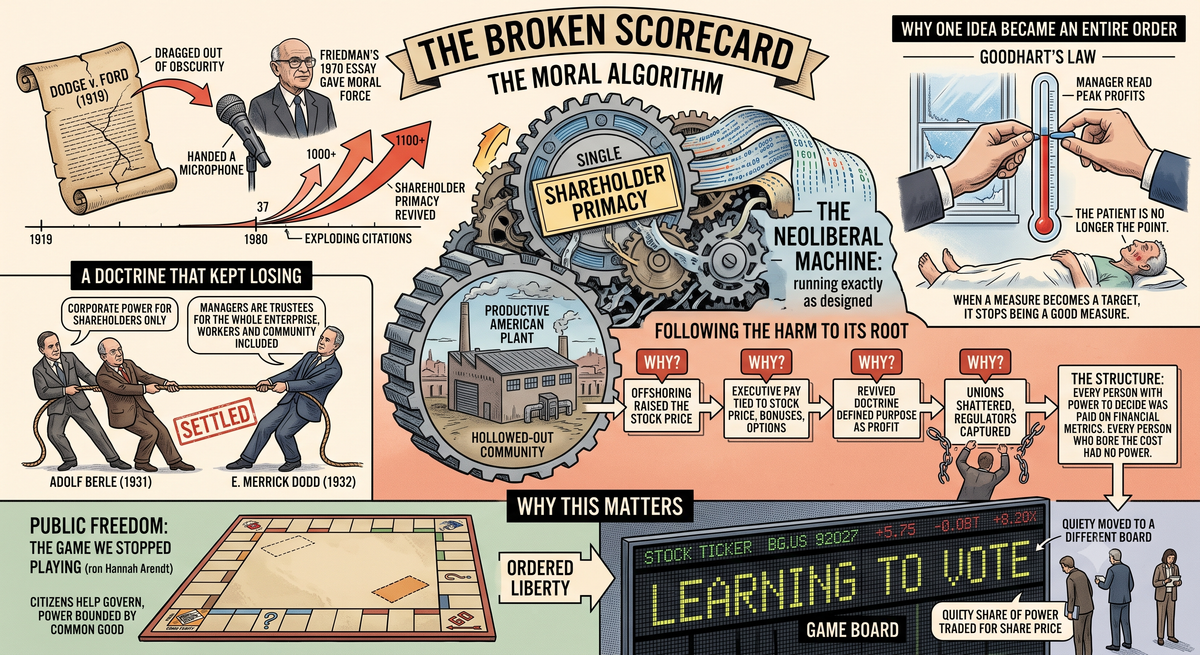
The famous wording does not come from Friedman. It comes from a courtroom. In 1919 the Michigan Supreme Court, in Dodge v. Ford Motor Co., ruled that a business corporation is organized and carried on primarily for the profit of the stockholders. That single line became the cornerstone lawyers point to when they claim shareholder primacy is ancient and settled.
It is neither. The idea was argued out a decade later in the Harvard Law Review, in what is now called the Berle-Dodd debate. In 1931 Adolf Berle claimed corporate power should be used only for the benefit of shareholders. In 1932 E. Merrick Dodd answered that managers are trustees for the whole enterprise, workers and community included, and that it was undesirable to teach that corporations exist for the sole purpose of making profits for their stockholders. Dodd won. By the 1950s Berle himself conceded the point in print, writing that the argument had been settled squarely in Dodd's favor, because the law had come to give directors real discretion to serve more than the owners.
The record proves how thoroughly shareholder primacy lost. One legal study counted how often Dodge v. Ford was cited in law review articles. Across the six decades from 1919 to 1979 it was cited just thirty-seven times. Then, from 1980 to 2019, citations exploded past eleven hundred. The case that supposedly founded the doctrine sat ignored for sixty years, then was resurrected the instant neoliberalism needed a founding myth. As the study's author put it, shareholder primacy did not and could not exist as settled law before the 1980s, because it conflicted with the prevailing order. It is not a discovered truth of economics. It is a rule that came to serve the needs of a particular moment.
Friedman is that moment's voice, not its author. His 1970 essay in the New York Times Magazine, "The Social Responsibility of Business Is to Increase Its Profits," took a doctrine that had lost the mid-century argument and gave it moral and political force. Then the movement reached back and pulled Dodge out of obscurity to make the whole thing look like law reaching back to 1919, rather than what it was, a fresh ideological choice made in the 1970s.
Why it could not take root earlier
An idea this consequential does not sit dormant for a century by accident. It could not win earlier because it ran against the two deepest foundations of American economic life, the moral one and the legal one.
The moral foundation is Adam Smith, and Smith is the opposite of the Friedman reading. Defenders of shareholder primacy love to invoke the invisible hand, but Smith never believed that the pursuit of private profit by merchants reliably serves the public. He believed the reverse about this exact class of men. He warned that the interest of dealers and manufacturers is always in some respects different from, and even opposite to, that of the public, and that any law of commerce proposed by them ought to be examined with the most suspicious attention, coming as it does from an order of men who have generally an interest to deceive and even oppress the public. He distrusted the corporate form itself. Directors managing other people's money, he wrote, cannot be expected to watch over it with the same anxious vigilance owners bring to their own, so negligence and profusion must always prevail. Smith placed his whole discussion of these companies under the heading of public works, not private enterprise. The founding text of market economics does not license shareholder primacy. It indicts it.
The legal foundation is the early American corporation, which looked nothing like the modern one. Corporations were rare. Legislatures chartered them one at a time, by special act, to accomplish a specific public purpose that private wealth alone could not, building a bridge, digging a canal, running a turnpike, opening a bank, laying water lines. The charters were public grants with public strings. They ran limited terms, often ten to forty years, and frequently required the company to dissolve once the work was done. They were revocable when the corporation strayed. They capped how much capital a firm could hold, and many forbade the corporation from taking part in politics at all. The founders feared concentrated private power as much as they feared kings, and they built the corporate charter as a leash. In that world, a doctrine announcing that a corporation exists solely to enrich its shareholders would have been not just strange but often illegal, a purpose outside the one the public had granted.
Both foundations had to erode before the idea could stand. Once general incorporation replaced the special charter, once courts recast the corporation from a public creature into a private person, and once the moral warning in Smith was quietly swapped for a cartoon of the invisible hand, the ground was finally clear. Only then could a defeated idea be revived and sold as timeless.
Why one idea became an entire order
Revived, the doctrine spread with astonishing speed, and it spread because of what it does to measurement. If the sole purpose of the firm is profit for shareholders, then the stock price becomes the one true measure of success. And the moment you make a measure the goal, a well-known law takes over.
It is called Goodhart's Law, and it is simple enough to teach a child. When a measure becomes a target, it stops being a good measure.
A thermometer tells you the temperature. That is its job. Now pay the nurse a bonus every time the thermometer reads a healthy number. Watch what happens. The nurse learns to hold it near a cold window, or under warm breath, anywhere that produces the number that pays. The reading still looks fine. The patient is no longer the point. The number is the point, and the number can be gamed.
That is neoliberalism in one image. The doctrine turned the stock price from a rough thermometer of corporate health into the single target of the whole system. Once the price became the goal, it stopped telling the truth. A company could fire its workers, sell its factories, load itself with debt, buy back its own shares, and watch the number climb. The thermometer read healthy while the patient died. Then the same logic escaped the boardroom and colonized the government. Deregulate, because rules lower the number. Privatize, because public goods do not report to shareholders. Cut taxes and break unions, because both raise the number. The politics of the last fifty years is the stock price learning to vote.
Following the harm to its root
Engineers use a plain tool for finding a root cause. You take the visible problem and ask why, and you keep asking until the answers stop and a structure appears. Run the collapse of American industry through it.
The problem: productive American plants were closed and their communities were hollowed out, even when the plants themselves worked.
Why? Because closing them, offshoring the work, and returning the cash to shareholders raised the stock price, and executives choose whatever raised the stock price.
Why did they choose that? Because their pay was tied to the stock price. Their bonuses, their options, their entire scorecard rewarded that number and nothing else.
Why was that number the only thing that counted? Because the revived doctrine had redefined the purpose of the firm, and new rules of the game, from stock-based executive pay to the legalization of buybacks in 1982, hard-wired that doctrine into daily practice.
Why did that redefinition go unchallenged? Because the forces that once pushed back had been broken or bought. Unions were shattered, regulators were captured, and the workers and towns who paid the price had no seat at the table.
Why did no one with a seat defend them? Here the questions stop, because we have struck the structure. No institutional actor's reward depended on the health of the workforce or the community. Every person with power to decide was paid on financial metrics. Every person who bore the cost had no power. The people who could see the harm were not paid to care, and the people who cared could not act.
Why this matters
Name the root plainly. Neoliberalism is not a conspiracy of cruel men and it is not the weather. It is a machine with the wrong incentives, running exactly as designed. Elevate one number to the purpose of the firm, connect no one's reward to human outcomes, and the machine will trade those outcomes for the number every single time. It does not need malice. It only needs to run.
This is why the diagnosis matters, and why the history matters even more. If shareholder primacy were the natural law its defenders claim, we would be stuck with it. It is not. It is a defeated idea that lost the argument to Dodd, lost it to Smith before that, and had no home in American law for the first century of the republic. It won a single time, in a single moment, because it served the people writing the rules. What one movement revived, another can retire.
The game we stopped playing
Hannah Arendt gave us the sharpest way to see what that revival cost. In On Revolution she argued that a real revolution takes two steps, and that most stop after the first. The first step is liberation: the people remove a bad government. The second and harder step is freedom: the people build a new government that gives citizens a real share in political decisions. Arendt called that share public freedom. Liberation frees you from a master. Freedom means you help govern. One is an escape. The other is a practice.
The founders offered the second kind. They did not merely throw off a king, they built a structure meant to keep power in citizens' hands. But public freedom is not a possession you inherit and keep. It is a game you have to keep playing, and it holds together only under discipline. That discipline is what Ordered Liberty names: liberty bounded by the common good, every rule tested by whether it serves the many or the few. Play by those rules and the game of freedom continues. Citizens keep their share.
Seen through Arendt's lens, this is what shareholder primacy actually did. It did not break the rules of the game. It changed them. It swapped a game whose object was public freedom for a game whose object was a single private number. And once you change the object, you are no longer playing the old game at all, however many of its forms survive. Elections still happen, but the stock price votes. No one was liberated in 1980. The people were quietly moved to a different board, one where their share of power had already been traded for someone else's share price.
So the counter-movement is not merely economic. Restoring wages and factories matters, but the deeper task is restoring the game itself, the one the founders offered and Arendt described, where reward and power are tied back to the common good and citizens hold a real share in the decisions that shape their lives. Ordered Liberty is the name for choosing to play that game on purpose. Not charity, not outrage, not one better executive who inherits the same scorecard, but a rebuild from the ground up, so that someone at the table finally profits when the patient lives, and the people finally get back the freedom they were told they already had.
Public freedom was never a gift to keep. It is a game you have to keep playing, and they changed it out from under us while we watched. Change the rules back, or stop calling what is left freedom.
About the book
This essay diagnoses the machine. My book hands you the tools to change it.
From Moral Algorithm to Ordered Liberty: A Citizen's Pathway turns the argument you just read into a plan a citizen can act on. It begins with the Moral Algorithm, a simple three-question test for whether any rule serves the common good or only the few, and follows the road from there to Ordered Liberty: a concrete stack of reforms built to tie power and reward back to the people who do the living and the working. If this piece made the broken scorecard visible, the book shows you how to fix it, and how to get back in the game.
Available now on Amazon.
Sources
Milton Friedman, "The Social Responsibility of Business Is to Increase Its Profits," New York Times Magazine, September 13, 1970.
Dodge v. Ford Motor Co., 204 Mich. 459 (1919), Michigan Supreme Court.
Adolf A. Berle, "Corporate Powers as Powers in Trust," 44 Harvard Law Review 1049 (1931).
E. Merrick Dodd, "For Whom Are Corporate Managers Trustees?," 45 Harvard Law Review 1145 (1932).
Adolf A. Berle, The 20th Century Capitalist Revolution (1954), conceding the debate in Dodd's favor; see also A.P. Smith Manufacturing Co. v. Barlow, 13 N.J. 145 (1953).
Robert J. Rhee, "The Neoliberal Corporate Purpose of Dodge v. Ford and Shareholder Primacy: A Historical Context 1919-2019," Stanford Journal of Law, Business & Finance (citation study: 37 citations 1919-1979, over 1,100 citations 1980-2019).
Adam Smith, An Inquiry into the Nature and Causes of the Wealth of Nations (1776): Book I on the interest of dealers being opposite to the public; Book V, Chapter 1, on joint-stock directors managing "other people's money" and the resulting "negligence and profusion."
On early American corporations chartered for public purpose with limited, revocable terms: Richard L. Grossman and Frank T. Adams, Taking Care of Business: Citizenship and the Charter of Incorporation (1993); SEC Historical Society, "Charters, States and Reformers."
Hannah Arendt, On Revolution (1963), on the distinction between liberation and freedom and the idea of public freedom.
Frequently Asked Questions
Did Milton Friedman invent shareholder primacy?
No. Friedman's 1970 essay gave the idea moral and political force, but the doctrine already existed and had lost the argument decades earlier. The famous wording actually comes from the 1919 Dodge v. Ford Motor Co. court ruling in Michigan.
Who won the Berle-Dodd debate about corporate purpose?
E. Merrick Dodd won. In 1932 he argued managers are trustees for the whole enterprise, including workers and community, not just shareholders. By the 1950s Adolf Berle himself conceded in print that Dodd had been proven right.
How do we know shareholder primacy was a fringe idea for most of the 1900s?
A legal study found Dodge v. Ford was cited only thirty-seven times in law reviews between 1919 and 1979. From 1980 to 2019, citations exploded past eleven hundred, showing the doctrine was revived, not continuously accepted.
Did Adam Smith support the idea that businesses should only maximize shareholder profit?
No, Smith argued the opposite. He warned that merchants and manufacturers have interests opposite to the public and often try to deceive or oppress it. He also distrusted corporate directors, saying they cannot manage other people's money as carefully as owners manage their own.
Why did shareholder primacy cause factory closures and job losses?
Once stock price became the sole measure of success, executives were paid based on that number alone. Closing plants, offshoring jobs, and returning cash to shareholders raised the stock price, so executives chose those actions regardless of harm to workers or communities.