Musings from Missouri
On one August ballot, Missouri showed the machinery of political manipulation in daylight, and voters rejected it four to one. A look at gerrymandering, shareholder primacy, and the founders' unkept promise: a free people no patron can buy.
TL;DR
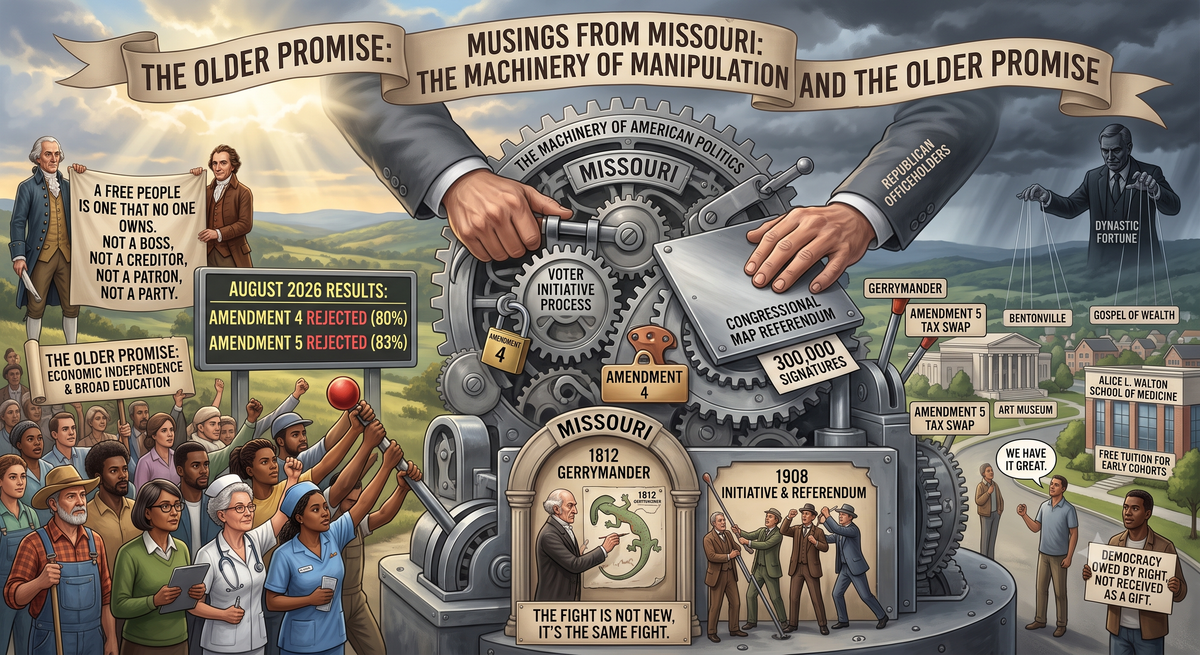
Missouri lawmakers redrew congressional maps and tried to block citizen referendums against them. The secretary of state refused to certify voter petitions on the map and initiative process. On the same ballot, voters rejected two amendments backed by the governor by huge margins. Voters rejected harder initiative rules and a regressive tax swap by about 80 percent. This shows voters can see through political manipulation when it is stated plainly on a ballot.
Notes from the Ozarks on the machinery of manipulation, and the older promise still waiting to be kept.
On the first Tuesday of August, a deep-red state did two contradictory things at once. Its Republican officeholders spent the day tightening their grip on the rules of the game. Its voters spent the same day prying that grip loose. Both happened on one ballot, in the same few hours, in the same state most of the country files under "settled." If you have ever wanted to watch the background machinery of American politics run in broad daylight, Missouri on August 4, 2026, was as clean a demonstration as you are likely to get.
Let me show you both hands at once, because the trick only works when you watch one and not the other.
The hand tightening its grip
Start with the machinery. In a special session in 2025, Missouri lawmakers redrew the state's congressional map, a plan they branded the "Missouri First Map," carving up a Kansas City district held for two decades by Democrat Emanuel Cleaver, with the encouragement of the president. Citizens answered the way the state constitution says they may: they gathered signatures, more than three hundred thousand of them, from every county, to force the map onto the November ballot for a public vote. A second group gathered a comparable pile to protect the initiative process itself.
Then, a few hours before the polls closed on primary day, the Republican secretary of state announced he would not certify either one. Not because the signatures fell short. He declined even to disclose whether they were sufficient. He ruled the referendums "unconstitutional" and sent everyone to court. This is the same office that has had its "neutral" ballot summaries struck down by Missouri judges five separate times for smuggling advocacy into what is supposed to be plain description, including a summary that quietly would have repealed the reproductive-rights amendment voters passed in 2024, and one a judge found prejudicial against the very map referendum now being blocked. The lawsuits were filed within hours. They are still live.
And on that same ballot sat Amendment 4, referred to the people not by the people but by the legislature, which would have made citizen initiatives dramatically harder to pass, replacing a statewide majority with a majority in each of eight congressional districts. Alongside it, Amendment 5, which would have phased out the state income tax and handed lawmakers broad new power to tax what you buy instead of what you earn. Both were the governor's priorities.
Read that as a single sentence and the choreography is obvious. Redraw the districts so the votes matter less. Block the referendum that would let the public undo it. Rewrite the initiative rules so the public cannot try again. Swap a stable, visible income tax for an open-ended power to tax consumption, which falls hardest on the people with the least. Four moves, one direction: put the machinery further out of the public's reach.
None of this is new, and that is the first thing worth seeing. The word for the first move, gerrymander, is nearly as old as the republic. It is named for Elbridge Gerry, a man who signed the Declaration of Independence, whose 1812 district was so contorted a newspaper drew it as a salamander. The tools Missourians were fighting to defend, the initiative and the referendum, are not radical inventions either. Missouri adopted them in 1908, in the last great age of corporate capture, precisely so that citizens could route around a legislature that the railroads and their allies had bought. The current effort to gut the initiative process is an attempt to undo a reform that was itself the answer to an earlier version of exactly this problem. The fight is not new. It is the same fight, wearing this decade's clothes.
The hand loosening it
Now the other hand, on the same ballot, in the same hours.
Missouri voters rejected Amendment 4, the measure to make their own voice harder to use, by roughly eighty percent. They rejected Amendment 5, the tax swap, by roughly eighty-three percent. Both were the sitting Republican governor's priorities. This was a low-turnout August primary in one of the reddest states in the country, and the electorate broke four to one against its own party's leadership to defend the machinery of self-government and to refuse a regressive shift in who pays for the state.
This is what I mean when I say people can split from their party's officeholders on the merits. It is not a realignment. Nobody switched teams. It was something simpler and older: a moment of sight. When the manipulation is dragged out of the background and stated plainly on a ballot, in words a person can read on their way into the booth, it loses. The people it was designed to manage look at it directly and say no. The whole apparatus depends on that never happening.
What the founders were actually building
To see why that "no" matters so much, it helps to be honest about what the founders were trying to make, and to clear away some of the myth that has grown over it.
The American Dream was never really about a house or a paycheck. It was the promise that anyone, whatever their birth, could stand as a full participant in a common project and remake their own life on that footing. Not a ladder a lucky few could climb, but a floor solid enough that no one had to be owned to survive.
The Declaration was written by a Committee of Five: Thomas Jefferson, who did the drafting; John Adams, whom Jefferson later called the pillar of the document's support on the floor of Congress; Benjamin Franklin, the elder who made the light edits; and two men history has mostly forgotten, Roger Sherman and Robert Livingston. The tavern firebrand of popular legend, the one talking up revolution over a pint, is a different Adams entirely: Samuel, the Boston cousin. The distinction matters, because the barroom myth flattens a careful act of construction into a marketing campaign, and these men were not running a campaign. They were building a machine meant to outlast them.
The harder truth is that there was never a single "dream" to reverse-engineer. Alexander Hamilton wanted a commercial, financial, centralized republic friendly to the men who moved money. Jefferson wanted a nation of independent freeholders and feared the moneyed corporations Hamilton's system was built to feed. The country has been swinging between those two visions for two and a half centuries. So when anyone, including me, claims to recover "the founders' intent," honesty requires admitting a choice is being made. I am choosing the Jeffersonian and Painite line, the one that runs through Adam Smith's suspicion of merchants who conspire against the public and Thomas Paine's argument, in Agrarian Justice, that every person is owed a stake.
And even that line failed its own test. The men who wrote that all are created equal held human beings as property, restricted the vote to men who owned land, and excluded women from the whole enterprise. So this is not archaeology. I am not brushing dust off what they secretly meant. I am holding them to the principle their rhetoric implied and their own conduct betrayed. That is the stronger project, because it cannot be knocked down by pointing at their hypocrisy. The hypocrisy is the whole point. The promise outran the men who made it. It has been waiting ever since for someone to take it literally.
And the promise, stripped to its core, is this: a free people is one that no one owns. Not a boss, not a creditor, not a patron, not a party. That is why the founders in this line cared so much about two things that sound quaint now, broad education and economic independence. A citizen who cannot reason cannot govern. A citizen who can be starved into obedience will not govern for long. Give people minds equipped to see the game and a material floor that keeps them from being bought, and self-government becomes possible. Take either away and it quietly dies while the forms remain.
What was lost when profit became the only point
For a while in the middle of the last century, the country drifted toward keeping that promise. Then, in the span of a single decade, the operating system was rewritten.
In 1970 came the argument that a corporation's only social responsibility is to increase its profits. In 1971 came a confidential memo urging American business to organize and take the culture back. In 1976 came the academic theory recasting executives as hired agents who owe their loyalty to shareholders and to no one else. Piece by piece, the postwar idea that a company answered to its workers, its town, and its owners together, was replaced by a single commandment: maximize the share price. Everything that had been a shared obligation, wages, communities, the commons, the future, became a cost to be cut.
The masterstroke was not economic. It was semantic. Once profit-at-all-cost became the invisible default, it never again had to argue for itself. Everything else did. A public bus, so a worker who cannot afford a car can reach a job, gets branded "socialism." A liberal education, the exact thing Jefferson and Franklin thought a republic could not survive without, becomes an insult. Capture the baseline and you win the argument before it starts, because your opponent has to justify the very idea of a public, while you get to pretend you are simply describing reality.
I have quoted, in other writing, a hard old line: that men will be free only when the last king is strangled with the entrails of the last priest. It is usually credited to Diderot, and he did write a version of it, but the sentiment came first from Jean Meslier, a village priest who buried the words in a testament read only after his death. It was never a war on faith. It was a war on power wearing faith as a costume, on any institution that demands obedience while claiming to speak for something higher than itself. Shareholder primacy is our era's version. It asks for our deference while claiming to speak for prosperity itself, and it treats any challenge as a kind of heresy.
The most comfortable trap of all
Drive a couple of hours from where I sit and you reach a different vision of the good life, and it is genuinely seductive. Bentonville. A world-class art museum, free to enter. A new medical school, opened in 2025, that covers tuition for its first classes of students. Libraries, galleries, infrastructure, a downtown that works. Ask a resident about Walmart and you tend to get one revealing sentence: sure, there are questions about how they do business, but we have it great.
Listen to the shape of that sentence, because the shape is the whole thing. Acknowledge the critique, then bury it under the gratitude. That burial is the mechanism. And notice what is true inside it: they do have it great. The gifts are real. That is precisely why it works. Coercion never produces a "but we have it great." Only a genuinely good deal produces that phrase.
Get the pattern right, though, because it matters. Most of this largesse is a family and its foundations, not a corporate charity line item. A dynastic fortune, built on one particular model of labor and retail, recycling a fraction of itself as the private provision of public goods, on terms the giver alone sets. Andrew Carnegie wrote the theory in 1889 and called it the Gospel of Wealth: let the rich administer the surplus on the community's behalf, since they know best how to spend it. The objection then is the objection now. Private discretion replaces public choice. Gratitude replaces citizenship. What a democracy is owed by right, it receives instead as a gift. And a gift, unlike a right, can always be withdrawn.
This is the danger I most want to name, because it is the one that does not feel like danger: benevolent private dependency. Jefferson's deepest fear was dependency, because a man who owes his job, his library, his hospital, and his sewer line to a patron's goodwill is not free, however comfortable he is. The mere anticipation of the patron's displeasure governs him before the patron ever has to lift a finger. It is the company town, softened and made beautiful. "We have it great" is what the workers at Pullman said too, right up until 1894, when the company cut their wages, kept their rents, and the model finally showed its teeth.
The same trap, wearing a suit
Here is where the road loops back to that August Tuesday, because dependency is not only a trap for citizens. It is a trap for the officeholders.
The gerrymander, the blocked referendum, the tax swap: each is a "great deal" for whoever holds power at this moment. Each buys a short-term gain, a safer seat, a friendlier donor, a faster headline, by mortgaging the public's long-term freedom to choose. A politician who takes that deal is doing exactly what the comfortable resident does. Trading a real and immediate benefit for a slow surrender of self-government. The only difference is that the bribe is paid in power rather than in amenities.
The founders had a word for this, and it was not the narrow modern one about cash in envelopes. Their word was corruption, in the older and larger sense they actually feared: the steady substitution of private advantage for public good, continued quietly until the forms of a republic still stand but the substance behind them has been hollowed out. A gerrymandered map is a corrupt bargain in that sense whether or not a dollar ever changes hands. So is a tax code rewritten to shield the powerful. So is a benefactor's city where everything is provided and nothing is owed to the citizen as a right.
The new direction, and why it is possible
So why treat any of this as hopeful? Because of the four to one.
On the very day the machinery ran at full tilt, the people it was built to manage looked at two of its levers, one that would make their voice harder to use and one that would shift the burden onto their daily purchases, and they said no, decisively, across every kind of county in the state. The manipulation works only while it stays in the background. The instant it steps into the light, named plainly on a ballot, it loses. That is the entire game, and Missouri just showed that the game can still be won.
The path forward is not a new ideology to be sold. It is an old promise, finally taken at its word: that a free people is one no one owns. Not a party boss redrawing their districts to make their votes lighter. Not a benefactor funding their hospital on terms they cannot vote on. Not an owner who sets the only wage in town. The way to keep that promise is to build the floor by right rather than to receive it by grace. Public goods that come to you because you are a citizen, not because someone chose, this year, to be generous. That is the whole difference between a homestead you hold and a room you are merely lent.
Missouri showed, for one Tuesday in August, that the sight is still possible, that ordinary people can still see the hand behind the curtain and refuse what it is reaching for. The founders left us a promise their own hands were too small to keep. The work now is the same as it was in 1908, and 1776: to keep the curtain open, and to build, at last, the independence that makes a citizen impossible to buy.
That is the musing. From Missouri, where the machinery is loud, and the answer, this week, was louder.
Sources and further reading:
- Missouri August 2026 results (Amendments 1, 2, 4, 5), KOMU 8:
- Secretary of state blocks the redistricting referendum, NBC News:
- Referendum blocked, lawsuit filed, Missouri Independent:
- Courts repeatedly reject the secretary of state's ballot summaries (background):
Alice L. Walton School of Medicine opens with free tuition for early cohorts, Axios NW Arkansas:
Released under the GNU General Public License v3.0 (GPLv3).
Frequently Asked Questions
What happened with Missouri's congressional map in 2025 and 2026?
Missouri lawmakers redrew the state's congressional map in a 2025 special session, targeting a Kansas City district long held by Democrat Emanuel Cleaver. Citizens gathered over 300,000 signatures to force a public vote on the map, but the Republican secretary of state refused to certify the referendum before the polls closed on primary day.
What were Amendment 4 and Amendment 5 on the August 2026 Missouri ballot?
Amendment 4 would have made citizen initiatives much harder to pass by requiring majorities in each of eight congressional districts instead of a simple statewide majority. Amendment 5 would have phased out the state income tax and given lawmakers broad new power to tax consumption instead. Both were priorities of the Republican governor.
How did Missouri voters respond to these ballot measures?
Voters rejected Amendment 4 by roughly 80 percent and Amendment 5 by roughly 83 percent. This happened in a low-turnout August primary in one of the reddest states in the country, with the electorate breaking sharply against its own party's leadership.
Why did Missouri adopt the initiative and referendum process in the first place?
Missouri adopted the initiative and referendum in 1908 during the last great age of corporate capture, so citizens could bypass a legislature bought by railroads and their allies. The current effort to weaken the initiative process is an attempt to undo that century-old reform.
What is the connection between shareholder primacy and Missouri's political fight?
In the 1970s, ideas emerged that a corporation's only responsibility is to increase profits and that executives owe loyalty only to shareholders. This shift made public goods like buses and education seem like special pleading, while profit-maximization became the unquestioned default, mirroring how political machinery in Missouri tries to make manipulation seem like normal governance.