The Moral Algorithm 120th Congressional Accountability Plan
How can Congress hold power accountable fairly? This 12-step plan uses five Moral Algorithm tests, public evidence, independent review, and measured outcomes to protect rights under any majority.
TL;DR
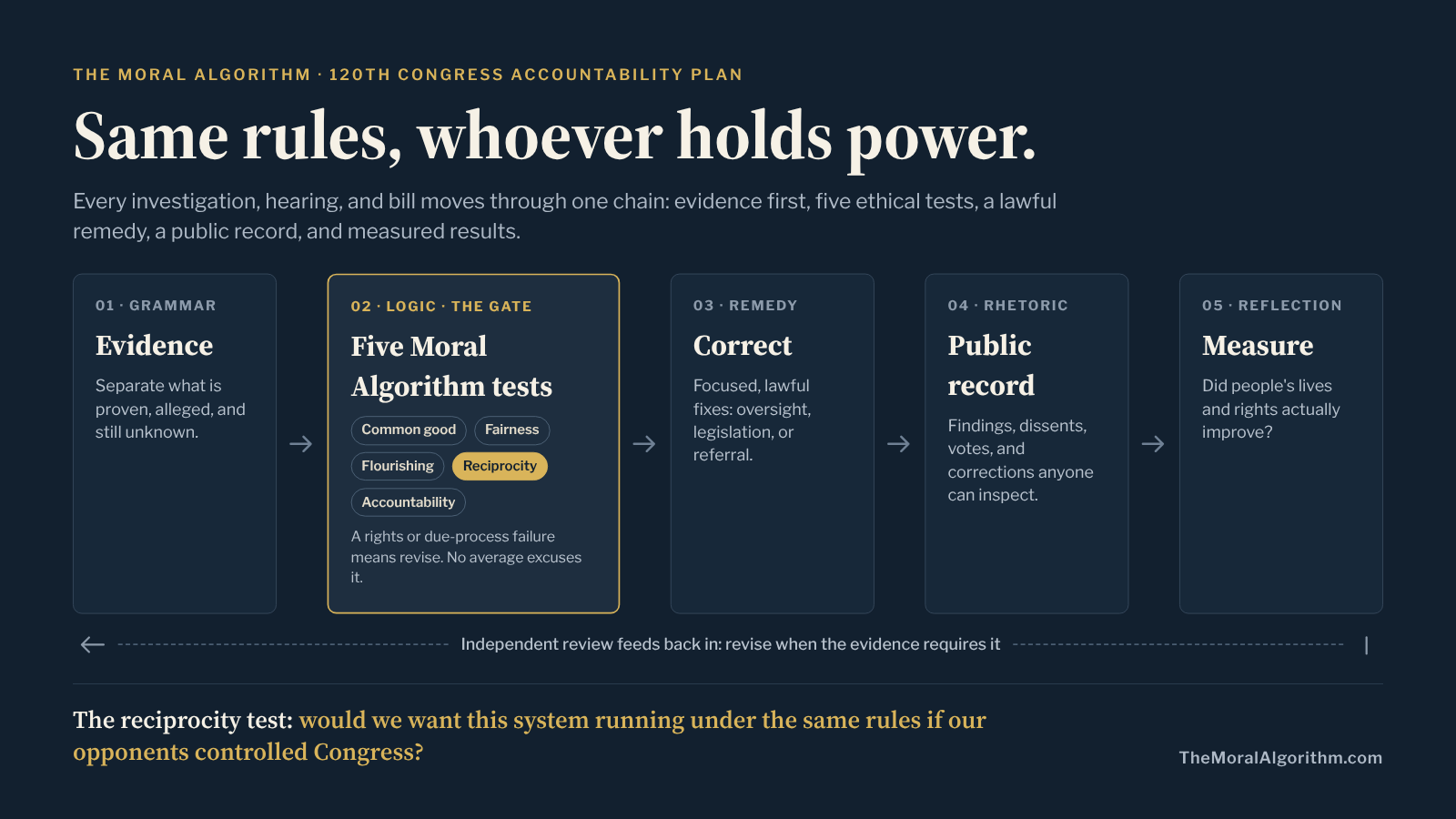
The Congressional Public Accountability and Reform Program sets rules for the 120th Congress. Congress applies five moral tests to every investigation and law. The tests check common good, fairness, human flourishing, constitutional rights, and accountability. Congress must follow the same rules no matter which party holds power. The plan uses public evidence, oversight, and measured results to guide action.
A step-by-step strategy for the 120th U.S. Congress (January 2027–January 2029)
Prepared: November 4, 2026
Executive summary
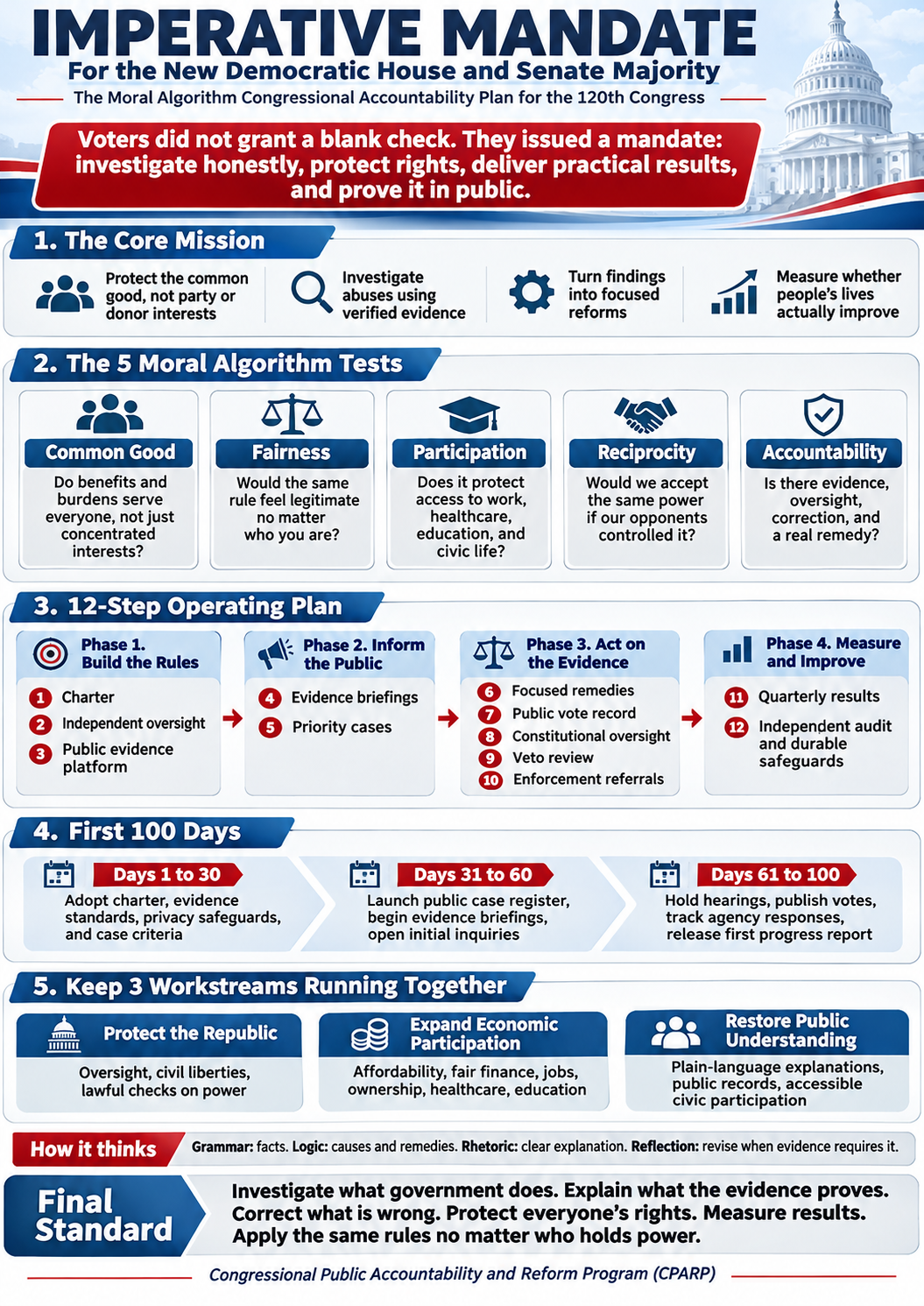
Goal: Establish a transparent, evidence-driven congressional accountability system that protects constitutional rights, investigates abuses of power, addresses practical public needs, and measures real-world results.
This plan is intended for a Congress with Democratic majorities in both chambers. Its design does not depend on Democratic control: the rules should be acceptable and enforceable regardless of which party holds power. Congressional control does not eliminate the presidential veto, Senate procedural limits, or constitutional protections.
The proposed Congressional Public Accountability and Reform Program (CPARP) combines evidence-based public communication with congressional oversight, focused legislation, independent review, and outcome measurement.
Governing principle: Government exists to serve the common good, not the interests of a party, corporation, donor, or individual. Every exercise of congressional power must be justifiable regardless of which party controls it.
1. Apply the five Moral Algorithm tests
Every investigation, hearing, legislative proposal, funding decision, and enforcement referral should be assessed against the following tests.
Test 1. Common good / stakeholder
Question: Do benefits and burdens reflect the interests of all affected people, rather than primarily privileged intermediaries or concentrated interests?
Required practice: Identify affected groups, public benefits, costs, conflicts of interest, and distribution of burdens.
Test 2. Fairness / veil of ignorance
Question: Would the same rule appear legitimate without knowing which political, economic, or social position one occupies?
Required practice: Apply consistent standards across parties, incomes, communities, and social groups.
Test 3. Human flourishing / participation
Question: Does the decision maintain practical access to education, productive work, healthcare, civil rights, and the economic means to participate?
Required practice: Assess impacts on access, opportunity, independence, and civic participation.
Test 4. Reciprocity / constitutional power
Question: Would we support the same authority if exercised by our political opponents? Are rights, due process, representation, and lawful limits protected?
Required practice: Conduct constitutional and privacy review. Protect fair notice, responses to allegations, and lawful limits on government power.
Test 5. Accountability / evidence
Question: Is there a transparent process, independent oversight, measurable outcomes, and a meaningful remedy when institutions fail?
Required practice: Publish verifiable evidence where lawful, provide independent review, document corrections, and measure results.
Decision rule: A proposal that fails a constitutional or due-process test must be revised. Other weaknesses require explanation and corrective review. No numerical average can excuse a serious rights violation.
2. Implementation roadmap
| Period | Phase | Primary deliverable |
|---|---|---|
| November–December 2026 | Prepare the institution | Charter, proposed chamber rules, evidence standards |
| January 2027 | Establish safeguards | Oversight and minority-rights procedures |
| January–February 2027 | Launch public transparency | Public case register, briefings, evidence platform |
| February–April 2027 | Investigate and legislate | Verified cases, hearings, focused remedies |
| April 2027 onward | Enforce and measure | Recorded actions, referrals, corrective-action monitoring |
| Quarterly through 2028 | Audit and improve | Public performance reports, independent reviews |
3. The twelve-step operating plan
Step 1. Establish a Congressional Moral Accountability Charter
Timing: November–December 2026
Responsible: Incoming chamber leadership, bipartisan working group, legislative counsel
- Draft a charter incorporating all five Moral Algorithm tests.
- Invite input from members of both parties, civil-liberties groups, constitutional scholars, workers, small businesses, and independent ethics experts.
- Set the same investigative, privacy, and disclosure standards for all parties.
- Prepare proposed chamber rules and committee procedures for the new Congress.
- Require a short Moral Algorithm assessment for major investigations and reforms.
Deliverable: Published charter, proposed rules package, and implementation guide.
Success test: Would the charter work unchanged under a Republican majority?
Step 2. Build independent oversight and protect minority rights
Timing: January 2027
Responsible: House and Senate leadership, committees, nonpartisan staff
- Establish a coordination structure while preserving the authority of each chamber and committee.
- Give minority members meaningful opportunities to submit evidence, request review, and publish documented objections, within chamber rules.
- Use qualified nonpartisan investigators and legal reviewers.
- Protect whistleblowers, confidential sources, personal information, and lawful security interests.
- Publish majority and dissenting findings; maintain a visible correction process.
Deliverable: Evidence procedures, safeguards, and complaints/corrections process.
Success test: Can a political minority challenge a false finding fairly and effectively?
Step 3. Launch a permanent public evidence platform
Timing: January–February 2027
Responsible: Congressional administrative and technology teams
Develop a searchable Congressional Accountability Record linked to authoritative House and Senate sources.
Each public case should display:
- Issue and case status.
- Verified facts, allegations, and unresolved questions, clearly separated.
- Source documents and legal redactions.
- Agency and affected-party responses.
- Relevant bills, amendments, and recorded votes.
- Proposed remedies, corrective actions, and deadlines.
- Independent review and corrections.
- Measured outcomes.
Provide captions, transcripts, screen-reader support, plain-language explanations, and low-bandwidth access.
Deliverable: Accessible case and evidence portal.
Success test: Can an ordinary reader understand the issue, inspect the evidence, and determine what Congress did?
Step 4. Publish regular public evidence briefings
Timing: February 2027 onward
Responsible: Committee chairs and designated congressional communicators
Publish short, direct-to-camera briefings, generally 90 seconds to three minutes, supported by documentation.
Standard format:
- Issue: What specific problem is being examined?
- Evidence: What is proven, alleged, or not yet known?
- Impact: How does it affect people, public money, services, or rights?
- Remedy: What congressional or administrative action could address it?
- Next step: What happens next, and where will the results appear?
Maintain a regular reporting rhythm without inventing a daily scandal. When nothing new is verified, report case progress or explain a completed finding. Respect restrictions on official congressional resources and campaign activity.
Deliverable: Documented briefings, transcripts, sources, and corrections.
Success test: Does a viewer learn something verifiably true regardless of political agreement?
Step 5. Prioritize investigations by public interest
Timing: February 2027 onward
Responsible: Relevant committees
Rank potential inquiries using credible evidence, public harm, constitutional risk, legislative jurisdiction, and available remedies. Do not treat an allegation as a finding.
| Priority area | Example questions | Core test |
|---|---|---|
| Federal data access | Were contractors properly authorized? Were privacy controls followed? | Rights and reciprocity |
| Financial conflicts | Were disclosures complete and official conflicts properly managed? | Common good and fairness |
| Government contracting | Was procurement competitive and lawful? | Stakeholder fairness |
| Financial extraction | Do fees or concentrated market power create avoidable public harm? | Economic participation |
| Public records | Were lawful disclosure, withholding, and privacy requirements observed? | Evidence and due process |
| Essential services | Are people unfairly blocked from benefits, healthcare, education, or employment? | Human flourishing |
Deliverable: Published case-priority register and reasons for opening or declining cases.
Success test: Would the same evidence prompt the same inquiry if it involved a different party?
Step 6. Convert verified findings into focused remedies
Timing: February–April 2027 onward
Responsible: Authorizing committees, legislative counsel
Choose the appropriate remedy: existing-law enforcement, administrative correction, oversight, appropriations condition, new legislation, or legally appropriate referral.
Where a bill is necessary, publish a one-page public explanation alongside complete, technically sound legislative text. Each bill assessment should answer:
- What specific problem does it solve?
- Who benefits and who bears the costs?
- What constitutional authority supports it?
- How will it be enforced?
- What unintended effects or rights risks exist?
- How will its impact be measured?
Deliverable: Narrowly focused remedies backed by legal and fiscal analysis.
Success test: Is the remedy worth pursuing even without media attention?
Step 7. Publish a faithful record of legislative decisions
Timing: March 2027 onward
Responsible: Committee and chamber leadership
Track committee hearings, markups, amendments, procedural votes, floor votes, and reasons for action or inaction. Distinguish a vote against final passage from an objection to a procedural motion or a specific version of a bill.
Procedural reality: A House majority can ordinarily pass bills by simple majority under regular procedures, but certain expedited House procedures require supermajorities. Most ordinary Senate legislation can face a 60-vote cloture threshold. Do not promise a final vote where rules do not permit one.
Deliverable: Complete legislative decision record.
Success test: Does the record portray every lawmaker's position accurately, including opponents?
Step 8. Exercise constitutional oversight independently of bill passage
Timing: Throughout 2027–2028
Responsible: Congressional committees and chamber leadership
Use hearings, document requests, lawful subpoenas, reports, spending scrutiny, and relevant Senate confirmation responsibilities. Track agency responses and unresolved inquiries. Funding restrictions can be pursued through legislation, but remain subject to legislative procedures and presidential approval or veto override.
Deliverable: Oversight register with agency responses and corrective actions.
Success test: Did Congress obtain reliable information or secure a lawful improvement rather than merely generate publicity?
Step 9. Review presidential vetoes without presuming guilt
Timing: Whenever a bill is vetoed
Responsible: Congressional legal and policy staff
Publish the veto message, legal objections, congressional response, and options for amendment, negotiation, or override. A veto alone does not prove corruption or complicity. An override requires a two-thirds vote in each chamber.
Deliverable: Documented veto assessment.
Success test: Would Congress apply the same evaluation to a Democratic president's veto?
Step 10. Make legally appropriate enforcement referrals
Timing: When supported by sufficient evidence
Responsible: Committees and counsel
Preserve relevant records and refer credible suspected violations to authorities with appropriate jurisdiction, such as inspectors general, prosecutors, state agencies, or regulators. Avoid treating a referral as a conviction or attempting to dictate an independent investigation. Publish only information that may lawfully be disclosed.
Deliverable: Protected referral record, with public status where appropriate.
Success test: Were fair procedures followed without political pressure on investigators?
Step 11. Measure real-world results
Timing: Beginning April 2027
Responsible: Nonpartisan analysts and independent auditors
Publish quarterly measures with clear definitions, baseline values, and methods.
| Measure | What it establishes |
|---|---|
| Verified accountability resolution rate | Share of verified cases reaching a documented conclusion |
| Corrective-action completion | Whether recommended safeguards or remedies were implemented |
| Public funds recovered or protected | Documented financial impact, excluding speculative savings |
| Constitutional compliance | Whether procedures protected rights and lawful authority |
| Public accessibility | Whether information can be found, read, and understood |
| Participation impact | Whether affected people gained practical access or opportunity |
| Recurrence rate | Whether a corrected institutional failure happened again |
Illustrative metric:
Verified Accountability Resolution Rate (VARR)
    = (Verified cases with a documented resolution
       / Total verified cases opened) * 100
Clearly report unresolved cases separately. A substantiated finding of no violation can be a valid resolution. Do not collapse all outcomes into one score that conceals a constitutional failure.
Deliverable: Quarterly Congressional Public Accountability Report.
Success test: Can the public tell what changed, what failed, and who is responsible for the next step?
Step 12. Require independent review and durable safeguards
Timing: Quarterly, beginning mid-2027
Responsible: Independent reviewers, relevant congressional bodies
Audit evidence handling, privacy, accuracy, accessibility, minority protections, and performance data. Allow documented challenges to findings and publish corrections. At the end of year one, identify which safeguards should be retained in chamber rules, which need legislation, and which should end.
Important limitation: A future congressional majority can generally alter chamber rules. Lasting protections require public confidence, sound institutional design, and lawful legislative structures, not a claim of irreversible entrenchment.
Deliverable: Independent annual audit and improvement plan.
Success test: Does the system remain fair after control of Congress changes?
4. Example: Federal database contractor-access inquiry
Illustrative scenario, not a finding of actual misconduct.
- Evidence received: A credible complaint alleges unauthorized access to sensitive Social Security records.
- Verification: Investigators inspect lawful access logs, approvals, contracts, and agency responses.
- Public briefing: Congress explains what is verified, disputed, and still unknown, using appropriate redactions.
- Corrective action: If a weakness is confirmed, Congress seeks stronger access controls, audit logging, and oversight requirements.
- Legislative process: Committees publish proposals, amendments, votes, and any presidential action.
- Outcome review: Independent reviewers determine whether security and legal compliance improved.
- Closure or continuation: The case ends with documented findings and remedies, or stays open with reasons and review dates.
Apply the same process to a Democratic administration, a Republican administration, an agency employee, or a private contractor.
5. First 100 days: Action checklist
Before January 3, 2027
- Draft the Moral Accountability Charter.
- Invite bipartisan participation and public consultation.
- Prepare proposed chamber rules and oversight standards.
- Assign initial committee and staff responsibilities.
Days 1–30
- Introduce the charter and proposed procedures.
- Establish evidence verification and privacy safeguards.
- Publish case-priority criteria.
- Begin development of the public evidence platform.
Days 31–60
- Launch the public case register.
- Begin verified evidence briefings.
- Open initial committee inquiries.
- Publish initial focused legislative proposals.
Days 61–100
- Conduct hearings and legislative review.
- Publish votes and procedural records.
- Track agency responses and required corrections.
- Issue an initial progress report and independent-review plan.
6. Keep three workstreams operating together
A. Protect the republic
Investigate suspected abuse, protect civil liberties, exercise constitutional oversight, and enforce lawful checks on government power.
B. Expand economic participation
Pursue measurable reforms in affordability, financial services, labor and ownership opportunities, healthcare, education, and fair competition. Oversight should not consume the entire legislative agenda.
C. Restore public understanding
Explain evidence and legislative choices in ordinary language, publish the record, and make it practical for citizens to contribute information and evaluate government claims.
Apply the recursive Trivium
- Grammar: Identify facts, terms, records, and definitions.
- Logic: Test causes, alternative explanations, proposed solutions, and foreseeable effects.
- Rhetoric: Explain the evidence and decisions clearly enough for meaningful public participation.
- Reflection: Compare outcomes with goals and revise when the evidence requires it.
The Trivium provides the learning process. The Moral Algorithm provides the ethical standard.
7. Institutionalize accountability, not partisan advantage
Seek durable, lawful practices including:
- Public access to verified findings, subject to privacy and security restrictions.
- Clear records of legislative texts, amendments, votes, and procedural decisions.
- Uniform evidence standards and due-process protections regardless of party.
- Independent audits, corrections, and meaningful routes to challenge errors.
- Measured assessments of public benefits and burdens.
- Accessible civic education and public participation.
The system should not depend on keeping a particular party in office. Future majorities must retain their lawful constitutional authority, but citizens should have strong reasons to demand the continuation of fair and transparent procedures.
8. Final standard
Investigate what government does. Explain what the evidence proves. Correct what is wrong. Protect everyone's rights. Measure whether people's lives improve. Apply the same rules regardless of who holds power.
The long-term test is straightforward:
If the opposing party controls Congress in 2029 or later, would the American people still want this accountability system operating under the same rules?
If yes, it passes the reciprocity test. If it also serves the common good, treats people fairly, expands participation, protects constitutional rights, and documents meaningful results, it satisfies all five tests of The Moral Algorithm.
Implementation note: This is a policy and governance proposal, not a statement that Congress has already adopted these processes. Specific chamber rules, legal authorities, and legislative feasibility should be confirmed by congressional counsel at implementation.
Frequently Asked Questions
What is the Congressional Public Accountability and Reform Program?
It is a plan for the 120th Congress to create transparent, evidence-based oversight. It combines public communication, investigations, focused laws, independent review, and outcome measurement.
What are the five Moral Algorithm tests Congress must apply?
The five tests are common good, fairness, human flourishing, reciprocity and constitutional power, and accountability. Every investigation, hearing, bill, funding decision, and enforcement referral must pass these tests.
Does a failed test always block a proposal from moving forward?
A proposal that fails a constitutional or due-process test must be revised before proceeding. Other weaknesses require explanation and corrective review, but no score can excuse a serious rights violation.
How will Congress make its investigations and evidence public?
Congress will build a searchable Congressional Accountability Record linked to official House and Senate sources. Each case will show verified facts, source documents, agency responses, related bills, proposed remedies, and measured outcomes.
Can a political minority in Congress challenge a finding it believes is false?
Yes, minority members get meaningful chances to submit evidence, request review, and publish documented objections. Congress publishes both majority and dissenting findings along with a visible correction process.