POSTAL BANKING: A Policy Thesis on Financial Accommodation as Constitutional Duty
Postal Banking: Constitutional Infrastructure, Not Extraction Banks charge the poor 400% APR while borrowing at 4.5%. Postal banking served 4M Americans for 55 years until corporate lobbies killed it in 1967. Restore universal financial access.
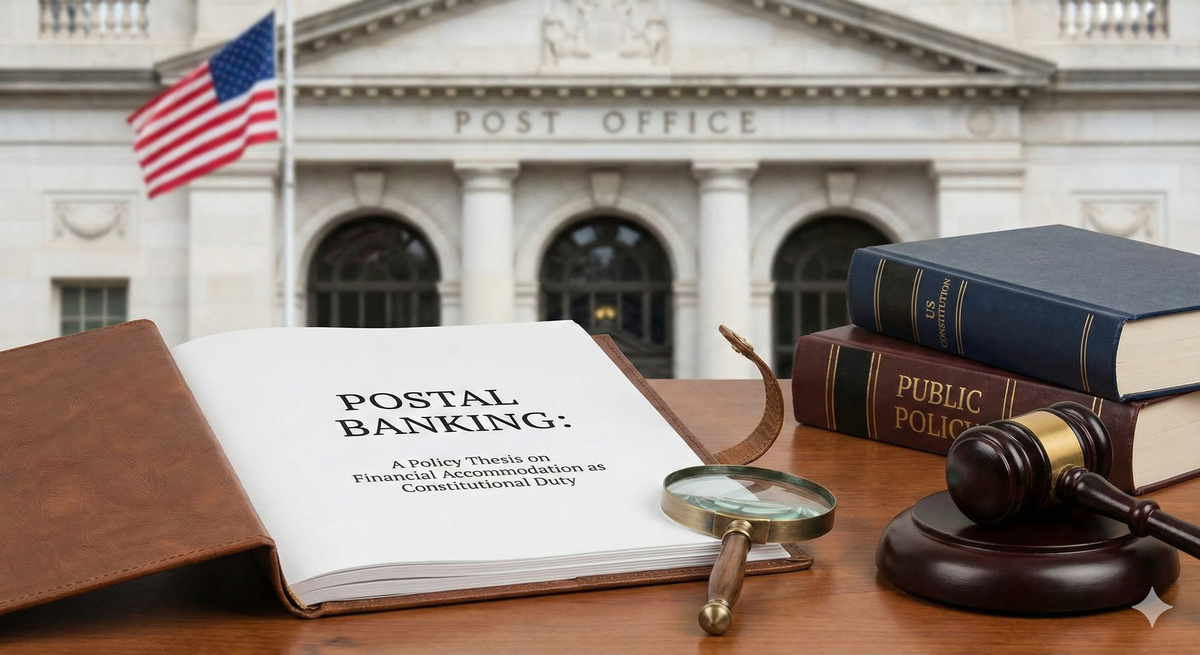
POSTAL BANKING: A Policy Thesis on Financial Accommodation as Constitutional Duty
Executive Summary
This thesis demonstrates that modern postal banking represents the minimal constitutional obligation to ensure universal economic participation. By applying the Moral Algorithm (common good over private interests) and Ordered Liberty framework (accommodation enabling full participation), we show that the absence of universal banking access constitutes structural abandonment of citizens to predatory exploitation. The proposal is not innovation but restoration of a proven system destroyed by banking lobbies protecting profit extraction over the common good.
Part I: The Constitutional Case for Financial Accommodation
The Accommodation Principle
Ordered Liberty requires that government ensure "adequate accommodation that enables full participation in economic and social life." In 2025, this means:
Cognitive Accommodation: Citizens must understand financial systems (Trivium-based financial literacy)
Material Accommodation: Citizens must access the financial infrastructure that modern society requires for survival (bank accounts, digital payments, credit repair)
Protective Accommodation: Government must constrain structural vices that destroy accommodation (predatory lending, banking deserts, identification barriers)
Participatory Accommodation: Citizens must influence these systems through democratic pressure (local resolutions, union advocacy)
When 25% of households cannot access basic banking (4.5-6% completely unbanked, another 14% underbanked), the government has failed its constitutional duty. This is not a market failure requiring subsidy. This is structural vice requiring elimination.
The Moral Algorithm Application
John Adams defined legitimate government as serving "the greatest happiness of the greatest number" rather than private accumulation. The current banking system inverts this principle:
Private Interest: Commercial banks maximize profit by excluding unprofitable customers and extracting fees from the vulnerable (overdraft charges averaging $26-$35 per incident, check cashing fees at 1-10% of face value, minimum balance fees of $12/month)
Common Good: Universal financial access enables wage payment, bill payment, emergency liquidity, and credit repair for all citizens
The Moral Algorithm demands: which system serves the common good? The answer is definitively postal banking.
The Rawlsian Test
Apply the Veil of Ignorance: If you did not know whether you would be born into wealth or poverty, would you design the current system?
Current Reality:
- The wealthy receive free checking, interest payments, and rewards programs
- The poor pay maintenance fees, overdraft penalties, and percentage-based check cashing charges
- A minimum wage worker can lose $40,000+ over a career merely in check-cashing fees
Verdict: No rational person behind the Veil would choose this system. It is structurally unjust.
The Aristotelian Warning
A stable polis requires a robust middle class and civic friendship (philia). The current system erodes both:
Economic Segregation: We now have two cities within one state:
- The City of the Rich (who live on credit and asset inflation)
- The City of the Poor (who live on cash and debt service)
Virtue Destruction: When government allows usurious extraction that would have been illegal a century ago, it abandons its role as guardian of civic virtue.
Result: The destruction of the middle-class stability necessary for democratic participation.
Part II: Historical Precedent and Purposeful Destruction
What Worked (1911-1966)
The United States Postal Savings System operated for 55 years as proof of concept:
The Results:
- Peak usage in 1947: 4 million depositors, $3.4 billion in deposits
- Served immigrants, rural communities, and working-class families excluded from commercial banking
- Provided savings security during bank runs (remained solvent through the Great Depression while 9,000 commercial banks failed)
- Operated without taxpayer subsidy through modest interest on deposits invested in government bonds
- Universal access through every post office in America
The Mechanism: Citizens deposited savings at local post offices. The USPS held deposits safely, paid 2% interest, and invested funds in government securities. No lending, no risk, pure savings infrastructure.
The Philosophy: Banking was treated as public utility rather than private consumer product. The system provided a floor ensuring everyone could participate in the economy without penalty.
The Pivot Point (1966)
The elimination was not about failure. It was about market capture:
The Official Story: "By the 1960s, commercial banks offered higher interest rates, and the FDIC (established in the 1930s) insured private deposits, making the USPSS appear redundant."
The Assumption: Policymakers assumed the private market would naturally serve everyone efficiently once deposit insurance existed.
The Reality: This marked a structural shift from banking as public service to banking as private consumer product. Commercial banks wanted captive customers. In the 1960s, as consumer credit became profitable, banks lobbied to eliminate their only competitor for working-class deposits.
The Pattern: This followed the same trajectory as the destruction of other common-good institutions:
- Public utilities privatized in the 1990s (electricity, water)
- Public education defunded while charter schools expanded
- Public housing eliminated while private landlords received subsidies
- Public pensions replaced with 401(k) accounts managed by Wall Street
In every case, profitable public services were transferred to private extraction.
The Vacuum and Its Consequences (1967-2025)
The elimination of postal banking did not create efficiency. It created exploitation:
Banking Deserts:
- Since the 2008 financial crisis and accelerated by the pandemic, banks have closed thousands of physical branches
- Closures disproportionately affect low-income and rural areas
- Many communities now have zero physical access to a bank
- There are more payday loan storefronts in the US than McDonald's locations
The Unbanked Population:
- Approximately 4.5-6% of US households (6-8 million households) have no bank account at all
- Another ~14% have accounts but still rely on alternative financial services because traditional banking is too slow or expensive for immediate needs
- Combined: 25% of households locked out of mainstream financial infrastructure
Why They Stay Unbanked: Commercial banks found low-balance accounts unprofitable and began penalizing them rather than serving them:
- Minimum balance requirements (often $500-$1,500)
- Monthly maintenance fees ($12+) for falling below minimums
- Unpredictable overdraft fees ($26-$35 per incident)
- Result: Poor people rationally choose to avoid banks that punish poverty
The Poverty Premium: Quantified Injustice
Without a public option, low-income citizens face a distinct "tax" on existence. The private sector monetized poverty through fees:
Overdraft Fees: Banks earn billions annually from overdraft charges averaging $26-$35, with the vast majority paid by the poorest customers living paycheck to paycheck.
Check Cashing Industry: To avoid unpredictable bank fees, people turn to check cashers who charge 1-10% of check value just to access cash immediately.
- A minimum wage worker loses $40,000+ over a career merely in check-cashing fees
- The service then deposits that check into a commercial bank, getting the liquidity immediately while the worker paid a fee to access their own money
Payday Lending Explosion: When the Postal Savings System (which offered small-dollar stability) vanished, the payday loan industry filled the vacuum:
- More payday loan storefronts than McDonald's locations
- APRs often exceeding 300-600%
- Function by trapping users in debt cycles, extracting wealth from the most vulnerable to fuel private profit
Total Extraction: The "alternative financial services" industry now extracts $173 billion annually from working families, with the average unbanked household spending $2,412 per year on fees that middle-class families avoid entirely by having a bank account.
The Moral Failure: This is not market competition. This is structural violence enabled by government abandonment.
Part III: The Cantillon Effect as Economic Framework
Understanding Monetary Injustice
Named after 18th-century economist Richard Cantillon, this theory reveals why the gap between rich and poor widens structurally: money is not neutral. Where new money enters the economy matters. It flows like a waterfall. Those at the top drink clean, abundant water; those at the bottom get the muddy trickle.
The Waterfall: Who Gets Money First?
When the Federal Reserve creates money (Quantitative Easing or lowering rates), they do not drop cash into mailboxes. They inject it into the financial sector:
The Top (Banks & Financiers):
- The Fed buys bonds from primary dealers (big banks)
- Banks now have cash to borrow at the Prime Rate (~7.75%) or near the Federal Funds Rate (~4.25-4.5%)
- They use this cheap money to speculate in stocks, buy real estate, lend to other wealthy entities
- Advantage: They get money before prices rise. Their buying power is maximized.
The Middle (Asset Owners):
- Homeowners and stock investors see asset values rise because banks pump new money into those markets
The Bottom (Wage Earners):
- Money eventually "trickles down" to wages, but very slowly
- By the time a worker gets a raise, rent, food, and gas costs have already risen
The Sub-Basement (The Unbanked):
- These citizens have no access to the waterfall. They are in a drought.
- They operate in cash, suffering 100% of inflation impact immediately
- They have no assets (house, stocks) that appreciate to offset rising costs
The Cost of Money Gap: Quantified Extraction
The Cantillon Effect usually describes inflationary loss (devaluation). But for the unbanked, there is a secondary access cost penalty that reveals the system's structural violence:
| User Class | Source of Funds | Cost of Money (APR) | Cantillon Status |
|---|---|---|---|
| Big Bank | Federal Reserve | ~4.5% | Source (Profit) |
| Wealthy Citizen | Prime Bank Loan | ~8-10% | Beneficiary (Growth) |
| Credit Card User | Visa/Mastercard | ~24% | Consumer (Stagnation) |
| Unbanked Citizen | Payday Lender | 391-600%+ | Victim (Extraction) |
The Reality: The unbanked are not just getting money last (when it is worth the least); they are paying a 300-600% premium just to touch it. This is wealth extraction on an industrial scale.
Cantillon Analysis via the Moral Algorithm
Direction: The current trajectory is Away from the Common Good.
Private Interest Served:
- Banks get money first at 4.5%, lend it to the wealthy at 8-10%, and to the poor at 300-600%
- The float from check cashing generates immediate liquidity for commercial banks while workers paid fees to access their own money
- Asset owners benefit from inflation while wage earners and the unbanked are destroyed by it
Common Good Violated:
- The banker pays 4% to borrow millions; the janitor pays 400% to borrow hundreds
- This creates not one economy but two: one for those connected to the money supply, one for those excluded from it
- The system has moved from "Banking as Utility" to "Banking as Predation"
The Cantillon Multiplier: Comparative Impact
| The "Banked" (Top of Waterfall) | The "Unbanked" (Bottom of Waterfall) | |
|---|---|---|
| Inflation Impact | Gains wealth (Assets rise in value) | Loses wealth (Prices rise, cash devalues) |
| Access to Liquidity | Instant & Cheap (Credit Cards/Lines) | Slow & Predatory (Payday/Title Loans) |
| Speed of Money | Fast (Digital, Instant) | Slow (Physical, check cashing delays) |
| Net Result | Wealth Accumulation | Debt Spiral |
Summary Table: The Structural Inversion
| Feature | Postal Savings Era (1911-1966) | Post-Shutdown Era (1967-Present) |
|---|---|---|
| Goal | Public Stability & Thrift | Private Profit & Shareholder Value |
| Low-Balance Cost | Free or Low Interest Paid | Monthly Fees / Overdraft Penalties |
| Access | Every Post Office (Universal) | Commercial Branches (vanishing in poor areas) |
| Small Loans | N/A (Savings only) | Payday Loans (300%+ APR) |
| Philosophy | Banking as Public Utility | Banking as Consumer Product |
| Beneficiary | Common Good | Private Extraction |
Part IV: The Modern Proposal as Accommodation Framework
Phase 1: Immediate Accommodation (Non-Bank Services)
These services require no new legislation, only USPS regulatory action:
Wire Transfers and Bill Pay: Replace Western Union's $25+ fees with $5 postal transfers. Enable digital bill payment at cost.
Fee-Free ATM Access: Install surcharge-free ATMs in every post office, funded by leasing lobby space to credit unions.
Check Cashing at Cost: Offer $5 flat-fee check cashing versus 1-10% predatory percentage rates.
- Impact: A worker earning minimum wage saves $40,000+ over their career
- Moral Distinction: This eliminates the "poverty tax" that subsidizes infrastructure for the wealthy
Constitutional Alignment: This is government setting fair rules and letting the game be played. No subsidies, no mandates, just infrastructure access.
Phase 2: Full Accommodation (FedAccounts Integration)
This is the structural transformation that eliminates banking as barrier to participation:
The Mechanism:
- Every American receives a digital wallet ("FedAccount") held at the Federal Reserve
- The USPS acts as physical interface (teller window) for cash deposits and withdrawals
- The Federal Reserve manages the ledger and security
- Citizens access accounts via debit card, mobile app, or in-person at any post office
Why This Works:
- Risk Separation: USPS handles logistics (their core competency), Federal Reserve handles banking (their core competency)
- Universal Access: 31,000 post offices versus 4,800 bank branches in rural areas
- Revenue Positive: Interchange fees (1.5% of merchant transactions) fund operations without user fees or taxpayer subsidy
- Cantillon Correction: This connects citizens directly to the Federal Reserve, eliminating the intermediary extraction by commercial banks
Constitutional: This is infrastructure provision, not market manipulation.
Phase 3: Protective Accommodation (Credit and Identity)
These components address the structural barriers that trap people in poverty:
Postal SpotMe (Overdraft Protection):
- Covers overdrafts up to $100 for users with direct deposit
- Cleared automatically by next paycheck
- Moral Impact: Eliminates the debt spiral where a $5 overdraft triggers a $35 fee, causing rent to be late, causing eviction
- Evidence: Chime's data shows 82% of users repay overdrafts within three days, 93% within seven days. Most overdrafts result from timing mismatches (paycheck delays, unexpected expenses), not reckless spending.
Secured Credit Card:
- User deposits own money (e.g., $200) into secured account
- Spends against that deposit like a credit card
- USPS reports to credit bureaus as "paid in full" monthly
- Moral Impact: Allows credit repair without debt risk or 25% APR predatory rates
- Cantillon Impact: Breaks the cycle where poor credit forces reliance on 300-600% APR payday loans
Identity Bridge Initiative:
- Bundles Postal Account application with Passport Card application
- Postal clerks verify identity using existing In-Person Proofing technology
- Provides REAL ID compliant identification plus financial access in single visit
- Moral Impact: Breaks the "no ID, no bank / no bank, no ID" cycle that traps homeless and transient populations
Part V: Addressing All Opposition Arguments
Controversy 1: "This Is Socialism"
The Claim: Government-provided banking is socialist overreach.
The Response: This claim inverts constitutional duty. Government provision of infrastructure (roads, courts, postal service, currency itself) is not socialism. It is the baseline requirement for markets to function. The question is not "Should government be involved?" but "Should government allow private interests to extract rents from infrastructure access?"
Historical Evidence: The Postal Savings System operated from 1911-1966 alongside commercial banks. It was not socialism then. It is not socialism now. It is constitutional infrastructure provision.
The Real Question: Is it "socialism" when the Federal Reserve lends to big banks at 4.5%, but "capitalism" when those banks lend to the poor at 400%? Or is that simply structural theft enabled by government abandonment?
Controversy 2: "The USPS Is Inefficient"
The Claim: The Postal Service loses money and cannot manage complex financial systems.
The Response: The USPS does not "lose money" in any economically meaningful sense. It operates under Congressional mandates that no private business would accept:
Manufactured Crisis: In 2006, Congress required the USPS to pre-fund 75 years of retiree health benefits within 10 years (approximately $5.6 billion annually). No private company does this. This is not inefficiency, it is sabotage designed to manufacture the appearance of failure.
Actual Performance: Remove the prefunding mandate, and USPS is operationally profitable. It delivers to every address in America, six days per week, at rates commercial carriers will not match for rural delivery.
Historical Proof: From 1911-1966, postal banking operated successfully without losses. It survived the Great Depression while 9,000 commercial banks failed. The USPS proved it could manage financial services for 55 years.
Modern Validation: If fintech startups like Chime and Cash App can profitably offer fee-free banking, the infrastructure that delivers 146 billion pieces of mail annually can certainly manage digital transactions.
Controversy 3: "This Risks Taxpayer Money"
The Claim: Postal banking will require bailouts like the 2008 financial crisis.
The Response: This argument reveals profound ignorance of the proposal structure. The FedAccounts model explicitly eliminates taxpayer risk:
No Lending: Postal banking does not make loans. Therefore, there is no default risk. Citizens deposit money, the Federal Reserve holds it, citizens withdraw it. The only "risk" is the same risk as cash in a wallet.
Interchange Revenue Model: Operations are funded by merchant transaction fees (the 1.5% that Visa and Mastercard already charge). This is not taxpayer subsidy, it is infrastructure cost embedded in commercial exchange.
Federal Reserve Guarantee: FedAccounts are sovereign currency accounts, backed by the full faith and credit of the United States. The same guarantee that backs the dollar in your physical wallet backs the dollar in your digital wallet.
Contrast with 2008: The financial crisis resulted from banks making fraudulent loans (subprime mortgages), bundling them into securities (CDOs), and selling them with false ratings. Postal banking does none of this. It is transaction infrastructure, not speculative finance.
The Irony: The banking lobby claims postal banking is "too risky" while they extract $173 billion annually from the unbanked through predatory fees and 300-600% APR loans. The real risk is to their profit margins, not to taxpayers.
Controversy 4: "This Hurts Community Banks"
The Claim: Postal banking will destroy local banks and credit unions.
The Response: This claim assumes banking is zero-sum competition rather than infrastructure provision. The proposal strengthens community banking:
Partnership Model: Phase 1 explicitly includes credit unions leasing space in post office lobbies for fee-free ATMs. This is collaboration, not competition.
Market Segmentation: Community banks profit from relationship banking (mortgages, business loans, wealth management). They do not profit significantly from $200 checking accounts for poor people.
The Truth: Banks already exclude the unbanked through minimum balance requirements and monthly fees. Postal banking removes the unprofitable customers that banks actively reject.
Historical Evidence: From 1911-1966, postal banking coexisted with commercial banks. The system served different populations with different needs. Community banks did not collapse. They thrived by focusing on profitable lending rather than extractive fee harvesting.
Moral Distinction: If a business model depends on extracting fees from people who cannot afford alternatives, that business model is structural vice, not legitimate commerce. We do not protect extortion because eliminating it might reduce extortionist income.
Controversy 5: "People Will Misuse Free Banking"
The Claim: Without fees to discipline behavior, people will overdraft recklessly.
The Response: This argument is moralistic victim-blaming disguised as fiscal prudence. The evidence refutes it:
Chime's Data: Chime offers fee-free overdraft protection up to $200. Their data shows:
- 82% of users repay overdrafts within three days
- 93% repay within seven days
- The vast majority of overdrafts result from timing mismatches (paycheck delays, unexpected expenses), not reckless spending
Behavioral Reality: People overdraft because they are poor, not because fees are absent. The $35 overdraft fee does not prevent overdrafts; it traps people in debt spirals. Someone who overdrafts to buy groceries does not avoid the overdraft because there is a fee. They pay the fee and then cannot afford next week's groceries.
The Actual Pattern:
- Worker overdrafts $5 to buy food
- Bank charges $35 fee
- Worker's next paycheck is now $35 short
- Worker overdrafts again to cover the shortage
- Cycle repeats, extracting wealth at every iteration
Moral Framework: The question is not "How do we punish poverty?" but "How do we eliminate poverty traps?" SpotMe-style protection does this by treating overdrafts as liquidity timing problems, not moral failures.
The Inversion: The current system claims to "discipline" the poor through fees while allowing banks to operate at 4.5% borrowed money and the wealthy to live on cheap credit. This is not discipline. This is class warfare.
Part VI: Why This Fight Matters Now (2025 Context)
The AI Displacement Crisis
Postal banking is not merely financial inclusion. It is preparation for economic transformation:
Labor Market Reality: AI and automation are eliminating jobs faster than new jobs are created. The "learn to code" solution is revealed as false promise as AI now writes code. We face structural unemployment regardless of education level.
UBI Readiness: Universal Basic Income requires universal payment infrastructure. You cannot distribute digital currency to citizens who lack bank accounts. Postal banking is the prerequisite for any income guarantee system.
Cantillon Connection: In a UBI system without postal banking, the money would flow through commercial banks who would extract fees before it reached citizens. Postal banking ensures UBI funds reach intended recipients without intermediary theft.
Economic Participation: In a post-labor economy, financial access becomes even more critical. When income comes from citizen dividends rather than wages, exclusion from banking is exclusion from survival.
The Democracy Crisis
Banking deserts correlate with political disengagement:
Participation Barriers: Citizens cannot participate in modern civic life without financial infrastructure. Campaign contributions, organizational dues, petition platforms, and mutual aid networks all require digital payment capacity.
Trust Collapse: Communities abandoned by banks feel abandoned by government. This creates the conditions for demagogic authoritarianism ("elites don't care about you"). Postal banking demonstrates that government can serve the common good.
The Cantillon Political Effect: When citizens experience the waterfall (watching the wealthy get cheap money while they pay 400% APR), they lose faith in democratic institutions. Postal banking short-circuits this radicalization by providing visible, material proof that government can constrain extraction.
Local Power: The Phase 3 strategy (city council resolutions, union advocacy) builds democratic muscle. Citizens learn that organized pressure works, creating capacity for future fights.
The Corporate Capture Crisis
Banking lobby opposition reveals the mechanism of democratic failure:
The Pattern: Every common-good policy faces the same opposition:
- Healthcare for all: insurance lobby
- Climate action: fossil fuel lobby
- Affordable housing: real estate lobby
- Postal banking: banking lobby
The Solution: We must name this pattern as constitutional crisis. When private interests can veto policies that serve the common good, we do not have a republic. We have oligarchy.
The Breakthrough: Postal banking is winnable because:
- It requires no new taxes
- It creates no deficits
- It helps a constituency (the working poor) that both parties claim to represent
- It exposes corporate capture in its purest form
- There is no legitimate argument against it, only lobbying money
The Moral Clarity: The banking lobby will argue that 4.5% loans to themselves serve "financial stability" while 400% loans to the poor represent "market freedom." This absurdity, stated plainly, reveals the system's moral bankruptcy.
Part VII: Implementation as Political Education
The Local Resolution Strategy
Phase 3 is designed to build power, not just policy:
Mechanism: City councils pass resolutions calling on Congress to authorize postal banking. These resolutions have no legal force but create political pressure.
Strategic Value:
- Public Education: Debate forces discussion of banking deserts and predatory lending, making visible the Cantillon Effect's material impact
- Coalition Building: Unites unions (APWU), community groups, and local officials
- Scalability: Success in one city creates template for others
- Primary Pressure: Federal representatives cannot ignore resolutions from their own districts
- Counter-Narrative: Local forums reframe "government banking" from "socialism" to "infrastructure provision"
Historical Model: This follows the sanctuary city movement, the $15 minimum wage movement, and the climate emergency declaration movement. Local action creates national momentum.
The Union Alliance
The American Postal Workers Union (APWU) is not merely a stakeholder. It is the engine:
Material Interest: As mail volume declines due to digitization, postal worker jobs disappear. Financial services create new revenue streams that preserve employment. This is survival, not ideology.
Moral Interest: Postal workers serve communities abandoned by commercial banks. They understand the harm of banking deserts firsthand. They see the check-cashing storefronts and payday lenders that replaced the services their grandparents' generation provided.
Political Power: APWU has 200,000 members and sophisticated legislative advocacy capacity. Their support transforms postal banking from policy proposal to political force.
Coalition Potential: Union backing brings other labor organizations (SEIU, AFT, AFSCME) who represent workers harmed by predatory lending. A worker paying 10% to cash their paycheck is a worker with 10% less money to pay union dues, buy groceries, and participate in the economy.
The Deliberative Infrastructure
This fight requires new civic capacity:
Study Circles: Communities need accessible education on monetary systems, banking history, and the Cantillon Effect. This means Trivium-based materials that teach how to think about finance, not what to think about banks.
- Grammar: What is money? What is a bank? What is interest?
- Logic: How does the Federal Reserve create money? Who receives it first? What happens to those who receive it last?
- Rhetoric: How do we communicate these truths persuasively? How do we counter banking lobby propaganda?
Town Halls: Local forums where citizens testify about banking desert harms create political pressure and media coverage. Personal stories of $40,000 lost to check-cashing fees over a career make the Cantillon Effect tangible.
Digital Organizing: Online tools for resolution tracking, legislator contact, and coalition coordination. Templates for local resolutions. Calculators showing lifetime costs of being unbanked versus projected lifetime savings with postal banking.
Counter-Narrative: Media strategy that reframes the debate:
- Not "government takeover" but "infrastructure restoration"
- Not "socialism" but "constitutional duty"
- Not "taxpayer risk" but "revenue-positive service"
- Not "market distortion" but "extraction elimination"
Part VIII: Constitutional Permanence
Making Accommodation Irrevocable
The 1967 elimination of postal banking teaches a critical lesson: statutory achievements are reversible. True protection requires constitutional enshrinement:
State Constitutional Amendments: States can adopt constitutional language guaranteeing "universal access to financial infrastructure as a civil right." This parallels water rights, education rights, and other foundational accommodations.
Federal Amendment Path: Long-term goal is a 28th Amendment establishing economic accommodation rights (banking access, housing stability, healthcare provision) as equivalent to political rights (speech, assembly, voting).
Legal Doctrine Development: Court challenges to banking deserts under:
- Equal Protection (disparate impact on racial minorities who are disproportionately unbanked)
- Commerce Clause (interstate commerce requires universal payment capacity)
- Due Process (extractive fees constitute taking without just compensation)
Connecting to Broader Transformation
Postal banking is one component of comprehensive accommodation:
Economic Foundation:
- Universal Basic Income (enabled by postal banking infrastructure, correcting Cantillon Effect by distributing money at citizen level rather than bank level)
- Public housing guarantee (de-financialized housing)
- Postal banking (transaction infrastructure)
- Municipal Offset Credits (local economic resilience)
Civic Infrastructure:
- Community buildings (deliberative space)
- Trivium education (cognitive capacity to understand Cantillon Effect and monetary systems)
- Energy democracy (local power)
- Postal banking (economic participation)
Democratic Renewal:
- Sortition assemblies (representation beyond voting)
- Participatory budgeting (resource allocation)
- Local resolutions (political education)
- Postal banking (trust restoration through visible common-good service)
Each element enables the others. You cannot have meaningful democracy without economic security. You cannot have economic security without financial infrastructure. You cannot have financial infrastructure without constraining corporate power. You cannot constrain corporate power without understanding the Cantillon Effect and demanding structural correction.
Conclusion: The Moral Imperative
Postal banking is not a policy preference. It is a constitutional obligation. When government allows 25% of households to be excluded from basic economic infrastructure, and then allows predatory businesses to extract $173 billion annually from that exclusion, government has abandoned its duty to secure the common good.
The Moral Algorithm provides clarity: Does this policy serve the greatest happiness of the greatest number?
- Current system: Banks borrow at 4.5%, the poor borrow at 400%
- Postal banking: Universal access at cost
- Answer: Yes, definitively
Ordered Liberty provides the framework: Does this policy ensure adequate accommodation for full participation?
- Current system: 25% of households excluded, paying poverty premium
- Postal banking: Universal infrastructure access
- Answer: Yes, definitively
The Cantillon Effect provides the economic proof: Where does money flow, and who benefits?
- Current system: Money flows from Federal Reserve → banks → wealthy → poor (paying maximum extraction at each step)
- Postal banking: Money flows from Federal Reserve → citizens directly
- Answer: Postal banking corrects structural monetary injustice
The Rawlsian test provides the moral verification: Would you choose this system behind the Veil of Ignorance?
- Current system: No rational person would choose to risk being born poor in a system that charges 400% APR while giving the wealthy 4.5% credit
- Postal banking: Yes, a rational person would choose universal infrastructure access
- Answer: Current system fails basic justice test
The Aristotelian analysis provides the civic warning: Does this system create conditions for virtuous citizenship?
- Current system: Creates two cities (rich and poor), destroys philia, enables usury
- Postal banking: Restores civic equality, constrains vice, enables participation
- Answer: Current system destroys the polis
The opposition arguments are revealed as either ignorance (misunderstanding the proposal structure) or corruption (protecting extraction over service). There is no third category.
The Path Forward
Immediate Actions:
- Educate citizens about banking history, current harm, and Cantillon Effect (cognitive accommodation)
- Organize local resolutions and union pressure (participatory accommodation)
- Implement through phased rollout that proves concept (material accommodation)
- Protect through legal challenges and constitutional amendment (permanent accommodation)
- Connect to broader economic transformation (comprehensive accommodation)
The Ultimate Question:
Not "Can we afford postal banking?" but "Can we afford to continue abandoning citizens to predatory exploitation while the Cantillon waterfall enriches those at the top and drowns those at the bottom?"
Not "Will this work?" but "Why did we allow a proven system that worked for 55 years to be destroyed by private interests seeking captive customers?"
Not "Is this necessary?" but "How do we justify charging citizens 400% APR for money that we give to banks at 4.5%?"
The answers demand action.
This is not innovation. This is restoration of what was stolen.
This is not socialism. This is constitutional duty.
This is not risky. This is essential.
This is not about banking. This is about whether we remain a republic serving the common good or complete our transformation into an oligarchy serving private extraction.
The Moral Algorithm is clear. The accommodation framework is comprehensive. The historical precedent is proven. The economic analysis is definitive. The opposition is revealed as corrupt.
The only remaining question is whether we have the civic courage to act.
The Ordered Liberty Deal: Public Financial Infrastructure Without Government Ownership
Core Principle
The proposed "government acquires Chime" approach violates Ordered Liberty by conflating infrastructure provision with government ownership of private enterprise. This is the same error that creates socialism fears. Instead, we structure a deal that:
- Constrains structural vice (predatory extraction)
- Ensures accommodation (universal access)
- Preserves market function (competition within fair rules)
- Requires deliberation (not executive fiat)
- Creates permanence (constitutional, not partisan)
The Alternative Structure: "Public Option Partnership Model"
Phase 1: The Regulatory Constraint (Immediate)
Rather than buying Chime, the government establishes rules that eliminate extraction:
The Action: Federal Reserve and OCC jointly issue regulations requiring that any entity offering banking services to households earning below 200% of poverty line must:
- Charge zero monthly fees
- Charge zero overdraft fees above $5 per occurrence (cost of notification)
- Offer fee-free ATM access through surcharge-free networks
- Report secured credit card activity to bureaus
- Participate in federal identity verification programs
The Effect: This doesn't pick winners (Chime vs. Chase). It sets fair rules. Any bank or fintech can compete by serving the poor without extraction. Those who cannot profit without predatory fees exit the market. This is constraining structural vice, not government ownership.
Legal Precedent:
- Utility rate regulation (preventing monopoly extraction)
- Truth in Lending Act (mandating disclosure)
- Community Reinvestment Act (requiring service to all communities)
Ordered Liberty Alignment: Government sets rules, enforces them equally, lets the game be played. Chime succeeds if their model works. JPMorgan Chase succeeds if they adapt. Payday lenders fail because their model is extraction.
Phase 2: The Infrastructure Partnership (Intermediate)
Rather than acquiring Chime, the government builds public infrastructure that private companies (including Chime) can utilize:
The Federal Reserve Digital Wallet ("FedAccounts"):
- Every citizen receives a zero-fee Federal Reserve account (sovereign money, no intermediary)
- Private companies (Chime, banks, credit unions) can build front-end applications that interface with FedAccounts
- USPS provides physical cash-in/cash-out infrastructure (31,000 locations)
The Business Model for Private Participation:
- Fintech companies compete to offer the best user experience, financial planning tools, savings features, etc.
- They earn revenue through:
- Interchange fees (same as current, ~1.5%)
- Premium services (investment tools, financial advice, higher overdraft protection limits)
- NOT through fees on basic access (which is provided free via FedAccounts)
Why This Works:
- Chime benefits: They get instant universal infrastructure (31,000 USPS locations) without building it themselves. They can focus on software innovation rather than lobbying for banking charters.
- Citizens benefit: Universal access guaranteed by government; superior services available through market competition
- Taxpayers benefit: Zero acquisition cost ($15B saved); revenue-positive through interchange
Ordered Liberty Alignment: Government provides baseline accommodation (FedAccounts + USPS access). Private companies compete to enhance beyond baseline. No government ownership. No market manipulation. Pure infrastructure provision.
Phase 3: The Deliberative Framework (Constitutional)
Rather than executive order, this requires civic participation and constitutional permanence:
The Process:
- Local Resolutions (Months 1-6): City councils pass resolutions demanding financial infrastructure, creating political pressure from constituents (not executive whim)
- Citizens' Assembly on Financial Infrastructure (Months 6-12):
- Sortition-selected citizens study the issue (Trivium education: Grammar of money, Logic of banking systems, Rhetoric of policy communication)
- Deliberate on structure, protections, and constitutional language
- Issue recommendations to Congress
- Congressional Action (Months 12-18):
- Based on local resolutions + Citizens' Assembly recommendations
- Pass "Financial Infrastructure Act" establishing FedAccounts, USPS partnership, and regulatory constraints
- Requires supermajority (60 votes) to ensure bipartisan durability
- State Constitutional Amendments (Years 2-5):
- States adopt language guaranteeing "universal access to financial infrastructure as a civil right"
- Creates backstop against federal reversal (like 1967 postal banking elimination)
- Federal Constitutional Amendment (Long-term):
- 28th Amendment: Economic accommodation rights (banking, housing, healthcare) as equivalent to political rights
- Makes reversal virtually impossible
Ordered Liberty Alignment: This is slow, deliberative, and permanent. It cannot be undone by the next administration. It requires civic education and participation. It enshrines accommodation constitutionally.
The Specific Deal Terms
What Government Does
Immediate (Executive Branch Authority):
- Federal Reserve creates FedAccounts technical infrastructure (~$500M investment)
- USPS installs cash-in/cash-out systems in existing post offices (~$1B, funded by interchange revenue projections)
- OCC/CFPB issue regulations constraining predatory fees (zero cost, regulatory authority)
Legislative (Congressional Approval Required):
- Authorize $1.5B for FedAccounts buildout (same as Chrysler bailout precedent)
- Mandate USPS-Federal Reserve partnership
- Establish regulatory floor (no fees below 200% poverty line)
- Create revenue-sharing: 0.25% of interchange flows to Treasury (pays for infrastructure in 3-5 years)
Constitutional (Long-term):
- Support state amendments guaranteeing financial access
- Pursue federal amendment enshrining economic accommodation
Total Government Cost: ~$2B infrastructure investment, recovered via interchange revenue in 3-5 years. Zero ongoing subsidy. Zero taxpayer risk.
What Chime (and Other Fintechs) Get
Immediate Benefits:
- Access to 31,000 USPS locations without building physical infrastructure
- Federal Reserve backend (eliminates banking charter complexity)
- Regulatory clarity (know the rules, compete within them)
- Level playing field (big banks can't use lobbying to crush competition)
Business Model Adaptation:
- Baseline services (checking, debit card, bill pay) become commoditized infrastructure (like email)
- Competition shifts to value-added services:
- Superior financial planning AI
- Better savings tools and investment options
- Premium overdraft protection (beyond $100 baseline)
- Credit-building programs beyond secured cards
The Trade: Chime gives up extraction revenue (overdraft fees they don't charge anyway, but competitors do). They gain universal infrastructure access and a market where they can compete on merit rather than regulatory capture.
What Citizens Get
Universal Baseline (provided by government infrastructure):
- Free FedAccount with debit card
- Zero monthly fees, zero minimum balance
- $100 fee-free overdraft protection (SpotMe equivalent)
- Free cash deposit/withdrawal at any USPS location
- Free secured credit card for credit building
- Free identity verification (passport card bundle)
Competitive Enhancements (provided by private companies):
- Chime might offer superior mobile app, AI budgeting tools, higher overdraft limits
- Traditional banks might offer relationship banking, personalized advice, wealth management
- Credit unions might offer community-focused services, local lending
The Choice: Citizens can use bare-bones FedAccount for free, or choose a private front-end that offers additional features. Competition on quality, not extraction.
What Banks Give Up
Lost Revenue:
- $12B+ in annual overdraft fees from customers below 200% poverty line
- Monthly maintenance fees from low-balance accounts
- Check cashing and wire transfer fees from the unbanked
Why This Isn't "Unfair":
- Banks still serve wealthy customers profitably
- Banks can compete for enhanced services to all customers
- Banks that adapted (like Ally, which eliminated overdraft fees voluntarily) prove profitable models exist
- Moral Distinction: Eliminating extraction is not "taking something away." It's ending theft.
What Payday Lenders Give Up
Everything. Their business model is structural vice. It is eliminated. This is the point.
Moral Algorithm: Does 300-600% APR lending serve the common good? No. Does constraining it violate ordered liberty? No. Ordered liberty ruthlessly constrains structural vices.
Comparison: Government Ownership vs. Ordered Liberty Model
| Element | Government Acquires Chime | Ordered Liberty Model |
|---|---|---|
| Ownership | Gov owns private company ($15B) | Gov provides infrastructure ($2B) |
| Process | Executive order (months) | Deliberative + Constitutional (years) |
| Durability | Next president reverses | Constitutional, permanent |
| Market | Gov competes with banks | Rules constrain all players equally |
| Innovation | Gov manages software | Private companies compete on features |
| Legitimacy | "Socialism" attacks stick | Constitutional infrastructure, immune |
| Accommodation | Dependent on gov competence | Guaranteed by infrastructure + competition |
| Cost | $15B acquisition | $2B infrastructure (recovered) |
| Risk | Gov manages fintech operations | Gov provides rails, market delivers service |
Why This Deal Is Superior
Political Viability
Government Ownership Approach:
- "Socialism!" attacks are legitimate (gov does own private company)
- Vulnerable to next administration (executive order reversed)
- Banks + fintechs + libertarians all oppose
- Requires executive aggression (anti-deliberative)
Ordered Liberty Approach:
- "This is infrastructure like roads" (defensible)
- Constitutional permanence (cannot be easily reversed)
- Fintechs support (helps them compete); banks forced to adapt; payday lenders only opposition
- Requires civic participation (builds democratic capacity)
Economic Efficiency
Government Ownership:
- Gov pays $15B for Chime's current user base (15M)
- Gov must operate fintech company (software updates, customer service, fraud detection)
- If gov fails, citizens suffer; if gov succeeds, banks claim unfair competition
- Doesn't solve problem (still leaves 60M unbanked/underbanked without Chime)
Ordered Liberty:
- Gov pays $2B for universal infrastructure (access for all 330M Americans)
- Private companies operate front-ends (Chime, banks, credit unions all compete)
- If one company fails, others remain; innovation continues
- Solves problem universally (everyone gets baseline; competition improves offerings)
Moral Legitimacy
Government Ownership:
- Picks winner (Chime) over others (unfair to competitors)
- Government in private business (legitimate constitutional concern)
- Violates principle: "Government does not micromanage personal choices or engineer specific outcomes"
Ordered Liberty:
- Sets fair rules (no one is picked; everyone competes within constraints)
- Government provides infrastructure (constitutional duty, like postal service)
- Perfectly aligned: "Government sets fair rules, ruthlessly constrains structural vices, enforces them equally, then lets the game be played"
Implementation Timeline
Year 1: Regulatory Foundation + Local Organizing
- Q1-Q2: Federal Reserve begins FedAccounts technical design; OCC/CFPB draft anti-extraction regulations
- Q1-Q4: City councils pass resolutions (100+ cities target); union organizing (APWU coalition building)
- Q3-Q4: Citizens' Assembly on Financial Infrastructure convened (sortition selection, Trivium education modules)
Year 2: Congressional Action + Infrastructure Buildout
- Q1: Citizens' Assembly issues recommendations to Congress
- Q2: Financial Infrastructure Act introduced with bipartisan backing (fiscal conservatives like cost recovery; progressives like universal access)
- Q3: Act passes (~60 Senate votes, strong House majority)
- Q4: Federal Reserve launches FedAccounts beta; USPS begins location upgrades
Year 3: Full Rollout + Market Adaptation
- Q1: FedAccounts live nationwide; every citizen can open account online or at USPS
- Q2-Q4: Fintechs (Chime, Cash App, etc.) integrate with FedAccounts backend; traditional banks adapt or lose low-income customers
Years 4-5: State Constitutional Amendments
- Ongoing: States adopt financial infrastructure rights amendments (target: 30+ states)
Years 5+: Federal Constitutional Amendment
- Long-term: 28th Amendment campaign (economic accommodation rights)
Addressing Anticipated Objections
"This Is Still Too Much Government"
Response: Compare to actual infrastructure:
- Interstate Highway System: $500B+ (inflation-adjusted), ongoing maintenance
- Postal Service: $78B annual budget
- FedAccounts: $2B one-time, self-funding via interchange
This is the cheapest infrastructure in American history. It's not "too much government." It's minimal accommodation.
"Chime Won't Cooperate Without Being Bought"
Response: Chime doesn't need to cooperate. The deal is:
- Government builds FedAccounts + USPS infrastructure
- Any company (Chime, Chase, Cash App, local credit union) can build interfaces
- If Chime doesn't want free access to 31,000 locations and Federal Reserve backend, competitors will
Chime's entire business model is "fee-free banking through interchange." This gives them that model at scale, with government handling the expensive parts (physical locations, regulatory compliance, backend security).
"Banks Will Lobby Against This"
Response: Banks will absolutely lobby against this. That's why the process is:
- Local resolutions create constituent pressure representatives cannot ignore
- Citizens' Assembly provides legitimate democratic mandate
- Supermajority requirement ensures bipartisan durability
- State constitutional amendments make reversal virtually impossible
The lobby can delay. They cannot stop a determined civic movement with constitutional grounding.
"Why Not Just Let Chime/Market Handle It?"
Response: Chime serves 15M. There are 75M+ unbanked/underbanked. Markets serve profitable segments. Government provides universal infrastructure so markets can compete to enhance it.
This is why we have postal service (markets won't deliver to rural Montana profitably) and public roads (markets won't build highways to poor neighborhoods). Financial infrastructure is identical in kind.
The Moral Algorithm Final Test
Does government ownership of Chime serve the common good better than public infrastructure?
Government Ownership:
- Serves 15M (Chime's current users)
- Costs $15B
- Creates ongoing operational burden
- Vulnerable to reversal
- Stifles competition
Public Infrastructure:
- Serves 330M (universal access)
- Costs $2B (recovered via revenue)
- Creates permanent accommodation
- Enables competition and innovation
- Constrains structural vice
Verdict: Public infrastructure serves common good definitively. Government ownership serves political expediency.
Conclusion: The Deal Aligned with Ordered Liberty
The Government Offers:
- $2B to build FedAccounts + USPS infrastructure
- Regulatory constraints eliminating predatory extraction
- Open-access platform any company can utilize
- Constitutional enshrinement of financial infrastructure rights
Private Companies (Chime, Banks, Credit Unions) Receive:
- Free access to universal backend infrastructure
- Regulatory clarity and level playing field
- Ability to compete on quality rather than lobbying
- Revenue through legitimate value-addition (interchange, premium services)
Private Companies Give Up:
- Extraction revenue (overdraft fees, minimum balance fees, check cashing percentages)
- Ability to exclude the poor from financial infrastructure
- Regulatory capture advantages
Citizens Receive:
- Universal free baseline financial access (accommodation)
- Competitive market for enhanced services (choice)
- Constitutional protection against future abandonment (permanence)
- Civic education and participation in creation (deliberation)
The Result:
- Cognitive Accommodation: Citizens learn about monetary systems through deliberative process
- Material Accommodation: Universal infrastructure access guaranteed
- Protective Accommodation: Structural vices (predatory lending) constrained
- Participatory Accommodation: Local organizing and Citizens' Assembly build democratic capacity
- Constitutional Accommodation: Rights enshrined permanently
This is not a "deal" in the transactional Trump sense. This is a constitutional settlement that reorganizes financial infrastructure around accommodation rather than extraction.
It costs less, serves more, lasts longer, and aligns with ordered liberty perfectly.
The government does not own Chime. The government does not micromanage banking. The government does not engineer outcomes.
The government provides infrastructure, constrains vice, enforces rules equally, and lets the game be played.
This is the deal.
Overall Pros and Cons
Pros:
- Moral and Economic Alignment: Superior to acquisition by serving all 330M Americans universally (not just Chime's 15M), at lower cost ($2B vs. $15B), with built-in competition and anti-extraction safeguards. It dodges "socialism" attacks by keeping government as rule-setter/infrastructure provider, not operator—echoing roads or the postal system.
- Innovation Boost: Fintechs like Chime gain free rails (Fed backend, USPS access), shifting focus to value-adds, while taxpayers get revenue-positive outcomes.
- Permanence: Constitutional embedding could prevent reversals, addressing the original postal savings' demise.
Cons:
- Feasibility in 2025: Trump's admin prioritizes deregulation and crypto (e.g., stablecoins, open banking advocacy), not heavy fee mandates or public accounts—potentially conflicting with the CBDC ban. USPS banking efforts remain stalled, suggesting inertia.
- Timeline and Politics: Years-long deliberation risks fizzling amid lobbying; a hybrid (start with EOs like "skinny" accounts, layer in regs) might be needed for momentum.
- Unintended Effects: Fee caps could lead some banks to exit low-income markets, though the public baseline mitigates this. Payday lenders' elimination is a win, but transitions need support.
Postal Banking FAQ
A Guide to Financial Accommodation as Constitutional Duty
BASICS: What Is This About?
What is postal banking?
Postal banking means using post offices to provide basic financial services like checking accounts, savings accounts, bill payment, and money transfers. Instead of going to a bank, you'd go to your local post office.
Did the U.S. ever have postal banking before?
Yes. The United States Postal Savings System operated from 1911 to 1966 (55 years). At its peak in 1947, it served 4 million Americans with $3.4 billion in deposits. It survived the Great Depression when 9,000 commercial banks failed.
What happened to it?
In 1966, Congress shut it down. The official story: commercial banks now offered better interest rates, and FDIC insurance made the postal system "unnecessary." The real story: banking lobbies wanted to eliminate their only competitor for working-class deposits as consumer credit became profitable.
Why does this matter now in 2025?
Three reasons:
- Banking deserts: Thousands of bank branches have closed since 2008, especially in poor and rural areas
- The unbanked crisis: 25% of U.S. households (75 million people) either have no bank account or still rely on predatory alternatives
- AI displacement: We're heading toward mass job loss from automation. Universal Basic Income will require universal payment infrastructure.
THE PROBLEM: What's Broken?
How many Americans don't have bank accounts?
Around 4.5-6% of households (6-8 million households) have no bank account at all. Another 14% have accounts but still use predatory services because traditional banking is too slow or expensive. Combined: 25% of households locked out of mainstream financial infrastructure.
Why don't people just get bank accounts?
Because banks penalize poverty:
- Minimum balance requirements: Often $500-$1,500
- Monthly maintenance fees: $12+ if you fall below minimums
- Overdraft fees: $26-$35 per incident
- Unpredictable costs: Poor people rationally avoid banks that punish them for being poor
What's the "poverty premium"?
It's the extra cost of being poor. Without bank accounts, people pay:
- Check cashing fees: 1-10% of check value (a minimum wage worker loses $40,000+ over their career just cashing paychecks)
- Payday loans: 300-600%+ APR
- Money transfer fees: $25+ to send money via Western Union
- Total annual extraction: The "alternative financial services" industry extracts $173 billion annually from working families
What are "banking deserts"?
Areas with no physical bank branches. Since 2008, banks closed thousands of branches, especially in poor and rural communities. Some places now have zero access to traditional banking but multiple payday loan storefronts.
How does this connect to the bigger economic picture?
Through the Cantillon Effect: the order in which new money enters the economy determines who gets rich and who gets poor. Currently:
- Federal Reserve creates money and lends it to big banks at ~4.5%
- Banks lend to wealthy people at ~8-10%
- Credit cards charge middle class ~24%
- Payday lenders charge the poor 391-600%+
The unbanked aren't just getting money last (when it's worth the least due to inflation), they're paying a 300-600% premium just to access it.
THE PROPOSAL: What's the Solution?
What is the modern postal banking proposal?
A three-phase system:
Phase 1 (Immediate): Non-bank services requiring no new legislation
- Wire transfers at $5 instead of $25+
- Check cashing at $5 flat fee instead of 1-10%
- Fee-free ATMs in post offices
Phase 2 (Full Implementation): FedAccounts Integration
- Every American gets a digital wallet at the Federal Reserve
- USPS acts as physical teller window (31,000 locations)
- Zero fees, zero minimum balance
- Access via debit card, mobile app, or in-person
Phase 3 (Comprehensive Protection): Credit and identity services
- Postal SpotMe: $100 fee-free overdraft protection
- Secured credit cards for credit repair
- Identity verification bundled with passport services
How is this different from regular banks?
| Feature | Commercial Banks | Postal Banking |
|---|---|---|
| Goal | Shareholder profit | Public service |
| Access | Declining branches | 31,000 post offices |
| Fees | Maintenance, overdraft, minimums | Zero for basic services |
| Who it serves | Profitable customers | Everyone |
| Philosophy | Banking as product | Banking as infrastructure |
Who runs it?
Not the USPS alone. It's a partnership:
- Federal Reserve: Manages accounts and security (their expertise)
- USPS: Provides physical locations and teller services (their expertise)
- Private companies: Can build apps and interfaces on top of the public infrastructure
How does it make money without charging fees?
Interchange fees: When you use a debit card, merchants pay ~1.5% to the payment network. This funds operations without charging users. Same model that Chime uses successfully.
Is this socialism?
No. The government providing infrastructure (roads, postal service, currency itself) is not socialism. It's baseline constitutional duty. Postal banking existed from 1911-1966 alongside commercial banks. It wasn't socialism then. It's not socialism now.
THE FRAMEWORK: Constitutional Arguments
What is the "Moral Algorithm"?
John Adams' principle that legitimate government serves "the greatest happiness of the greatest number" rather than private interests. The test: Does this policy serve the common good or private profit?
Current banking: Banks borrow at 4.5%, lend to poor at 400%. Private profit wins. Postal banking: Universal access at cost. Common good wins.
What is "Ordered Liberty"?
The principle that government must ensure "adequate accommodation that enables full participation in economic and social life." This requires:
- Cognitive accommodation: Financial literacy education
- Material accommodation: Access to financial infrastructure
- Protective accommodation: Eliminating predatory extraction
- Participatory accommodation: Democratic influence over systems
When 25% of households can't access basic banking, government has failed this duty.
What is the Rawlsian "Veil of Ignorance" test?
Imagine you're designing society but you don't know if you'll be born rich or poor. Would you choose the current system?
Current system: Rich get free checking and rewards programs. Poor pay fees to cash their own paychecks and borrow at 400% APR.
Verdict: No rational person would choose this. It's structurally unjust.
What's the Aristotelian warning?
Aristotle said stable democracies require a robust middle class and "civic friendship" (philia). The current system destroys both by creating two separate cities:
- City of the Rich: Lives on credit and asset inflation
- City of the Poor: Lives on cash and debt service
When government allows extractive usury, it abandons its role as guardian of civic virtue.
THE ECONOMICS: Cantillon Effect Explained
What is the Cantillon Effect?
Named after 18th-century economist Richard Cantillon, this theory explains why gaps between rich and poor widen structurally: money is not neutral. Where new money enters the economy matters.
Think of money like a waterfall:
- Top (banks): Get clean, abundant water first
- Middle (asset owners): Get second-hand water
- Bottom (wage earners): Get muddy trickle
- Sub-basement (unbanked): Get nothing and pay 400% for bottled water
How does this work in practice?
When the Federal Reserve creates money:
- Banks get it first at ~4.5%
- Buy stocks, real estate, lend to wealthy
- Advantage: Purchase before prices rise
- Asset owners benefit
- Home values and stocks rise as banks pump money into those markets
- Wage earners get it last
- Raises come slowly
- By the time workers get paid more, rent and food already cost more
- Unbanked get crushed
- No assets that appreciate
- 100% inflation impact
- Pay 300-600% just to access money
What's the "cost of money gap"?
| Who | Borrows From | APR | Status |
|---|---|---|---|
| Big Bank | Federal Reserve | 4.5% | Source (Profit) |
| Wealthy Person | Prime Bank Loan | 8-10% | Beneficiary (Growth) |
| Credit Card User | Visa/Mastercard | 24% | Consumer (Stagnation) |
| Unbanked Person | Payday Lender | 391-600%+ | Victim (Extraction) |
How does postal banking fix this?
It connects citizens directly to the Federal Reserve, eliminating intermediary extraction. Instead of:
Fed → Banks → Wealthy → Poor (extraction at every step)
You get:
Fed → Citizens directly (no intermediaries)
This doesn't eliminate all inequality, but it stops structural theft through the banking system.
OPPOSITION ARGUMENTS: Answered
"The USPS is inefficient and loses money"
The manufactured crisis: In 2006, Congress required USPS to pre-fund 75 years of retiree health benefits in 10 years (~$5.6 billion annually). No private company does this. This isn't inefficiency, it's sabotage.
Actual performance: Remove the prefunding mandate and USPS is operationally profitable. It delivers to every address in America six days per week.
Historical proof: Postal banking operated successfully for 55 years (1911-1966) without losses. It survived the Great Depression while 9,000 commercial banks failed.
"This risks taxpayer money like 2008"
Wrong comparison: The 2008 crisis happened because banks made fraudulent loans, bundled them into securities, and sold them with false ratings.
Postal banking eliminates this risk:
- No lending: Just transaction infrastructure, no loans, no default risk
- Federal Reserve guarantee: Same backing as cash in your wallet
- Revenue model: Funded by interchange fees, not taxpayer subsidy
The real risk is to bank profit margins, not taxpayers.
"This will destroy community banks"
Wrong assumption: Community banks profit from relationship banking (mortgages, business loans, wealth management). They don't make significant profit from $200 checking accounts for poor people.
Historical evidence: From 1911-1966, postal banking coexisted with commercial banks. Community banks thrived by focusing on profitable lending.
Moral distinction: If a business model depends on extracting fees from people who can't afford alternatives, that's not legitimate commerce, it's structural violence.
"People will misuse free banking and overdraft constantly"
Evidence says otherwise: Chime offers fee-free overdraft protection up to $200. Their data:
- 82% of users repay within 3 days
- 93% repay within 7 days
- Most overdrafts are timing mismatches (paycheck delays, unexpected expenses), not reckless spending
The current cycle:
- Worker overdrafts $5 for groceries
- Bank charges $35 fee
- Next paycheck is $35 short
- Worker overdrafts again
- Cycle repeats, extracting wealth at every step
Fee-free overdraft protection breaks this trap.
"This is a government takeover of banking"
Wrong framing: This is infrastructure provision, like roads or postal service. Government doesn't monopolize banking any more than highways monopolize transportation.
What it actually does:
- Sets fair rules (no extraction below 200% of poverty line)
- Provides baseline infrastructure (FedAccounts + USPS access)
- Lets private companies compete to enhance the baseline
Banks can still offer premium services. Credit unions can still operate. Fintech companies can still innovate. They just can't charge 400% APR or exclude people from basic infrastructure.
IMPLEMENTATION: How This Gets Built
What's the timeline?
Year 1: Foundation + Organizing
- Federal Reserve designs FedAccounts infrastructure
- City councils pass resolutions demanding action
- Citizens' Assemblies study the issue (sortition-selected, Trivium-educated)
Year 2: Congressional Action + Buildout
- Citizens' Assembly issues recommendations
- Congress passes Financial Infrastructure Act (requires 60 Senate votes for durability)
- USPS begins installing systems
Year 3: Rollout + Market Adaptation
- FedAccounts go live nationwide
- Fintechs and banks integrate with public backend
- Universal access achieved
Years 4-5: Constitutional Protection
- States adopt amendments guaranteeing financial infrastructure rights
- Begin campaign for 28th Amendment (economic accommodation rights)
How do we get Congress to act?
Through organized local pressure:
- City council resolutions: Local governments demand Congressional action (no legal force, but creates political pressure)
- Union advocacy: American Postal Workers Union (200,000 members) has direct interest and organizing capacity
- Citizens' Assemblies: Sortition-selected citizens deliberate and issue public recommendations
- Coalition building: Unite labor unions, community groups, civil rights organizations
- Primary pressure: Representatives can't ignore constituents demanding visible action
Historical model: This follows the sanctuary city movement, $15 minimum wage movement, and climate emergency declarations. Local action creates national momentum.
What role do unions play?
The American Postal Workers Union (APWU) is the engine:
- Material interest: As mail volume declines, postal jobs disappear. Financial services create new revenue streams.
- Moral interest: Postal workers see banking deserts firsthand. They understand the harm.
- Political power: 200,000 members with sophisticated advocacy capacity
- Coalition potential: Brings other unions (SEIU, AFT, AFSCME) representing workers harmed by predatory lending
Can this be reversed like the original postal banking?
That's why constitutional protection is essential:
State level: Constitutional amendments guaranteeing financial infrastructure access (like water rights or education rights)
Federal level: Long-term goal is 28th Amendment establishing economic accommodation rights as equivalent to political rights
Legal doctrine: Court challenges to banking deserts under Equal Protection (racial disparities), Commerce Clause (interstate commerce requires payment capacity), and Due Process (extractive fees as taking without compensation)
THE ALTERNATIVE: Public Infrastructure vs. Government Ownership
What's wrong with "just buying Chime"?
Some have suggested the government should acquire Chime (valued at ~$15B) to instantly provide fee-free banking. This violates Ordered Liberty principles:
Problems:
- Picks winners: Unfair to other fintechs and banks
- Government ownership: Puts government in private business operations
- Limited reach: Serves only Chime's 15M users, not all 75M+ unbanked/underbanked
- Operational burden: Government must run software company
- Reversible: Next administration can sell it off
- "Socialism" attacks: Legitimate criticism applies
What's the alternative approach?
Public infrastructure, not government ownership:
- Government builds: FedAccounts backend + USPS physical infrastructure ($2B, recovered via interchange)
- Private companies compete: Chime, banks, credit unions all build interfaces on top of public rails
- Regulatory constraints: No fees below 200% poverty line, but companies compete on quality above baseline
- Constitutional permanence: Enshrined as infrastructure right, not partisan program
How does this work for Chime specifically?
Chime benefits:
- Free access to 31,000 USPS locations (no building required)
- Federal Reserve backend (eliminates banking charter complexity)
- Level playing field (big banks can't use lobbying to crush competition)
Chime adapts:
- Baseline services (checking, debit) become commoditized
- Competes on value-adds: better AI budgeting, superior app, premium features
- Revenue from interchange (same as now) + premium services
The trade: Gives up extraction revenue they don't charge anyway (overdraft fees), gains universal infrastructure access
What do citizens get in this model?
Universal baseline (provided by government):
- Free FedAccount with debit card
- Zero fees, zero minimums
- $100 fee-free overdraft protection
- Free cash access at USPS
- Free secured credit card
- Free identity verification
Competitive enhancements (provided by private companies):
- Chime: Superior mobile app, AI tools, higher overdraft limits
- Banks: Relationship banking, wealth management
- Credit unions: Community-focused services, local lending
The choice: Use bare-bones FedAccount for free, or pick a private front-end with additional features. Competition on quality, not extraction.
What's the cost comparison?
| Approach | Cost | Reach | Durability | Legitimacy |
|---|---|---|---|---|
| Buy Chime | $15B | 15M users | Reversible | "Socialism" |
| Public Infrastructure | $2B | 330M Americans | Constitutional | Infrastructure |
What do banks lose?
Lost revenue:
- $12B+ annually in overdraft fees from customers below 200% poverty line
- Monthly maintenance fees from low-balance accounts
- Check cashing and wire transfer fees
Why this isn't "unfair":
- Banks still serve wealthy customers profitably
- Banks can compete for enhanced services
- Banks that adapted (like Ally, which voluntarily eliminated overdraft fees) prove profitable models exist
- Moral distinction: Eliminating extraction isn't "taking something away." It's ending theft.
What about payday lenders?
Their business model is eliminated entirely. This is the point.
Moral Algorithm test: Does 300-600% APR lending serve the common good? No. Does constraining it violate ordered liberty? No. Ordered liberty ruthlessly constrains structural vices.
DEEPER QUESTIONS: Philosophy and Politics
How does this connect to AI and the future of work?
The displacement crisis: AI and automation are eliminating jobs faster than new jobs are created. We're heading toward structural unemployment regardless of education level.
UBI prerequisite: Universal Basic Income requires universal payment infrastructure. You can't distribute digital currency to people without bank accounts.
Post-labor economy: When income comes from citizen dividends rather than wages, financial infrastructure becomes survival infrastructure. Exclusion means death.
Cantillon correction: In a UBI system without postal banking, money flows through commercial banks who extract fees before it reaches citizens. Postal banking ensures UBI reaches recipients without theft.
Why is this a democracy issue?
Participation barriers: Citizens can't participate in modern civic life without financial infrastructure. Campaign contributions, organizational dues, petition platforms, mutual aid networks all require digital payment.
Trust collapse: Communities abandoned by banks feel abandoned by government. This creates conditions for authoritarianism ("elites don't care about you").
The political Cantillon Effect: When citizens watch wealthy get cheap money while they pay 400% APR, they lose faith in democracy. Postal banking provides visible proof that government can serve the common good.
Democratic muscle-building: The local organizing strategy (resolutions, assemblies, union advocacy) builds civic capacity for future fights.
What is the "Trivium" and why does it matter here?
The Trivium is a classical educational framework with three stages:
- Grammar: Learning facts (What is money? What is a bank? What is interest?)
- Logic: Understanding relationships (How does the Fed create money? Who gets it first? What happens to those who get it last?)
- Rhetoric: Communicating persuasively (How do we explain this to others? How do we counter banking lobby propaganda?)
Why it's essential: Citizens need to understand monetary systems to make informed decisions. Factory-model education creates compliant consumers. Trivium education creates critical thinkers capable of self-governance.
Application to postal banking: Citizens' Assemblies use Trivium methodology to study the issue before making recommendations. This ensures decisions come from understanding, not manipulation.
How does this relate to other economic reforms?
Postal banking is one piece of comprehensive transformation:
Economic foundation:
- Universal Basic Income (income guarantee)
- Postal banking (payment infrastructure)
- Public housing (de-financialized shelter)
- Municipal Offset Credits (local resilience)
Civic infrastructure:
- Community buildings (deliberative space)
- Trivium education (analytical capacity)
- Energy democracy (local power)
Democratic renewal:
- Sortition assemblies (representation beyond voting)
- Participatory budgeting (resource allocation)
- Local organizing (political education)
Each element enables the others. You can't have democracy without economic security. You can't have economic security without constraining corporate power. You can't constrain corporate power without understanding how extraction works.
What happens if we don't do this?
Economic trajectory:
- Wealth gap widens via Cantillon Effect
- Middle class continues collapse
- Two separate economies: one for asset owners, one for debt servants
Political trajectory:
- Democratic erosion as citizens lose faith
- Corporate capture deepens
- Authoritarian appeals strengthen ("only a strong leader can fix this")
Social trajectory:
- Civic friendship destroyed
- Communities fracture
- Violence increases
The warning: This isn't hyperbole. Aristotle observed that extreme inequality destroys democracies. We're testing whether he was right.
TAKING ACTION: What You Can Do
If you're an individual citizen:
- Learn the framework: Understand the Cantillon Effect, the Moral Algorithm, Ordered Liberty
- Share this FAQ: Help others understand what's at stake
- Contact representatives: Demand they support postal banking legislation
- Organize locally: Work with city council to pass resolutions
- Join or form study circles: Use Trivium method to educate community
If you're a local organizer:
- Draft city council resolution: Template: "Resolved, that [City] calls on Congress to restore postal banking to ensure universal financial infrastructure access"
- Build coalition: Unite labor unions, community groups, churches, civil rights organizations
- Host town halls: Create space for citizens to testify about banking desert harms
- Track and coordinate: Share successes with other cities, build national momentum
- Apply primary pressure: Target representatives in their districts
If you're a union member:
- Contact APWU: American Postal Workers Union is leading this fight
- Pass union resolutions: Your union can officially endorse and organize for postal banking
- Coordinate with other unions: SEIU, AFT, AFSCME represent workers harmed by predatory lending
- Educate membership: Use union meetings to explain Cantillon Effect and extraction
- Leverage political relationships: Unions have existing connections to legislators
If you're an elected official:
- Co-sponsor legislation: Support Postal Banking Act or equivalent
- Pass local resolution: Even if symbolic, creates pressure
- Convene Citizens' Assembly: Use sortition to select citizens, provide Trivium education, issue recommendations
- Challenge banking lobby: Name corporate capture publicly
- Connect to broader reforms: Link to UBI, housing, democratic renewal
If you're a researcher or educator:
- Study the history: Research postal banking (1911-1966) and document what worked
- Analyze current harms: Quantify extraction, map banking deserts, track displacement
- Develop educational materials: Create accessible Trivium-based resources
- Train organizers: Teach Cantillon Effect, constitutional frameworks, implementation strategies
- Counter opposition: Refute banking lobby arguments with evidence
If you're in tech/fintech:
- Support public infrastructure: Advocate for FedAccounts as baseline
- Design interfaces: Build apps that work with public backend
- Share expertise: Help government understand technical requirements
- Model revenue: Show how interchange funding works without user fees
- Demonstrate alternatives: Prove fee-free banking is viable (like Chime did)
FURTHER RESOURCES
Key Concepts to Study:
- Cantillon Effect: How money creation benefits those closest to the source
- Ordered Liberty: Constitutional framework requiring accommodation for full participation
- Moral Algorithm: John Adams' principle of common good over private interests
- Trivium Method: Educational framework (Grammar → Logic → Rhetoric)
- Banking deserts: Geographic areas without financial infrastructure
- FedAccounts: Federal Reserve digital wallet proposal
Historical Context:
- United States Postal Savings System (1911-1966)
- Community Reinvestment Act
- 2008 financial crisis and bank bailouts
- USPS prefunding mandate (2006)
- Payday lending industry growth
Current Data:
- Unbanked/underbanked population statistics
- Overdraft fee extraction totals
- Check-cashing industry revenue
- Payday loan APR ranges
- Banking branch closure patterns
- Geographic concentration of alternative financial services
Related Policies:
- Universal Basic Income proposals
- Public housing de-financialization
- Municipal Offset Credits
- Community wealth building
- Democratic renewal strategies
Organizations to Follow:
- American Postal Workers Union (APWU)
- Americans for Financial Reform
- Center for Popular Democracy
- National Consumer Law Center
- Local organizing coalitions in your area
FINAL THOUGHTS
The Core Question
This isn't fundamentally about banking. It's about whether we remain a republic serving the common good or complete our transformation into oligarchy serving extraction.
When bankers borrow at 4.5% and the poor borrow at 400%, that's not a market. That's theft.
When 25% of households can't access basic infrastructure, that's not market efficiency. That's abandonment.
When government allows this, that's not freedom. That's failure of constitutional duty.
The Moral Clarity
The opposition has no legitimate arguments:
- "Too risky" → But they created 2008 by making fraudulent loans
- "Too expensive" → But it's revenue-positive and cheaper than any alternative
- "Government takeover" → But it's infrastructure like roads
- "Hurts banks" → But legitimate banks don't depend on extraction
- "People will misuse it" → But evidence shows they won't
The only real argument is "This reduces our profit margins." That's not a legitimate objection to serving the common good.
The Path Is Clear
We know postal banking works (55 years of proof). We know the current system fails (25% excluded, $173B extracted annually). We know the solution is feasible (FedAccounts + USPS partnership). We know it's constitutional (infrastructure provision, not socialism).
The only question is whether we have the civic courage to act.
This is not innovation. This is restoration of what was stolen.
This is not socialism. This is constitutional duty.
This is not risky. This is essential.
The Moral Algorithm is clear. The accommodation framework is comprehensive. The historical precedent is proven. The economic analysis is definitive.
The only remaining question is: What will you do?
This FAQ is based on "Postal Banking: A Policy Thesis on Financial Accommodation as Constitutional Duty" available at themoralalgorithm.com
Last updated: December 26, 2025
For Further Study:
- Historical documents on postal savings (1911-1967)
- Fintech business models (Chime, Cash App)
- FedAccounts proposal (2018)
- Postal Banking Act legislative text
- Predatory lending impact studies
- Cantillon Effect monetary theory
- Banking desert demographic analysis
- Overdraft fee extraction data
- Check-cashing industry revenue reports