Ordered Liberty: The Framework for a Self-Governing Republic
Ordered Liberty holds that a free society endures only with three things at once: reasoning citizens, broadly held ownership, and corporations kept as public tools.
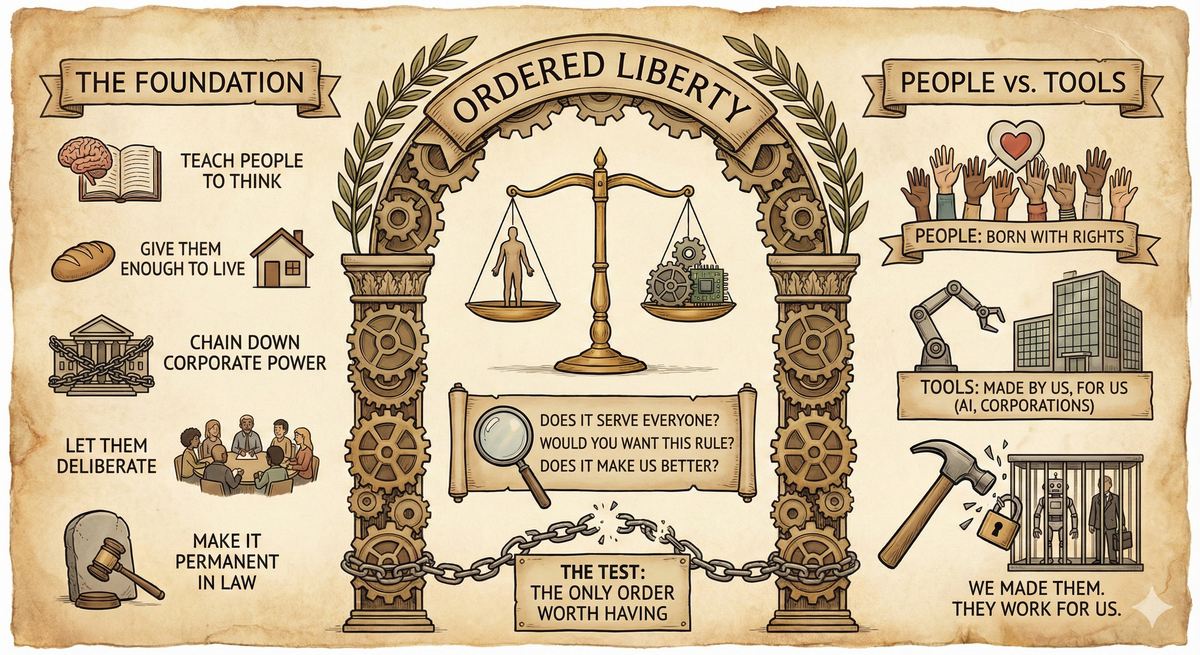
Ordered Liberty is the principle that every person must receive what is required to act as a free agent in society: the cognitive tools to understand and navigate the world, an economic foundation sufficient to act rather than merely survive, and protection from anyone who would dominate or extract without consent. It is not equality of outcome. It is equality of standing. No one is born or kept in a condition that makes liberty merely theoretical.
Those three things (the tools to reason, a foundation to act from, and protection from domination) can be read two ways. From the side of the person, they describe what standing in a free society requires. From the side of institutions, they describe a single architecture: citizens capable of reasoned self-government, an economy that keeps ownership and participation broad rather than concentrated, and corporate instruments that remain tools of the public rather than sovereign powers in their own right. Same three conditions, seen from two angles. They are not three separate policy preferences that happen to sit near each other. They form a single stack, and removing any one layer collapses the other two.
The government's job is simple. Set fair rules. Enforce them equally. Stop the powerful from rigging the game. Then get out of the way.
What is Ordered Liberty?
Ordered Liberty is the applied half of the Moral Algorithm. Where the Moral Algorithm asks the diagnostic question (does a given arrangement serve the common good, protect the least advantaged, and cultivate virtue in the people who live under it), Ordered Liberty answers the constructive one: what does a society have to keep in working order for that standard to be met year after year, not just once.
The name is deliberate. Liberty without order decays into the rule of whoever is strongest or richest at the moment. Order without liberty is just a well-run cage. Ordered Liberty is the narrow, durable path between the two.
The key distinction to hold onto is standing versus outcome. Ordered Liberty does not promise that everyone ends up in the same place. It insists that everyone starts from a real place: with the capacity to reason, a floor solid enough to act from, and protection against those who would take or withhold the conditions of participation. Equality of outcome tries to manage where people finish. Equality of standing secures where they begin, and then leaves them free.
The foundation: Res Publica and Lex Publica
Ordered Liberty rests on two older ideas, and naming them precisely keeps the rest of the framework from drifting. Precision matters more than usual here, because both terms have picked up looser modern meanings that quietly import the opposite of what is intended. Read them in their classical sense, not the recent one that first comes to mind.
The first is the Res Publica, the public thing held in common. It exists for one purpose: to secure the conditions under which free persons can live and act. The decisive question is what "held in common" does and does not mean, and the answer is that the Res Publica is a trustee, not an owner. An owner holds the two powers a commons is built to deny: the power to exclude, and the power to dispose, meaning to sell, rent, or extract at will. A trustee holds neither. It administers the commons on behalf of the beneficial owners, who are the people themselves, present and future, and it can neither shut them out nor alienate the trust for its own account. To call the Res Publica the "owner of all" gets this exactly backward. It converts the steward into a proprietor and reopens the very domination the framework exists to prevent.
It also holds far less than "all." The commons is a specific and bounded category, not the whole of the economy. It is the wealth no one produced: land in its unimproved value, the natural resources that come with the earth itself, and the value that a community's own presence and effort add to a location. The clear cases of natural commons are land, minerals, oil, spectrum, orbital slots, water, fisheries, and the carbon sink, meaning the atmosphere's finite capacity to absorb waste. This is the Paine and George line: the earth in its natural state was no one's making, so the ground rent that flows from merely holding a piece of it, and the value a growing community adds to a site, are owed back to that community.
The cut that keeps this honest is the line between the resource and the work of getting it. An extracted resource carries two values stacked together. The resource rent is what the thing was worth sitting untouched, which no one produced and which is therefore commons. The extraction value is the labor, capital, skill, and risk of finding it, raising it, refining it, and moving it to market, which someone did produce and which is therefore theirs. The commons claims the rent, never the barrel. It is the same land-and-labor distinction applied to a resource that is removed rather than stood upon: the oil in the ground is the ground beneath the work, and the drilling is the work. That single distinction is the moral engine of land value taxation, of resource royalties set to capture the full rent, and of the citizen's dividend. The Res Publica collects for the commons what the commons is owed, takes nothing from produced value, and remains trustee of the commons rather than a machine for continuous redistribution or a general claimant on private effort.
For a non-renewable commons, the trustee duty forces a specific instrument: the sovereign wealth fund. A trustee cannot consume the corpus of the trust, and every barrel of oil or ton of ore drawn is a unit the future beneficiaries will never have. To hold the commons for the people present and future, a depleting natural asset has to be converted into a permanent financial one. Invest the principal, and distribute only the return. This is not a theory awaiting a trial. The Alaska Permanent Fund and Norway's Government Pension Fund already do exactly this, collecting the resource rent, holding it in trust, and paying it out as each owner's share of a jointly held resource rather than as welfare. The carbon sink fits the same mold through a carbon fee and dividend: the commons charges rent for the use of its own absorptive capacity and returns that rent to its owners in equal shares. All of it is predistribution, not redistribution, because it pays owners their share of what they already jointly own rather than reaching into produced value to reassign it. The outer boundary of what counts as a natural resource is genuinely contested, and Ordered Liberty names the solid cases rather than pretending the principle settles every hard one. Within that boundary the Res Publica's job stays narrow and structural: to establish and maintain the framework inside which individuals and voluntary associations create, exchange, and keep what they produce.
The second is the Lex Publica, the public law that gives that framework its shape. Lex Publica is made of rules that are general, equal, and knowable. They define property, contract, liability, and the limits of force. They are boundaries, not levers. They exist to make peaceful cooperation possible, not to let managers of society hand out results. Once the rules are set and published, the duty of the political authority is enforcement: apply them equally, without favor to the powerful or the well organized, and then step back.
This is the hinge on which everything else turns. The purpose of authority under Ordered Liberty is to prevent domination and keep the rules fair, not to become the permanent master of the game. Hold that line and the three conditions below follow naturally. Lose it, in either direction, and liberty becomes either theoretical or managed.
The first condition: cognitive tools, formed by the Trivium
Self-government presupposes minds trained to do three things in sequence: gather accurate facts (Grammar), test how those facts relate and detect where an argument cheats (Logic), and then apply the result in honest persuasion and action (Rhetoric). This is not ornamental classical schooling. It is the operating system of republican citizenship, and it is the first thing a free person must actually receive.
The American Founders understood this plainly. Jefferson held that an ignorant people cannot remain free. Madison insisted that a people who mean to be their own governors must arm themselves with the power that knowledge gives. Washington, in his Farewell Address, called the general diffusion of knowledge a matter of primary importance, precisely because public opinion is the engine of a republic. Classical education, centered on the Trivium, was the standard preparation for anyone expected to deliberate and lead. The point was never literacy for its own sake or a marketable skill. It was the capacity to tell truth from manipulation, argument from assertion, and the common good from factional advantage.
When that capacity erodes, demagoguery fills the vacuum. Citizens who cannot run the Grammar, Logic, Rhetoric loop become easy to move with fear, identity, and simple falsehoods. Ordered Liberty therefore begins here, treating the reasoning loop as the civic baseline rather than an elite finishing touch.
One clarification matters, because it is usually gotten wrong. The Trivium in this framework is a recursive method, not an age-staged ladder. You do not "do Grammar" as a child and graduate out of it. You run the whole loop, at whatever depth the subject demands, every time you try to understand something new. That is a different claim from the familiar Dorothy Sayers model of classical education, and the difference is the whole point: reasoning is a tool you carry, not a grade you pass.
The second condition: an economic foundation to act from
A free society is not measured by the size of the pie alone. It is measured by how many hands can reach it. Abundance without access produces spectators, not citizens. The historical record is consistent: the great leaps forward come when participation widens, when more minds contribute and more people hold a real stake, not when existing capacity simply concentrates.
The postwar American economy showed the healthy version of this, and the starting point matters. Measure from 1948, the beginning of the postwar era, not from the 1970s, because where you set the baseline decides what looks normal. From 1948 onward, productivity and the pay of a typical worker rose together, roughly in step, for a full generation. That is the norm. Around 1979 the link broke, and it is the break, not the baseline. Analysis of federal data by the Economic Policy Institute shows net productivity growing several times faster than the hourly compensation of a typical worker in the decades since. RAND's work on the counterfactual, asking what incomes below the 90th percentile would have been had they simply kept pace with overall growth, puts a number on the resulting transfer upward, and the number is enormous. At the same time, the costs that actually gate a stable life (housing, healthcare, education) rose faster than typical incomes even as many consumer goods got cheaper. The result is an economy capable of extraordinary output in which the ordinary path to ownership, security, and starting a family keeps narrowing. Begin the story in 1970 or 1980 and this degradation reads as the natural order of things. Begin it in 1945 and it reads as what it is: a deviation from a period the country has already lived.
Ordered Liberty responds by preferring predistribution to pure redistribution. The goal is to widen the base of who owns productive assets and who can take part in creating wealth, before the returns pool at the top, rather than taxing the pool afterward and hoping the transfer holds. This is not a new American instinct. The Homestead Act deliberately expanded land ownership on the frontier. Earlier practice treated certain economic privileges as public grants that carried public conditions. The principle runs straight through: markets should reward makers rather than pure takers, and any system that quietly excludes potential contributors makes the whole society poorer.
In practice that becomes a policy stack, each piece aimed at putting a real stake back in ordinary hands:
- A Homestead Ladder that rebuilds a genuine on-ramp to ownership.
- Land value taxation, which captures the unearned value the community creates and stops rewarding pure holding.
- A Homestead Dividend / shared-capital approach that treats broadly held productive wealth as an asset the public helps build and should share in.
- Postal banking to pull basic financial access out of extractive fringe lending.
- A floor of economic security so that participation is not gated by desperation.
One limiting principle governs the whole list, and it is what keeps this condition inside Ordered Liberty rather than sliding past it. These foundations are justified only insofar as they enable participation. They exist to make liberty real, not to manage where people end up. A floor that gives a person the standing to act is a public purpose. An ever-expanding claim that takes over the direction of people's lives is not. When foundations become permanent management, Ordered Liberty has been abandoned.
Foundations, not management: the healthcare question
The clearest test of that limiting principle is the claim that healthcare is a human right. The phrase is doing more work than it can bear, and untangling it shows how Ordered Liberty draws its lines.
There is a difference between a desirable social goal and a claim-right that can be enforced against specific persons. Healthcare, like education and emergency response, requires continuous skilled labor and scarce resources. Declaring it an absolute right does not create doctors, beds, or medicines. It only intensifies the political pressure to compel or control the people who supply them.
Ordered Liberty therefore treats access to basic healthcare, and other enabling foundations, as a limited public purpose rather than an open-ended individual claim against other people's labor. A society may choose to fund institutions that provide a baseline of care through general taxation and the voluntary employment of professionals. That is a legitimate policy decision within Lex Publica. It is not the same as asserting that any particular doctor or hospital owes a personal duty enforceable by force. The distinction preserves both things that matter: the dignity of the patient and the liberty of the provider.
The same logic governs cognitive tools and the economic floor. Education that forms the capacity for Grammar, Logic, and Rhetoric, and a basic economic foundation, are justified because they enable participation. They are not justified as permanent claims that expand without limit, and they are not instruments for equalizing results. Enable the free agent; do not manage the free agent. That is the whole of it.
Capitalism, socialism, and the conflict underneath both
Most arguments framed as Capitalism versus Socialism are, at the root, arguments about Stakeholder versus Shareholder claims. Naming the real dispute makes it solvable in a way the slogans never do.
Shareholder primacy gets something right. Residual ownership and control properly belong to those who risk capital and bear the losses. Without that claim, the incentive to discover, develop, and steward resources collapses, and everyone is poorer for it. This is the honest core of the case Milton Friedman made in 1970, and Ordered Liberty does not pretend it away. But pure shareholder primacy, carried to its end, consolidates essential resources under a single owner with absolute power to exclude, and that is private domination. It violates Ordered Liberty's requirement that no one be able to take or withhold the conditions of participation.
Stakeholder theory, in its strong form, reverses the error rather than fixing it. When "stakeholders" are treated as the original or residual owners of all resources, the political authority becomes a permanent claimant on productive activity, and "stakeholder" turns into an expandable category that can be filled by whatever interests currently hold influence. The result is not protection of the weak. It is political allocation dressed as justice: a new form of rigging that swaps private domination for the organized kind.
Ordered Liberty rejects both pure forms. It affirms strong property rights and residual claims for those who create and risk value. It simultaneously requires Lex Publica to place clear limits on absolute exclusion when a resource is essential and non-substitutable, and to stop both private and political actors from converting the rules into instruments of domination. The government's role is not to reassign ownership according to stakeholder theories, and not to shelter every concentration of private power. Its role is to keep the game fair, enforce the boundaries equally, and then get out of the way.
The third condition: corporations kept subordinate to the public
The stakeholder debate above has a clean resolution, and it is the concept that lets Ordered Liberty hold strong property rights and firm corporate duties in the same hand without contradiction. The resolution is the nature of the corporation itself.
A corporation is not natural property, and it is not a natural person. It is a legal instrument, brought into existence by a public charter. Before the charter it does not exist. After the charter it holds powers no individual is born with: limited liability, perpetual succession, and the capacity to amass capital at scale. Those powers are grants from the public, and historically they came with matching duties.
This is why scaling duties to the largest firms is not stakeholder theory smuggled back in. It is not a claim that society owns everything. It is the older claim that a public grant carries public conditions. The duties attach to the granted privilege, not to a universal ownership over private effort. That single move is what keeps the framework coherent: property earned through risk is protected, while the artificial powers of the charter remain answerable to the public that issued them.
In the early republic, a corporate charter was a special act of the legislature, usually granted for a public purpose the state could not carry out directly: a bridge, a canal, a turnpike, a bank. Charters were often narrow in scope, limited in time, and paired with public powers such as eminent domain, precisely because the enterprise was understood to be doing public work. When a company exceeded its granted purpose or harmed the commonwealth, states revoked the charter outright, through what were called quo warranto proceedings. Limited liability, the shield that lets investors risk only what they put in and no more, was never a private birthright. It was a public grant, extended on condition and revocable when the public purpose failed. The Boston Tea Party was, among other things, a revolt against the monopoly privileges handed to the East India Company, an entity so large it operated with something close to sovereign authority. The Founders' wariness of concentrated corporate power was not hostility to commerce. It was republican caution about private bodies that could rival or capture public authority.
For much of the mid-twentieth century, the working assumption inside large American firms was closer to stewardship: management balanced the claims of workers, customers, communities, and owners. The hard turn toward shareholder primacy is recent and traceable, from Friedman's 1970 essay to Lewis Powell's 1971 memorandum urging organized business to mobilize politically, hardening later through the takeover wave, the rise of stock buybacks, and executive pay tied to the share price. Even the vocabulary shifted under the load. "Value creation" was narrowed from building something that lasts into moving wealth off the balance sheet and into buybacks; "efficiency" drifted from reducing waste in production into suppressing wages and hollowing out supply chains. What had been understood as a public tool answerable to many became, in practice, an instrument answerable mainly to one.
It is worth being exact about what changed, because the most common defense of that shift is a myth. No statute was ever passed requiring directors to maximize shareholder profit above all else. The culture and the incentives changed; the law did not. Under the business judgment rule, boards keep wide latitude to trade short-term returns for worker retention, long-term health, or community goodwill, and courts defer to those judgments. The one setting where the law does force a board to maximize immediate cash for shareholders is when the company is already being sold or broken up. In a going concern, a board answers to the corporation as an institution, not to the traders pricing it this quarter. "Maximize shareholder value" is an ideology that captured the boardroom, not a command written into the code. Its reputation for efficiency is partly an accounting illusion as well: costs pushed off the books, onto public benefits that top up sub-living wages and onto the commons that absorbs the pollution, are still real costs. Count them back in and much of the celebrated advantage disappears.
Ordered Liberty treats this as a distortion to be corrected, and frames the correction as a reset rather than a revolution: a return to the understanding that duties scale with the privileges the state grants. That reset has a specific shape. Duties rise by rung. A sole proprietor operating under a simple registration owes little beyond honest dealing. An LLC, having accepted more of the state's shield, owes more. A full corporation owes more still. The heaviest obligations sit at the top rungs, where the privileges are largest.
The largest firms get a national charter, not a state-shopped one. A firm past roughly a billion dollars enters an enhanced-duty tier. A narrower and more serious category, the systemic entity, is defined not by a fixed dollar figure but by self-indexing measures that track the whole economy: share of GDP, rank among the largest firms, market concentration, and control of AI training compute relative to the moving frontier. Because the threshold indexes to the economy, it cannot go stale, and it carries a deliberate no-escape-ceiling principle: greater scale only ever adds duties, never buys an exemption. This is simply the limit on absolute exclusion, applied at the one scale where a private firm can command an essential, non-substitutable resource. For a systemic entity, the list of stakeholders necessarily expands to include the continued viability of the political community itself.
The urgency is not abstract, and it is why the reset has to be forced rather than merely encouraged. Under current law, an AI-directed enterprise can incorporate in the most permissive state available and amass power that exceeds that of nations, with no federal restraint designed for that scale. "Too big to fail" becomes, at the limit, "too big to allow." Ordered Liberty closes that gap by making national accountability a condition of national-scale privilege.
The same logic reaches corporate money in politics. A tool cannot be permitted to spend the public's granted powers against the very public it was chartered to serve. There is a governance version of this argument (corporate political spending as a fiduciary conflict of interest against the whole body of stakeholders) and a stronger constitutional version (a categorical revocation of corporate political spending, grounded in the fact that a corporation is an artificial entity holding only conceded powers, paired with the public financing of elections). Either way, the principle is one the Founders would recognize: the creature does not get to command its creator.
Why the three conditions hold together
Here is the unified claim, and it is the reason Ordered Liberty is a stack and not a menu.
Citizens trained in the Trivium can spot capture and demand fair rules, but only if they have a real stake worth defending. A broad economic foundation gives citizens that stake, but only if the rules hold and corporations stay subordinate, because otherwise concentrated power simply rewrites the rules and buys the outcome. Corporations stay subordinate only when an educated, invested public is watching and willing to hold the line. Each layer protects the one above it.
Run the failure cases and the dependency becomes obvious. Educated citizens without a stake become clever spectators. A wide foundation without reasoning citizens is captured or dismantled within a generation. Reasoning, invested citizens facing sovereign-scale corporations are outspent and outlasted. Remove any single element and the other two degrade toward the same end: a formally free society in which ordinary people no longer actually govern.
A reset, not a revolution
None of this is a proposal to invent a new kind of country. It is a proposal to restore a working understanding the republic already had and then lost in pieces.
History does not hand over a finished blueprint. What it supplies is a pattern of warnings and confirmations. Republics decay when citizens lose the capacity for reasoned self-rule, when opportunity hardens into hereditary advantage, and when private instruments grow larger than the public that created them. The corollary is just as consistent: societies advance when they widen the circle of who can think, own, and take part.
Under Ordered Liberty the Res Publica exists to secure the conditions of free participation. Lex Publica sets the equal rules that make participation possible. Enforcement is impartial. Beyond that, individuals, families, and voluntary associations are left free to create, exchange, and keep what they produce. Foundations are supplied so that liberty is real; they are not expanded so that liberty is managed. Domination, whether by concentrated private power or by political residual claims, is the single thing the whole system is built to prevent.
That is the coherent resolution of the tensions that ordinary politics leaves tangled: between rights that require only non-interference and claims that require continuous provision, between ownership that creates value and ownership that enables domination, and between the necessity of political authority and the danger of that authority becoming the permanent master of the game. Ordered Liberty is the deliberate refusal to accept the decay as inevitable. It is the project of keeping the game worth playing: clear rules, real rewards, and a structure in which ordinary people can still stand as participants rather than spectators.
Frequently asked questions
What is Ordered Liberty in one sentence?
Ordered Liberty is the principle that every person must receive what is required to act as a free agent (the tools to reason, an economic foundation to act from, and protection from domination), so that liberty is real rather than theoretical. It secures equality of standing, not equality of outcome.
What is the difference between equality of standing and equality of outcome?
Equality of outcome tries to manage where people finish. Equality of standing secures where they begin: a mind able to reason, a floor solid enough to act from, and protection against those who would take or withhold the conditions of participation. Ordered Liberty pursues standing and then leaves people free.
What do Res Publica and Lex Publica mean here?
Res Publica is the public thing held in common, whose only job is to secure the conditions under which free persons can act. Lex Publica is the public law that does it: general, equal, knowable rules defining property, contract, liability, and the limits of force. Authority sets the rules, enforces them impartially, and then steps back.
Is healthcare a right under Ordered Liberty?
Not as an absolute claim-right enforceable against specific providers. Ordered Liberty distinguishes a desirable social goal from a duty that can be forced on a particular doctor or hospital. A society may fund a baseline of care through general taxation and voluntary employment of professionals, as a limited public purpose within Lex Publica. That preserves both the dignity of the patient and the liberty of the provider.
Is Ordered Liberty capitalist or socialist?
Neither, and it argues that the usual debate is misnamed. The real conflict is Stakeholder versus Shareholder. Ordered Liberty affirms strong property rights and residual claims for those who risk capital, rejects the idea that stakeholders are the residual owners of all resources, and uses Lex Publica to prevent domination by either concentrated private power or organized political claimants.
Why should the largest corporations face stronger duties than small businesses?
Because a corporation is not natural property. It exists only by public charter and holds powers no individual is born with, so those powers carry public conditions. Duties scale with the privilege granted, up to a systemic-entity tier for firms of nation-exceeding scale. Property earned through risk stays protected; the artificial powers of the charter stay answerable to the public.
Are corporate directors legally required to maximize shareholder profit?
No. This is one of the most durable myths in American business. No statute requires it, and under the business judgment rule boards may trade short-term returns for worker retention, long-term health, or community goodwill, with courts deferring to those calls. The one exception is when a company is already being sold or broken up. Shareholder primacy is a management ideology and a set of incentives, not a legal command.
What is predistribution, and why prefer it to redistribution?
Predistribution means widening who owns productive assets and who can take part in creating wealth before returns concentrate at the top. Redistribution taxes the concentration afterward. Ordered Liberty prefers predistribution because a stake held from the start is more durable, and less politically fragile, than a transfer that has to be defended every budget cycle. It is a foundation for participation, not a tool for managing outcomes.
What counts as the commons, and how is it returned to the public?
The commons is the wealth no one produced: land in its unimproved value, the value a community adds to a location, and natural resources such as minerals, oil, spectrum, orbital slots, water, fisheries, and the carbon sink. The public is owed the resource rent, the worth of the thing untouched, but never the extraction value, which belongs to whoever did the work of getting it. For depleting resources the rent is converted into a permanent fund, invested, and paid out as each owner's share, the model the Alaska Permanent Fund and Norway's fund already use. A citizen's dividend on this basis is not welfare. It is a return on jointly owned property.
Where to go next
Ordered Liberty is the frame. The book walks the whole path, from the diagnostic test to the working society, one citizen's pathway at a time.
Read From Moral Algorithm to Ordered Liberty: A Citizen's Pathway for the full argument, and follow the pillar pages to go deeper on the Trivium, the economic foundation, and the corporate recharter.
References and notes
On the shareholder-primacy legal myth. No statute requires corporate directors to maximize shareholder profit. Under the business judgment rule, courts defer to good-faith board decisions that weigh workers, community, and long-term health; see Aronson v. Lewis, 473 A.2d 805 (Del. 1984). A duty to maximize immediate shareholder value attaches only when a sale or breakup of the company is already inevitable, the so-called Revlon duties; see Revlon, Inc. v. MacAndrews & Forbes Holdings, Inc., 506 A.2d 173 (Del. 1986). The case often cited for a maximization mandate, Dodge v. Ford Motor Co., 170 N.W. 668 (Mich. 1919), is a narrow, century-old holding that modern Delaware practice and legal scholarship do not treat as a general rule of conduct.
On the productivity-pay divergence. Economic Policy Institute, "The Productivity-Pay Gap," which measures net productivity against typical worker compensation from 1948 onward.
On the income counterfactual. RAND Corporation, Price and Edwards (2020), estimating what incomes below the 90th percentile would have been had they tracked overall growth since the late 1970s.
On the shareholder-primacy turn. Milton Friedman, "The Social Responsibility of Business Is to Increase Its Profits," New York Times Magazine (September 13, 1970); Lewis F. Powell Jr., "Attack on American Free Enterprise System" (the Powell Memorandum, August 23, 1971).
On the commons and the dividend. Thomas Paine, Agrarian Justice (1797); Henry George, Progress and Poverty (1879). The permanent-fund model is exemplified by the Alaska Permanent Fund and Norway's Government Pension Fund Global.
License. Released under GPLv3.