
Our Hardware. Our AI. Our Right to Participate
Liberty in the AI age requires owning the tools of thought: open weights, strong encryption, and repairable hardware. This thesis maps a sovereign hybrid AI model and an Ordered Liberty policy plan so communities share in AI’s gains instead of renting intelligence.
TL;DR
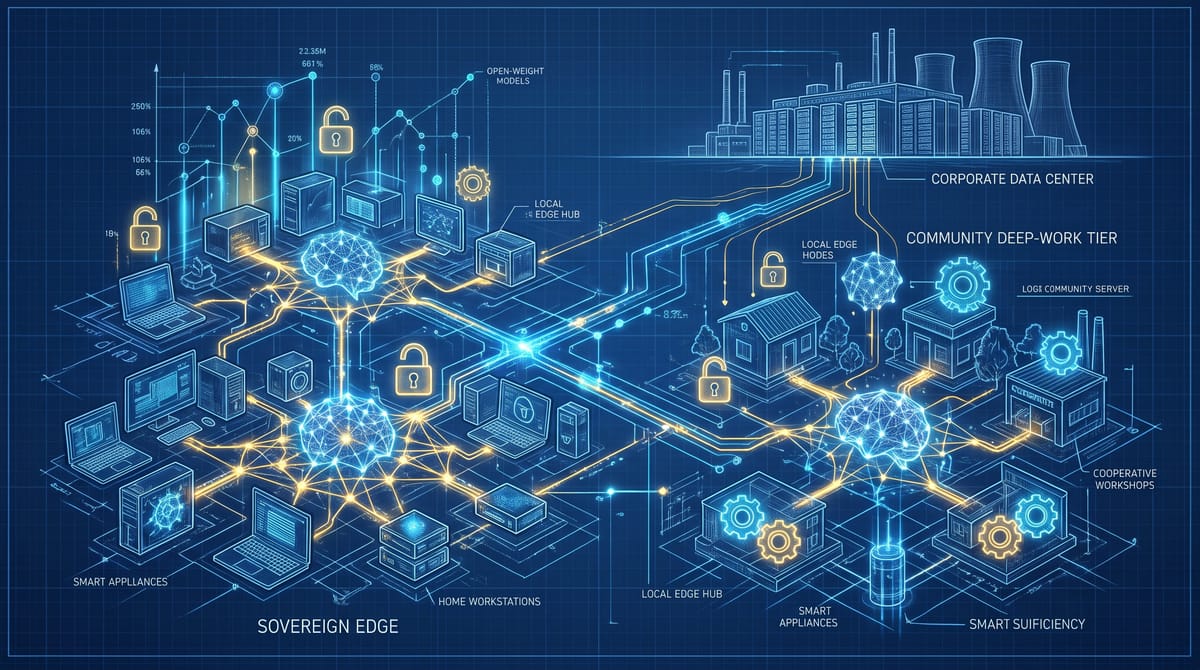
AI companies make digital goods artificially scarce to charge rent on them. A few companies own most AI computing power, and this makes wealth and control very concentrated. This centralized system can fail all at once, revoke access, and limit diverse thinking. People need local AI they own, strong encryption, and repairable hardware. Policy should turn rising AI productivity into real economic freedom for individuals, not just corporate profit.
Liberty, Ownership, and the Architecture of Artificial Intelligence
Nov 5, 2026 · @Darin Lawson Hosking
Thesis
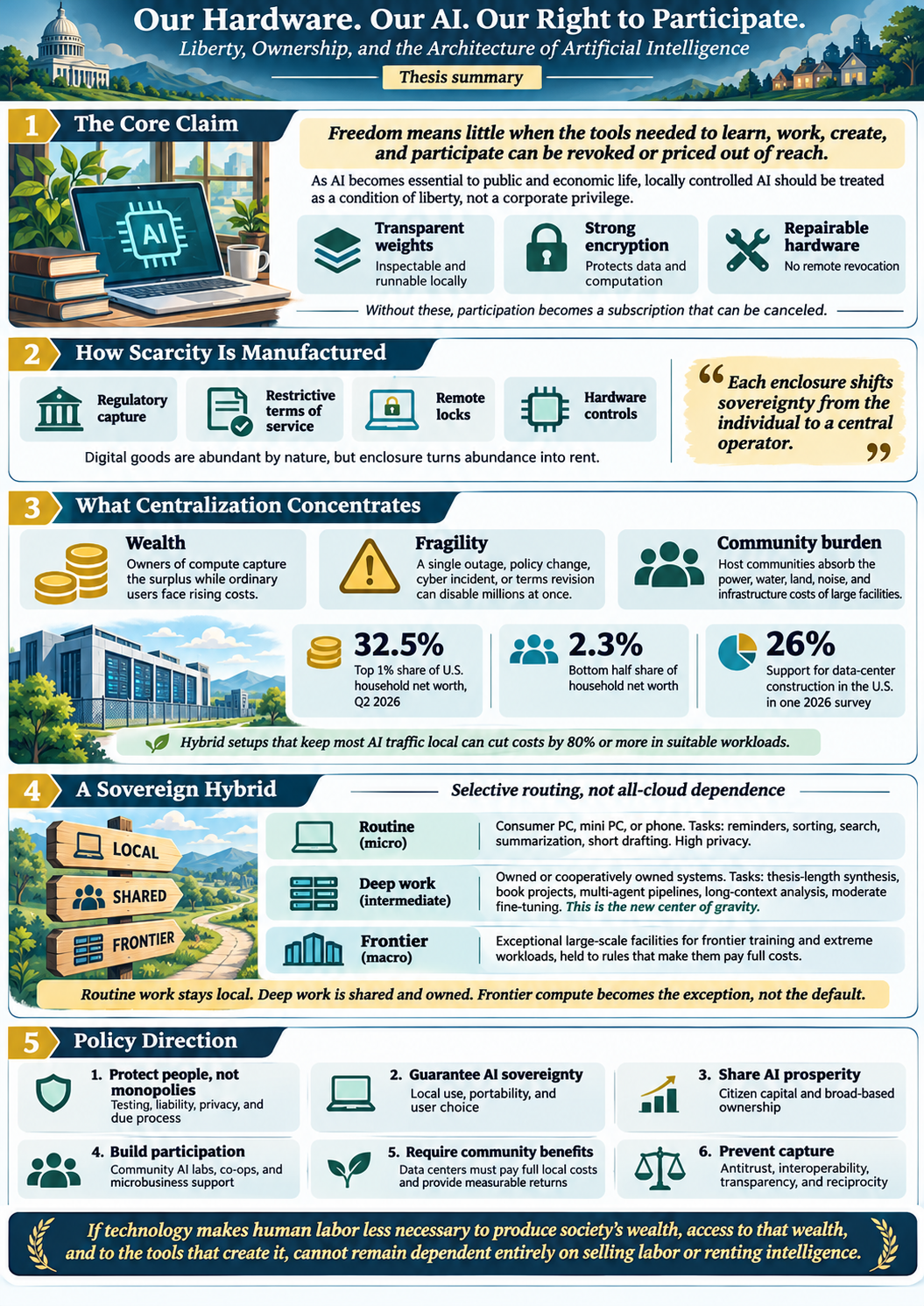
Freedom means little when the tools needed to exercise it belong to someone who can revoke access or price it out of reach. As artificial intelligence becomes essential to learning, working, creating, and participating in public life, a baseline of locally controlled AI must be treated as a condition of liberty, not a corporate privilege.
This thesis argues that liberty in an AI-mediated economy requires three concrete conditions: transparent weights that can be inspected and run locally, strong encryption that protects both data and computation, and repairable hardware whose function cannot be remotely revoked. Without them, participation itself becomes a subscription that can be canceled.
The argument proceeds in five steps:
- Scarcity is manufactured. Digital goods are abundant by nature. Ongoing rent requires enclosure, and every enclosure shifts sovereignty from the individual to a central operator.
- Centralization concentrates both wealth and fragility. Owners of compute capture the surplus, host communities absorb the physical costs, and a single outage or policy change can disable millions of people at once.
- Centralization is a choice, not a necessity. The structural logic of the Second Amendment, the Crypto Wars, Right to Repair, and independent software such as VLC all show that residual individual capability can be preserved.
- A sovereign hybrid is the practical answer. Routine work runs on owned local hardware, deep work runs on cooperatively owned intermediate systems, and frontier data centers become the exception, held to rules that make them pay their full costs.
- Regulation alone leaves ownership where it is. Policy must convert rising productive capacity into rising individual economic freedom.
The principle beneath all five: if technology makes human labor less necessary to produce society's wealth, access to that wealth, and to the tools that create it, cannot remain dependent entirely on selling labor or renting intelligence.
I. Manufactured Scarcity in an Abundant Medium
Digital goods are abundant by nature; scarcity in AI is a business model, not a law of physics. Once a model or program exists, it can be copied at near-zero marginal cost. A provider that wants recurring revenue from something infinitely copyable must therefore make it artificially scarce.
The tools of enclosure are familiar:
- Regulatory capture. Compliance regimes written so that only the largest firms can afford to meet them.
- Restrictive terms of service. Contracts that forbid distillation, reverse engineering, or competitive use of outputs.
- Remote locks. Software that phones home, expires, or can be disabled from a distance.
- Hardware controls. Firmware restrictions, parts pairing, and supply constraints that keep capable machines out of ordinary hands.
Each enclosure shifts sovereignty from the individual to a central operator. The pattern is clearest where public inputs become private choke points. Frontier labs trained on humanity's publicly available knowledge, defended under fair-use arguments. Many of the same firms have since sought to restrict distillation of their own outputs and have supported proposals to treat open model release as a national-security risk comparable to exporting munitions. The result is a double standard: corporate scraping of the commons is called innovation, while citizens adapting open models are treated as a threat.
The hardware market shows the same squeeze. Memory and GPU demand from data-center buildouts has pushed prices for capable consumer hardware sharply upward. In practical terms, the price of one top-end graphics card today approaches what three complete high-end gaming PCs cost five years ago. A capability that was a hobbyist purchase has become a capital outlay comparable to a used car.
II. The Topography of AI Work
Most AI work does not need a data center; the scale of a task dictates its hardware. AI workloads fall along a spectrum from the household edge to the hyperscale cluster, and each tier carries different costs, privacy exposure, and ownership implications.
| Tier | Typical tasks | Hardware and models | Ownership and privacy |
|---|---|---|---|
| Routine (micro) | Reminders, schedules, sorting, classification, parsing, short drafting, search, summarization | Consumer PC, mini PC, or phone NPU running roughly 4B to 9B parameter models | High privacy: personal records and financial files never leave the device |
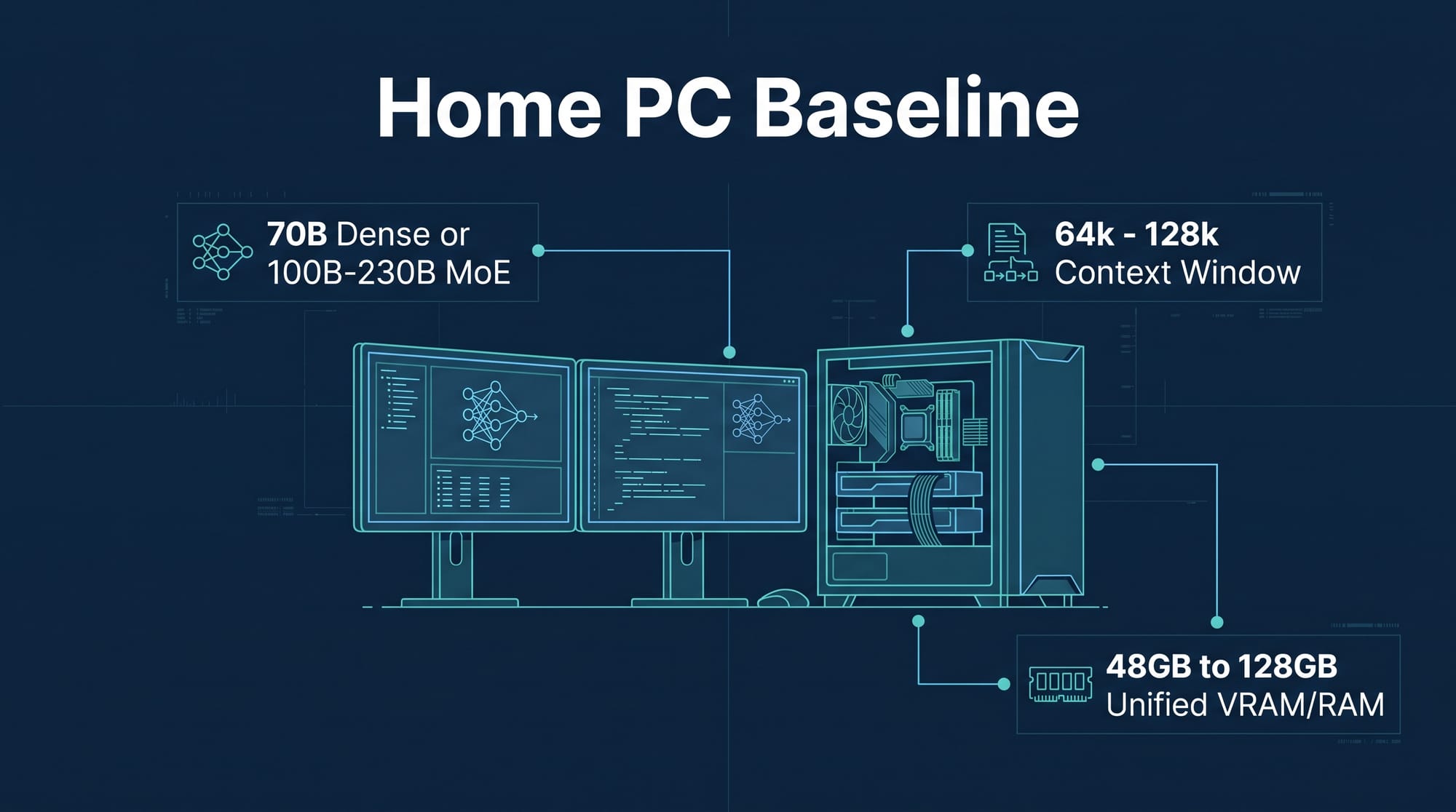
| Deep work (intermediate) | Thesis-length synthesis, book projects, multi-agent pipelines, long-context analysis, procedural generation, moderate fine-tuning | 48 to 128 GB unified memory or high-VRAM workstation running 32B to 70B dense or 100B to 230B mixture-of-experts models with 64k to 128k token context | High privacy if owned individually or cooperatively; this is the new center of gravity |
| Frontier (macro) | Training frontier models, extreme-scale reasoning, 100k+ token batch analysis, synthetic data generation | Data-center clusters of enterprise accelerators | Low privacy: sensitive context must be transmitted to a third party |
Two engineering facts shape the whole argument. First, routing routine work to small local models avoids per-token cloud charges, which have ranged from a few dollars to the mid-teens per million tokens depending on model tier, and removes network round trips that dominate latency on simple requests. In suitable workloads, hybrid setups that keep most traffic local can cut costs by 80 percent or more. Second, frontier systems remain genuinely superior for some tasks. Memory bandwidth and interconnect limits on large-scale attention are real; not every workload belongs on a laptop.
The rational design is therefore selective routing, not a binary choice between local and cloud. The question this thesis presses is who owns each tier.
III. Concentration: Capital, Cost, and Community
When the marginal cost of digital labor falls toward zero but the compute that performs it is owned by a few, the surplus flows to the owners of the compute. This is a Cantillon-style effect applied to capital rather than money: those closest to scarce, high-return assets capture a disproportionate share of the gains.
The capital picture
Wealth concentration is already at a record. The Federal Reserve's Distributional Financial Accounts put the top 1 percent's share of U.S. household net worth at 32.5 percent in the second quarter of 2026, the highest in the quarterly series and up from 31.1 percent a year earlier. The bottom half of households held 2.3 percent. The share given up came mostly from the 50th to 90th percentile, the house-rich middle class, which fell from 30.1 to 28.8 percent as financial assets outpaced housing (Fed DFA via FRED; Axis Intelligence summary).
AI does not create this pattern by itself, but it amplifies it. Routine cognitive and clerical work faces higher displacement risk, while demand rises for those who design, own, or oversee AI systems. Women face elevated exposure largely because of occupational concentration in administrative and support roles. When labor's share of production falls and capital ownership stays concentrated, productivity growth becomes extraction rather than broad prosperity.
The hardware gate
The local side of a hybrid is now capital-gated. Machines able to run useful models at interactive speed have moved out of ordinary household reach. Without deliberate intervention, the people who can own capable hardware are the people who already have capital, and hybrid routing simply reproduces the concentration it was meant to prevent.
The community burden
The cloud side generates concentrated local costs. Large clusters need electricity, cooling water, land, and grid upgrades. In small towns and rural areas they can raise power bills, strain water supplies, add noise and traffic, and reshape tax and land-use balances. The returns flow to distant owners; the externalities stay local.
Public resistance reflects this. Americans showed the lowest support for data-center construction among 15 large economies in one 2026 survey, at 26 percent. New York's legislature passed a one-year data-center moratorium bill, and Illinois suspended data-center tax breaks (Transformer, June 2026).
Communities are being asked to surrender land, water, energy, infrastructure, quiet, and potentially jobs to facilities that may offer little lasting benefit to their neighbors. They bear the costs while the corporations collect the profits, and residents can still be denied affordable access to the intelligence their communities help power. Where are the lower utility bills, better schools, affordable housing, health care, economic opportunity, or shared ownership? If the public provides the resources, the public deserves a share of the benefits.
IV. The Rented Mind: Fragility, Revocability, and Monoculture
A society that runs its cognition, work, and coordination through a handful of provider-managed systems inherits their failure modes. Centralization is efficient in good times and brittle in bad ones.
Correlated failure. A single outage, policy change, cyber incident, or terms revision can disable millions of users and every downstream application built on them at once. Distributed systems fail locally; centralized systems fail together.
Conditional independence. When access is metered and revocable, independence becomes conditional. The ability to learn, create, or earn can be withdrawn by algorithm, by price, or by decree. A closed cloud model is a rented mind: one that can be monitored, filtered, or switched off by someone else.
Alignment monoculture. Centralized alignment narrows the range of acceptable outputs. Safety tuning has real value, but when a few operators set the boundaries for nearly everyone, society loses the diversity of approaches it needs when novel problems arise. A monoculture of thought is as vulnerable as a monoculture of crops.
Loss of continuity. Citizens who depend on subscription AI for education, employment, creativity, and communication have no guarantee of portability, privacy, or continued access. Their accumulated work, context, and fine-tuning can be stranded by a pricing change or a discontinued product.
Open-weight models running on hardware the user owns answer all four failure modes. They keep working offline. They cannot be revoked. They can be adapted to local needs and values. And they preserve the user's work and data under the user's control.
V. Precedents: Centralization Is a Choice
The fight over open AI is not new; it is the latest round in a long contest over who controls the tools of human agency. Each earlier round established a principle that applies directly to AI.
The structural logic of the Second Amendment
Whatever one's view of firearms policy, the Second Amendment embodies a structural idea: no central power should hold a monopoly on a capability essential to self-government. It preserves a residual individual capacity that does not depend on continuous permission. Open-weight models running on owned hardware serve the same structural function for thought and production. The analogy is about architecture, not weapons. A free people retains some baseline capability that cannot be switched off from above.
The Crypto Wars
In the 1990s, the U.S. government pushed key-escrow schemes such as the Clipper Chip and treated strong encryption as a munition for export purposes. The effort failed. Clipper was abandoned, courts in Bernstein v. United States treated source code as protected expression, and export controls on encryption were substantially relaxed by 2000. The lessons were that code is speech, that strong encryption once widely distributed cannot be fully suppressed, and that restricting it harms ordinary citizens more than it hinders adversaries. Privacy is a precondition of free expression.
Right to Repair
Right to Repair extends the principle from code to physical devices: a machine someone else can disable is not fully owned. Recent state laws requiring access to parts, tools, and documentation, and limits on software-enforced parts pairing, reflect a growing consensus that ownership includes the right to maintain and modify what you bought.
VLC and independent implementations
Projects such as the VLC media player and its companion library for reading encrypted DVDs showed that independent, legally distributed implementations can preserve users' ability to exit a platform even when commercial vendors prefer enclosure. Interoperability is a form of liberty.
What the precedents establish
These are not historical curiosities. They are working precedents showing that centralization is a policy and design choice, not a technical necessity. In each case, the attempt to lock a general-purpose capability behind a central gatekeeper was justified by security, and in each case broad distribution proved both safer for liberty and more productive for society.
VI. Three Conditions of Liberty
Liberty in an AI-mediated economy rests on three concrete, testable conditions. Each answers a specific form of enclosure.
| Condition | What it requires | Enclosure it defeats | Historical precedent |
|---|---|---|---|
| Transparent weights | Models that can be inspected, run, and fine-tuned locally under open licenses | Rented minds, alignment monoculture, revocable access | Open-source software; the Crypto Wars principle that code is speech |
| Strong encryption | Unbreakable protection for data at rest, in transit, and during computation, with no mandated backdoors | Surveillance, data harvesting, compelled disclosure | Defeat of the Clipper Chip and key escrow |
| Repairable hardware | Devices whose function cannot be remotely revoked, with available parts, tools, and documentation | Remote locks, parts pairing, planned obsolescence | Right to Repair; independent implementations such as VLC |
The three conditions are mutually dependent. Open weights on a device someone else can brick are not free. Owned hardware running a model that leaks every query is not private. Encryption without an inspectable model cannot prove what happens to the data it protects.
The principle is simple: keep the tools of thought in your own hands, or accept that participation itself becomes a subscription that can be canceled.
The ethical test
Two tests from the Ordered Liberty framework confirm the conclusion. Behind Rawls's veil of ignorance, not knowing one's own wealth or station, no rational person would choose a world where intelligence and productive capability sit behind paywalled servers owned by a few. And Aristotelian flourishing requires that people possess the tools to build, reason, and govern themselves. A baseline of sovereign, unencumbered local compute is a precondition of both.
VII. The End State: A Sovereign Hybrid
In the end state, routine inference is an ordinary household utility, deep work runs on locally or cooperatively owned systems, and frontier data centers are the exception rather than the toll road.
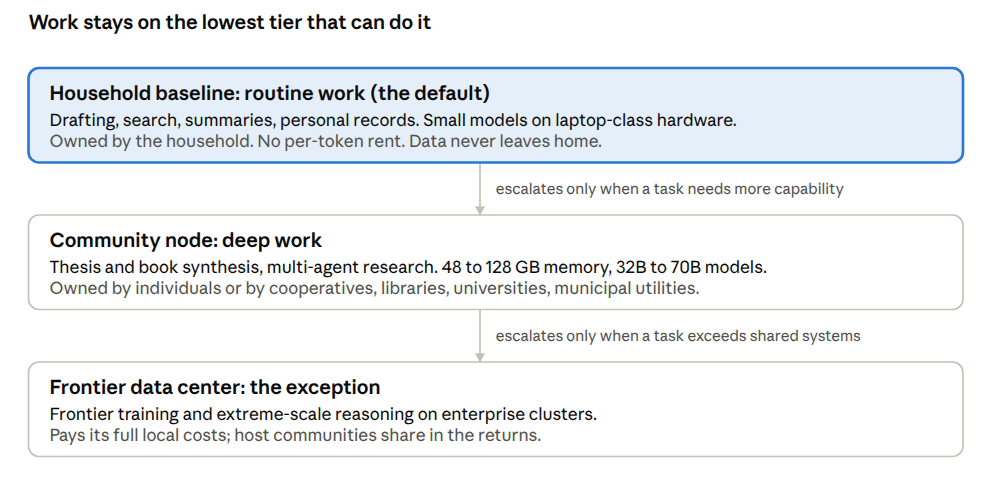
Ownership widens toward the bottom of the stack: most daily work never leaves hardware the user or their community owns, and only the hardest tasks reach a frontier facility.
Three tiers, three ownership models
- Household baseline (routine). Everyday drafting, search, summarization, personal records, and short-form generation run on modest hardware the household owns, at roughly the price of a mid-range laptop or game console. No per-token rent; data stays home.
- Community and deep-work tier (the center of gravity). Thesis-scale synthesis, book projects, multi-agent research, and large-context analysis run on 48 to 128 GB class systems. These are owned by individuals who need them full time, or by cooperatives, libraries, universities, professional associations, and municipal utilities that members join. Members hold ownership claims or membership rights, so the surplus from deep work is not extracted as rent. Deep synthesis becomes like a specialized workshop or laboratory: productive capital that can be shared.
- Frontier tier (the exception). The largest models and training runs remain in specialized facilities, but siting is bound by explicit standards for energy, water, noise, and grid impact, and host communities receive a defined share of returns.
Routing and control
Routing is automatic, transparent, and user-overridable. Work stays on the lowest tier that can handle it. Escalation happens only when a task demonstrably needs more capability, and the user sees the cost and data implications before anything leaves their control. Non-frontier models are predominantly open-weight; proprietary frontier systems are reachable through open interfaces, not lock-in.
What changes in daily life
- Personal documents, finances, health notes, and correspondence are processed locally with no third-party exposure.
- Personal and small-business workflows (research, planning, code, content, administration) run without continuous subscription fees.
- Most tasks keep working offline, which matters for rural connectivity and emergency preparedness.
- Individuals and communities fine-tune models for their own languages, trades, and needs without sending data outward.
- Energy costs for ordinary use are visible and controllable at household or community scale instead of externalized onto distant towns.
Under these conditions the hybrid is both efficient, because work runs on the cheapest and most private tier that can do it, and distributive, because ownership of the means of routine digital production is widespread.
VIII. The Path: Sequencing the Transition
The transition needs no single breakthrough; it needs five reinforcing tracks that run in parallel and steadily move the default for daily work from rented capacity to owned capacity.
- Keep compressing the routine tier. Open-weight models, better quantization, speculative decoding, and smarter routing already handle a large share of everyday tasks. One-click local runtimes, automatic model selection, and clear cost and privacy indicators make local inference ordinary digital literacy rather than a specialist skill. The goal: routine work never requires the 48 to 128 GB class.
- Restore affordable baseline hardware. Encourage competition in memory and accelerators, use public procurement to create volume for lower-cost memory-rich designs, and build shared-access bridges (library, school, and municipal inference nodes; neighborhood machines; cooperative purchasing) so the local tier is not capital-gated during the transition.
- Build intermediate ownership at community scale. Stand up cooperative, library, university, and municipal deep-work nodes with public or philanthropic seed capital, then operate them on cost recovery with members holding ownership claims. Community broadband and open-source infrastructure already demonstrate the organizational patterns.
- Constrain frontier externalities and lock-in. Siting standards that internalize energy, water, noise, and grid costs; community-benefit or revenue-sharing requirements; interoperability and data-portability rules; and antitrust limits on exclusive control of scarce inputs such as advanced chips and large training runs.
- Align institutions and incentives. Make open weights the norm for non-frontier systems, favor distributed and cooperative ownership in tax, procurement, and financing rules, and measure success by how much ordinary digital work happens without per-token rent.
The tracks overlap rather than queue. Efficiency gains expand what existing hardware can do every year. Affordability bridges and cooperative pilots can start immediately. Frontier rules apply as the physical buildout continues.
The path succeeds if, at each stage, more people can do more of their daily digital work on hardware they or their community own, at costs they control, without surrendering their data, paying perpetual rent, or imposing uncompensated burdens on the places that host any remaining large facilities.
IX. Policy: Beyond Regulation Toward Ownership
Regulating AI's owners does not, by itself, change who owns the benefits. Current proposals ask how to prevent AI companies from harming Americans. Ordered Liberty asks a further question: how do we prevent harm while ensuring every American can use, benefit from, and participate economically in the AI economy?
Where the current debate stands
Throughout 2026, lawmakers have offered a growing menu of responses, though not a single unified platform. Rep. Greg Casar, chair of the Congressional Progressive Caucus, has proposed taxing AI-driven layoffs and AI output measured in tokens to fund jobs and retraining, led 18 members in calling for open hearings with AI company CEOs, and joined Sen. Bernie Sanders in introducing the Ban Artificial Superintelligence Act in September 2026. Sen. Elizabeth Warren has pursued a data-center tax, Sen. Ron Wyden a tech-company levy for worker-displacement programs, and Sen. Sanders a sovereign wealth fund financed by taking a share of major AI companies' stock (Casar press releases; Transformer, June 2026). Others have emphasized independent safety audits and enforceable standards.
| Core question | Emerging regulatory response | Ordered Liberty response |
|---|---|---|
| AI threatens jobs | Protect and retrain workers; tax layoffs | Protect workers, expand ownership, and create new ways to earn |
| AI companies grow too powerful | Investigate and regulate companies | Regulate harmful conduct and distribute access and economic power |
| AI creates enormous profits | Tax some of the gains | Build enduring citizen-owned productive capital |
| AI systems are dangerous | Testing, audits, liability, limits on frontier development | Same protections, plus user sovereignty and checks on regulators |
| Data centers burden communities | Data-center taxes, fewer tax breaks | Full cost recovery, local accountability, and direct benefits |
| People need AI access | No universal-access proposal yet | Affordable, portable, locally controlled capability |
There is real common ground. Worker protections, independent testing, and corporate accountability all belong in an Ordered Liberty program, and the sovereign-wealth-fund idea points in the same direction as citizen capital. What is missing is a durable mechanism that turns rising productive capacity into rising individual economic freedom.
Six pillars
- Protect people, not monopolies. Independent testing of high-risk systems, liability for preventable harms, protection from unlawful surveillance and discrimination, and real appeals when automated decisions affect livelihoods or civil rights. Requirements scale with demonstrated capability and risk, so small developers do not carry frontier-lab compliance burdens.
- Guarantee individual AI sovereignty. Protect lawful local AI use and the right to run open models; strengthen control over personal data; require practical data and work portability; and let people choose among local, commercial, cooperative, and public systems.
- Give citizens a share of AI-generated prosperity. A Shared Capital Fund, financed by carefully designed corporate contributions, public resource revenues, selected automation-related rents, and investment returns, distributes eligible returns through individual Postal Capital Accounts. Part compounds for the long term; a defined share supports approved productive investment.
- Make AI a tool for economic participation. Community AI labs, libraries, cooperatives, and microbusiness support built around the Trivium: grammar (learn the facts and tools), logic (test evidence and choices), and rhetoric (apply knowledge and build useful work). Success is judged by lasting economic independence, not certificates.
- Require measurable community benefits from data centers. Developers pay the full incremental costs they impose on power, water, roads, and services; transparent impact studies; enforceable local agreements with financial guarantees and independent monitoring; and, where appropriate, revenue sharing, local computing access, and community infrastructure ownership. A community should not subsidize private profits while absorbing the costs and risks.
- Prevent both corporate and government capture. Antitrust enforcement, interoperability, open procurement, transparent governance, and due process. Every proposed AI power faces the reciprocity test: would we accept this authority if it were controlled by our worst political opponent?
A legislative sequence
Rather than one massive bill, introduce four focused ones:
| Bill | Purpose |
|---|---|
| AI Rights and Accountability Act | Local AI use, privacy, portability, due process, and proportionate testing and liability for high-risk systems |
| Data Center Community Fairness Act | Full infrastructure cost accounting, environmental safeguards, subsidy disclosure, financial guarantees, verified community benefits |
| American AI Opportunity Act | Community-accessible computing, adult education, microbusiness and cooperative development |
| Shared Capital and Automation Dividend Act | Citizen capital accounts and a public investment fund converting part of automation gains into broadly held productive assets |
Fiscal discipline
A tax based on counting replaced workers is hard to administer and can discourage beneficial productivity. A sounder base examines measurable economic rents, resource-use fees, existing corporate tax structures, and investment returns. Before any dividend amount is promised, independent estimates of revenue, administrative cost, distributional effects, and long-term sustainability are required. Uncertain investment returns are not guaranteed funding, and existing public services must be protected.
X. Measuring Success: A National Scorecard
Success should be measured by outcomes for ordinary people, not by the number of laws passed or the size of the largest model. These are proposed indicators, not existing official statistics; each needs transparent definitions, public data sources, historical baselines, and regular reporting.
| Indicator | What it measures |
|---|---|
| Sustainable Economic Participation Rate | Share of adults sustaining meaningful participation through employment, self-employment, or productive capital |
| Citizen Capital Ownership | Breadth of household ownership of productive assets and investment income |
| AI Access and Independence | Affordable access, real provider choice, portability, and local-control options |
| Rent-Free Work Share | Share of ordinary digital work performed without per-token rent on owned or cooperative hardware |
| Edge Hardware Ownership | Distribution of ownership of hardware capable of useful local inference |
| Community Net Benefit | Verified local benefits of AI infrastructure minus the added public costs |
| Productivity Gain Distribution | Division of AI-related gains among workers, consumers, capital owners, and the public |
| AI Rights and Safety | Serious incidents, audits, due-process protections, and successful appeals |
XI. Objections and Limits
A serious thesis must answer its strongest critics. Five objections deserve direct replies.
"Open weights let bad actors misuse powerful models." Some capabilities do pose concrete risks, and the thesis does not claim every model must be released. Pillar 1 scales obligations to demonstrated capability and risk, and frontier systems remain governed. But the Crypto Wars showed that blanket restriction of a general-purpose capability mostly burdens law-abiding citizens while determined adversaries route around it. The burden of proof belongs on restriction, judged case by case, and the reciprocity test applies to whoever holds the restricting power.
"Centralized cloud is simply more efficient." For frontier tasks it is, and this thesis keeps frontier systems. For routine work, local routing is cheaper, faster, and more private. The efficiency case for total centralization rests on ignoring externalities: community costs, correlated failure, and the rent extracted from users. Priced honestly, the hybrid wins.
"Most people cannot afford capable hardware." True today, which is why the thesis treats deep-work capacity as shared productive capital and calls for affordability interventions. The goal is a 128 GB workstation in every home so that no one's ordinary digital life depends on a perpetual toll.
"The Second Amendment analogy is inflammatory." The analogy is structural, not about weapons: a free society preserves residual capabilities that do not depend on continuous permission from a central authority. Readers who reject the analogy can rest the same conclusion on the Crypto Wars and Right to Repair alone.
"Shared capital funds will be mismanaged or politicized." That risk is real. The Alaska Permanent Fund and Norway's sovereign fund show that distributing returns on jointly owned assets can work over decades, but only with independent governance, transparent accounting, and conservative assumptions. Hence the requirement for scored fiscal models before any dividend is promised.
The thesis also has limits. Projections about displacement are risks, not certainties; policy, competition, and bargaining power shape the outcome. Hardware prices and model efficiency are moving quickly, and the tier boundaries described here will shift. The architecture, not the specific numbers, is the claim.
Conclusion
The goal is not to stop AI. The goal is to ensure AI increases human freedom rather than making people economically obsolete.
We are not against technological progress. We are against surrendering our resources, livelihoods, privacy, and independence for progress that benefits everyone except the people paying its price. Our labor built the wealth of the AI industry. Our knowledge trained its models. Our communities supply its land, water, and power. Our future belongs to us, too.
Our computers, open-source software, and local models are tools of independence. They let us learn, work, create, and participate without asking corporate permission. If AI is productive enough to replace human labor, it is productive enough to improve human lives, and the institutions that govern it should be judged by whether it does.
No corporation should control the tools of thought while communities absorb the costs of running them. Government's role is to set fair rules, enforce them equally, stop the powerful from rigging the game, and protect everyone's ability to participate.
Participation is a right, not a subscription. Progress without public benefit is extraction.
Our hardware. Our AI. Our communities. Our future.
Notes on Sources and Verification
The policy proposals in Sections IX and X (six pillars, four bills, Shared Capital Fund, Postal Capital Accounts, scorecard) are recommendations of the Ordered Liberty framework, not enacted or formally introduced legislation. Statements about lawmakers' positions summarize public reporting from 2026 and do not describe an official party platform. Before external publication, verify each against official releases, especially the post-election remarks of November 3, 2026 and any framework attributed to individual senators that is not linked below. Hardware tier figures reflect the author's working estimates as of late 2026 and will shift as models and prices change.
Sources
- Federal Reserve Distributional Financial Accounts: top 1% share of net worth (FRED WFRBST01134)
- Axis Intelligence, Wealth Inequality Statistics 2026 (Oct. 2, 2026), summarizing the Sept. 18, 2026 DFA release
- Transformer Weekly, "The best AI bill yet may not get far" (June 5, 2026)
- Rep. Greg Casar, press releases
Released under GPLv3 by The Moral Algorithm.
Frequently Asked Questions
Why is AI scarcity considered artificial rather than natural?
Digital goods like AI models can be copied at almost no cost once they exist. Companies create artificial scarcity through restrictive contracts, remote locks, hardware controls, and regulations that only large firms can meet, allowing them to charge ongoing rent for something that could otherwise be freely shared.
What are the three conditions needed for AI liberty?
Liberty in an AI economy requires transparent model weights that people can inspect and run locally, strong encryption to protect data and computation, and repairable hardware that cannot be remotely disabled. Without these three conditions, participation in AI becomes a subscription that a company can cancel at any time.
How does AI hardware concentration connect to wealth inequality?
The top 1 percent of U.S. households held 32.5 percent of net worth in mid-2026, the highest level on record, while the bottom half held just 2.3 percent. As GPU and memory prices rise due to data-center demand, capable AI hardware becomes a capital outlay only the already-wealthy can afford, reinforcing this concentration.
What is a 'sovereign hybrid' approach to AI?
A sovereign hybrid runs routine daily AI tasks on personally owned local hardware, handles deeper work on cooperatively owned intermediate systems, and reserves massive data centers only for frontier tasks that truly require them. This structure keeps most computing power and privacy in individual or community hands rather than corporate ones.
Do local communities benefit from hosting AI data centers?
Communities hosting data centers often bear rising electricity and water costs, strained infrastructure, and noise, while profits flow to distant corporate owners. A 2026 survey found only 26 percent of Americans supported data-center construction, the lowest among 15 large economies, and some states like New York and Illinois have pushed back with moratoriums or ended tax breaks.