From the “Tea Party” to Trumpism
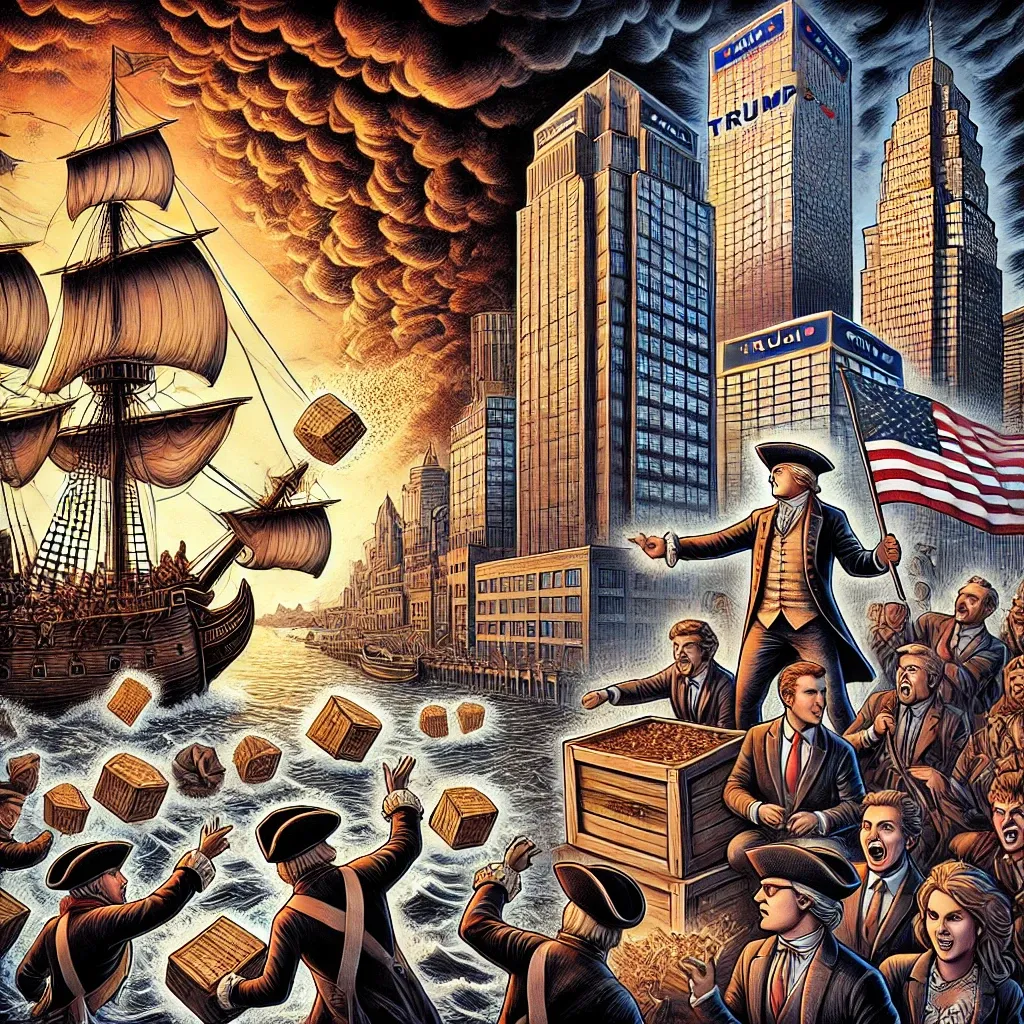
The Boston Tea Party of 1773, a pivotal event in American history, saw colonists defiantly reject the corporate tax privileges granted by…
TL;DR
The American Revolution began as a fight against corporate power and unfair privilege. Over decades, neoliberal policies and corporate influence have reversed this founding goal. Tools like the Powell Memo and strategic language use helped corporations gain political power. Trump's 2024 agenda combines corporate deregulation with authoritarian and religious nationalist policies. This combination threatens individual rights and democratic values that started the Revolution.
The Boston Tea Party of 1773, a pivotal event in American history, saw colonists defiantly reject the corporate tax privileges granted by the British government to the East India Company. This act of resistance against corporate favoritism and tax loopholes was a catalyst for the American Revolution and the establishment of a new nation founded on principles of protecting the rights of the individual and limited government power.
The USA "mandate" that was put in place at the inception of the USA, but it has been forgotten or lost in the pursuit of power and profit.
“Government is instituted for the common good; for the protection, safety, prosperity and happiness of the people; and not for the profit, honor, or private interest of any one man, family, or class of men.” - John Adams
The modern United States has witnessed a remarkable shift away from these founding ideals, as widespread support for corporate tax breaks and pro-business policies reflects the ascendance of neoliberal economic policies and the increasing influence of corporate interests. This transformation has been facilitated by several key developments, including the influential Powell Memo, Newt Gingrich’s “Language: A Key Mechanism of Control,” and decades of pro-corporate policies that have reshaped the political landscape, prioritizing corporate interests over individual rights.
Today Neoliberalism, with its emphasis on free-market principles, deregulation, and privatization, has created an environment that caters to corporate control and power. By advocating for the reduction of government intervention in the economy and the deregulation of industries, neoliberal policies have effectively removed many of the checks and balances that had previously limited corporate influence (Harvey, 2005). This has allowed corporations to operate with fewer constraints, pursue profit maximization more aggressively, and exert greater influence over the policymaking process through lobbying and political contributions (Gilens & Page, 2014).
The Powell Memo, officially titled “Attack on American Free Enterprise System,” written by Lewis F. Powell Jr. in 1971, played a crucial role in clarifying and amplifying these neoliberal ideals. Powell urged corporate America to actively defend and promote the free-enterprise system against perceived threats from anti-corporate sentiment and government regulation. The memo called for a coordinated effort by businesses to shape public opinion, influence academic institutions, and leverage their resources to advance pro-business policies (Greenwood, 2017).
Though the initial break out of Neoliberalism started with Reaganism, the Clinton administration perfected it. Now Neoliberalism has global dominance over even the most "social" countries.
Complementing this strategic push by corporations, Newt Gingrich’s GOPAC Republican Handout “Language: A Key Mechanism of Control,” published in 1990, exemplified the strategic use of language to control the narrative and shape public perception. By carefully crafting and disseminating specific terminology and framing, politicians and interest groups could effectively manipulate public discourse and sway opinion toward their desired outcomes (Gingrich, 1990).
One striking example of this linguistic manipulation is the evolution of the term “liberal.” Historically associated with ideas of generosity, openness, and individual freedoms, the word has been transformed into a derogatory term often used to discredit or dismiss those who advocate for human rights, social welfare, or any policies that may be perceived as limiting corporate power or challenging the neoliberal status quo (Lakoff, 2014).
Over the past several decades, pro-corporate policies have indeed reshaped the political landscape in the United States. These policies have included tax cuts for corporations, deregulation of various industries, weakening of labor laws, and the promotion of free trade agreements (Hacker & Pierson, 2010). These developments have been facilitated by the increasing influence of corporate money in politics through lobbying efforts and campaign contributions (Gilens & Page, 2014).
The result has been an erosion of labor rights and growing income inequality in the United States. Union membership rates have declined significantly since their peak in the 1950s, weakening the bargaining power of workers (Mayer, 2004). Income inequality has reached historically high levels, with the top 1% of earners capturing a disproportionate share of the nation’s income and wealth (Piketty, 2014).
Furthermore, the entrenchment of corporate power in American democracy has been well-documented. Corporations have gained significant influence over the policymaking process, often shaping regulations and legislation to serve their interests (Lessig, 2011). The Citizens United v. FEC Supreme Court decision in 2010 further amplified the role of corporate money in elections by allowing unlimited independent expenditures by corporations and unions (Hasen, 2012).
If Donald Trump is elected president in 2024, his stated policy plans could accelerate this erosion of individual rights and tilt the balance even further towards corporate control and authoritarian rule verging on religious fascism.
Trump’s economic agenda doubles down on the neoliberal playbook — calling for sweeping tax cuts tilted towards the wealthy and corporations, drastic deregulation across industries like energy and finance, and an escalation of the free trade policies that have hollowed out American manufacturing towns. His plans also include privatizing aspects of public services and social safety nets like Medicare.
Such unfettered corporate capitalist policies would exacerbate income inequality and concentrate even more wealth and power in the hands of the corporate elite, undermining individual economic freedoms for the majority. The deregulation binge would strip away vital safeguards protecting consumers, workers’ rights, public health, and the environment from the excesses of unconstrained corporate profiteering.
Perhaps more ominously, Trump has embraced a reactionary populist nationalist ideology infused with religious fundamentalist overtones that is overtly hostile towards liberal democratic values like pluralism, minority rights, and secularism in governance.
His proposals include draconian immigration restrictions, echoing the nativist xenophobia of earlier American anti-democratic movements. More chillingly, he has floated expansive laws allowing summary deportations of lawful immigrants without due process protections. Such discriminatory policies eviscerate cherished constitutional rights like equal protection and habeas corpus.
He has also openly advocated for extreme law enforcement powers unrestrained by privacy or civil liberty safeguards, including reviving torture as official policy and loosening laws against police brutality. Such authoritarian criminal justice policies harken back to the worst civil rights abuses of America’s past.
On the cultural front, Trump’s rhetoric has embraced an exclusionary, hyper-patriarchal interpretation of Christianity as the national religion, hostilely challenging modern secular pluralism ideals. He has advocated stripping Constitutional rights from religious minorities like Muslims, and empowering fundamentalist Christian moral precepts on issues like abortion and LGBTQ rights.
In essence, Trump’s agenda represents a dangerous confluence of neoliberal corporate capitalist policies that disempower workers and individuals, fused with a nativist, anti-democratic ideology of religious ethno-nationalism reminiscent of 20th century fascist movements. The combination threatens to rapidly accelerate America’s transformation into a corporate plutocracy hostile to founding liberal Enlightenment values of democracy, secularism, and individual rights.
Should he prevail, Trump’s plutocratic kleptocracy would rot away the few remaining vestiges of the Founding ideals of individual liberty, religious freedom, and liberal democracy that originally sparked the American Revolution’s rebellion against subjugation to the corporate interests of the modern day equivalents of the East India Company and abusive Crown power.
Citations:
- Harvey, D. (2005). A brief history of neoliberalism. Oxford University Press.
- Greenwood, J. (2017). The Powell Memo: A Call-to-Arms for Corporations, Answered by the Modern Supreme Court. Harvard Law & Policy Review, 11, 195–220.
- Gingrich, N. (1990). Language: A Key Mechanism of Control. GOPAC.
- Lakoff, G. (2014). The all new don’t think of an elephant!: Know your values and frame the debate. Chelsea Green Publishing.
- Hacker, J. S., & Pierson, P. (2010). Winner-take-all politics: How Washington made the rich richer — and turned its back on the middle class. Simon and Schuster.
- Gilens, M., & Page, B. I. (2014). Testing theories of American politics: Elites, interest groups, and average citizens. Perspectives on politics, 12(3), 564–581.
- Mayer, G. (2004). Union membership trends in the United States. Congressional Research Service, Library of Congress.
- Piketty, T. (2014). Capital in the twenty-first century. Harvard University Press.
- Lessig, L. (2011). Republic, lost: How money corrupts Congress — and a plan to stop it. Twelve.
- Hasen, R. L. (2012). Plutocrats united: Campaign money, the Supreme Court, and the distortion of American elections. Yale Law Journal, 121(5), 1073–1086.
Frequently Asked Questions
What sparked the Boston Tea Party in 1773?
Colonists rejected special tax privileges the British government gave to the East India Company. This act of resistance against corporate favoritism helped start the American Revolution.
What was the Powell Memo and why does it matter?
Lewis F. Powell Jr. wrote this 1971 memo urging corporations to actively defend free enterprise against regulation. It called for businesses to shape public opinion, influence education, and push pro-business policies, helping launch the modern corporate political strategy.
How did Newt Gingrich's 1990 memo change political language?
Gingrich's GOPAC handout taught politicians to use specific words and framing to control public opinion. One result was turning the word "liberal" into a negative term used to attack supporters of social welfare and human rights.
What has been the effect of pro-corporate policies since the 1970s?
Union membership has dropped sharply since its peak in the 1950s, weakening workers' bargaining power. Income inequality has grown to historic levels, with the top 1% capturing a disproportionate share of wealth.
What risks does a 2024 Trump presidency pose to individual rights?
Trump's economic plans include more tax cuts for corporations, deregulation, and privatizing programs like Medicare. He has also proposed harsh immigration laws, expanded police powers including torture, and Christian nationalist policies that threaten religious minorities and secular governance.