When the Rules Get Rewritten - Right to Repair
How anti-circumvention laws let corporations control devices people own (tractors, phones, ventilators, trains)
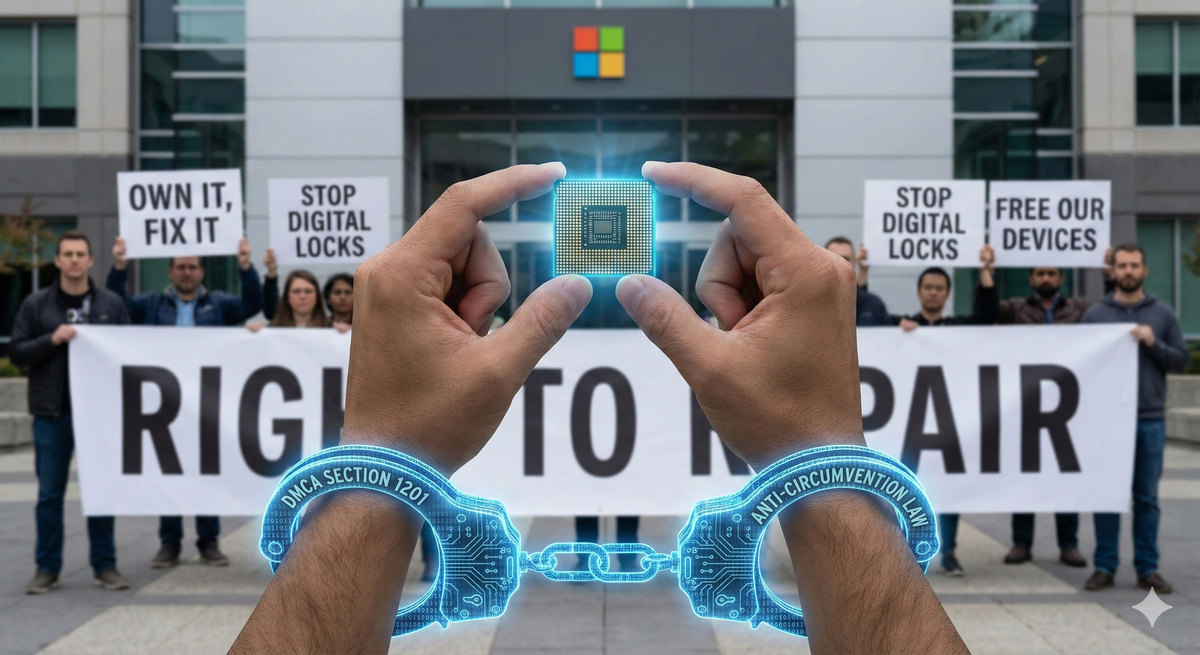
When the Rules Get Rewritten: How Ordered Liberty Changes Everything About Controlling Our Computers
What This Is Really About
Imagine you buy a tractor. You own it. It sits on your farm. But when it breaks, you cannot fix it yourself. The company that made it says you have to pay them $200 just to unlock the part you already installed. They do not fix anything. They just type in a code.
Or imagine you buy a phone. You own it. But the company that made it decides which apps you can use. They take 30 cents out of every dollar you spend. Not because they made the app. Just because they own the gate.
This is happening right now. To tractors. To phones. To ventilators in hospitals. To trains. To cars. To almost everything with a computer chip inside it.
The question is simple: Should the people who make our devices control how we use them forever? Or should we actually own what we buy?
Cory Doctorow has been fighting this fight for 25 years. He calls it "the war on general purpose computing." He has a plan to win it. But we need to ask: What happens after we win? What kind of world do we build?
That is where Ordered Liberty comes in.
The Problem: They Own What You Bought
How We Got Here
In 1998, the United States passed a law called the Digital Millennium Copyright Act. Section 1201 of this law made it a crime to modify digital products without permission from the company that made them. The penalty? Five years in prison and a $500,000 fine for a first offense.
Think about that. You can go to prison for fixing your own tractor.
The law was supposed to protect copyrights. But companies figured out they could use it to protect their profits instead. They put the flimsiest digital lock on their products. Then anyone who broke that lock was breaking the law. Even if they were not stealing anything. Even if they were just trying to fix what they owned.
This law spread to every country in the world. Not because other countries thought it was a good idea. But because America forced them to accept it through trade deals. The message was clear: Accept this law or we will not buy your coffee, your cars, your products.
What This Looks Like In Real Life
John Deere Tractors
When a farmer's tractor breaks down, they need to fix it fast. Crops do not wait. But John Deere tractors will not recognize new parts until a John Deere technician comes out and types in an unlock code. The farmer can install the part themselves. But the tractor will not start until they pay John Deere $200 for someone to press a few buttons.
During planting season, when every day matters, farmers are trapped. Pay up or lose your crop.
Apple's App Store
Apple makes about $100 billion every year from its app store. Not from making apps. From taking 30% of every dollar spent on apps made by other people. Every game developer, every news outlet, every creator on Patreon, everyone pays Apple just for the privilege of reaching iPhone users.
Could someone make a cheaper app store? Sure. But it is illegal to modify an iPhone to use a different app store. Apple uses the law to protect this $100 billion tax on the digital economy.
Medtronic Ventilators
Medtronic makes ventilators for hospitals. When a hospital technician fixes a broken ventilator, the machine will not work until a Medtronic representative comes and authorizes it. They charge hundreds of euros for this "service." All they do is remote into the computer and unlock what the hospital already fixed.
During COVID, when every ventilator mattered and planes were not flying, this arrangement killed people. Hospital technicians knew how to fix the machines. But they could not because the law protected Medtronic's profit stream.
Polish Trains
A Polish company named Newag makes trains. They programmed their trains to detect when they were taken to a competing repair shop. When a train sensed it was in the wrong place, it would brick itself. Just stop working completely.
The train operator would call Newag confused. Newag would helpfully remote in to "diagnose the problem." The diagnosis was always the same. For €20,000, they would send the unlock code.
Polish hackers figured this out and told everyone. Now Newag is suing them. Not for lying. The hackers told the truth. But for breaking the anti-circumvention law by revealing how the scam worked.
The Pattern
See the pattern? These are not bugs. These are features. The law lets companies:
- Turn ownership into permanent rental
- Extract money for doing nothing
- Block competition
- Punish anyone who tries to fix the system
Companies that make things do not want you to own them. They want you to rent them forever. The law backs them up.
The Trump Opportunity
The Tariff Weapon Loses Power
Here is where things get interesting. All those other countries agreed to anti-circumvention laws because America threatened them with tariffs. "Accept this law or we will not buy your stuff."
But then Donald Trump became president again. And he put tariffs on everyone anyway. Canada, Mexico, Europe, China. It did not matter if they followed the rules or not. Trump put tariffs on them.
Think about this from their perspective. You agreed to a bad deal because someone threatened to burn down your house if you did not. Then they burned down your house anyway.
Why keep following their rules?
The Third Option
When Trump put tariffs on other countries, most of them did one of two things:
- They gave Trump everything he wanted. This did not work. He just demanded more.
- They put tariffs on American goods. This hurt their own people more than it hurt America.
But there is a third option nobody has tried yet: Repeal the anti-circumvention law.
Here is why this is brilliant:
If Canada repeals their law, Canadian engineers can modify John Deere tractors without going to prison. They can make a modification that lets the tractor recognize new parts without calling home to John Deere. Then they can sell this modification to farmers all over the world. Including American farmers.
If Finland repeals their law, Finnish engineers can jailbreak iPhones. They can make a device that lets people install alternative app stores. Then they can sell this device everywhere. Suddenly everyone can buy apps without giving Apple 30%.
If France repeals their law, French engineers can unlock Mercedes cars so you do not have to pay a monthly subscription to use your own accelerator pedal.
Why This Works
This approach is targeted. It goes after the profit margins of the most exploitative companies. It does not hurt regular Americans. Most Americans are not shareholders in big tech companies. Most Americans are victims of big tech companies.
When Apple charges 30% on every app purchase, that hurts American small businesses. When John Deere forces expensive service calls, that hurts American farmers. When Medtronic bricks ventilators, that hurts American hospitals.
Breaking the tech monopolies helps everyone except the monopolists.
Plus, there is a bonus: Digital sovereignty. Right now, American companies control critical infrastructure in every country. Microsoft controls most government email. John Deere can brick tractors remotely. Apple can delete apps it does not like.
In 2025, when the International Criminal Court issued an arrest warrant for Benjamin Netanyahu, Microsoft immediately lost access to its email and calendars. Microsoft says this was a coincidence. But the timing makes people suspicious.
Under U.S. law, the government can force any American company to hand over any data, even if stored in foreign countries. And they can put a gag order on the company so nobody knows it happened.
This is exactly what people worried about when China's Huawei wanted to sell telecommunications equipment. Nobody wants to depend on infrastructure that can be turned off by a foreign government.
What Ordered Liberty Adds
The Question Nobody Is Asking
Doctorow's plan is good. Break the locks. Let people modify what they own. Build alternatives. This is important and necessary.
But here is the question: What kind of system do we build?
Right now, we live under what Doctorow calls "enshittification." Platforms start good, attract users, then gradually get worse as they extract more money and give less value. Think about Facebook. Think about Twitter becoming X. Think about Netflix raising prices and adding commercials.
If we just repeal anti-circumvention laws, we break the current monopolies. That is great. But what stops new monopolies from forming? What stops the new companies from doing the same things once they get big enough?
This is where Ordered Liberty matters. It gives us a framework for what we are building toward.
The Five Pillars Applied to Computing
Pillar 1: Educate Citizens in the Trivium Method
The Trivium is an ancient method of thinking clearly. It teaches you three things:
- Grammar: Gathering facts and information
- Logic: Understanding how ideas connect and spotting bad arguments
- Rhetoric: Communicating effectively and detecting manipulation
When people understand the Trivium, they can:
- Spot when tech companies are lying to them
- Understand their own interests
- Make informed choices about technology
- Participate in decisions about how technology gets regulated
Right now, tech companies depend on confusion. They hide what they are doing in complicated terms and long agreements nobody reads. They count on people not understanding how their devices work.
Education in clear thinking removes this advantage. When people can parse reality and detect manipulation, it is much harder to exploit them.
How this changes the computing debate: Instead of experts arguing while regular people feel lost, everyone has the tools to understand what is at stake. The debate about digital rights becomes a debate everyone can join.
Pillar 2: Provide Economic Foundation
Ordered Liberty proposes three automatic economic rules:
Rule A: Income Floor Everyone gets a base income tied to how much the economy produces. If machines are doing more work, everyone benefits from that productivity. This is not welfare. It is a foundation for participating in economic life.
Rule B: Credit Restrictions
Banks can create credit for productive things like new buildings, new businesses, and improvements. They cannot create credit for speculation like buying existing stocks or buying houses to flip them. This prevents artificial scarcity.
Rule C: Capacity Response When real shortages emerge, the system responds by expanding capacity, not by rationing through poverty. Temporary price controls prevent gouging while production catches up.
How this changes the computing debate: Right now, tech companies argue that they need to extract money from users to fund innovation. But what if basic security was guaranteed for everyone? What if we funded innovation through public investment instead of monopoly profits?
When people have economic security:
- They can afford to switch away from exploitative platforms
- They have time to learn about alternatives
- They can take risks on new technologies without fear
- They can demand better instead of accepting whatever is cheapest
Right now, people stick with Facebook even though they hate it because they cannot afford to lose those connections. They stick with expensive Apple products because switching costs money. They let companies spy on them because the free version is all they can afford.
Economic security removes this trap. Companies have to compete on quality, not just on being the default option people cannot afford to leave.
Pillar 3: Constrain Corporate Power
Ordered Liberty says corporations serve by charter, not by right. This means:
- Charters can be revoked for violations
- No credit privileges for political capture, stock buybacks, or regulatory gaming
- Size limits prevent "too big to fail"
- Corporate persons have no speech or religion rights
How this changes the computing debate: This is the missing piece in Doctorow's plan.
Yes, we should repeal anti-circumvention laws. Yes, we should enable adversarial interoperability. But we also need rules that prevent new monopolies from forming and keep companies from buying their way out of competition.
Right now:
- Apple buys smaller competitors before they become threats
- Facebook bought Instagram and WhatsApp to eliminate competition
- Amazon uses its platform data to identify and copy successful products
- Google pays billions to be the default search engine everywhere
- Microsoft buys up game studios to control content
These tactics do not depend on anti-circumvention law. They depend on having more money than everyone else and using that money to capture markets.
Under Ordered Liberty:
- Companies above a certain size cannot buy competitors
- Companies cannot use credit to fund buybacks or lobbying
- Charters get revoked for antitrust violations
- Corporate lobbying is prohibited
- Political spending is limited to natural persons only
This means even after we break the current monopolies, they stay broken. We do not just fight the same battle every ten years with new company names.
Pillar 4: Create Deliberative Infrastructure
Ordered Liberty proposes sortition assemblies: randomly selected citizens, trained in the Trivium method, who deliberate on major policy questions.
How this changes the computing debate: Right now, tech policy is made by three groups:
- Tech company lobbyists who write favorable laws
- Politicians who do not understand technology
- A few experts who do understand but lack democratic legitimacy
This is backward. The people affected by technology should have a say in how it is regulated.
Imagine sortition assemblies examining tech policy questions:
- Should companies be allowed to brick devices remotely?
- What data should companies be allowed to collect?
- Should platforms be required to provide data portability?
- How should AI systems be tested before deployment?
These assemblies would include:
- Farmers who deal with locked tractors
- Small business owners who pay app store fees
- Parents worried about what data schools collect
- Hospital workers dealing with locked equipment
- Regular users of social media platforms
They would be trained in the Trivium to:
- Understand the technical realities
- Spot manipulation from all sides
- Reason through competing interests
- Develop fair policies
This is not mob rule because the assembly members are educated in clear thinking. This is not technocracy because it includes broad participation from those affected.
How this differs from current tech policy: Current policy either comes from industry-captured regulators or from backlash regulation that does not quite work. Sortition assemblies would combine technical understanding with democratic legitimacy and immunity to lobbying.
Pillar 5: Enshrine Protections Constitutionally
Everything above gets protected by constitutional amendment requiring a supermajority to change. This prevents temporary majorities from selling out to corporate power.
How this changes the computing debate: Right now, each generation has to fight the same battles over again. Even when we win, we lose twenty years later when corporate lobbyists get new laws passed.
Constitutional protection means:
- The right to modify devices you own becomes permanent
- Economic foundation cannot be dismantled
- Corporate charters remain revocable
- Deliberative infrastructure stays funded
- Future generations inherit these protections
The Moral Framework
Three Questions
Ordered Liberty tests every policy through three questions:
1. Adams' Moral Algorithm: Does this serve the common good, or just private power?
Anti-circumvention laws clearly fail this test. They do not protect creators. Most creators never see copyright terms longer than the standard duration anyway. These laws protect corporate rent-seeking at everyone else's expense.
They serve private power, not the common good.
2. Rawls' Veil of Ignorance: Would you agree to this rule not knowing who you would be under it?
Imagine you do not know if you will be:
- A farmer needing to fix a tractor
- A CEO of John Deere
- A hospital worker during a pandemic
- A shareholder in Medtronic
- A small app developer
- An Apple executive
- A patient needing a ventilator
- A train operator in Poland
Would you agree to laws that let companies brick the equipment you depend on? Would you agree to laws that let companies charge arbitrary fees for doing nothing?
No rational person would agree to this from behind the veil of ignorance. The only people who benefit are a tiny number of executives and major shareholders. Everyone else loses.
3. Aristotle's Virtue Ethics: Does this build virtue, justice, and human flourishing?
What virtues does the current system build?
- Learned helplessness: "I cannot fix my own things"
- Dependence: "I must ask permission to use what I own"
- Resignation: "This is just how things work now"
What kind of flourishing does it enable?
- Corporate extraction flourishes
- Rent-seeking flourishes
- Planned obsolescence flourishes
- Human potential remains underdeveloped
The system teaches people they are powerless. It discourages self-reliance, problem-solving, and innovation. It rewards extracting from others rather than creating value.
A just system would build different virtues:
- Self-reliance: "I can repair what I own"
- Autonomy: "I control my own devices"
- Innovation: "I can make things better"
- Justice: "Companies serve us; we do not serve them"
Why This Matters Now
The Political Moment
We are living through a rare moment when change is possible. Here is why:
1. The old leverage is gone.
Trump put tariffs on everyone regardless of compliance. The threat that forced other countries to accept bad deals no longer works. Countries have already lost what they were trying to protect by cooperating.
2. Digital sovereignty is now existential. Microsoft bricking the International Criminal Court's email was a wake-up call. Every government now understands they are vulnerable. This is not theoretical anymore.
3. The coalition is unprecedented.
For the first time, we have:
- Digital rights activists with 25 years of experience
- Economic nationalists who want their countries to profit
- National security hawks worried about dependency
- Regular people hurt by monopoly extraction
4. The economic case is clear. Big tech margins represent pure extraction. There is $100 billion per year just in Apple's app store fees. Multiple billions more in John Deere's forced service calls, Microsoft's subscriptions, and similar schemes. This money could fund innovation or stay in people's pockets. Instead it piles up in corporate accounts and gets paid out to shareholders.
5. Public opinion has shifted.
Twenty years ago, people loved tech companies. Google was not evil. Facebook connected people. Apple made cool devices.
Now everyone understands these companies are extracting from them. People know Facebook is bad for mental health but feel stuck. They know they are being spied on but feel powerless. They know prices are too high but see no alternative.
This resentment is looking for direction.
The Danger of Winning Without Knowing Why
Here is the risk: We might win the fight against anti-circumvention laws. Other countries might repeal them. Adversarial interoperability might return. The current monopolies might break.
And then what?
If we do not build a better system, we just get new monopolies. The cycle repeats. We fight the same battle with different company names in twenty years.
Or worse: We get chaos. Breaking the current system without having a vision for what comes next can lead to fragmentation, confusion, and backlash that makes things even worse.
This is why Ordered Liberty matters. It is not just about breaking what is wrong. It is about building what is right.
What This Looks Like in Practice
Scenario 1: The Farmer
Under Current System: Maria's tractor breaks during planting season. She knows how to fix it. She orders the part overnight. But the tractor will not recognize the new part without a John Deere technician. The earliest appointment is in three days. Each day of delay costs her $5,000 in lost planting time. She has no choice but to wait and pay.
After Repealing Anti-Circumvention:
Maria's tractor breaks. She knows how to fix it. She orders the part and a small device made by a Canadian company. She plugs in the device, installs the part, and the device makes the tractor recognize it. Total time: four hours. Total cost: the part plus $50 for the device. She is back to work the same day.
Under Ordered Liberty: Maria's tractor breaks. She fixes it herself because right-to-repair is constitutionally protected and tractor companies cannot use software locks to prevent repairs. She learned how to fix tractors in a public technical education program that teaches practical skills along with Trivium thinking. She has economic security from the income floor, so she could afford to buy the tools she needs. The tractor company's charter prohibits planned obsolescence and rent-seeking. If they tried to lock down tractors, they would lose their charter and right to do business. Maria is back to work in four hours, paying only for the part.
Scenario 2: The Small Business Owner
Under Current System: James runs a small online business selling custom prints. He uses an app on the iPhone app store. Apple takes 30% of every sale. James wants to use a different payment processor that only charges 3%, but that violates Apple's rules. If he tries, Apple kicks his app off the store and he loses all his customers. He has no choice but to pay.
After Repealing Anti-Circumvention: James still runs his custom print business. He now sells through an alternative app store that a European company created after anti-circumvention laws were repealed. This store only charges 5% instead of 30%. His customers can still find him easily. He keeps more of his money.
Under Ordered Liberty:
James runs his business using open platforms that compete on service quality, not lock-in. App distribution is treated like infrastructure: regulated to prevent monopoly abuse, but open to competition. James pays transaction fees that cover actual costs plus reasonable profit, not monopoly rents. The economic foundation means his customers have purchasing power, so he has a reliable market. Corporate size limits prevented Apple from buying up all the alternative platforms. Constitutional protection means this openness cannot be taken away by lobbying.
Scenario 3: The Hospital
Under Current System: A pandemic hits. The hospital's ventilators are running 24/7. Some break down. The hospital's skilled technicians can fix them, but Medtronic's software prevents the ventilators from working until a Medtronic representative authorizes each repair. Representatives are overbooked. Planes are not flying. Ventilators sit broken while patients die.
After Repealing Anti-Circumvention: The same pandemic hits. Hospital technicians fix the ventilators. A medical device company in Germany made an authorization bypass device and made it freely available during the emergency. Hospitals use it. Ventilators get back online within hours instead of days. More patients survive.
Under Ordered Liberty: Ventilators are regulated as critical medical infrastructure. Software locks on life-saving equipment are prohibited. Hospital technicians are trained to maintain and repair equipment. Medical device companies compete on reliability and innovation, not on maintenance lock-in. Charters require them to support equipment for the device's full lifetime. During emergencies, regional supply networks can shift equipment where it is needed most. The economic foundation means hospitals are funded adequately so they can maintain proper equipment and staffing. Nobody profits from crisis.
The Hard Questions
Won't This Kill Innovation?
This is the standard objection. "If we limit corporate power and break monopolies, companies will not have money to innovate."
But look at where innovation actually comes from:
- The Internet came from public research
- GPS came from military research
- Touch screens came from public research
- The algorithms behind Google came from public research
- mRNA vaccines came from public research
Corporations are good at commercializing innovation. They are not usually where breakthrough innovation happens. Breakthrough innovation comes from people who are economically secure enough to take risks and think long-term.
Right now, most tech company money goes to:
- Stock buybacks
- Executive compensation
- Buying competitors
- Lobbying
- Marketing
Very little goes to actual research and development. Breaking monopolies and providing economic foundation would probably increase innovation by freeing people to pursue good ideas without depending on corporate approval.
Won't People Make Bad Choices?
"If people can modify their devices, they will break them or install malware or make poor decisions."
Three responses:
First, people already make poor choices. The current system does not prevent this. It just means people make poor choices while also being exploited.
Second, education in the Trivium helps people make better choices. Instead of keeping people helpless and hoping they do not get hurt, we give them tools to evaluate risks and make informed decisions.
Third, freedom includes the freedom to make mistakes. A system that protects people from all possible bad outcomes is a system that treats people as children. Adults should be allowed to take risks with things they own.
What About Security?
"If people can modify devices, won't this create security risks?"
Yes and no. The current system has plenty of security problems. Locking down devices does not actually make them more secure. It just means only the company can fix security problems, and companies are often slow to fix things that do not affect their profits.
Open systems with open code can be audited by anyone. When more eyes look at code, more problems get found and fixed. This is why Linux, an open system, often has better security than Windows, a closed system.
The real security risk is dependence on single companies that can be pressured by governments or that can fail. Diversification and openness usually improve security, not harm it.
Won't This Hurt American Companies?
In the short term, yes. Big tech monopolies will make less money. But consider:
First, most Americans do not own significant stock in big tech companies. The average American has almost zero financial assets. These companies getting smaller does not hurt regular Americans. It helps them by reducing the prices they pay and increasing their freedom.
Second, American innovation will continue. Breaking monopolies historically leads to more innovation, not less. When AT&T was broken up, telecommunications innovation accelerated. When Microsoft's monopoly was challenged, the internet flourished.
Third, American tech workers will be fine. The world will still need software, hardware, and services. Breaking monopolies just means more companies competing to provide these things, which often means more jobs, not fewer.
Fourth, defining "American interest" as "whatever helps big tech profits" is itself a form of corporate capture. America's interest is the wellbeing of American people, not the share price of a few companies.
The Path Forward
What Countries Should Do
Any country with the political will can lead this:
Step 1: Repeal anti-circumvention law
Remove criminal penalties for modifying devices and reverse-engineering software. This can happen through legislation or court decisions declaring the laws incompatible with property rights.
Step 2: Protect those who enable ownership Make it explicitly legal to:
- Develop and sell tools that let people modify devices
- Publish information about how systems work
- Create alternative app stores, firmware, and software
- Reverse-engineer for interoperability
Step 3: Support domestic industry
Invest in companies that create tools for digital sovereignty:
- Jailbreaking tools
- Alternative app stores
- Repair tools and training
- Open-source alternatives to big tech services
Step 4: Build coalition with other countries This works better if multiple countries do it together. Share tools, standards, and legal frameworks. Create a network of open systems.
Step 5: Implement Ordered Liberty framework Use this moment to build a better system, not just break the old one:
- Invest in Trivium education so citizens understand these issues
- Implement economic foundation so people can afford to switch away from exploitative services
- Constrain corporate power so new monopolies cannot form
- Create deliberative assemblies to make ongoing tech policy
- Enshrine these protections constitutionally
What Citizens Should Do
1. Get educated
Learn the Trivium method. Practice spotting manipulation. Understand how your devices work. You do not need to be an expert, but you should understand the basics of digital systems you depend on.
2. Support organizations fighting for digital rights Groups like the Electronic Frontier Foundation, Netzpolitik, Open Rights Group, and many others have been fighting this battle for years. They need support and members.
3. Demand better from representatives
Most politicians do not understand tech issues well. Explain to them why this matters. Share stories about how device locks harm real people. Make it a voting issue.
4. Use alternatives when available Every time you can, choose open systems over closed ones. Use open-source software. Support right-to-repair businesses. Buy from companies that respect ownership.
5. Talk about it
Many people do not know these issues exist. They do not realize they do not really own their devices. They do not know alternatives are possible. Share information.
What Advocates Should Do
1. Build the coalition Digital rights advocates need to actively build relationships with:
- Economic nationalists who want domestic industry
- National security hawks worried about dependency
- Labor unions concerned about worker power
- Environmental groups fighting planned obsolescence
- Consumer protection organizations
- Small business associations
These groups want different things, but they want enough of the same things to fight together.
2. Make it simple
Regular people do not care about "interoperability" or "circumvention." They care about fixing their stuff, keeping their data private, and not being ripped off. Frame issues in concrete terms people experience.
3. Show the economics
This is not just about rights. This is about billions of dollars being extracted from the economy. Countries that break tech monopolies will see that money stay in their economy. Make the economic case loudly.
4. Have the vision ready Do not just oppose the current system. Describe what comes next. Show people what a better system looks like. Give them something to work toward, not just something to work against.
5. Think constitutionally
Whatever gains we make need to be protected from future corporate capture. Think about how to make these changes permanent through constitutional protection or similarly strong mechanisms.
The Deeper Question
What is Technology For?
This whole debate comes down to a simple question: What is technology for?
The current answer is: Technology exists to generate profits for shareholders. Everything else is secondary. User benefit, innovation, security, sustainability all come after maximizing returns.
This is insane. Technology is a tool. Tools should serve people. When tools start to control people instead, something has gone very wrong.
Under Ordered Liberty, technology serves human flourishing. It expands human capability. It reduces drudgery. It connects people. It enables creation. It solves problems.
This means:
- Devices should work for owners, not manufacturers
- Software should be transparent and auditable
- Innovation should serve human needs, not just profit opportunities
- Technology should expand freedom, not create dependency
- Systems should be resilient and diverse, not centralized and fragile
These are not radical ideas. They are how we used to think about tools before software ate the world.
The Trap of Artificial Necessity
One reason this is hard is that we have been trained to see current conditions as necessary. "This is just how computers work." "This is just how apps are distributed." "This is just how modern devices are."
No. This is how powerful companies built systems to their own advantage. There is nothing necessary about it.
Farmers used to repair their own tractors. It was fine. Companies changed this not because repair became impossible, but because they saw a chance to charge for it.
Phones used to allow any software. It was fine. Apple changed this not because it became necessary to restrict software, but because they saw a chance to tax it.
Software used to be transparent and auditable. It was fine. Companies changed this not because secrecy became necessary, but because transparency limited exploitation.
When people say "you cannot turn back the clock," they are right. We cannot go back. But we can go forward to something better. We can build new systems that serve people rather than extract from them.
The technology to do this exists. The legal framework is simple. The economic benefits are clear. The moral case is overwhelming.
The only thing preventing it is the political will to challenge concentrated power.
The American Question
For Americans reading this, there is a specific question: What side are you on?
The current system extracts wealth from most Americans and concentrates it in a few companies. Yes, these are American companies. But they do not serve American interests. They serve shareholder interests.
When farmers pay $200 for someone to type in a code, that is money leaving farming communities and going to shareholders. When small businesses pay 30% to Apple, that is money leaving main street and going to Cupertino. When hospitals pay ransoms to use equipment they already fixed, that is money leaving healthcare and going to corporate profits.
This is not patriotism. This is extraction dressed up in a flag.
Real American interest means:
- Farmers keep their money and their freedom
- Small businesses keep their margins
- Hospital budgets go to care, not corporate ransoms
- Innovation serves people, not just shareholders
Breaking tech monopolies might hurt stock prices. But it helps people. If you have to choose between the two, which matters more?
Conclusion: The Choice
We are at a decision point. The old system is breaking down. Trump's chaos has broken the leverage that maintained it. Countries now face a choice:
Option 1: Try to restore the old system
Give in to American demands. Hope Trump goes away eventually. Wait for things to go back to normal. This will not work. The old system was already failing before Trump. Normal is not coming back.
Option 2: Retaliate within the old framework Put tariffs on American goods. Hurt your own people to show you are tough. This is just punching yourself in the face and hoping someone else says ouch.
Option 3: Build something better Repeal anti-circumvention laws. Enable digital sovereignty. Let your engineers and companies compete against big tech monopolies by serving users instead of extracting from them. Implement the Ordered Liberty framework to make sure you build a just system, not just a different exploitative system.
The first two options are losing plays. They might feel safe because they are familiar. But they lead nowhere good.
The third option is the one with potential. It is riskier because it is new. But it is also the only path to something actually better.
For This to Work
This is not a technical problem. The technology exists to build better systems. This is a political problem. It requires:
Political courage
Leaders must be willing to stand up to powerful companies and American pressure. This is hard. But the moment is right. Trump has made American pressure less frightening by making it constant and arbitrary.
Popular support
People need to understand what is at stake and why it matters. This requires education and clear communication. It requires showing people how the current system harms them and how alternatives would help.
Coalition building
No single group can do this alone. Digital rights advocates, economic nationalists, security hawks, labor unions, small businesses, and regular citizens need to work together. They do not need to agree on everything. They need to agree on enough.
Long-term thinking
This is not about the next election or the next quarter. This is about building systems that serve people for generations. That requires constitutional thinking and protection from corporate capture.
Moral clarity At its core, this is about what kind of world we want to live in. Do we want a world where a few companies control how we use our own property? Or do we want a world where people own what they buy and control their own lives?
The answer should be obvious. Making that answer real requires work.
The Historic Opportunity
Every few generations, circumstances align to allow major change. This is one of those moments. The old system is vulnerable. The tools exist to build something better. The coalition is forming. Public opinion is shifting.
If we miss this opportunity, we might not get another one for a long time. Corporate power will adapt. They will find new ways to lock down systems. They will buy new laws. They will fund think tanks to convince people this is necessary.
But right now, in this moment, change is possible.
The question is whether we have the vision to see what we are fighting for, not just what we are fighting against.
That is what Ordered Liberty provides: A vision of a system that serves people. A framework for testing whether policies work. A path to making changes permanent.
Combined with Doctorow's practical strategy for breaking current locks, we have both the means and the ends. We know how to break free. And we know what to build.
The rest is up to us.
Final Thoughts
This is not about being anti-technology. Technology is amazing. It has improved lives in countless ways. We should want more technology, better technology, technology that serves people more effectively.
This is not about being anti-American either. Many of the best ideas for digital freedom came from America. The Electronic Frontier Foundation is American. The free software movement started in America. Some of the strongest voices for digital rights are American.
This is about being pro-human. It is about building systems that serve people rather than extract from them. It is about democracy extending into the digital realm. It is about owning what we buy. It is about freedom, autonomy, and justice.
These are not complicated ideas. They are simple and ancient. We are just applying them to new problems.
When someone sells you something, you own it. When you own something, you control it. When you control it, you can modify it, fix it, improve it. Nobody should be able to use the law to take that away from you.
That is the core principle.
Everything else is just working out the details.
But the details matter. And the framework for thinking through those details matters. That is what Ordered Liberty provides.
Together, the practical strategy to break current locks and the moral framework to build better systems give us a complete path forward.
The door is open. The wind is blowing. The future is not determined.
What happens next is up to us.