The Database You Never Consented To
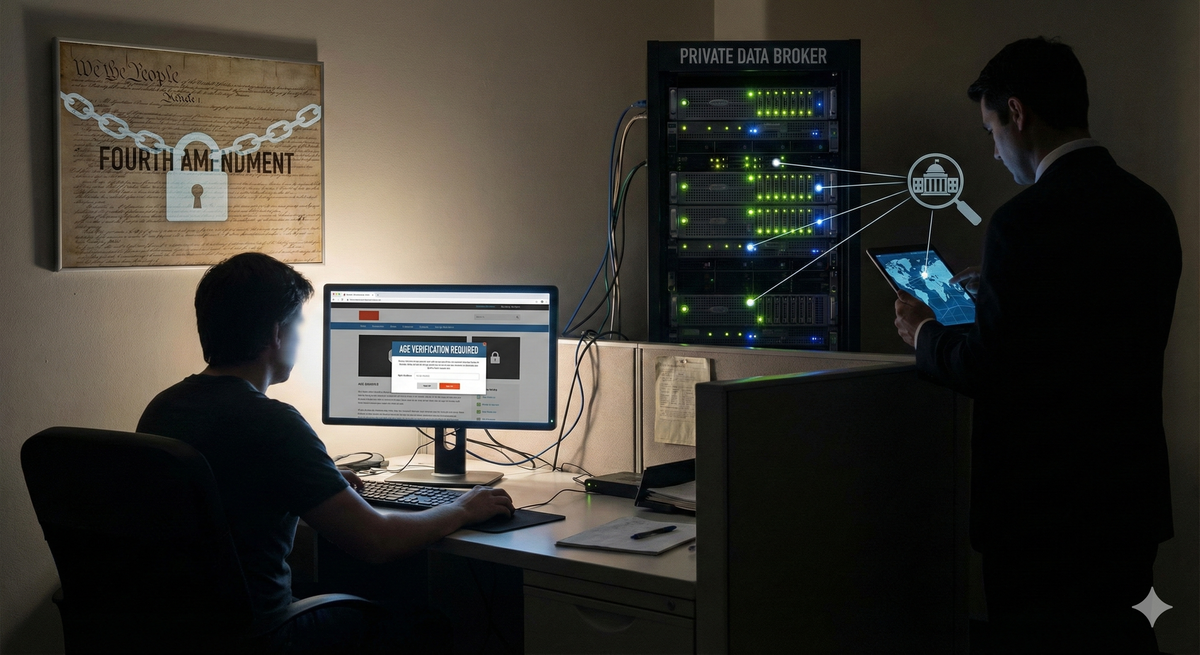
Age verification laws mandate private surveillance infrastructure. The third-party doctrine allows warrantless government access to these databases—accomplishing through corporate proxies what the Fourth Amendment prohibits directly.
The Third-Party Trap: How Age Verification Laws Create a Constitutional End-Run Around Your Fourth Amendment Rights
The Constitutional Loophole That Swallows Your Privacy Whole
There exists a peculiar quirk in American constitutional law that most people don't understand until it's used against them. When you share information with a third party—a bank, a phone company, a data broker—the traditional interpretation of the Fourth Amendment has been that you've voluntarily surrendered your privacy interest in that information. This legal principle, known as the third-party doctrine, means that government agencies can often obtain records about you from companies without ever getting a warrant, without ever showing probable cause to a judge, and often without you ever knowing it happened.
On December 2, 2025, the House Energy and Commerce Subcommittee convened what Representative Dingle acknowledged was their fifth hearing in recent years on "children's safety online." Nineteen bills were examined. Expert testimony was heard. Chairman Gus Bilirakis declared that "meaningful, lasting protections are urgently needed." The framing was entirely about protecting children from technology companies that have "failed to adequately protect" young people online.
What wasn't discussed—what the mainstream media isn't covering—is the infrastructure these bills are actually constructing.
Behind the child-safety rhetoric lies a sophisticated scheme to build what age verification mandates truly create: comprehensive surveillance databases that document every American's information access patterns, held by private third-party companies, and potentially accessible to government agencies without warrants, without probable cause, and without the Fourth Amendment protections that are supposed to constrain government surveillance.
The 2018 Supreme Court decision in Carpenter v. United States created a narrow exception to this doctrine for cell phone location data, recognizing that such information is so comprehensive, so revealing, and so automatically collected that it deserves Fourth Amendment protection even though it's held by wireless carriers. But that exception is limited, and it leaves vast categories of third-party data vulnerable to warrantless government access.
Now consider what age verification laws actually do. They don't just require you to prove your age. They mandate the creation of a massive infrastructure of third-party companies whose entire business model is collecting, verifying, and retaining your identity information and creating detailed records of which websites and services you and your family members access. Every verification creates a record. Every record is held by a third party. And under existing constitutional doctrine, much of this data may be accessible to government agencies without warrants.
This isn't a bug in the system. This is the feature. Age verification laws create a constitutional end-run around the Fourth Amendment, outsourcing surveillance to private companies and then accessing the resulting databases through the third-party doctrine loophole. What law enforcement cannot do directly—continuously monitor which information sources you access without obtaining warrants based on probable cause—they can potentially accomplish indirectly by mandating that private companies create the surveillance infrastructure and then requesting the data those companies collect.
Understanding the Third-Party Doctrine: The 1970s Cases That Haunt Your Digital Life
To understand why age verification databases represent such a profound constitutional threat, you need to understand two Supreme Court cases from the 1970s that established the third-party doctrine.
TL;DR To understand this legal loophole, imagine you keep a private diary in your home. For the police to read it, they need a warrant signed by a judge.
Now, imagine a new law requires that before you can write in your diary, you must dictate the entry to a clerk at a private "Verification Shop," who writes it down for you and keeps a copy. Because you "voluntarily" shared your thoughts with the clerk, the third-party doctrine says you have lost your expectation of privacy. The police no longer need a warrant to read your diary; they can simply ask the shopkeeper for the copy.
Age verification mandates force you to use the "shopkeeper" for every website you visit, effectively handing the government a key to your intellectual life that the Fourth Amendment was supposed to keep secure.
In United States v. Miller (1976), the Supreme Court ruled that you have no expectation of privacy in your bank records. The court reasoned that when you deposit checks, withdraw cash, or conduct transactions, you voluntarily convey that information to bank employees who must review and process those transactions. Because you've voluntarily shared the information with a third party—the bank—the government can obtain those records without a warrant. Your bank records, detailing your income, spending patterns, financial relationships, and economic behavior, are accessible to law enforcement without meeting the constitutional standard of probable cause.
Three years later, in Smith v. Maryland (1979), the court applied similar reasoning to telephone records. The case involved a pen register, a device that recorded the phone numbers a suspect dialed. The court held that you have no expectation of privacy in the phone numbers you dial because you voluntarily convey that information to the phone company, which must process it to complete your calls. The pattern of who you call, when you call them, and how often you communicate became accessible to government surveillance without warrant requirements.
These decisions established a principle that has haunted privacy rights ever since: if you voluntarily share information with a third party, you lose Fourth Amendment protection over that information. The government can obtain it without a warrant, without probable cause, without judicial oversight, and often without your knowledge.
Why the Carpenter Exception Doesn't Save You
In 2018, the Supreme Court recognized that the third-party doctrine couldn't be applied mechanically to all modern data without gutting the Fourth Amendment entirely. Chief Justice Roberts wrote that cell phone location data was different—so comprehensive, so revealing, so automatically collected—that it required warrant protection despite being held by wireless carriers.
The court's reasoning was specific and carefully bounded. Justice Roberts emphasized that cell phones have become "indispensable to participation in modern society," that location data collected over 127 days provides "an all-encompassing record of the holder's whereabouts," and that this data reveals "the privacies of life." Critically, he noted that people don't voluntarily share their location information in any meaningful sense; the data is collected automatically and continuously simply as a consequence of carrying a device that has become necessary for modern life.
But the Carpenter exception is narrow. The court explicitly stated it was not overturning the third-party doctrine. It was creating a specific exception for a particular type of data under particular circumstances. This leaves enormous categories of third-party held information potentially accessible without warrants.
Age verification records don't clearly fall within the Carpenter exception. When you verify your age to access a website, courts might characterize this as a voluntary action—you chose to visit that site, you chose to verify your identity, you chose to proceed. The data collection isn't continuous and automatic in the same way as location tracking; it happens at discrete moments when you take affirmative steps to access particular services.
This distinction might seem technical, but it could be constitutionally decisive. If age verification data falls outside the Carpenter exception, it remains subject to the third-party doctrine, meaning government agencies could potentially access comprehensive records of your family's online activities without ever obtaining warrants.
The Pre-Investigation Surveillance State
Here's where the constitutional implications become truly disturbing when you think through the practical applications. Traditional Fourth Amendment analysis assumes a sequence: law enforcement develops suspicion about a specific person, they gather evidence to establish probable cause, they obtain a warrant, then they conduct a search. The warrant requirement serves as a constitutional checkpoint, requiring government agents to convince a neutral judge that they have good reason to believe a crime has occurred and that the search will produce evidence of that specific crime.
Third-party databases accessible without warrants invert this entire structure. Instead of suspicion leading to investigation leading to warrant leading to search, we get continuous surveillance of everyone leading to database compilation leading to search triggering investigation. The surveillance precedes the suspicion. The data collection precedes any articulation of probable cause. The constitutional checkpoint that's supposed to prevent fishing expeditions gets bypassed entirely.
Consider how this works in practice with age verification databases. Imagine you're a federal prosecutor investigating a political organization you believe may have committed some form of fraud. Under traditional Fourth Amendment analysis, you'd need to develop evidence of probable cause that specific individuals committed specific crimes before you could obtain warrants to search their communications or movements.
But if comprehensive age verification databases exist, you might take a different approach. You could subpoena or request records from age verification companies showing everyone who accessed the organization's website, when they accessed it, how frequently they visited, and which other sites related to the organization they accessed. You're not searching for evidence of a crime. You're searching to identify potential suspects or witnesses, casting a wide net to see what you can find. The database makes this backwards investigation possible because the surveillance infrastructure already exists, comprehensively documenting everyone's information access patterns.
The Supreme Court addressed exactly this concern in Carpenter. Justice Roberts wrote: "The retrospective quality of the data here gives police access to a category of information otherwise unknowable. In the past, attempts to reconstruct a person's movements were limited by a dearth of records and the frailties of recollection. With access to cell site location information, the government can now travel back in time to retrace a person's whereabouts."
Age verification databases enable the same retrospective surveillance, but instead of retracing physical whereabouts, they retrace information access patterns. Law enforcement can travel back in time to see which websites you visited, which forums you accessed, which health information you researched, which political content you consumed—all without ever establishing probable cause that you committed any crime.
The Aggregation Danger: When Many Small Surrenders Become Total Exposure
The third-party doctrine becomes exponentially more dangerous when combined with the data aggregation capabilities of modern technology. In 1976, when the Supreme Court ruled on bank records, and in 1979, when they ruled on phone numbers, data existed in isolated silos. Your bank knew about your finances. The phone company knew about your calls. But these datasets weren't connected, weren't cross-referenced, and couldn't be easily compiled into comprehensive profiles.
Today's age verification infrastructure operates in a fundamentally different information ecosystem. Multiple companies provide verification services. These companies may share data, sell data, or consolidate through mergers and acquisitions. Government agencies can request data from multiple third-party verification providers and aggregate the results, constructing comprehensive pictures of individuals' online activities.
Think about what this means for your family in practical terms. Your teenage daughter verifies her age to access a social media platform using Company A's verification service. You verify your age to access a health forum using Company B's service. Your college-age son verifies his age to access an educational platform using Company C's service. Later, Company A acquires Company B, merging their databases. Company C sells its historical verification data to a data broker who also purchases information from the newly merged Company AB.
A prosecutor or government agency can now potentially access a comprehensive map of your entire family's information access patterns across platforms and time periods, all without obtaining a single warrant. Each individual verification might seem like a discrete, voluntary transaction. In aggregate, they create exactly the kind of "exhaustive chronicle" and "all-encompassing record" that concerned the Supreme Court in Carpenter, but without the constitutional protections the court provided for location data.
The Investigation That Starts Before You're Suspected
The practical implications of this legal structure become clear when you consider how investigations actually work in an age of accessible third-party databases. Law enforcement doesn't need to suspect you of anything specific to examine your digital footprints if those footprints are documented in third-party databases that don't require warrants to access.
Imagine federal agents investigating healthcare fraud. They want to identify doctors who might be involved in a prescription drug scheme. Under traditional investigation methods, they'd need specific evidence pointing to specific doctors before they could obtain warrants to search those doctors' records or communications.
With age verification databases, they might take a different approach: request data from verification companies showing everyone who accessed certain medical forums, telemedicine platforms, or pharmaceutical information sites over the past two years. They're not investigating you specifically. They're investigating a pattern, and you happen to match that pattern because you researched medication for your chronic pain condition online. Your verification records flag you as someone who accessed relevant sites frequently. Now you're on an investigation list, not because agents had probable cause to believe you committed a crime, but because algorithms found your data access patterns interesting.
Or consider political investigations. Congressional committees or federal agencies investigating activist organizations can potentially request verification records showing everyone who accessed the organization's website, downloaded their materials, or participated in their online forums. You attended one virtual meeting because you were curious about their position on local zoning policy. Your verification record now places you in a database of people associated with an organization under investigation. You didn't commit any crime. You didn't do anything wrong. You simply accessed information, and that access was documented by a third-party verification system that government agencies can access without showing a judge any evidence that you did anything improper.
The Fourth Amendment was supposed to prevent exactly this kind of dragnet surveillance. Justice Roberts cited Supreme Court precedents going back over 130 years, emphasizing that a central aim of the constitutional framers was to "place obstacles in the way of a too permeating police state." The warrant requirement serves as one of those obstacles, forcing government agents to develop specific evidence of specific crimes before conducting specific searches of specific people.
Third-party databases accessible without warrants remove that obstacle. The search precedes the evidence. The surveillance precedes the suspicion. The data collection happens continuously for everyone, creating comprehensive records that investigators can mine whenever they decide to start looking.
What Your Family's Verification Records Actually Reveal
To understand why age verification databases are so constitutionally problematic, consider what these records actually contain and what they reveal when aggregated over time.
Each verification event documents:
- Your verified identity (name, date of birth, government ID details, or biometric signature)
- The specific service or website you were accessing
- The precise date and time you sought access
- Your IP address or device identifier
- Potentially, the frequency of your access to that service
Individually, each verification might reveal little. You accessed a news site. You verified your age to view a medical forum. You created an account on a social platform. Taken as discrete events, these actions might not reveal much about you.
But verification systems don't capture discrete events. They capture patterns over time. And patterns are extraordinarily revealing. Justice Roberts recognized this in Carpenter, writing that comprehensive location data reveals "not only particular movements but through them a person's familial, political, professional, religious, and sexual associations."
Age verification data reveals the same associational information through information access patterns rather than physical movements:
Your health status and concerns become visible through which medical forums you access, which telemedicine platforms you use, which pharmaceutical information sites you visit, and when you access them. The frequency and timing of these accesses can reveal whether you're researching a chronic condition, a sudden health crisis, or preventive care. For your children, the pattern might reveal eating disorders, mental health struggles, or sexual health concerns they haven't shared with you.
Your political affiliations and interests emerge from which news sources you access, which political organizations' sites you visit, which activist platforms you engage with, and how those patterns change around elections or political events. Investigators don't need to read your posts or messages. The pattern of which platforms you access tells them which political tribes you belong to, which issues matter to you, and potentially which candidates you might support.
Your religious beliefs and practices become apparent through religious sites accessed, faith-based forums visited, and theological content consumed. The timing might reveal observance of religious holidays, periods of spiritual seeking, or exploration of different faith traditions.
Your sexual orientation and relationships can be inferred from which dating platforms you access, which LGBTQ resources you visit, which sexual health information you research, and when these access patterns emerge or change. For teenagers questioning their identity, these verification records document their entire journey of self-discovery, creating permanent records of their most private explorations.
Your financial situation and concerns show through which financial advice sites you visit, which debt management resources you access, which investment platforms you research, and how these patterns change over time. Verification records might reveal job searching, bankruptcy concerns, sudden wealth, or financial crisis.
Your legal troubles or concerns become visible through which legal information sites you access, which attorney directories you search, which specific areas of law you research, and when these accesses occur relative to other events in your life.
This is precisely the kind of information that Justice Roberts described as "the privacies of life." And just as with cell phone location data, verification records provide law enforcement with "access to a category of information otherwise unknowable," enabling them to travel back in time through your family's information access history.
The critical difference is that location data received Carpenter's warrant protection. Age verification data might not.
The Justice Gorsuch Problem: Property Rights vs. Privacy Expectations
The future of Fourth Amendment protection for age verification databases might depend on an unexpected source: Justice Neil Gorsuch, currently one of the Supreme Court's most conservative members.
In his Carpenter dissent, Justice Gorsuch voted against requiring warrants for cell phone location data, but his reasoning reveals important nuances. He didn't argue that the government should have unlimited surveillance power. Instead, he argued that the legal framework the court was using—the "reasonable expectation of privacy" test—was fundamentally flawed.
Justice Gorsuch wrote: "The Fourth Amendment protects your property, not reasonable expectations. It grants you the right to invoke its guarantees whenever one of your things—your person, your house, your papers, or your effects—is unreasonably searched or seized. Period."
His concern was both logical and troubling: if constitutional protection depends on whether society considers something private, then increasing surveillance erodes privacy expectations, which legally justifies more surveillance, which further erodes expectations in a downward spiral. If everyone accepts constant monitoring as normal, then we have no reasonable expectation of privacy, and therefore no Fourth Amendment protection. The protection disappears precisely when it's needed most.
This reasoning has profound implications for age verification databases. If a case challenging warrantless access to verification records relies on arguing that people have a reasonable expectation of privacy in which websites they visit, the government could respond that society increasingly accepts such monitoring as normal. After all, we agreed to terms of service. We clicked consent buttons. We knew verification companies would keep records. Under the expectation-of-privacy framework, this acceptance might defeat Fourth Amendment protection.
But Justice Gorsuch's property-based approach might offer stronger protection. Do you have a property interest in records documenting which information sources you access? Under older legal frameworks predating the 1970s third-party doctrine cases, the Supreme Court recognized property interests in private papers and personal records. A comprehensive database documenting your information access patterns across months or years might qualify as "papers" or "effects" within the Fourth Amendment's original meaning.
If a future case challenging age verification surveillance were argued using property-based rather than privacy-expectation-based reasoning, Justice Gorsuch might provide the critical fifth vote for requiring warrants. His dissent repeatedly emphasized that he would support stronger privacy protections if cases were argued using better legal frameworks. This creates a strategic opening: the right case, argued the right way, might establish warrant requirements for age verification databases even with the court's current conservative composition.
But that protection doesn't exist yet. And in the meantime, the infrastructure is being built, the databases are being filled, and your family's information access patterns are being documented in third-party systems that government agencies might access without warrants.
The Merger of Corporate and Government Surveillance
The third-party doctrine creates a troubling alignment of interests between private companies and government agencies. Age verification mandates force private companies to build surveillance infrastructure, those companies monetize the resulting databases, and government agencies gain access to comprehensive surveillance capabilities without having to build the systems themselves or obtain warrants to use them.
Consider the business model of age verification companies. Their primary revenue comes from fees charged for each verification transaction, but that's not their only potential revenue source. The databases they compile have enormous commercial value. Comprehensive records of which websites specific, verified individuals access represent exactly the kind of detailed consumer information that data brokers pay premium prices to acquire.
So verification companies face perverse incentives: they profit from transaction fees, but they also profit from retaining and selling data. Government mandates require the infrastructure to be built. Market forces encourage maximum data retention and monetization. And government agencies benefit from the resulting accessible databases.
This creates what security experts call a "public-private surveillance partnership," where legal mandates force infrastructure creation, economic incentives ensure comprehensive data retention, and constitutional loopholes enable government access. Nobody explicitly designed this system to be a surveillance state, but the separate logics of legislative mandates, market incentives, and legal doctrines combine to create one.
The Supreme Court in Carpenter recognized that technology has fundamentally changed the economics of surveillance. Justice Roberts wrote: "Prior to the digital age, law enforcement might have pursued a suspect for a brief stretch, but doing so for any extended period of time was difficult and costly and therefore rarely undertaken."
He continued: "For that reason, society's expectation has been that law enforcement agents and others would not and indeed in the main simply could not secretly monitor and catalog every single movement of an individual's car for a very long period."
Age verification laws eliminate those practical constraints. Law enforcement doesn't need to pursue anyone or expend any resources monitoring them. The verification infrastructure monitors everyone continuously and automatically, creating comprehensive databases documenting information access patterns. Investigators simply request the data, potentially without warrants, whenever they decide someone or some pattern interests them.
This represents a fundamental shift in the relationship between citizens and government surveillance. The Fourth Amendment's protections were designed for a world where surveillance required deliberate government action, resource expenditure, and therefore selective targeting. When surveillance is automatic, continuous, and comprehensive, the constitutional framework designed to regulate selective monitoring loses much of its protective value.
The Investigative Paths That Never Require Warrants
To make the constitutional danger concrete, consider the investigative pathways that age verification databases enable without requiring warrants at any stage.
Pathway 1: The Association Map
Federal investigators want to understand the network around a suspected organized crime figure. Instead of obtaining warrants to tap phones or search communications, they request age verification records showing everyone who accessed the same forums, websites, or services that the suspect accessed. They're not searching the suspect's records—they're searching third-party databases to find people with similar patterns. These people haven't committed crimes. They might have no connection to the suspect beyond visiting the same websites. But they're now documented in an investigative database as "associates" based on shared information access patterns.
For your family, this means that if any of you ever accessed any website or service that someone under investigation also accessed, your verification records might end up in an investigative file. You researched Italian restaurants in the same city where a money laundering suspect researched them. Your son accessed gaming forums that someone involved in a cybercrime case also accessed. Your daughter visited college websites that appeared in a fraud investigation involving false credentials. None of you did anything wrong, but your verification records create associations that make you investigative data points.
Pathway 2: The Behavior Profile
Researchers have developed algorithms that claim to predict criminal behavior based on online activity patterns. Government agencies, rather than obtaining warrants to monitor specific suspects, could potentially request age verification data for thousands or millions of people, run it through predictive algorithms, and generate lists of individuals whose behavior patterns the algorithms flag as suspicious. The "investigation" consists of mining existing third-party databases for patterns, with no particularized suspicion of specific individuals required to start the process.
This isn't speculative. It's already happening with other data types. License plate readers create databases that algorithms search for suspicious travel patterns. Social media monitoring identifies individuals whose posts match linguistic patterns associated with various behaviors. Age verification databases provide another dataset that predictive algorithms can mine to identify people for investigation based on information access patterns rather than evidence of crimes.
Pathway 3: The Retroactive Timeline
A political scandal breaks, and investigators want to understand who knew what and when. They request verification records showing everyone who accessed certain news sites, leaked document repositories, or whistleblower platforms during specific time windows. They're not investigating specific suspects—they're using verification databases to identify everyone who accessed relevant information, then working backward to determine who might have been sources, reporters, or others involved in the scandal. Your verification records document that you accessed a news site that published leaked information. Now investigators want to know if you're a leaker, a journalist, or just a curious reader. Your information access became investigative evidence without anyone ever obtaining a warrant to search your records.
Pathway 4: The Compliance Audit
Regulatory agencies investigating potential violations of any law can request verification data to identify everyone who accessed information relevant to their regulatory domain. The SEC investigating potential insider trading can request records of everyone who accessed certain financial information platforms around the time of suspicious trades. The FDA investigating pharmaceutical marketing violations can request records of everyone who accessed certain medical information sites. The FEC investigating campaign finance violations can request records of everyone who accessed political organization sites. These aren't criminal investigations requiring probable cause. They're regulatory compliance matters where the legal standards for information requests are often lower than Fourth Amendment requirements.
Each of these pathways operates without requiring warrants because the data is held by third parties, the requests target databases rather than specific individuals, and the investigations begin with pattern analysis rather than individualized suspicion. This is exactly the kind of general warrant and dragnet search that the Fourth Amendment was designed to prohibit, accomplished through the third-party doctrine loophole.
The Permanent Record That Follows Your Children
The long-term implications for young people growing up in an age verification regime are particularly concerning when combined with third-party doctrine accessibility. Every verification event that your teenage children create becomes a permanent data point in third-party databases that could be accessible to government agencies throughout their adult lives without warrant requirements.
Your 14-year-old daughter researches reproductive health information online. Her age verification records document these inquiries. Ten years later, she's 24 and applies for a job that requires a security clearance. Background investigators request verification data from companies documenting her information access history over the past decade. Her adolescent health concerns, documented through verification records, become part of her adult security clearance file. No warrant was required to access this data because it's held by third parties and the government characterizes the request as part of a background check rather than a criminal investigation.
Your 16-year-old son explores questions about gender identity by accessing LGBTQ forums and resources. His verification records document this entire journey of self-discovery. Five years later, he's 21 and his family is going through a difficult divorce and custody battle. Attorneys in the case request age verification data to build arguments about parental influence or household environment. His most private adolescent explorations become evidence in family court because that data sits in third-party databases accessible through civil discovery processes.
Your nephew researches political activism as a high school civics project, accessing sites associated with various political movements across the spectrum. His verification records document these access patterns. Years later, when he's applying to college or seeking employment or traveling internationally, those patterns might be analyzed by algorithms that flag certain political associations as concerning. His educational curiosity becomes a data trail that follows him through life, always available for examination by any entity with legal authority to request third-party records.
This represents a profound shift in how young people experience growing up. Previous generations had the privilege of exploration, mistakes, and identity formation in relative privacy. What happened in adolescence generally stayed in adolescence unless it resulted in criminal records or similar formal documentation. The digital traces of their questions, interests, and development weren't systematically compiled into permanent, accessible databases.
Age verification infrastructure eliminates that privacy of development. Every question your children ask through information access, every interest they explore, every aspect of identity they examine gets documented in third-party databases that could be accessible to government agencies, employers, schools, opposing attorneys, or others throughout their lives. The verification system ostensibly designed to protect children creates permanent surveillance records of their developmental journeys.
The Chilling Effect on Information Seeking
Constitutional scholars have long recognized that surveillance has chilling effects on speech and information access even when no formal punishment follows. If people know their information-seeking behavior is being documented and potentially accessible to government agencies, they alter what they research, which questions they ask, and which topics they explore.
This isn't paranoia. It's a rational response to surveillance. If you know that accessing certain medical information might create records that government agencies can review without warrants, you might avoid researching that condition even if you legitimately need the information. If your teenager knows that exploring questions about sexuality or gender might create accessible records, they might avoid seeking information crucial to their development.
The Supreme Court has repeatedly recognized these chilling effects as constitutional injuries. In Carpenter, Justice Roberts quoted extensively from precedents emphasizing that Fourth Amendment protections exist precisely because surveillance alters behavior even without direct consequences. The knowledge that you're being watched, that records are being kept, that those records might be accessible changes how you act and what you're willing to explore.
Age verification databases create exactly this chilling effect. Every time you or your family members encounter an age gate, you make a calculation: is the information valuable enough to create a verification record? Is accessing this resource worth documenting that you accessed it? For sensitive health information, political content, religious exploration, or any other private inquiry, the answer might be no—not because the information isn't valuable, but because the surveillance cost is too high.
This calculation is particularly acute for the topics that often matter most: information about abuse, mental health struggles, sexual orientation, political dissent, religious questioning, or other subjects where privacy is essential. The people who most need information are often the people for whom surveillance poses the greatest risks. And under current legal doctrines, the verification records documenting their information access might be accessible to government agencies without warrants.
What Constitutional Protection Actually Requires
The Fourth Amendment contains a simple and clear protection: government agents cannot conduct unreasonable searches and seizures. To be reasonable, searches generally must be based on warrants, and warrants require probable cause—specific evidence that crimes have occurred and that the search will produce evidence of those specific crimes.
This constitutional structure serves multiple purposes. It protects innocent people from being investigated when there's no evidence they've done anything wrong. It ensures that government surveillance is targeted rather than general. It places a neutral judge between law enforcement suspicions and investigative actions. It requires investigators to develop evidence before conducting searches rather than searching to see if evidence exists.
The third-party doctrine undermines each of these protections. When government agencies can access comprehensive databases documenting your information access patterns, political interests, health concerns, and private inquiries without obtaining warrants, the Fourth Amendment's protective framework collapses. Surveillance becomes general rather than targeted. Searches precede rather than follow evidence of crimes. Judicial oversight disappears. The barriers between citizens and pervasive government monitoring dissolve.
Age verification laws accelerate this collapse by mandating the creation of exactly the kind of comprehensive surveillance infrastructure that the Fourth Amendment should prohibit. They force private companies to build databases that the government potentially can access without warrants, creating a surveillance system that circumvents constitutional protections through the third-party doctrine loophole.
The Supreme Court recognized in Carpenter that some data is so comprehensive and revealing that it requires warrant protection even when held by third parties. The court should extend that reasoning to age verification databases. Comprehensive records of information access over time reveal the same "privacies of life" that location data reveals. They're collected automatically as a consequence of participation in modern society. They provide retroactive surveillance capabilities that law enforcement has never had before.
But that constitutional protection doesn't exist yet. Until courts explicitly extend Carpenter's logic to age verification data, or until Justice Gorsuch's property-based approach gains majority support, your family's information access patterns documented in third-party verification databases might remain accessible to government agencies without warrant requirements.
The System We're Building While Debating Privacy
As lawmakers debate age verification mandates and courts slowly work through constitutional challenges, the surveillance infrastructure is being built in real time. Every verification system that gets implemented creates new databases. Every verification event adds records. Every day that passes fills those databases with more comprehensive information about more people's information access patterns.
By the time courts definitively rule on whether warrants are required to access age verification databases, those databases will already contain years of comprehensive data about millions of people. If courts ultimately rule that warrants are required, the data already collected won't disappear. If courts rule that the third-party doctrine applies and warrants aren't required, the infrastructure for warrantless surveillance will already be fully operational.
This represents a fundamental challenge to constitutional governance. The Fourth Amendment is supposed to constrain government surveillance before it occurs, not remediate it afterward. But modern technology moves faster than legal processes. Systems get built, deployed, and populated with data while courts are still hearing arguments about whether those systems are constitutional.
The practical result is that your family's information access patterns are being documented right now in third-party databases whose constitutional status remains uncertain. Government agencies might already be requesting and accessing this data while courts debate whether they should be allowed to. The surveillance happens during the legal uncertainty, and by the time the law is settled, the surveillance has already occurred.
Conclusion: The Surveillance Infrastructure Disguised as Child Safety
When you see lawmakers proposing age verification mandates to "protect children," recognize what's actually being proposed: the construction of comprehensive surveillance infrastructure that documents everyone's information access patterns in third-party databases that government agencies might access without warrants, without probable cause, and without judicial oversight.
This isn't conspiracy theory or speculation. It's the logical consequence of combining age verification mandates with existing legal doctrines around third-party data. The third-party doctrine, established in the 1970s before digital surveillance capabilities existed, creates a constitutional loophole that age verification laws exploit. The result is a surveillance system that accomplishes through private companies what government agencies cannot accomplish directly: continuous monitoring of which information sources you and your family access.
The Carpenter decision showed that some Supreme Court justices understand how technology has changed surveillance capabilities and are willing to adapt constitutional protections accordingly. But Carpenter's protections are narrow, and they might not extend to age verification databases. Justice Gorsuch's property-based approach might eventually provide stronger protection, but only if cases are argued using frameworks he finds constitutionally sound.
In the meantime, the databases are being built, filled, and potentially accessed by government agencies that don't need warrants to request third-party data. Your information access patterns, your children's developmental journeys, your family's private inquiries—all documented in systems that circumvent Fourth Amendment protections through legal technicalities.
This is the system being constructed in the name of protecting children. The question is whether courts will recognize it as the Fourth Amendment violation it appears to be before it becomes so entrenched that dismantling it is politically impossible.
The Fourth Amendment was supposed to place obstacles in the way of a too-permeating police state. Age verification mandates, combined with the third-party doctrine, remove those obstacles and construct the very pervasive surveillance infrastructure that constitutional protections were designed to prevent. Whether those protections will be extended or eroded depends on legal battles that are just beginning—while the surveillance they're meant to constrain is already underway.