Symmetry of Democratic Collapse
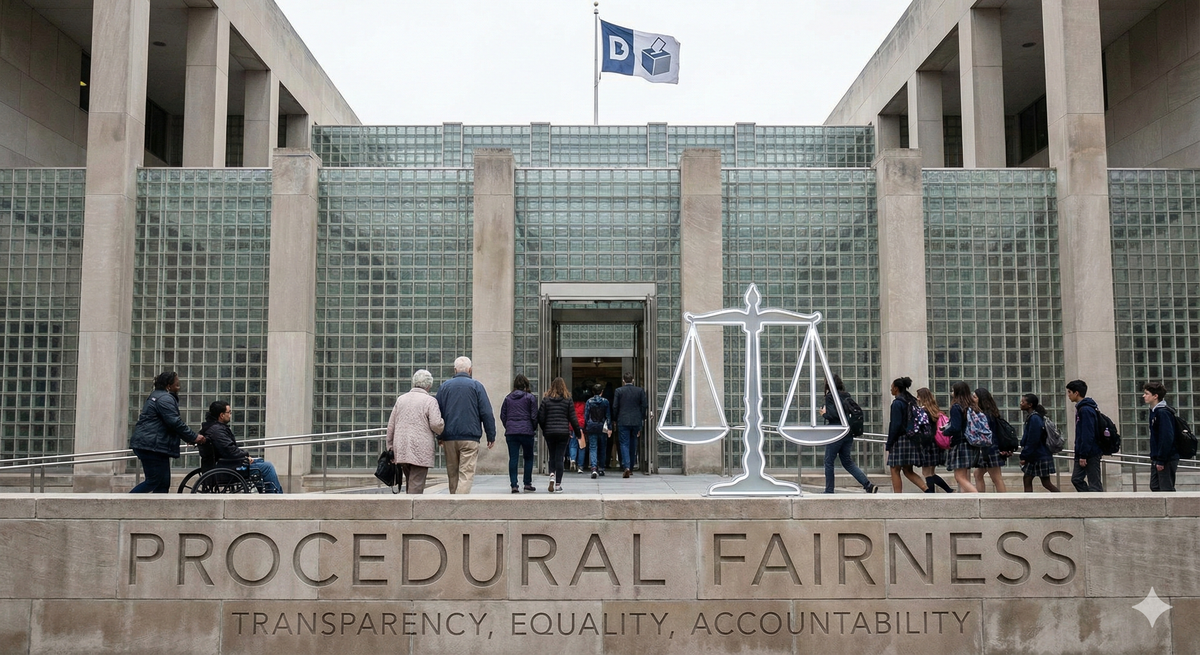
Procedural fairness, not moral certainty or ideological victory, is the true foundation of democratic survival
A Theory of Constitutional Restraint in an Age of Moral Certainty
Core Thesis
Democratic governance survives not through the victory of correct ideas, but through the systematic restraint of power by those who believe themselves correct. The central crisis of contemporary American democracy is not ideological disagreement about justice, equality, liberty, or order—it is the progressive abandonment by all sides of the constitutional principle that procedural fairness must constrain even righteous causes.
This thesis argues that:
- Both major political traditions have constructed increasingly sophisticated justifications for using institutional power to enforce moral conclusions rather than protect democratic contestation
- This symmetry of abandonment creates a ratchet effect where each side's power-grab normalizes the next escalation
- The solution requires not ideological convergence but restoration of shared constitutional restraint through educational transformation
- Democratic renewal depends on teaching citizens how to think (procedural reasoning) rather than what to think (substantive conclusions)
I. The Foundational Maxim: Power, Reciprocity, and Constitutional Legitimacy
The Principle
No cause, even one that believes it is right, should use government or institutional power to label some citizens as morally better or worse, silence legal disagreement, or ignore the Constitution.
This maxim rests on three pillars:
1. The Reciprocity Test
Any power you claim must be acceptable when wielded by your opponents. This is not relativism—it is the recognition that institutional power persists beyond the tenure of those who currently hold it. Today's precedent becomes tomorrow's weapon.
Constitutional legitimacy requires asking: "Would I accept this same authority, procedure, and enforcement mechanism in the hands of those I most distrust?" If the answer is no, you are seeking not justice but domination.
2. The Epistemic Humility Principle
Bad ideas fade when debated. Bad ideas harden when enforced.
The enforcement of conclusions—even correct ones—through institutional power rather than persuasion produces three pathologies:
- Martyrdom effect: Suppressed ideas gain moral authority from their suppression
- Calcification: Enforcement prevents the natural evolution, refinement, and eventual obsolescence of bad ideas
- Intellectual atrophy: Protecting people from error prevents them from developing the cognitive tools to recognize and reject it
The liberal democratic wager is that free inquiry, despite producing temporary harm through the circulation of bad ideas, produces more durable truth and more capable citizens than does institutional enforcement of orthodoxy.
3. The Common Good Standard (Adams' Constitutional Principle)
Government legitimacy derives from serving "the common good" rather than "the profit, honor, or private interest of any one man, family, or class of men."
This requires distinguishing between:
- Procedural fairness (rules that protect equal standing and contestation) = legitimate
- Substantive enforcement (using power to make some citizens morally/socially superior) = illegitimate
The Constitution establishes process protections (speech, due process, equal protection, federalism, separation of powers) precisely because the Founders understood that concentrated power corrupts even when wielded by the virtuous.
II. The Historical Pattern: Symmetry of Abandonment (1920s-2025)
The Escalation Mechanism
Your historical analysis reveals a consistent pattern across a century:
Phase 1: Legitimate Grievance
Each era begins with a real injustice or crisis requiring institutional response:
- Civil rights violations
- Economic exploitation
- Security threats
- Public health emergencies
- Democratic erosion
Phase 2: Justified Intervention
Power is deployed to address the crisis with moral certainty:
- Federal enforcement against Jim Crow
- Securities regulation after crashes
- Surveillance expansion after terrorism
- Mandates during pandemic
- Emergency procedures to "save democracy"
Phase 3: Precedent Normalization
The exceptional becomes routine; the temporary becomes permanent:
- Civil rights enforcement becomes disparate impact doctrine
- Financial regulation becomes regulatory capture
- Counterterrorism becomes mass surveillance
- Emergency powers become governance norms
- "Democracy protection" becomes opposition suppression
Phase 4: Counter-Mobilization
The other side, having opposed the initial intervention, eventually gains power and uses the now-normalized tools:
- Right uses courts to block federal mandates
- Left uses courts to enforce outcomes
- Both sides weaponize emergency powers
- Both sides expand surveillance against "extremists"
- Both sides justify hardball as existential necessity
Phase 5: Legitimacy Collapse
Neither side trusts institutional neutrality because both sides have demonstrated they will use power to enforce preferred outcomes when possible.
The Symmetry Observation: Two Failures, One Pattern
The brilliance of analysis is recognizing that left and right fail symmetrically but differently:
Left Pattern: Over-Theorizing Morality, Under-Restraining Power
- Develops sophisticated frameworks for identifying systemic injustice
- Correctly analyzes how power operates through culture, institutions, and "neutral" rules
- Fatal flaw: Believes that moral sophistication justifies institutional enforcement
- Result: "All disparate outcomes are discrimination" → enforcement without due process
The left built a theory of everything except restraint.
Right Pattern: Under-Theorizing Power, Defending Authority
- Correctly warns against utopian projects and rapid social transformation
- Recognizes importance of tradition, stability, and mediating institutions
- Fatal flaw: Fails to develop theory of how power corrupts even "traditional" institutions
- Result: "Law and order" → accepts authoritarian tools to preserve hierarchy
The right defended power structures without a theory of constitutional limits.
The Ratchet Effect
Each cycle makes the next worse because:
- Precedent Normalization: Yesterday's emergency power is today's standard operating procedure
- Tactical Learning: Each side learns from the other's techniques and applies them with their own moral justification
- Legitimacy Erosion: Institutional neutrality becomes implausible when both sides have demonstrated partisan weaponization
- Moral Escalation: Each side's power-grab is justified by the other side's previous violation
- Constitutional Abandonment: Process protections are dismissed as obstacles to justice rather than constraints on power
III. Contemporary Applications: Testing Policies Against the Maxim
The Decision Framework
For any policy, ask four questions:
- Reciprocity Test: Would I accept this power/procedure/standard in the hands of my opponents?
- Procedural Test: Does this protect contestation or enforce conclusions?
- Restraint Test: Are there built-in limits, sunset provisions, appeal mechanisms, transparency requirements?
- Common Good Test: Does this serve all citizens equally or advantage one faction over others?
Applied to Current Flashpoints
Civil Rights Enforcement
Disparate Impact Doctrine
- Fails reciprocity: Presumes discrimination from statistical outcomes without due process
- Fails procedure: Enforces outcome-equality rather than protecting equal treatment
- Constitutional alternative: Intent-based standard with evidence, adversarial process, and judicial review
Intent-Only Standard
- Fails power theory: Ignores how neutral rules can embed structural discrimination
- Fails common good: Allows systematic exclusion through formally neutral procedures
- Constitutional alternative: Evidence of discriminatory effect triggers scrutiny of whether neutral rule serves legitimate purpose
Constitutional Middle Path:
Statistical disparities trigger investigation → burden shifts to institution to demonstrate legitimate, non-discriminatory purpose → adversarial process with evidence → judicial review of both means and ends.
Free Speech & Platform Governance
Government-Pressured Moderation
- Fails reciprocity: "Misinformation" determinations change with who holds power
- Fails procedure: Suppresses contestation rather than protecting it
- Constitutional alternative: Narrow prohibitions on direct incitement/fraud with clear standards and judicial review
Absolute Deregulation
- Fails common good: Permits oligopolistic control of public discourse
- Under-theorizes how private power can suppress speech as effectively as government
- Constitutional alternative: Antitrust enforcement against concentration + transparency requirements + user control over algorithmic curation
Public Health & Emergency Powers
Indefinite Mandates
- Fails restraint: No sunset provisions, legislative oversight, or exit criteria
- Fails procedure: Expert decree without political accountability
- Constitutional alternative: Time-limited authorization → legislative reauthorization required → adversarial scientific review → individual accommodation process
Blanket Opposition to Any Mandate
- Fails common good: Denies collective action problems requiring coordination
- Under-theorizes how individual liberty requires baseline health security
- Constitutional alternative: Narrow mandates for clear public goods + exemption processes + transparent cost-benefit analysis + automatic sunset
Education & Curriculum
Compelled Affirmation
- Fails reciprocity: Today's required orthodoxy becomes tomorrow's forbidden heresy
- Fails procedure: Teaching conclusions rather than methods of inquiry
- Constitutional alternative: Teach contested ideas with viewpoint diversity + develop analytical tools + protect dissent
Banned Topics/Books
- Fails reciprocity: Control of acceptable ideas depends on who holds power
- Fails procedure: Prevents exposure to uncomfortable truths
- Constitutional alternative: Age-appropriate exposure to contested ideas + critical analysis instruction + parental notification/opt-out for youngest students
Constitutional Middle Path:
Teach the Trivium, not the orthodoxy.
- Grammar: What are the competing claims and evidence?
- Logic: What are the strongest arguments for each position?
- Rhetoric: How do we persuade across disagreement while respecting pluralism?
IV. The Theoretical Foundation: Why Restraint Precedes Justice
The Liberal Democratic Wager
The Enlightenment insight was not that all ideas are equally valid (relativism) but that:
Institutional enforcement of orthodoxy produces worse outcomes than does protected contestation, even when the enforced orthodoxy is correct.
This is because:
1. Epistemic Benefits of Error
- Encountering and refuting bad arguments strengthens capacity to recognize good ones
- Mill's principle: Truth that goes uncontested becomes "dead dogma" rather than "living truth"
- The process of defending correct positions against challenge improves understanding
2. Adaptive Evolution
- Ideas must evolve as circumstances change
- Enforcement freezes ideas at moment of codification
- Free inquiry allows continuous refinement and correction
3. Legitimacy Through Consent
- Conclusions accepted through persuasion have democratic legitimacy
- Conclusions enforced through power create resentment and resistance
- Voluntary cooperation is more durable than compelled compliance
4. Power Always Corrupts
- Today's righteous enforcers become tomorrow's defensive establishment
- The tools built for noble purposes get used for base ones
- Constitutional restraints protect against future abuse, not just current threat
The Critical Insight: Process Before Outcome
You cannot reach just outcomes through unjust procedures.
This is the reverse of "ends justify means" consequentialism. Democratic theory holds that:
- Legitimate outcomes must emerge from legitimate processes
- Legitimate processes protect contestation and equal standing
- Protecting these processes is more important than achieving any particular outcome
Why? Because sustainable justice requires voluntary cooperation, which requires perceived legitimacy, which requires fair procedures.
Enforcement can compel compliance but cannot generate legitimacy. Illegitimate procedures—even when producing substantively correct outcomes—undermine their own sustainability by breeding resentment and resistance.
V. The Educational Imperative: Teaching How to Think
The Trivium as Constitutional Method
Your educational framework is not just pedagogical—it's constitutional infrastructure:
Grammar Phase: Establishing Shared Facts
- What are the competing claims?
- What evidence supports each position?
- What do we actually know vs. what do we infer?
Constitutional function: Creates common factual ground for contestation without requiring agreement on interpretation.
Logic Phase: Evaluating Arguments
- What are the strongest arguments for each position?
- What are the logical connections between premises and conclusions?
- Where do competing frameworks diverge and why?
Constitutional function: Develops capacity to recognize when disagreement stems from different values vs. different reasoning vs. different facts.
Rhetoric Phase: Persuading Across Disagreement
- How do we make our case to those who start from different premises?
- What rhetorical appeals work across ideological divides?
- How do we preserve relationships while contesting ideas?
Constitutional function: Creates culture of persuasion rather than enforcement, negotiation rather than domination.
Why This Matters for Democratic Survival
The factory model of education—optimized for producing compliant workers—created citizens who:
- Accept authority without questioning
- Seek correct answers rather than developing analytical capacity
- Fear being wrong more than they value discovering truth
- Treat disagreement as threat rather than opportunity
This is how democracies die: not from shortage of correct ideas but from citizens incapable of navigating disagreement through reason rather than force.
The Trivium method produces citizens who:
- Can distinguish between "I disagree" and "you're evil"
- Understand that reasonable people can reach different conclusions from shared evidence
- Value the process of inquiry over the comfort of certainty
- Recognize that today's orthodoxy may be tomorrow's discarded error
The Connection to Democratic Restraint
Citizens educated in Trivium method understand:
Procedural fairness protects them more reliably than does substantive enforcement of currently popular positions.
Why? Because:
- Today's majority opinion becomes tomorrow's minority view
- The tools of enforcement you build will be used against you
- Your cognitive sovereignty depends on protecting others' dissent
- Democracy survives through contested inquiry, not enforced consensus
VI. The Way Forward: Constitutional Restoration Through Educational Transformation
The Strategic Framework
Democratic renewal requires three simultaneous transformations:
1. Institutional Reform: Rebuilding Constitutional Restraints
Sunset all emergency powers
- No authority lasts beyond specified term without legislative reauthorization
- Independent review of whether emergency conditions persist
- Automatic return to normal procedures unless explicitly renewed
Restore procedural safeguards
- Due process requirements before institutional sanctions
- Adversarial hearings with right to present evidence
- Judicial review of both means and ends
- Transparency requirements for enforcement decisions
Limit concentrated power
- Antitrust enforcement against oligopolies
- Campaign finance reform based on reciprocity test
- Rotating authority and term limits
- Checks and balances within administrative state
2. Cultural Transformation: From Moral Certainty to Analytical Humility
Reward intellectual honesty over tribal loyalty
- Celebrate people who change minds based on evidence
- Honor those who acknowledge complexity and uncertainty
- Create space for "I was wrong" without social annihilation
De-moralize disagreement
- Distinguish between "bad argument" and "bad person"
- Develop capacity to articulate opponent's position fairly
- Practice steelmanning rather than strawmanning
- Understand that reasonable people disagree about hard questions
Embrace productive failure
- Recognize that encountering and rejecting bad ideas builds cognitive capacity
- Accept that protecting error today prevents larger disasters tomorrow
- Understand that wisdom comes from learning what doesn't work
3. Educational Revolution: Trivium Method as Democratic Infrastructure
Transform schools from compliance factories to inquiry laboratories
- Teach analytical methods, not approved conclusions
- Expose students to strongest versions of competing arguments
- Develop capacity to recognize bad reasoning regardless of source
- Practice persuasion across disagreement
Prepare citizens for permanent contestation
- Democracy is not consensus but managed disagreement
- Political conflict is feature, not bug
- Legitimate outcomes emerge from fair processes, not imposed solutions
- Your liberty depends on protecting others' dissent
Build cognitive sovereignty
- Capacity to evaluate claims independently
- Resistance to manipulation and propaganda
- Comfort with uncertainty and complexity
- Understanding of how power operates through framing and narrative
The Transition Strategy
Phase 1: Demonstrate the pattern
Show both sides how they've violated reciprocity:
- Right's expansion of executive power now used by left
- Left's weaponization of institutions now wielded by right
- Both sides' emergency powers normalize authoritarian tools
- Each escalation enables the next
Phase 2: Establish shared restraint principles
Not ideological agreement but procedural commitments:
- Sunset provisions on all emergency powers
- Due process before institutional sanctions
- Transparency and appeal mechanisms
- Protection for lawful dissent
Phase 3: Educational transformation
Long-term project of creating citizens capable of self-government:
- Trivium method in schools
- Analytical thinking over partisan loyalty
- Persuasion over enforcement
- Procedural fairness over substantive correctness
The Challenge: Persuading Both Sides
To the Left:
Your sophisticated theories of systemic power are correct—and that's precisely why you cannot use institutional power to enforce them. The tools you build to fight today's injustice will be weaponized against tomorrow's progress. Constitutional restraints protect the possibility of future reform more reliably than does temporary control of enforcement mechanisms.
To the Right:
Your warnings about concentrated power and social engineering are correct—and that's precisely why you cannot defend authority without theory of restraint. The "law and order" tools you accept today will be used for purposes you find abhorrent tomorrow. Constitutional limits protect traditional institutions more reliably than does expansive enforcement authority.
To Everyone:
You are building the tools of your own oppression. Every precedent you set, every norm you violate, every procedure you shortcut—your opponents are taking notes. The republic survives not through your victory but through mutual restraint.
VII. Conclusion: The Paradox of Democratic Sustainability
The Core Paradox
Democratic governance requires both moral conviction and procedural restraint—but the former constantly threatens to overwhelm the latter.
We need citizens who:
- Care deeply about justice (moral conviction)
- Accept that reasonable people disagree about what justice requires (epistemic humility)
- Demand fair procedures even when they produce "wrong" outcomes (constitutional restraint)
- Understand that protecting dissent today preserves the possibility of progress tomorrow (long-term thinking)
This is psychologically difficult because:
- Moral certainty feels righteous
- Using power feels effective
- Restraint feels like betrayal of the cause
- Procedural fairness feels like obstacle to justice
The Resolution
The only sustainable solution is education that produces citizens capable of holding these tensions:
- Cognitive capacity: Trivium method develops ability to think rather than accept
- Epistemic humility: Exposure to strong counterarguments prevents arrogance
- Constitutional literacy: Understanding that fair procedures protect all sides
- Long-term thinking: Recognition that permanent power-seeking leads to permanent conflict
The Stakes
We are in a race between two futures:
Path 1: Continued Escalation
- Each side uses power when it can
- Norms erode faster with each cycle
- Legitimacy collapses completely
- System becomes purely coercive
- Eventual authoritarian consolidation by whichever side wins
Path 2: Constitutional Restoration
- Both sides accept reciprocity test
- Emergency powers sunset automatically
- Procedural fairness constrains all causes
- Educational transformation produces capable citizens
- Democracy survives through managed disagreement
The choice is binary: Either we restore constitutional restraint or we descend into permanent conflict punctuated by temporary authoritarian stability.
The Final Insight
We are wrong.
Not about our values, not about injustices we identify, not about the importance of our causes—but about the methods we use to pursue them.
The victory we seek through institutional enforcement will be temporary.
The constitutional restraint we sacrifice will be permanent.
The precedents we set will be weaponized against us.
The legitimacy we undermine will not return.
Democratic survival requires recognizing that procedural fairness is not an obstacle to justice—it is the only sustainable path to it.
The republic belongs to no faction permanently. The only question is whether we govern through fair procedures that all sides can accept, or through rotating domination that guarantees permanent conflict.
Choose restraint. Choose procedure. Choose education. Choose democracy.
The alternative is not victory for your side—it's the death of the system that makes peaceful disagreement possible.
Appendix: Implementation Framework
Immediate Actions (Constitutional Restoration)
- Sunset all emergency authorities enacted since 2001
- Require adversarial hearings before institutional sanctions
- Mandate transparency in enforcement decisions
- Establish independent review of disparate impact claims
- Create appeal mechanisms for content moderation
Medium-term Projects (Cultural Transformation)
- Develop media literacy curriculum based on Trivium
- Create civic dialogue infrastructure in communities
- Establish cross-ideological working groups on contested issues
- Reform higher education admissions/hiring to reward analytical diversity
- Build institutions that reward intellectual honesty over tribal loyalty
Long-term Infrastructure (Educational Revolution)
- Transform K-12 education to Trivium method
- Create certification for democratic citizenship (like driver's license)
- Establish lifelong learning institutions for civic education
- Develop assessment tools that measure analytical capacity rather than content knowledge
- Build economic support systems that allow citizens time for civic education
Success Metrics
Constitutional health:
- Rate of emergency power sunset vs. renewal
- Frequency of procedural challenges upheld
- Transparency of enforcement decisions
- Public trust in institutional neutrality
Cultural indicators:
- Frequency of cross-ideological collaboration
- Public comfort with contested inquiry
- Rate of mind-changing based on evidence
- Decline in moral condemnation of disagreement
Educational outcomes:
- Student capacity for steelmanning
- Comfort with uncertainty and complexity
- Ability to separate reasoning from conclusions
- Understanding of procedural fairness principles
Democratic sustainability:
- Peaceful transfer of power
- Protection of dissent
- Voluntary cooperation rates
- Long-term institutional trust
The work ahead is generational. The alternative is catastrophic. The choice is ours.