ReSkilling: Trivium Edge Method
Teaching citizens to demand procedural fairness during political conflict is the same as teaching them to evaluate economic transformation independently is the same as preparing them for meaning beyond employment.
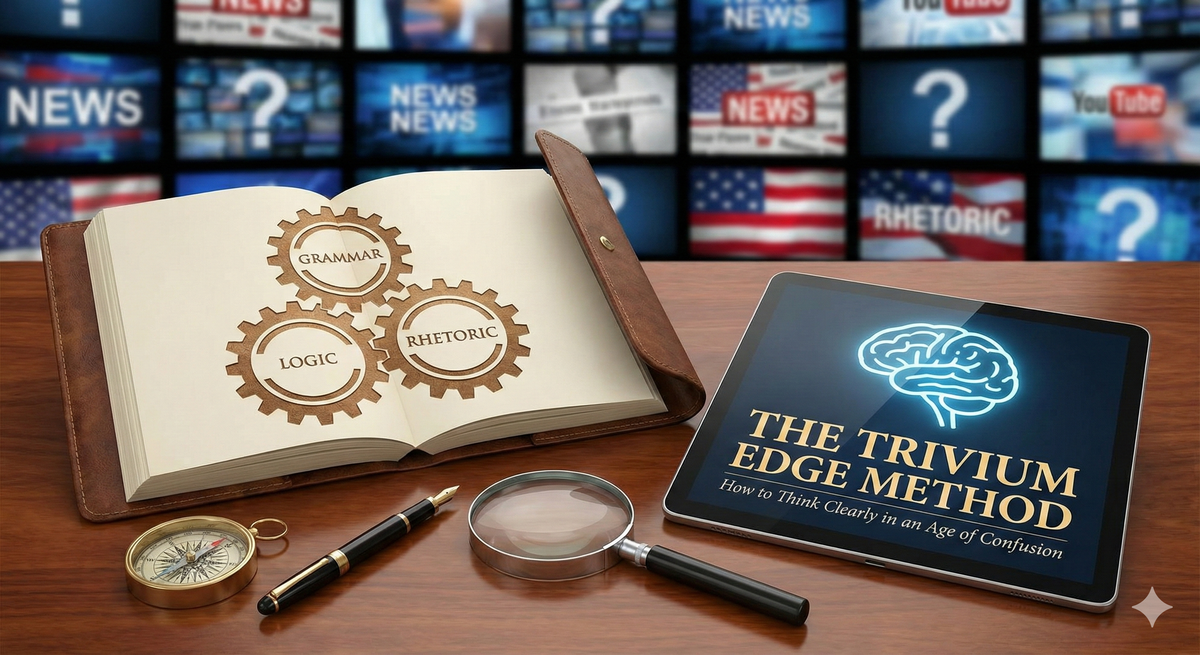
The Trivium Edge: How to Think Clearly in an Age of Confusion
Something is Breaking
You can feel it, can't you?
Something fundamental is breaking in how Americans talk to each other, make decisions together, and solve problems. Both sides seem convinced the other wants to destroy the country. Every political fight feels existential—like democracy itself hangs in the balance. Trust in government, media, and institutions keeps falling. Meanwhile, technology changes faster than most people can process.
This document offers a different path forward. Not left-wing or right-wing. Not about who should win the next election. Instead, it's about learning a method of thinking that helps you:
- Figure out what's actually true in a world drowning in competing claims
- Understand different viewpoints without losing your sanity
- Protect yourself from manipulation by politicians and media
- Find solutions that actually work instead of just scoring tribal points
- Prepare for massive economic changes coming in the next 10-20 years
The method is called the Trivium. It's an ancient approach to clear thinking that's more relevant now than ever before. This isn't abstract philosophy locked in ivory towers. It's a practical tool you can use tomorrow when watching the news, talking politics with family, or making decisions about your future in an uncertain economy.
The One Rule That Changes Everything
Before we explore the full method, here's the single most important idea in this entire document:
Would you accept this power in the hands of your worst political enemy?
This question—called the Reciprocity Test—is the foundation of everything else. It's deceptively simple but devastatingly effective at cutting through partisan fog.
Here's how it works:
Imagine your preferred political party controls the government. They create a new power: "The President can ban any speech the government labels as 'misinformation.'" You might think that's wonderful—finally, someone will stop all those dangerous lies from the other side!
But now apply the test: In four or eight years, your political enemies will probably control that same power. Will you be okay when they decide what counts as "misinformation"? When they use that power to ban speech you think is true? When they label your concerns as dangerous propaganda?
If your honest answer is "No, I wouldn't accept that," then you shouldn't support creating that power in the first place—even when your side holds it.
This principle applies to everything:
- Surveillance powers that let government monitor citizens
- Emergency authorities that bypass normal legal procedures
- Restrictions on speech or assembly
- Ability to punish people without due process
- Authority to enforce particular beliefs or behaviors
The Reciprocity Test forces you to think beyond the next election cycle. Power doesn't stay with your side forever. Any tool you build today will eventually be wielded by people you profoundly disagree with. The precedents you set when you're winning become the weapons used against you when you're losing.
This isn't cynicism—it's constitutional wisdom. The American founders understood that human nature doesn't change. Good people with power eventually become corrupt. Systems that seem benevolent under wise leaders turn tyrannical under unwise ones. The only sustainable protection is limiting power itself, not trusting that the "right people" will always wield it.
The Revenge Cycle Tearing Us Apart
Right now, America is caught in a dangerous escalation pattern. Understanding this cycle is the first step toward breaking it.
Stage 1: One Side Wins Power
A political party wins an election. They think: "Finally! Now we can fix all these problems. The other side has been blocking progress for years. It's time to act decisively."
This feels righteous. They genuinely believe they're serving the common good.
Stage 2: They Expand Their Power
They create new rules, new enforcement mechanisms, new ways to punish opposition. They justify it because their cause is just—they're fighting for justice, freedom, security, or the American way. How could limiting such important work be right?
They tell themselves: "These are unprecedented times. Normal procedures are too slow. We need to act boldly. The other side would do the same if they cared about solving problems."
Stage 3: The Other Side Watches and Waits
The losing side sees all this happening. They feel shut out, silenced, sometimes punished for their beliefs. They think: "This isn't fair. This isn't how America is supposed to work. They're violating democratic norms. They're consolidating power. Just wait until we get back in charge."
They don't see bold problem-solving. They see tyranny dressed up as virtue.
Stage 4: Power Flips and Revenge Begins
Eventually—because power always changes hands in a functioning democracy—the other side wins. And what do they do?
They use all those expanded powers. Plus they create new powers to "correct" what the other side did. They justify it the same way: their cause is righteous too. They're just restoring balance. Preventing the other side from ever doing that again.
The tools they once denounced as tyrannical suddenly seem necessary.
Stage 5: The Spiral Accelerates
This pattern repeats. Each cycle, both sides grab more power when they're winning. Each cycle, both sides grow angrier when they're losing. Each cycle, trust in the system drops further. Each cycle moves us closer to a breaking point.
Nobody trusts that the other side will play fair anymore. Everyone is just trying to win by any means necessary. The idea that we're all Americans working out our differences through democratic processes? That's dying.
This pattern has destroyed democracies throughout history. The Roman Republic fell this way. Weimar Germany fell this way. It doesn't end well.
We're watching the same movie again, and most people don't even realize they're playing their assigned roles.
The Solution: A Method for Clear Thinking
The only way out of this spiral is for regular citizens to get better at thinking. Not smarter—better. More fair. More honest. Less tribal. More willing to change minds based on evidence.
The Trivium is a method that helps you think through problems in three distinct stages: Grammar, Logic, and Rhetoric.
Don't let the classical names intimidate you. Think of them as three fundamental questions:
| Stage | Core Question | What You're Doing |
|---|---|---|
| Grammar | What's actually true? | Establishing facts, separating signal from noise |
| Logic | What are the best arguments on each side? | Understanding reasoning, not just conclusions |
| Rhetoric | What's a fair solution? | Finding answers that work for everyone |
This isn't about becoming an expert in Greek philosophy. It's about developing a systematic way to cut through propaganda, resist manipulation, and think for yourself.
Let's walk through each stage with a real, urgent example that will affect your life in the coming decade.
Stage 1: Grammar—Establishing What's Actually True
Before you can solve a problem, you need to know what's actually happening. This is harder than it sounds in 2024 because:
- Different news sources report completely different "facts" about the same events
- Politicians spin everything to make themselves look good and opponents look terrible
- Social media algorithms amplify the most extreme, emotionally triggering voices
- Everyone has an agenda, and few sources are genuinely neutral
The Grammar stage teaches you to cut through all that noise and get to bedrock reality.
Example: Should There Be a Universal Basic Income?
This question will become increasingly urgent as AI and automation eliminate traditional jobs. Let's use it to demonstrate the Grammar stage.
Grammar Phase Questions (before we argue about solutions):
- How many jobs are actually being eliminated by automation?
- What does the data show, not what do politicians claim?
- Which industries are most affected?
- What's the timeline—years or decades?
- What's the real unemployment rate?
- Not just the official number (which excludes people who stopped looking)
- How many people have given up on finding work?
- What percentage are underemployed?
- How much would a basic income actually cost?
- Run the actual numbers: population × amount × time
- What's the total compared to current federal spending?
- What are the different funding models proposed?
- Where would the money come from?
- Tax increases? Which taxes, on whom?
- Cutting other programs? Which ones?
- New revenue sources? What evidence they'd work?
- What happened when other countries tried this?
- Actual pilot programs, not theory
- What did the data show about work, poverty, health?
- What were the unintended consequences?
- What do economists across the political spectrum actually say?
- Not just ones your preferred news source quotes
- Where do they agree? Where do they disagree?
- What are their actual arguments, not soundbites?
Notice What We're NOT Doing
We're not arguing about whether UBI is "socialist" or "compassionate." We're not picking a side yet. We're not listening to what politicians want us to believe.
We're just trying to establish: What's actually true? What do we know for sure? What's uncertain? What are we just guessing about?
This is the foundation. You cannot think clearly if you're starting from false information. It doesn't matter how logical your reasoning is if your premises are wrong. Garbage in, garbage out.
The Grammar stage is about intellectual humility. It requires admitting "I don't actually know" more often than most people are comfortable with. It means distinguishing between:Facts we can verify (unemployment statistics, UBI pilot results)Reasonable inferences (likely consequences based on past patterns)Pure speculation (guesses about human behavior, untested theories)
Most political arguments skip this stage entirely. People start with their preferred conclusion and work backward, cherry-picking "facts" that support what they already believe.
The Trivium method forces you to do the hard work first: establish reality before you interpret it.
Stage 2: Logic—Understanding All Sides
Now that you know the facts, it's time to understand the arguments. Here's the crucial part that most people skip:
You need to understand EVERY side's argument as well as they understand it themselves. Not just your preferred side. Not the dumbed-down version your side uses to mock the other side. The actual, strongest version of each position.
This is called "steelmanning"—making the strongest possible version of each argument. It's the opposite of what happens on cable news, where everyone makes the other side sound as stupid as possible (strawmanning).
Why Steelmanning Matters
If you can only defeat weak versions of opposing arguments, you haven't actually tested your own position. You've just given yourself a false sense of security.
But if you can defeat the strongest version of opposing arguments—the version a smart, well-informed person on that side would make—then you might actually be onto something.
Or you might discover that the other side has better points than you realized. Either way, you learn.
Continuing Our UBI Example
Let's steelman both sides of the Universal Basic Income debate:
Strongest Arguments FOR Universal Basic Income:
The Automation Tsunami
Automation is eliminating jobs faster than we're creating new ones. This isn't like previous industrial revolutions. AI can now do cognitive work—the very thing humans shifted to when machines took over physical labor. Millions of truck drivers, retail workers, office workers, and even professionals will lose jobs to AI and robots in the next 10-20 years. We need a solution before mass unemployment causes social collapse, not after.
The Wage-Productivity Gap
Workers created all this productivity growth over the past 40 years, but wages have been essentially flat while corporate profits and CEO compensation soared. The gains from automation are going almost entirely to capital owners, not workers. A basic income isn't welfare—it's returning some of those productivity gains to the people who actually generated them. It's correcting a massive market failure.
Economic Dynamism
Right now, millions of people are trapped in jobs they hate because they need healthcare and can't risk losing income. With a basic income, people could pursue education, start businesses, do creative work, or care for family without fear of destitution. This would actually increase innovation, entrepreneurship, and economic growth. The evidence from pilot programs supports this.
Efficiency Over Bureaucracy
Our current welfare system is a Byzantine nightmare of means testing, bureaucracy, gaps in coverage, and perverse incentives. A universal basic income would be simpler, more efficient, and would eliminate the degrading process of proving you "deserve" help.
Strongest Arguments AGAINST Universal Basic Income:
The Math Doesn't Work
We literally cannot afford this without massive tax increases that would crush economic growth. Even a modest $1,000/month for all adults would cost roughly $3 trillion per year—about three-quarters of total current federal spending. The numbers don't add up without either gutting every other government program or doubling tax rates. Both would be economically catastrophic.
Work Provides Purpose
Work gives people more than money—it provides purpose, structure, social connection, and dignity. Humans need to feel useful and productive. Just handing out money could destroy the work ethic that makes society function. We've seen how welfare dependency can trap people and communities in cycles of dysfunction. This would be welfare dependency on a civilizational scale.
The Government Power Ratchet
This creates a massive government program that will never go away and will only expand. Once people depend on it, politicians will endlessly increase it to buy votes. It's a one-way ratchet toward government control of everyone's lives. Every citizen would become dependent on political decisions for their basic survival—that's dangerous.
The Automation Myth
People have been predicting the end of work since the Luddites smashed weaving machines. It never happens. New jobs always emerge that we couldn't imagine before. The solution is education and retraining, not paying people not to work. We should invest in human capital, not human idleness.
The Critical Insight
Notice: Both sides have legitimate points. Both sides have evidence. Both sides care about important things—they just prioritize different values and make different predictions about consequences.
The Logic stage isn't about picking a winner. It's about understanding why reasonable people disagree. Once you can explain the other side's position as well as they can—maybe even better—you're ready for the final stage.
The mark of a first-rate intelligence is the ability to hold two opposing ideas in mind at the same time and still retain the ability to function. —F. Scott Fitzgerald
This is what the Logic stage develops: the ability to genuinely understand multiple perspectives without your brain short-circuiting into tribal defensiveness.
Stage 3: Rhetoric—Finding Fair Solutions
This is where most political discussions completely fail. People try to "win" instead of finding solutions that actually work for everyone involved.
The Rhetoric stage asks: What solution addresses the legitimate concerns on ALL sides? What would be fair even if your political enemies were in charge?
What Do Both Sides Actually Care About?
Beneath the partisan rhetoric, people across the political spectrum often share deeper concerns:
- Everyone wants people to have enough money to live with dignity
- Everyone worries about economic disruption from technology
- Everyone values the meaning and purpose that comes from productive work
- Everyone wants solutions that actually work long-term, not just sound good in speeches
The disagreement isn't usually about these fundamental values. It's about:
- Which value should take priority when they conflict
- How to achieve these shared goals
- What the unintended consequences might be
- Who should bear the costs of solutions
A Possible Solution That Respects Both Sides
Here's what a Rhetoric-stage solution might look like:
"Let's run a 5-year pilot program in several diverse cities and regions. Fund it with a portion of the productivity gains from automation (through modest taxes on AI/robotics). Make it genuinely universal within those areas—everyone gets it, no means testing, no strings attached. Study what actually happens to employment, entrepreneurship, health, education, and community wellbeing. Set clear, agreed-upon metrics for success or failure. Then make a national decision based on real evidence instead of ideology or fear."
This solution:
✓ Tests the idea without betting the entire country on it (addresses conservative concerns about unintended consequences)
✓ Can be stopped or modified if it fails (addresses the "one-way ratchet" fear)
✓ Collects real data instead of relying on theories (respects both sides' legitimate uncertainty)
✓ Links funding to automation gains (addresses progressive concerns about fair distribution)
✓ Respects both the urgency of the problem AND concerns about rushing into massive changes
✓ Passes the Reciprocity Test—both sides could accept this regardless of which party controlled implementation
The Goal of Rhetoric
The goal isn't to make everyone happy. That's impossible. The goal is to find solutions that are procedurally fair—that respect legitimate concerns on all sides and can work regardless of which party temporarily holds power.
Fair procedures create sustainable solutions. Imposed solutions create endless resentment and eventual backlash.
When one side "wins" by cramming through their preferred solution over fierce opposition, that solution is living on borrowed time. As soon as the other side regains power, they'll undo it out of spite—or worse, use it as justification for their own overreach.
But when solutions emerge from genuine deliberation that respects all sides' concerns, they're much more durable. People accept outcomes from fair processes even when they don't get their first choice.
Why This Matters: The Economic Storm Coming
You need to understand something about your economic future that most people aren't prepared for: Major changes are coming whether we're ready or not.
The Musical Chairs Economy
Think of the job market like a game of musical chairs. For most of American history, when technology eliminated old jobs, it created new ones. Farmers became factory workers. Factory workers became office workers. People who built horseshoes learned to build car parts. The music kept playing, and there were always enough chairs—sometimes even more chairs than before.
That pattern is breaking down.
Here's what's happening now:
- AI and robots are eliminating jobs faster than we're creating accessible new ones
- Not just manufacturing this time—white-collar cognitive work too
- The jobs that DO exist often require credentials or skills most people don't have
- Retraining programs aren't working at the scale we need
- The new jobs being created are increasingly polarized
- High-skill, high-pay positions for the educated elite
- Low-skill, low-pay service jobs for everyone else
- The middle is being hollowed out
- The chairs are disappearing faster than people can adapt
- A 50-year-old truck driver can't realistically retrain as a data scientist
- Student debt makes education financially ruinous for many
- Even young people are struggling to find stable career paths
This Isn't Just About "Low-Skilled" Jobs Anymore
AI is coming for work we thought was safe:
- Truck drivers → Self-driving vehicles already work; just waiting for regulatory approval
- Retail workers → Amazon Go stores need almost no employees; other retailers will follow
- Office workers → AI assistants can do most administrative tasks
- Accountants → Automated tax prep and bookkeeping improve every year
- Paralegals → AI legal research is already better than junior lawyers
- Radiologists → AI can read medical images more accurately than humans
- Writers and artists → AI can generate text and images on demand
- Customer service → Chatbots handle most interactions already
Even parts of medicine, law, teaching, and creative work are being automated.
The timeline? Most experts say massive disruption within 10-20 years. Some say it's already starting. Some say faster.
The Two Questions Society Must Answer
When this economic transformation accelerates, we face two urgent, interconnected questions:
Question 1: How do people pay for food, housing, and healthcare when traditional employment disappears?
Some people say Universal Basic Income. Others say job guarantees. Others propose entirely different frameworks. We need to figure this out together, democratically, and soon.
But here's what we cannot do: ignore the problem and hope it goes away. It won't.
Question 2: How do people find purpose and meaning without traditional jobs?
For most of modern history, people defined themselves by their work:
- "I'm a teacher."
- "I'm a mechanic."
- "I'm a nurse."
Work provided more than money—it gave structure, identity, social connection, and a sense of contributing to something larger than yourself.
If that disappears for millions of people simultaneously, we need new frameworks for people to feel valuable and find purpose. Otherwise, we get social collapse.
Why the Trivium Method Matters for Economic Transformation
When massive economic changes happen, scared and confused people make terrible decisions. Throughout history, economic crises have led to:
- Scapegoating of minority groups ("They took our jobs!")
- Support for authoritarian leaders who promise easy fixes
- Violent social upheaval as desperate people lash out
- Collapse of democratic institutions as people trade freedom for security
But citizens who know how to think clearly can:
- Separate real solutions from snake oil and demagoguery
- Understand trade-offs honestly instead of believing in magic fixes
- Work together across political divides to find practical solutions
- Keep democracy functioning even during profound stress
- Build new systems that actually serve the common good rather than concentrated interests
The Trivium method isn't abstract philosophy. It's survival training for democratic citizenship in an age of massive disruption.
The Third Edge: Meaning Beyond Employment
Here's where the Trivium method reveals its full power. The same skills that help you think clearly about politics and economics also prepare you for something even more fundamental: finding purpose and contribution in a world where traditional employment no longer defines who you are.
This isn't a separate skill set. It's the same method applied to a different problem. Let me show you how.
The Crisis of Meaning
When automation eliminates your job, you lose more than income. You lose:
Structure - Work organizes your day, your week, your year. Without it, time becomes formless. Many people struggle with retirement for this exact reason. Now imagine millions of people facing forced retirement in their 40s and 50s.
Identity - For most of modern history, work has been the answer to "Who are you?" Take that away, and people face an existential crisis. If you're not a teacher, mechanic, accountant, or manager, then what are you?
Social Connection - Work provides community, shared purpose, friendships. The office or factory floor creates bonds. Remote work already showed us how isolation damages mental health. Now multiply that by entire industries disappearing.
Contribution - Humans need to feel useful. We need to believe our existence matters to others. Employment, whatever its flaws, provided that sense of mattering. What replaces it?
Universal Basic Income might solve the money problem. But money alone won't solve the meaning problem. History shows that people with resources but no purpose often spiral into depression, addiction, and despair. We've seen this in communities devastated by factory closures. We're about to see it at civilizational scale.
Why Most Retraining Programs Miss the Point
The conventional response to automation is "retrain for new jobs." This makes sense when technology creates as many jobs as it eliminates. But it misses what's different this time.
The problem isn't that workers lack skills for the new economy. The problem is that the new economy doesn't need most workers.
Even if you could retrain every displaced truck driver to code (you can't), we don't need 3.5 million new programmers. Even if you could make every retail worker a nurse (you can't), we don't need that many nurses. And increasingly, AI is coming for those jobs too.
The fundamental equation has changed. For the first time in history, human labor is becoming optional on a massive scale. Not because humans are lazy or unskilled, but because machines can do cognitive work better, faster, and cheaper.
This means we need a different kind of preparation. Not retraining for jobs that will also be automated. But reskilling for a life where paid employment is no longer the primary source of meaning, contribution, and identity.
That's what the Trivium method actually does.
How Grammar-Logic-Rhetoric Prepares You for Post-Labor Life
The same three-stage method that helps you think about politics and economics also builds the capacity for meaning-making in a post-employment world. Here's how:
Grammar Stage: Finding Your Own Truth
In a world where your value isn't measured by a paycheck, you need the ability to determine what actually matters to you. Not what employers value. Not what the market rewards. Not what society tells you to care about. But what genuinely gives YOUR life meaning.
The Grammar stage teaches you to:
Separate external narratives from internal reality
- Society tells you "successful people have careers." But is that actually true for you?
- Culture says "your worth equals your salary." But do you really believe that?
- Family expects certain achievements. But are those your goals or theirs?
Identify what you actually value
- What activities make you lose track of time?
- What would you do if money were no object?
- What problems in the world make you angry enough to want to fix them?
- When do you feel most alive and engaged?
Distinguish between wants and needs
- What do you actually need to feel fulfilled?
- What have you been chasing because others chase it?
- What brings lasting satisfaction vs. temporary pleasure?
This is the same skill you use to separate facts from spin in political debates. You're applying it to your own life. You're establishing the reality of who you are beneath the layers of what you've been told to be.
Logic Stage: Understanding Multiple Paths
Once you know what matters to you, you need to understand different ways of creating meaning and contributing value. The Logic stage develops this capacity.
In traditional employment, there's basically one path: find a job, do it well enough to keep it, advance if possible, retire. Simple. Constraining. But simple.
In a post-employment world, there are infinite paths:
Creative contribution
- Writing, art, music, filmmaking, crafts
- Not for money necessarily, but for the value it brings to others
- The satisfaction of making something that didn't exist
Community building
- Organizing neighbors to solve local problems
- Creating spaces where people can connect
- Building the social infrastructure that employment used to provide
Knowledge sharing
- Teaching skills to others (formal or informal)
- Documenting wisdom and experience
- Mentoring younger people navigating changes
Caregiving
- Children, elderly parents, disabled family members
- Work that's always been essential but undervalued by markets
- Freeing others to pursue their own meaning
Civic participation
- Deep engagement in democratic processes
- Running for local office or supporting those who do
- Organizing around issues you care about
Innovation and experimentation
- Trying new approaches to old problems
- Building things because they should exist
- Taking risks that employment never allowed
The Logic stage teaches you to evaluate these paths fairly. To understand the trade-offs. To see why different approaches work for different people. To recognize that there's no single right answer, just different frameworks for creating meaning.
This is the same skill you use to steelman political arguments. You're making the strongest case for different ways of living, then choosing thoughtfully among them.
Rhetoric Stage: Creating Your Narrative
Here's where the Trivium method becomes most powerful for post-labor life. The Rhetoric stage isn't just about persuading others. It's about constructing coherent narratives that give life meaning.
Humans are storytelling creatures. We understand our lives as narratives with characters, conflicts, and arcs. Employment provided a ready-made narrative structure:
"I started as an assistant, worked hard, got promoted to manager, led successful projects, mentored junior staff, and retired with pride in my contributions."
That narrative gave life coherence. It answered "What did you do with your time on Earth?" in a way that made sense to yourself and others.
In a post-employment world, you need to become the author of your own narrative. Nobody hands you a story anymore. You have to write it.
The Rhetoric stage teaches you to:
Construct meaning from disparate activities
- Weaving together volunteering, creative work, family care, and civic engagement into a coherent story
- Seeing patterns and themes across different contributions
- Articulating the through-line that makes your life make sense
Communicate your value to others
- Explaining what you do and why it matters, even when there's no job title
- Helping others understand your contributions outside market frameworks
- Building social recognition for non-market work
Adapt your narrative as life changes
- Revising the story as you discover new interests
- Incorporating setbacks and redirections meaningfully
- Maintaining coherence through transitions
Find your audience
- Identifying who benefits from your contributions
- Connecting with communities that value what you offer
- Building relationships around shared purpose rather than shared employment
This is the same skill you use to find fair political solutions. You're persuading yourself and others that your life has meaning, purpose, and value even without traditional employment.
The Storytelling Economy
In a post-labor society, storytelling becomes infrastructure. Not entertainment (though that too). But the fundamental way humans create and communicate value.
Think about what stories do:
Stories preserve and transmit knowledge
- The best teachers are storytellers who make ideas memorable
- Cultural wisdom passes through narratives, not data dumps
- Lessons learned become lessons taught through compelling stories
Stories build community and shared identity
- We bond around common narratives
- Social movements spread through powerful stories
- Communities cohere when members share stories about who they are
Stories inspire action and change
- Every social transformation began with a new story about what's possible
- People act on stories more readily than statistics
- Hope itself is a story about the future
Stories give individual lives meaning
- Your life story is how you understand yourself
- The narratives you tell yourself shape what you become
- Meaning emerges from the story you're living, not just the events
In an economy where human labor is optional, the ability to create, share, and engage with stories becomes a primary form of contribution. Not everyone will write novels. But everyone will need narrative capacity to make sense of their lives.
The Trivium method builds that capacity. Grammar helps you find the truth worth telling. Logic helps you understand different narrative frameworks. Rhetoric helps you craft stories that resonate.
Why This Connects to Everything Else
This isn't a digression from politics and economics. It's the same problem viewed from a different angle.
When you can think clearly about contested political questions:
- You're building narrative capacity to understand competing stories about society
- You're developing the cognitive flexibility to hold multiple frameworks
- You're learning to construct coherent arguments, which is storytelling
When you can evaluate economic transformation independently:
- You're building the analytical skills to understand your own situation
- You're developing resistance to manipulation by those selling easy answers
- You're learning to separate what markets value from what actually matters
When you can create meaning beyond employment:
- You're building the narrative capacity for democratic participation
- You're developing the psychological resilience to navigate change
- You're learning to contribute value without market validation
It's the same Trivium method. The same cognitive toolkit. Applied to citizenship, economic adaptation, and personal meaning simultaneously.
Teaching people to think clearly about politics isn't separate from teaching them to navigate economic disruption. And neither is separate from teaching them to find purpose beyond employment. They're three facets of the same fundamental capacity: the ability to think for yourself, evaluate reality clearly, and create meaning in collaboration with others.
Practical Application: Building Post-Labor Skills Now
You don't have to wait for mass unemployment to develop these capacities. Start now:
1. Practice creation over consumption
Spend less time consuming entertainment and more time creating things. Doesn't matter what. Write, draw, build, code, garden, cook, craft. The medium doesn't matter. What matters is developing the muscle of bringing new things into existence.
Why this matters: In a post-labor world, your value comes from what you create and contribute, not what you consume. Start building that capacity now.
2. Develop your narrative voice
Write about your experiences. Start a blog nobody reads. Keep a journal. Record video essays. The audience doesn't matter initially. What matters is developing the ability to transform experience into coherent narrative.
Why this matters: You're learning to be the author of your own life story. That's the skill that creates meaning when employment doesn't.
3. Contribute outside market frameworks
Volunteer. Mentor. Organize community events. Help neighbors. Participate in local government. Do work that matters but nobody pays you for.
Why this matters: You're discovering what gives you satisfaction beyond paychecks. You're building the psychological infrastructure for post-employment contribution.
4. Learn for learning's sake
Study something you're curious about with no career application. Deep dive into history, philosophy, science, art. Follow your genuine interests.
Why this matters: When you don't need knowledge for employment, curiosity becomes its own reward. You're rewiring your relationship with learning.
5. Build community bonds
Invest in relationships that aren't based on work. Strengthen family connections. Deepen friendships. Join groups organized around shared interests rather than shared employment.
Why this matters: When work no longer structures your social world, you need other sources of belonging. Build them now.
The Integration: Three Problems, One Solution
Now you can see the full picture of why this document exists.
America faces three simultaneous crises:
Political Crisis: Democracy failing as both sides abandon procedural fairness for tribal victory
Economic Crisis: Employment-based society collapsing as automation eliminates accessible jobs
Meaning Crisis: Identity and purpose eroding as the structures that provided them disappear
Most people think these are separate problems requiring separate solutions.
They're not. They're the same problem at different scales. And they share the same solution.
The Trivium method teaches you to:
- Demand procedural fairness during political conflict (Grammar: establish facts, Logic: understand all arguments, Rhetoric: find fair solutions)
- Evaluate economic transformation independently (Grammar: see what's actually happening, Logic: understand competing explanations, Rhetoric: navigate change thoughtfully)
- Create meaning beyond employment (Grammar: discover your truth, Logic: explore multiple paths, Rhetoric: author your narrative)
These aren't three different skills. They're one skill applied to three domains.
The person who can think clearly about contested political questions without tribal reflexes is the same person who can evaluate automation's impact without panic or denial. And that's the same person who can construct meaningful life narratives when employment no longer provides them.
They're all using the same cognitive toolkit: the ability to establish truth, evaluate arguments fairly, and create coherent meaning in collaboration with others.
This is why teaching the Trivium method isn't just civics education or job training or self-help. It's teaching the foundational capacity for human flourishing in the century ahead.
Without it, people will:
- Turn to authoritarians who promise simple answers to political chaos
- Blame scapegoats for economic disruption instead of adapting
- Spiral into despair when employment disappears and meaning collapses
With it, people can:
- Maintain democracy through profound political stress
- Navigate economic transformation without social collapse
- Find purpose and contribution in a post-labor world
The edge isn't having the right political opinions. The edge isn't having the right job skills. The edge is having the cognitive capacity to think clearly, adapt continually, and create meaning regardless of circumstances.
That's the Trivium Edge.
And you can start building it today.
What Does "Common Good" Actually Mean?
John Adams, one of America's founders, wrote that government should serve "the common good" rather than "the profit, honor, or private interest of any one man, family, or class of men."
That sounds noble, but what does it actually mean in practice? Here's a test you can apply to any policy:
A Policy Serves the Common Good If:
It benefits all citizens fairly, not just one faction
- Does it help everyone, or does it advantage your tribe over others?
- Would it still be legitimate if a different party implemented it?
It strengthens democratic participation rather than concentrating power
- Does it empower citizens or create dependency on government?
- Does it protect rights or expand control?
It can be changed if it stops working
- Are there sunset provisions and review mechanisms?
- Or is it designed to be permanent and irreversible?
It protects everyone's basic rights and freedoms
- Does it respect human dignity across ideological lines?
- Or does it punish people for their beliefs?
It passes the Reciprocity Test
- Would you accept this if your opponents controlled it?
- Is it based on fair procedures or partisan outcomes?
Examples in Practice
Policies That Serve the Common Good:
- National defense → Protects all citizens equally regardless of politics
- Public infrastructure → Roads, bridges, utilities everyone can use
- Fair court system → Protects rights regardless of political views
- Free speech protections → Benefits whoever is currently unpopular with those in power
- Environmental protection → Clean air and water benefit everyone
Policies That Do NOT Serve the Common Good:
- Laws giving your political party permanent structural advantages → Gerrymandering, voter suppression
- Subsidies for companies with political connections → Crony capitalism
- Powers to silence political opponents → Speech restrictions, de-banking, deplatforming
- Programs designed to reward supporters and punish opponents → Using government as partisan weapon
- Regulations that entrench existing power structures → Capture by special interests
The test is simple but profound: Does this serve all Americans, or just the people who happen to hold power right now?
Understanding Why People Disagree
People usually disagree for one of three fundamental reasons. Understanding which reason helps you find common ground:
Reason 1: Different Facts
Sometimes people literally believe different things are true. One person watches Fox News, another watches MSNBC, and they're receiving completely different information about the same events. They live in separate information ecosystems.
Solution: Grammar phase. Dig into the actual data together. Find sources both sides can trust—or at least, primary sources both can examine. Separate what we know for certain from what we're guessing about.
Example: Claims about crime rates, immigration statistics, climate data—these are questions with factual answers, even if they're contested politically.
Reason 2: Different Values
Sometimes people agree on facts but prioritize different values. One person values individual freedom above all else. Another values community safety above all else. Both are legitimate values—just different priorities.
This is often where productive disagreement lives. You're not arguing about reality—you're navigating the inherent tensions between competing goods.
Solution: Rhetoric phase. Find solutions that honor both values. Freedom AND safety. Individual rights AND community needs. Innovation AND stability. It's rarely either/or.
Example: Pandemic restrictions involved genuine tensions between public health and personal liberty. Both values matter. The question is how to balance them, not which to obliterate.
Reason 3: Different Causal Models
Sometimes people agree on facts and values but follow different logical chains about cause and effect. One person thinks "If we allow X, then Y will inevitably happen." Another thinks "X won't lead to Y at all—actually, Z will happen instead."
They're making different predictions about how complex systems behave.
Solution: Logic phase. Talk about the reasoning itself, not just the conclusions. What assumptions are you making? What evidence would change your mind? Can we test these predictions? What do similar cases from history or other countries tell us?
Example: Economic policy debates often hinge on different models of how markets work, how people respond to incentives, how much regulation helps vs. hurts.
Understanding which type of disagreement you're having prevents talking past each other. If you're having a values disagreement but think it's a facts disagreement, you'll never find common ground—you're solving the wrong problem.
How to Use This in Real Life
Here's how to apply the Trivium method to real political questions you encounter:
Example 1: Free Speech on Social Media
Grammar (Facts):
- How much content is actually being removed or restricted?
- Who makes these decisions—companies, governments, AI algorithms?
- What are the stated policies vs. actual practices?
- How does this compare to traditional media gatekeeping?
- What do we know about the effects of different approaches?
Logic (Arguments):
For more content moderation:
- Misinformation causes real harm (vaccine hesitancy, election distrust, violence)
- Private companies should control their own platforms
- Hate speech drives marginalized people away from public discourse
- Some content genuinely incites imminent violence
- Unlimited speech favors those with resources to amplify messages
For less content moderation:
- Who decides what counts as "misinformation"? Yesterday's heresy is tomorrow's accepted truth
- Government pressure on private companies is censorship by proxy
- Bad speech is best countered with good speech, not silence
- Censorship creates martyrs and drives extreme voices underground where they radicalize
- The cure (suppression) is worse than the disease (bad ideas)
Rhetoric (Fair Solution):
What rules could both sides accept regardless of who's in power?
Possible framework:
- Transparent, equally-applied rules published in advance
- Appeals process for removed content with human review
- No government pressure on companies to remove legal speech
- Users can choose their own content filtering preferences
- Antitrust enforcement prevents monopolistic control of discourse
- Liability protection contingent on neutral application of stated policies
This won't satisfy everyone—but it passes the Reciprocity Test and addresses legitimate concerns on all sides.
Example 2: Border Security vs. Immigration
Grammar (Facts):
- How many people actually cross illegally vs. overstay visas?
- What do immigrants contribute economically (taxes, innovation, labor)?
- What do they cost in services (education, healthcare, infrastructure)?
- What drives migration (violence, economics, family reunification)?
- What do other developed countries do?
- What are the actual security risks vs. perceived risks?
Logic (Arguments):
For stricter enforcement:
- Sovereign nations have a right and duty to control borders
- Rule of law matters—rewarding illegal entry undermines legal immigration
- Can't sustain unlimited immigration without overwhelming services
- Security concerns are real in an age of terrorism and trafficking
- Wages for low-skilled American workers are depressed by labor competition
For more open immigration:
- America was built by immigrants and remains strengthened by them
- Workers fill crucial jobs many Americans won't take
- Enforcement-first approach separates families and violates human dignity
- Most are fleeing violence or seeking better life for children
- Legal immigration is so restricted it's virtually impossible for most people
- Economic evidence shows immigration grows the overall economy
Rhetoric (Fair Solution):
What addresses both security concerns AND humanitarian concerns?
Possible framework:
- Secure borders with modern technology and clear enforcement
- Simultaneously expand legal immigration pathways significantly
- Guest worker programs for industries that need labor
- Humane treatment of asylum seekers with fair, swift hearings
- Path to legal status for long-term residents with clean records
- Penalties for employers who exploit undocumented workers
- Investment in addressing root causes of migration at source countries
Neither side gets everything, but both sides get something. The focus shifts from total victory to workable compromise.
What You Can Do Starting Today
This isn't just theory. Here's how to start using this method immediately:
1. Practice the Reciprocity Test
Every time you hear about a new law or government power, ask yourself:
"Would I be okay with this if my political enemies controlled it?"
If the answer is no, you should oppose it even when your side wants it. Otherwise you're building the tools of your own oppression.
This week's practice:
- Find one policy your preferred party supports
- Honestly imagine the other party controlling that power
- If you feel uncomfortable, speak up—even to your own side
2. Steelman One Argument This Week
Pick a political position you strongly disagree with.
Spend 30 minutes trying to make the BEST case for it you can. Not the dumb version you've heard strawmanned on social media—the smart version an intelligent, well-informed person on that side would make.
You'll discover one of two things:
- The other side has better points than you realized (which means you learned something)
- Your own position is even stronger because you've tested it against worthy opposition
Either outcome makes you smarter.
3. Fact-Check Your Own Side
It's easy to fact-check the other side. It's hard to fact-check your own. But that's where intellectual honesty matters most.
When you encounter information that confirms what you already believe, that's precisely when you need to be MOST skeptical.
Ask yourself:
- What's the source? Are they credible or partisan?
- What's their agenda? Everyone has one.
- What contrary evidence might exist?
- Am I believing this because it's true or because I want it to be true?
4. Talk Politics Without Fighting
Next time you're in a political discussion, try this framework:
Start with shared facts: "What do we actually know for certain about this issue?"
Ask the key question: "What evidence would change your mind?" (and answer it yourself)
Look for solutions that address all concerns: "What would work for everyone involved, not just our preferred outcome?"
End with intellectual humility: "I could be wrong about this. Here's what would convince me otherwise."
5. Protect Democracy in Small Ways
Democracy doesn't die in one dramatic moment. It dies in a thousand small moments where people choose tribal victory over procedural fairness.
Protect it by:
- Calling out your own side when they violate democratic norms
- Defending free speech even when you hate what's being said
- Supporting fair procedures even when they produce outcomes you dislike
- Refusing to demonize people who disagree with you
- Treating political opponents as fellow citizens, not enemies
These seem like small things. They're not. They're everything.
The Choice We Face
America is at a crossroads. We can continue down the path we're on—more revenge, more power grabs, more division, eventual collapse into some form of authoritarianism. Or we can choose something different.
That choice isn't made by politicians in Washington. It's made by regular citizens in everyday conversations, in school board meetings, in family dinners where politics comes up. It's made when you choose to:
- Seek truth instead of confirmation of your existing beliefs
- Understand instead of caricature those who disagree
- Find solutions instead of scoring tribal victories
- Protect fairness even when it costs you tactically
The Trivium method—Grammar, Logic, Rhetoric—gives you tools for that choice. But tools are useless if you don't use them.
The Stakes Are Real
The economic storm is coming. AI and automation will disrupt millions of jobs and transform how society organizes itself. We'll need to make enormous decisions about:
- How people survive economically when traditional employment changes
- How to distribute the gains from automation fairly
- What new forms of purpose and meaning look like
- How to maintain social cohesion during massive transitions
Those decisions will be made either by:
Citizens who can think clearly, work together across differences, and find fair solutions even under profound stress...
Or by:
Whichever authoritarian figure promises the easiest answers to scared, confused people who never learned to think for themselves.
Which future we get depends on whether enough people learn to think like citizens instead of tribe members.
Start Now
Start today. Start small. Practice on easy questions before the hard ones arrive.
Because they're coming.
The Trivium method isn't a magic solution. It won't make political disagreement disappear. It won't eliminate legitimate conflicts between different values and visions.
But it will help you:
- Think instead of react
- Understand instead of rage
- Build instead of destroy
- Preserve democracy instead of accidentally helping to dismantle it
That's not everything. But it's enough to matter.
Quick Reference Card
The Trivium Method in Three Steps
GRAMMAR: What's Actually True?
- What are the verified facts we can establish?
- What are we uncertain about?
- Where do credible sources agree and disagree?
- What are we assuming vs. what do we actually know?
- What would count as evidence one way or the other?
LOGIC: What Are the Best Arguments?
- What's the strongest case for each position (steelmanning)?
- Why do reasonable, informed people disagree about this?
- What are the hidden assumptions underlying each argument?
- What are the real trade-offs each position accepts?
- What predictions does each side make, and can we test them?
RHETORIC: What's Fair to Everyone?
- What solution addresses legitimate concerns on all sides?
- Would this be fair if your political opponents controlled it?
- Can it be adjusted or reversed if it doesn't work?
- Does it serve the common good or factional interests?
- Does it strengthen or weaken democratic participation?
The Golden Rule of Power
Any power you create today will eventually be used by your political enemies. Only support powers and precedents that would be legitimate in anyone's hands.
Remember
Democracy doesn't fail because people disagree.
It fails because people stop thinking fairly about their disagreements.
The Trivium method helps you think fairly—not perfectly, not without effort, but better than the tribal reflexes that are currently destroying our ability to solve problems together.
That's what's at stake. Not who wins the next election. Whether we can still have meaningful elections at all.
Choose wisely.
For more resources and tools for clear thinking about policy, democracy, and the common good, visit TheMorelAlgorithm.com