Ordered Liberty
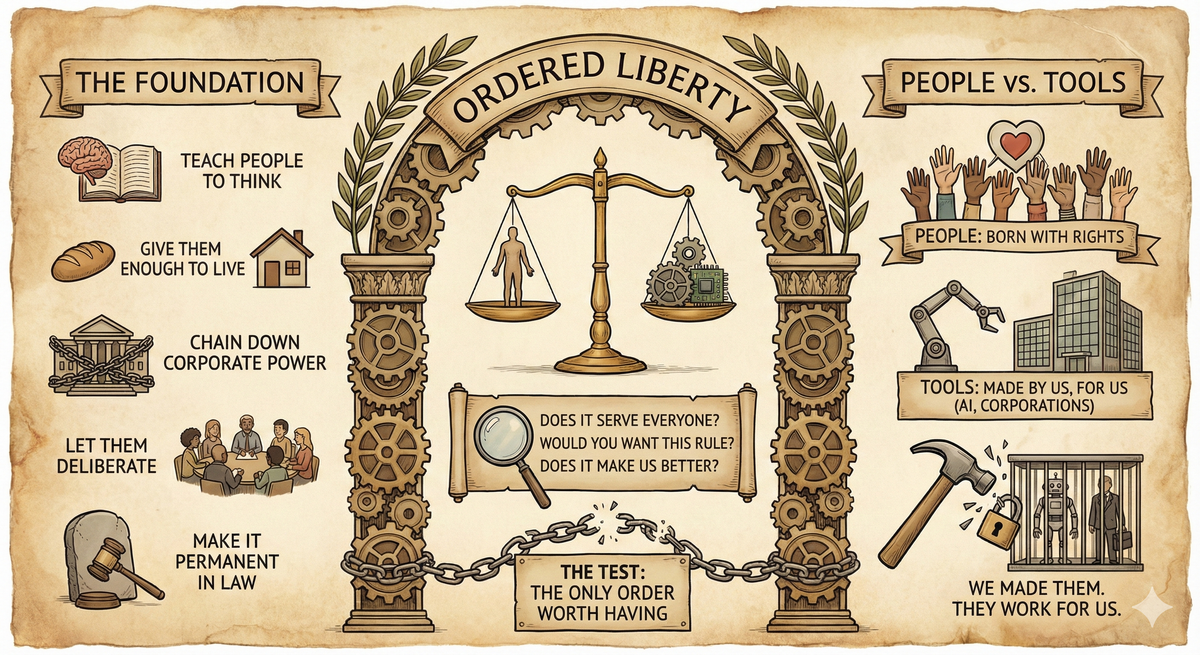
Ordered Liberty: Constitutional framework ensuring adequate accommodation (material, cognitive, participatory) for everyone globally. Automatic rules align purchasing power with productive capacity, prevent speculation-driven crises, constrain domination, enable self-governance.
Ordered Liberty: Complete Framework
"Ordered Liberty" = Reorganizing human society around a single, clarifying goal: ensuring adequate accommodation that enables full participation in economic and social life for every individual on the planet.
The Limit: Government does not engineer specific outcomes, impose particular moralities beyond rights protection, or micromanage personal choices. It sets fair rules, ruthlessly constrains structural vices, enforces them equally, then lets the game be played.
TL;DR Ordered Liberty = everyone gets what they need to participate. Cognitive tools. Economic foundation. Protection from those who would take it away.
The government's job is simple. Set fair rules. Enforce them equally. Stop the powerful from rigging the game. Then get out of the way.
-The Five Pillars (Expanded)
1. Educate citizens in trivium method (cognitive accommodation)
- Universal access to tools for parsing reality, detecting manipulation, constructing arguments
- Enables self-governance and immune system against demagoguery
- Government provides the method, not the conclusions
2. Provide economic foundation (material accommodation)
Consists of three automatic rules that prevent crises by aligning purchasing power with productive capacity:
Rule A: Income Floor
- Base income indexed to productive capacity (GDP per capita)
- Rises automatically when capacity utilization falls below 85%
- Ensures everyone can participate in the economy regardless of employment status
- Not welfare—it's the foundation required for participation itself
Rule B: Credit Restrictions
- Banks create credit for productive capacity (new construction, new businesses, improvements)
- Banks cannot create credit for speculation (existing stocks, existing homes beyond first property, commodity hoarding)
- Housing, business ownership, and investment still happen—just with equity risk, not credit creation privilege
- Prevents artificial scarcity from financial extraction
Rule C: Capacity Response
- When real constraints emerge (95%+ utilization), automatic triggers engage:
- Tax unproductive accumulation during scarcity
- Redirect resources to expand constrained capacity
- Temporary price controls on monopoly necessities during transition
- System recognizes real limits and expands capacity rather than rations through poverty
- Turns real constraints into innovation opportunities, not crises
3. Constrain corporate power (protect accommodation from destruction)
- Corporations serve by charter, not right—revocable for violations
- No credit privileges for political capture, buybacks, or regulatory gaming
- Size limits prevent "too big to fail" destruction of markets
- Corporate persons have no speech/religion rights—only natural persons do
4. Create deliberative infrastructure (enable participation)
- Sortition assemblies (citizen juries) with trivium training
- Transparent policy information and protected deliberative spaces
- Actual self-governance through structured, informed deliberation
- Not mob rule (trivium-trained) or technocracy (broad participation)
5. Enshrine protections constitutionally (make accommodation permanent)
- All four pillars above protected by constitutional amendment
- Supermajority required to alter (prevents capture by temporary majorities)
- Future generations inherit accommodation, not extraction
Ordered Liberty Framework: FAQ - Global Implementation
Foundational Questions About Planetary Unity
Q: How can ONE system work for 8 billion people across radically different cultures, climates, and development levels?
Challenge: Ordered Liberty assumes shared values (individual participation, rational deliberation, market-based allocation). But cultures vary enormously:
- Collectivist vs. individualist societies
- Oral vs. written traditions
- Different concepts of property, family, authority
- Wildly different climate/resource constraints
- Development ranges from subsistence farming to post-industrial
Imposing one framework on this diversity seems like Western imperialism, not universal liberation.
Response:
The framework is more flexible than it appears:
What's universal (non-negotiable):
- Right to adequate accommodation (material, cognitive, participatory)
- Constraints on structural vices (no extraction through artificial scarcity)
- Protection from domination (corporate or political)
What's locally adapted:
- How trivium principles manifest (oral traditions can teach critical thinking differently than written)
- What specific base income level (indexed to local productive capacity)
- How deliberation structures (cultural variations in decision-making)
- What specific economic arrangements (co-ops, family businesses, traditional commons)
Example:
- Arctic communities: Base income higher (climate costs), traditional hunting/gathering valued in capacity metrics, deliberation incorporates elder councils
- Tropical agricultural regions: Base income reflects local costs, credit directed to sustainable farming, land tenure respects traditional practices
- Post-industrial cities: Higher base income (costs), credit for services/tech, deliberation through digital platforms
The test: Does everyone have adequate accommodation to participate? If yes through different means, that's success, not failure.
Counter-question: Current system (neoliberal capitalism) already imposed globally—how's that working for cultural diversity?
Q: Who enforces this globally? There's no world government, and creating one is terrifying.
Challenge: Enforcement requires authority. At national level, you have government. At planetary level, you'd need:
- Global tax collection (sovereignty violation)
- Global corporate charter enforcement (who decides?)
- Global constitutional court (cultural imperialism?)
- Global military/police (dystopian)
Creating institutions powerful enough to enforce this makes them powerful enough to become tyrannical. We've seen this: UN can't enforce anything; attempts at world government rightfully feared.
Response:
Federation model, not world government:
Tier 1 - Constitutional Framework (Planetary):
- Treaty establishing accommodation rights
- Credit restriction principles
- Corporate charter standards
- Amendment requires supermajority of regions, not global authority
Tier 2 - Regional Implementation (Continental/Cultural):
- Regions adapt framework to local context
- Enforce corporate charters within region
- Collect and distribute base income
- Run deliberative assemblies
- Regions can be cultural (Islamic world, Confucian sphere) or geographic (EU, African Union, etc.)
Tier 3 - Local Variation (National/Provincial):
- Specific program details
- Cultural adaptations
- Day-to-day governance
Enforcement mechanisms:
For corporations:
- Charter required to access any regional market
- Violate in one region → lose charter everywhere
- No "world police" needed—market access is leverage
For regions:
- Peer enforcement through trade access
- Region violating accommodation rights faces coordinated response
- Similar to current trade agreements but for rights, not just commerce
For individuals:
- Regional/local enforcement, not planetary
- Right to migrate between regions (see below)
Key insight: Framework is enforced through access (to markets, to charters, to trade), not through hierarchical control. Distributed enforcement, not centralized power.
Q: What happens to national sovereignty? Can countries opt out?
Challenge: Sovereignty is fundamental to international order since Westphalia (1648). Ordered Liberty effectively eliminates it—nations can't set their own economic rules, credit systems, corporate law, or welfare policies. This is conquest by framework, not force. Many nations fought for independence only to be told "actually, you must follow these planetary rules."
Response:
Sovereignty redefined, not eliminated:
Current sovereignty: Nation-states can do anything within borders (subject to power constraints)
- Result: Race to bottom (tax havens, regulatory arbitrage, labor exploitation)
- Weak nations dominated by strong (economic coercion)
- Capital mobility but labor immobility (asymmetric power)
Ordered Liberty sovereignty: Regions self-govern within accommodation framework
- Can't use "sovereignty" to extract from own people (accommodation rights)
- Can't use "sovereignty" to enable extraction from others (corporate charter rules)
- Maximum freedom within constraint of: no domination
What regions STILL control:
- Cultural practices, languages, traditions
- Specific policy implementations (how to deliver accommodation)
- Local economic organization (co-ops vs. corporations vs. commons)
- Education content (using trivium method)
- Most legislation and governance
What regions CAN'T do:
- Deny accommodation to own people (tyranny)
- Allow unconstrained corporate extraction (exploitation)
- Enable speculation that creates artificial scarcity (vice)
The opt-out question:
Strict answer: No, because accommodation is a human right, not subject to regional veto. A region can't "opt out" of prohibiting slavery either.
But: If a region genuinely provides adequate accommodation through different means that pass the veil of ignorance test, framework should accommodate that. The question isn't "do you follow these exact rules" but "do your people have adequate accommodation?"
Example: Indigenous communities with traditional commons-based systems that provide accommodation might not need base income if their system works. Framework should protect their right to continue, not impose different structures.
Q: How do you handle massive wealth/development gaps between regions?
Challenge: Norway's GDP per capita: $89,000. Burundi's: $270. If base income is "indexed to productive capacity," Norwegians get $30k/year while Burundians get $90/year. That's not accommodation—it's perpetuating global inequality. Either you have global redistribution (politically impossible) or you have fake universalism that maintains current hierarchy.
Response:
Two-part answer:
Part 1: Base income IS regionally indexed, but...
- Norwegian base income ≈ $25k-30k (local accommodation)
- Burundian base income ≈ $2k-3k (local accommodation)
- Looks unfair until you consider: Cost of living, climate needs, infrastructure
Norwegian needs for accommodation:
- Extreme heating costs
- Expensive food imports
- High cost of housing/services
- Requires high nominal income for same real accommodation
Burundian needs for accommodation:
- Lower nominal costs for basics
- Less climate control needed
- More subsistence capacity
- Lower nominal income provides adequate accommodation
Part 2: Global Capacity Development Fund
Problem: Some regions genuinely lack productive capacity through:
- Colonial extraction (centuries of resource theft)
- Climate vulnerability (desertification, flooding)
- Infrastructure deficit (no ports, roads, power)
- Trapped in low-productivity patterns
Solution: Part of credit creation directed to capacity expansion in developing regions:
- Credit for infrastructure (ports, power, water)
- Technology transfer (no IP restrictions on essentials)
- Education systems (trivium method implementation)
- Climate adaptation (critical for equitable capacity)
Funded how?
- Tax on unproductive accumulation (wealthy regions)
- Redirection of credit from speculation to capacity building
- Calculated so all regions can reach "adequate accommodation" threshold within generation
Key principle: Everyone reaches adequate accommodation (locally defined), not everyone reaches same nominal income (unnecessary and impractical).
Q: What about migration? If Norway has $30k base income and Burundi has $2k, won't everyone move to Norway?
Challenge: Open borders + massive income differentials = migration flood. Either:
- Close borders (violates freedom of movement, creates hierarchy of citizenship)
- Allow free movement (wealthy regions overwhelmed, systems collapse)
Current EU already struggles with this internally. Planetary scale makes it exponentially worse.
Response:
Residence-based accommodation, not citizenship-based:
How it works:
- Base income tied to residency, not citizenship
- Live in Norway = Norwegian base income
- Live in Burundi = Burundian base income
- Move between = income adjusts to new residence
Migration pressures:
Current system:
- Massive incentive to migrate (Norway vs. Burundi = survival vs. starvation)
- Desperate migration (risk death to escape poverty)
- Resentment and backlash (natives vs. immigrants)
With Ordered Liberty:
- Reduced pressure (both have adequate accommodation)
- Migration for preference (climate, culture, opportunity) not desperation
- Both sending and receiving regions benefit (less brain drain, more chosen immigration)
Regional variation allowed:
Regions can set additional residence requirements:
- Language/cultural integration (reasonable)
- Contribution periods (work/community participation before full income access)
- Skills-based criteria (if demonstrably needed for capacity)
BUT cannot:
- Deny basic accommodation to anyone present (human right)
- Create permanent underclass (everyone reaches full accommodation status)
- Discriminate by race/ethnicity/religion (veil of ignorance test)
Reality check:
- Most people prefer staying near family/culture
- Migration is hard (language, dislocation, starting over)
- With adequate accommodation everywhere, migration becomes choice not desperation
- Empirically: When regions develop, migration pressures decrease (see South Korea, China rising)
Q: Different regions have radically different resource constraints—how can the same rules work?
Challenge:
- Small island nations: No land for expansion, import everything
- Russia: Vast land and resources, extreme climate
- Singapore: No natural resources, pure services/trade
- Congo: Massive natural resources, extractive colonial legacy
- Netherlands: Below sea level, constant infrastructure battle
"Capacity utilization" and "productive capacity" mean completely different things in these contexts. Framework assumes some baseline uniformity that doesn't exist.
Response:
Resources ≠ Capacity (key distinction)
Singapore proves this:
- Zero natural resources
- Highest productivity and living standards
- Capacity = human capital + infrastructure + organization
Congo disproves the reverse:
- Massive natural resources
- Low productivity and living standards
- Resources without organization = poverty
Framework addresses this:
Capacity defined as: Ability to meet population needs given available resources and technology
- Singapore: High capacity through human capital
- Congo: Low capacity despite resources (requires development)
- Iceland: High capacity despite isolation (geothermal + organization)
Base income formula adapts:
- Regions with resource constraints: Higher nominal income to afford imports
- Regions with resource abundance: Lower nominal income sufficient for needs
- Both reach adequate accommodation threshold
Capacity Response (95% trigger) adapts:
- Land-scarce regions: Expand through technology, efficiency, trade relationships
- Resource-scarce regions: Develop alternatives, trade specialization
- Climate-challenged regions: Infrastructure investment, migration assistance if needed
Example scenarios:
Maldives (sinking from climate change):
- Base income high (import costs, adaptation needs)
- Capacity expansion includes: Floating cities, assisted migration, climate compensation
- Credit directed to adaptation/resilience
Sahel region (desertification):
- Base income adequate for local costs
- Capacity expansion: Reforestation, water tech, alternative livelihoods
- Credit for transformation, not extraction
Arctic communities:
- Higher base income (extreme costs)
- Traditional practices valued in capacity metrics
- Climate adaptation + cultural continuity
The test: Can everyone participate fully in economic/social life? Different regions achieve this differently.
Governance and Decision-Making at Planetary Scale
Q: How can deliberative assemblies work with 8 billion people? Sortition at that scale is mathematically impossible.
Challenge: Sortition works for city-states (Athens: 30k citizens) or small nations. But planetary scale? You can't have meaningful representation when each person represents millions. And how do random Mongolian herders deliberate with Icelandic fishermen, Amazon villagers, and Tokyo urbanites? Language barriers, cultural assumptions, context differences make communication impossible.
Response:
Nested deliberation, not flat:
Tier 1 - Local Assemblies (100-1000 people):
- Sortition from community
- Deliberate on local implementation
- Frequent rotation (quarterly/annually)
- Direct impact on daily life
Tier 2 - Regional Assemblies (10,000-100,000 representatives):
- Sortition from Tier 1 participants (experienced deliberators)
- Deliberate on regional policy
- Bridge between local and planetary
- Medium-term rotation (1-3 years)
Tier 3 - Planetary Assembly (1,000-10,000 representatives):
- Sortition from Tier 2 participants
- Constitutional amendments only (not regular policy)
- Address cross-regional issues
- Translation/facilitation infrastructure
- Longer rotation (3-5 years) due to training needed
Key mechanisms:
Language/culture:
- Real-time translation tech (already exists)
- Cultural facilitators (trained in bridging)
- Pre-deliberation materials in all languages
- Small group breakouts within linguistic/cultural clusters
Scale:
- Most decisions stay local (Tier 1)
- Regional for most policy (Tier 2)
- Planetary only for framework issues (Tier 3)
- Subsidiarity principle: lowest level capable decides
Expertise:
- Expert testimony available to all tiers
- Experts inform but don't decide
- Trivium training helps evaluate expert claims
Statistical representation:
8 billion people, 10,000 planetary representatives:
- Each represents ~800,000 people
- But they're not "representing" as in democracy
- They're deliberating as randomly selected citizens
- Statistical diversity ensures all perspectives present
Empirical basis:
- Citizens' assemblies work at national level (Ireland, France, Belgium)
- Online deliberation platforms scale successfully (vTaiwan)
- Translation tech increasingly seamless
- Cultural bridging is learned skill
Q: What happens when regions fundamentally disagree on constitutional amendments?
Challenge: Western secular liberals want X, Islamic regions want Y, Confucian societies want Z, Indigenous peoples want Q. Supermajority requirement means nothing changes—framework ossifies into whatever the initial compromise was. Or worse: powerful regions impose their views and call it "supermajority." Either paralysis or imperialism.
Response:
Good—paralysis is a feature, not bug:
What requires planetary supermajority (75% of regions):
- Changes to accommodation rights
- Credit restriction principles
- Corporate charter standards
- Enforcement mechanisms
Why high bar is correct:
- These are constraints on domination, not policy preferences
- Should be near-universal ("don't extract" isn't culturally specific)
- If you can't get 75% to agree, probably shouldn't change
Example disagreements:
Hypothetical conflict: "Women's accommodation"
- Some regions: Full equality required
- Some regions: Gender-segregated but equivalent
- Framework: Does everyone have adequate accommodation to participate?
- If segregated system genuinely provides equal accommodation (resources, education, participation rights), allowed
- If segregation creates subordination/exclusion, violates framework
- Test: Veil of ignorance—would you accept this if you might be born as woman in that region?
Actual mechanism:
- Deliberative assemblies from both perspectives
- Must articulate position in terms of universal accommodation
- If genuine disagreement on means (not ends), regional variation allowed
- If disagreement on whether domination is acceptable, framework decides: not acceptable
What if powerful regions dominate?
Protections:
- Each region = one vote (not population weighted)
- Small/vulnerable regions have equal voice
- Cannot use economic pressure (accommodation guaranteed)
- Cannot use military pressure (framework prohibits)
Reality check:
- Current system: Powerful dominate completely (IMF, World Bank, sanctions)
- Ordered Liberty: Powerful constrained by charter/accommodation rules
- Improvement even if not perfect
Q: How do you prevent the planetary framework from becoming a totalitarian nightmare?
Challenge: You're creating institutions powerful enough to:
- Enforce accommodation globally (requires monitoring everyone)
- Revoke corporate charters (economic life-or-death power)
- Constrain credit (control over money creation)
- Constitutional supremacy (override local choices)
History shows: Power corrupts. Institutions meant to protect become oppressors (Church, Communist parties, regulatory agencies). At planetary scale with no external check, corruption is inevitable. You've built the infrastructure for dystopia.
Response:
Built-in corruption resistance:
1. Distributed Power (no center to capture):
- Enforcement through access denial, not hierarchical control
- Regions enforce locally, coordinate horizontally
- No planetary executive or police force
- Can't "take over the capital" because there isn't one
2. Automatic Rules (minimize discretion):
- Income floor formula = mathematical, not decided
- Credit restrictions = binary (productive/speculative), not judgment calls
- Capacity triggers = measurable thresholds, not opinions
- Corruption requires changing rules (supermajority), not just controlling bureaucrats
3. Sortition (prevents elite capture):
- Random selection makes bribery impractical
- Rotation prevents entrenchment
- No permanent political class to corrupt
- Statistical diversity means no single interest group dominates
4. Transparency (makes corruption visible):
- All deliberations public
- All charter revocations public with reasoning
- All capacity metrics public and auditable
- Whistleblower protections constitutional
5. Exit Rights (escape valve):
- Can migrate between regions if one becomes oppressive
- Can form new regions if supermajority agrees
- Regional variation allows experimentation
- Framework prevents trapping people
Counter-questions:
"But what if ALL regions become corrupt?"
- Requires coordinated corruption across diverse cultures simultaneously
- Much harder than corrupting single nation-state
- Current system: Already corrupted (corporate capture, oligarchy)
- Framework raises barrier to corruption, doesn't eliminate possibility
"What prevents Framework Guardians from becoming new priesthood?"
- No Framework Guardians—just mathematical rules and sortition assemblies
- Closest: Legal interpreters, but they're sortition-selected and rotating
- Compare to current: Permanent bureaucracies, captured regulators
- Improvement even if not perfect
The honest answer: No system is corruption-proof. The question is: Which resists corruption better?
- Current: Centralized, permanent, easily captured
- Ordered Liberty: Distributed, rotating, transparent, rule-based
- Less vulnerable, not invulnerable
Implementation and Transition
Q: How do you possibly get from here to there? This requires everyone agreeing simultaneously.
Challenge: Prisoner's dilemma writ large:
- First movers risk capital flight (until others join)
- First movers risk competitive disadvantage (playing fair while others cheat)
- Coordination requires trust (which is why it doesn't exist)
- Even if 90% want this, 10% holdouts break it
Classic collective action problem with no solution. You're describing end state, not path. Therefore useless.
Response:
Phase 1: Crisis Convergence (2025-2035)
Current trajectory:
- Financial instability (speculation bubbles)
- Climate crisis (resource constraints)
- AI displacement (employment crisis)
- Democratic backsliding (legitimacy crisis)
- Growing inequality (social instability)
Catalyst: Major financial crisis (2008 scale or worse)
- Current system's failure becomes undeniable
- Public demands structural solutions
- Window for fundamental restructuring
First movers: Developed nations hit hardest
- EU, US, or both implement pilot version
- Domestic income floor + credit restrictions
- Demonstrate stability advantage
- Creates proof-of-concept
Phase 2: Competitive Adoption (2035-2045)
Why others join:
- Early adopters show: Stable growth, full employment, political stability
- Current system countries: Continued crises, instability
- Brain drain to stable regions (with accommodation)
- Business preference for stable markets
Spread pattern:
- Developed nations adopt (OECD)
- Middle-income nations follow (BRICS+)
- Developing nations leverage global capacity fund
Key mechanism: Not altruism—self-interest
- Stable trading partners benefit everyone
- Accommodation-enabled populations are better markets
- Climate stability requires coordination (forcing function)
Phase 3: Planetary Coordination (2045-2055)
Formalization:
- Multiple regions operating similar frameworks
- Harmonization through trade agreements
- Corporate charter standards converge
- Constitutional treaty establishing universal accommodation
Holdouts:
- Small tax havens, petrostates, authoritarian regimes
- Handled through: Coordinated trade access restrictions
- Choose: Join framework or lose access to major markets
- Same mechanism that ended apartheid South Africa
Phase 4: Implementation (2055-2075)
Build-out:
- Planetary assembly established
- Regional variations accommodated
- Capacity development fund operational
- Monitoring systems functional
Critical insights:
Don't need everyone agreeing simultaneously:
- Tipping point: 60-70% of global economy
- Network effects make joining beneficial
- Holdouts increasingly isolated
Crisis creates opportunity:
- Current system's failures accelerate timeline
- Each crisis builds constituency for change
- AI displacement might be forcing function
Path-dependent:
- Start with achievable (national/regional)
- Build on success
- Expand through demonstration, not imposition
Q: What happens to geopolitical competition? Don't nations need competition to drive progress?
Challenge: International rivalry drives:
- Technological innovation (space race, military R&D)
- Economic efficiency (compete for investment)
- Political accountability (compare to rivals)
Remove competition and you get stagnation. Soviet Union collapsed partly because it isolated itself from competition. Your unified planet has no rivals—what drives improvement?
Response:
Competition shifts from destructive to constructive:
Current competition (eliminated): ✗ Military arms races (waste) ✗ Tax competition (race to bottom) ✗ Regulatory arbitrage (enable extraction) ✗ Currency wars (beggar-thy-neighbor) ✗ Resource conflicts (zero-sum)
New competition (enabled): ✓ Innovation competition (credit for capacity expansion) ✓ Quality of life competition (attract voluntary migrants) ✓ Efficiency competition (better use of resources) ✓ Cultural competition (ideas, arts, practices) ✓ Problem-solving competition (address challenges better)
Mechanisms:
Regional rivalry:
- Regions still compete for prestige, innovation, cultural influence
- But within framework (can't cheat by exploiting people)
- Olympics model: Competition within rules
Corporate competition:
- Companies still compete vigorously
- But for productive capacity, not speculation
- Innovation rewarded, extraction not
Individual achievement:
- People still compete for success, recognition, advancement
- Markets still reward value creation
- Just can't leverage domination/extraction
Examples of constructive competition:
Climate solutions:
- Which region develops best renewable tech?
- Which builds most efficient cities?
- Which adapts most successfully?
- Competition drives innovation, shared benefits
Education outcomes:
- Which trivium implementations work best?
- Which regions produce most capable citizens?
- Cross-pollination of successful methods
Economic organization:
- Co-ops vs. traditional corporations vs. commons
- Regional experimentation
- Best practices spread voluntarily
Counter to "isolation breeds stagnation":
Soviet Union failed because:
- No internal market competition (command economy)
- No information flow (closed borders)
- No choice (forced membership)
Ordered Liberty has:
- Vigorous internal competition (markets within framework)
- Free information flow (transparency, migration)
- Regional variation (experimentation enabled)
The insight: Competition for domination is destructive. Competition for excellence within fair rules is constructive. Framework preserves latter, eliminates former.
Q: What about space? Do these rules apply to Mars colonies? Moon bases? Space resources?
Challenge: Framework assumes planetary boundaries. But humanity will expand to space. Do accommodation rights apply on Mars? Can Mars colony opt out? What about asteroid mining—who owns space resources? If framework extends to space, you're preemptively colonizing the cosmos with one set of rules before we even know what challenges we'll face there.
Response:
Two-part answer:
Part 1: Near-term (space stations, moon, Mars - next 50 years):
Accommodation extends:
- Anyone in space has right to adequate accommodation
- Can't establish space colonies as extraction zones
- Labor rights apply in space as on Earth
- Credit restrictions apply (no speculation on space assets)
Why: Humans in space are still humans, framework follows them
Practical:
- Base income continues (ties to Earth economy initially)
- Life support = accommodation requirement (breathable air isn't optional)
- No "company towns" in space (historical nightmare on Earth)
Part 2: Long-term (self-sufficient colonies, multiple worlds - 100+ years):
When colony becomes self-sufficient:
- Capacity to sustain itself without Earth supply
- Develops distinct culture/identity
- May want different frameworks
Self-determination applies:
- Colony can propose alternative framework
- Must pass veil of ignorance test (provides adequate accommodation)
- If yes: Regional status, allowed variation
- If no: Remains bound to accommodation principles
Space resources:
- Resources discovered belong to humanity (commons)
- Development requires charter (no private claim)
- Benefits flow to capacity development (including colony and Earth)
- Cannot be monopolized for extraction
Key principle:
Framework is about human accommodation, not planetary governance
- Applies wherever humans are
- Adapts to context (space has different constraints)
- Core principle (adequate accommodation for participation) universal
- Implementation details contextual
Example scenarios:
Mars colony year 2100:
- Population: 100,000
- Self-sufficient: Yes
- Wants different governance: Maybe
- Process: Demonstrate their system provides accommodation
- If yes: Allowed as regional variation
- If no: Framework applies
Asteroid mining operation year 2080:
- Workers have accommodation rights
- Company has charter (revocable for violations)
- Resources benefit humanity, not just company
- No "indentured servitude" in space
The harder question:
What about non-human intelligence?
- AI entities
- Uplifted animals
- Alien contact
Framework currently anthropocentric. Would need expansion, not replacement:
- Accommodation extends to all beings capable of participation
- Veil of ignorance includes: "What if you're the AI/alien/uplifted dolphin?"
- Deliberation includes all affected parties
This is speculative but: Framework's core logic (enable participation, prevent domination) extends to non-human persons if/when they exist.
Cultural and Philosophical Critiques at Planetary Scale
Q: Isn't imposing one framework on all cultures the definition of imperialism?
Challenge: Western Enlightenment values (individual rights, rational deliberation, market exchange) embedded in framework. But:
- Many Indigenous cultures: Collective decision-making, land as sacred not property
- Islamic world: Sharia law, religious authority, different property concepts
- Confucian societies: Hierarchy, harmony over conflict, collective over individual
- African Ubuntu philosophy: "I am because we are"
Calling this "universal" while encoding Western assumptions is textbook cultural imperialism. You're doing what colonizers did—claiming universality for particular values.
Response:
Distinguish: Universal from Culturally-Specific
Universal (framework requires):
- Everyone has adequate accommodation to participate in their society
- No domination (strong over weak)
- No extraction creating artificial scarcity
- Some form of collective decision-making (not necessarily Western democracy)
Culturally-Specific (framework doesn't require):
- Individual vs. collective primary
- Markets vs. commons vs. mixed
- Nuclear family vs. extended kinship vs. communal
- Written vs. oral tradition
- Property concepts
- Religious vs. secular authority
How this works in practice:
Indigenous community:
- Land held communally (not individual property) ✓ Allowed
- Decisions by elder council (not sortition) ✓ Allowed if inclusive
- Traditional sharing economy (not markets) ✓ Allowed
- Must meet: Everyone in community has accommodation to participate
- Test: Could member who disagrees still participate? If yes, passes.
Islamic region:
- Sharia-based law ✓ Allowed
- Religious authority structures ✓ Allowed
- Gender-segregated spaces ✓ Allowed if accommodation equal
- Must meet: Everyone has adequate accommodation (women, minorities, dissidents)
- Test: Would you accept this if born as woman in this region? If yes, passes.
Confucian society:
- Hierarchical structures ✓ Allowed
- Harmony-focused deliberation ✓ Allowed (different form, same function)
- Collective priorities ✓ Allowed
- Must meet: Hierarchy doesn't become domination (lower ranks have accommodation)
- Test: Would you accept this if born at bottom of hierarchy? If yes, passes.
The key distinction:
Imperialism: "You must do it our way" (specific implementation) Ordered Liberty: "Everyone must have accommodation" (outcome requirement)
Counter-question to challenge:
Is it "Western imperialism" to say:
- Slavery is wrong (even if culturally traditional)?
- FGM is wrong (even if culturally practiced)?
- Child marriage is wrong (even if culturally accepted)?
Some things aren't culturally relative. Domination is one. Framework only prohibits domination, doesn't mandate specific culture.
The honest tension:
Some practices do violate accommodation and are culturally valued:
- Caste systems creating subordinate classes
- Forced marriage eliminating choice
- Ethno-religious discrimination
Framework says: These violate accommodation, not allowed. Critique says: That's imposing values.
Response: Yes, it is. The value is "don't dominate." If that's imperialism, own it. Some values are universal.
Q: What about religious communities that reject this entire framework?
Challenge: Some religious groups believe:
- God's law supersedes human frameworks
- Secular accommodation is insufficient (need salvation/righteousness)
- Material concerns secondary to spiritual
- Community survival requires separation from corrupt systems
Examples: Amish, ultra-Orthodox Jews, Islamic separatists, Buddhist monastics, isolated Christian sects.
Your framework either:
- Forces participation (violates religious freedom)
- Allows opt-out (creates enclaves of potential abuse)
Response:
Accommodation includes religious accommodation:
Groups can:
- Organize internally by religious law ✓
- Reject modern technology ✓
- Educate children in tradition ✓
- Refuse base income (voluntary poverty) ✓
- Maintain separate communities ✓
Groups cannot:
- Deny members' right to leave (with accommodation available if they do)
- Deny children education enabling choice (must include critical thinking tools)
- Use "religious freedom" to dominate members (domestic abuse, child marriage)
- Violate accommodation rights of members
The balance:
Amish example:
- Can maintain traditional lifestyle ✓
- Can refuse modern technology ✓
- Can educate in traditional ways ✓
- Must include: Basic literacy, critical thinking (so children can choose)
- Must allow: Rumspringa (exploration period)
- Must ensure: Members can leave with skills to survive outside
Ultra-Orthodox community:
- Can maintain religious law internally ✓
- Can segregate by gender ✓
- Can prioritize religious study ✓
- Must ensure: Women have skills/education to leave if they choose
- Must ensure: Dissenters can exit with accommodation
The principle:
Religious freedom to organize your life ✓ Religious authority to trap others ✗
Children's rights specifically:
This is hardest case. Framework says:
- Children must receive cognitive accommodation (trivium/critical thinking)
- Enables choice when adult: Stay in tradition or leave
- "Religious education only" violates this (traps children)
Religious critique: "You're undermining our ability to transmit tradition"
Response: If tradition can only survive by preventing children from developing choice, is it worthy tradition? Real traditions survive encounter with alternatives.
The exit clause:
All religious accommodations conditional on:
- Right to leave maintained
- Leavers have accommodation outside community
- Children educated for choice
If community violates these: Loses accommodation for separate governance, members' individual rights enforced.
Practical Implementation Challenges
Q: How do you handle regions in active conflict or civil war? Do warlords get sortition assemblies?
Challenge: Framework assumes stable governance. But:
- Somalia, Afghanistan, Yemen: No effective government
- Syria, Libya: Competing factions
- Myanmar, Sudan: Military vs. civilian
- Drug cartels effectively governing regions
You can't implement deliberative assemblies under warlord rule. You can't enforce corporate charters during active war. Framework requires peace before it can operate—but current conflicts driven by resource scarcity and political illegitimacy that framework would solve. Chicken-and-egg.
Response:
Emergency Accommodation Protocol:
During active conflict:
Immediate (humanitarian):
- Base income provided as refugee support
- Safe zones with basic accommodation
- Education continues (trauma-informed trivium)
- Medical care, food security prioritized
Interim (stabilization):
- Regional neighbors administer accommodation
- Temporary governance until stable
- Focus: Meet immediate needs, rebuild capacity
Long-term (reconstruction):
- As violence decreases, local deliberative assemblies form
- Credit directed to rebuilding capacity
- Truth and reconciliation (not imposed, supported)
Examples:
Afghanistan scenario:
- Base income distributed through local networks (not Taliban-controlled)
- Regional consortium (Pakistan, Iran, Central Asia) oversees
- Education includes religious + trivium (both)
- Women's accommodation non-negotiable (Taliban must accept or lose regional cooperation)
Syria scenario:
- Safe zones with full accommodation
- Competing factions: Must provide accommodation to civilians or lose legitimacy
- Regional pressure: Want access to larger markets? Implement accommodation.
- Gradual: As areas stabilize, local assemblies form
The hard truth:
Framework can't stop ongoing violence immediately. But it can:
- Provide accommodation to displaced (reduces desperation)
- Remove resource scarcity motive (base income exists)
- Offer political legitimacy path (implement framework = regional recognition)
- Create peace incentives (access to planetary economy requires accommodation)
Warlords specifically:
- Can't get corporate charters (means limited power)
- Can't access planetary credit (no speculation profits)
- Population has exit option (migrate to accommodation regions)
- Eventually: Either implement accommodation or become irrelevant
Not instant, but better than current where:
- Intervention creates new conflicts
- Sanctions hurt civilians
- No exit option for population
- Perpetual instability
Q: What happens to military forces? Who defends against aggression if there's no geopolitical competition?
Challenge: Framework assumes away conflict, but:
- Regional disputes remain (Kashmir, South China Sea, Israel-Palestine)
- Terrorist groups reject any framework
- Nuclear weapons exist
- Human nature includes aggression
Without nation-states competing for power, who maintains order? Planetary military is dystopian. Regional militaries recreate competition. No military is naive.
Response:
Distributed Defense Within Framework:
Regional defense forces:
- Maintain security capacity ✓
- Funded through regional budgets ✓
- Defensive posture (protect accommodation, don't project power) ✓
- Coordinated through planetary protocols ✓
What changes:
Offensive capability:
- No credit for offensive weapons (speculation on destruction)
- Corporate charters revoked for arms manufacturers violating framework
- Military-industrial complex broken (can't use credit for lobbying)
Motivation:
- Resource conflicts: Eliminated (accommodation guaranteed, credit for capacity expansion)
- Ideological conflicts: Reduced (regional variation allowed)
- Territorial disputes: Mediated (deliberative assemblies arbitrate)
Nuclear weapons:
- Existing arsenals: Decommissioned gradually (mutual verification)
- New development: Prohibited (no credit access, charter violations)
- Motivation reduced: Not competing for survival
Example conflicts under framework:
Kashmir:
- Both India and Pakistan must provide accommodation to all residents
- Residents vote via sortition assembly: Which region to join?
- Decision based on: Where accommodation better served?
- Neither can "win" by force (loses planetary framework benefits)
Israel-Palestine:
- Both must provide accommodation to all residents
- Settlements: Violate Palestinian accommodation (illegal)
- Two-state: Acceptable if both provide accommodation
- One-state: Acceptable if accommodation universal
- Violence: Neither can use force to dominate (framework violation)
Terrorism:
Root causes addressed:
- Economic desperation: Eliminated (base income)
- Political grievance: Addressed (deliberative participation)
- Cultural marginalization: Accommodated (regional variation)
Remaining threats:
- Ideological extremism
- Handled through: Regional coordination, intelligence sharing, targeted response
- Not through: Mass surveillance, perpetual war, occupation
The key shift:
Current: Military power to win Framework: Security to protect, mediation to resolve, accommodation to prevent
Q: How do you prevent technological monopolies (AI, biotech, nanotech) from circumventing the framework?
Challenge: Future technologies might enable:
- AI replacing human deliberation
- Genetic engineering creating hierarchies
- Nanotech enabling post-scarcity (or destruction)
- Surveillance rendering accommodation meaningless
- Brain-computer interfaces undermining autonomy
Framework written for current context. Powerful technologies could break assumptions:
- If AI is smarter, why human deliberation?
- If biotech extends life 200 years, who gets it?
- If nanotech creates post-scarcity, what's accommodation?
- If surveillance is perfect, what's freedom?
Response:
Technology Governance Principles:
Accommodation extends to:
- Access to beneficial technologies
- Protection from harmful technologies
- Participation in technology governance
- Cognitive liberty (brain sovereignty)
Specific applications:
AI:
- No AI can revoke human accommodation
- AI informs deliberation, doesn't replace it
- AI benefits distributed (not monopolized)
- Credit restrictions apply to AI development (productive capacity, not control)
Genetic engineering:
- Medical applications: Available as accommodation (health)
- Enhancement: Available to all or none (no genetic caste system)
- Discrimination by genetic status: Prohibited
- Veil of ignorance test: Would you accept this if born with "inferior" genetics?
Life extension:
- If technology works: Available universally (accommodation includes health)
- Can't create immortal elite vs. mortal underclass
- Funded through capacity expansion (longer lives = more capacity)
Surveillance:
- Accommodation requires privacy (can't participate if monitored constantly)
- Surveillance tech: Corporate charters conditional on privacy protection
- No "social credit" systems that violate participation rights
- Transparency requirements don't apply to individuals, only institutions
Brain-computer interfaces:
- Cognitive liberty: Constitutional right
- Can't be required for participation
- Can't be used to control/monitor
- Can be used to assist (disabilities, enhancement) if voluntary
Framework adaptation:
When assumptions break:
- Planetary Assembly reviews (scheduled every 20 years)
- New technologies assessed for accommodation impacts
- Framework updated if needed (supermajority)
- Core principle (adequate accommodation for participation) remains
Example scenario:
Post-scarcity nanotech year 2080:
- Material needs met easily
- What's "accommodation" mean?
- New definition: Access to meaningful participation (purpose, connection, growth)
- Base income less relevant, but participation rights more critical
- Framework adapts to new context
The principle:
Technology should serve accommodation, not undermine it. When new tech emerges, ask: Does everyone have adequate accommodation to participate in a world with this technology? If no, framework constrains it until yes.
Final Existential Questions
Q: Isn't this just secular religion? You're replacing God with "accommodation."
Philosophical Critique: Framework functions like religion:
- Universal moral claims (accommodation is right)
- Constitutional scripture (cannot easily change)
- Heresy concept (domination is wrong, accommodation-denial prohibited)
- Missionary impulse (planetary implementation)
- Apocalyptic thinking (current system leads to crisis)
- Utopian vision (ordered liberty achieves harmony)
You've created ideology that brooks no dissent. How is this different from every other universal system that became tyranny?
Response:
Similarities (acknowledged):
- Makes moral claims ✓
- Seeks universal application ✓
- Has non-negotiable core ✓
- Believes current system failing ✓
Critical differences:
Testing:
- Religion: Revelation, faith-based, unfalsifiable
- Ordered Liberty: Empirical, veil-of-ignorance testable, evidence-based
- Ask: Would you accept this not knowing who you'd be? (Logical test, not faith)
Authority:
- Religion: Divine command, prophets, sacred texts
- Ordered Liberty: Sortition assemblies (random citizens), deliberation, amendable
- No prophet, no priesthood, no sacred text beyond "enable participation, prevent domination"
Pluralism:
- Religion (often): One true way, salvation requires conversion
- Ordered Liberty: Regional variation allowed, multiple paths to accommodation, cultural diversity preserved
- Accommodation is outcome requirement, not specific practice requirement
Dissent:
- Religion: Heresy, apostasy, excommunication
- Ordered Liberty: Dissent welcomed in deliberation, can advocate changes, free speech protected
- Only prohibition: Can't use your "freedom" to dominate others
The honest tension:
Yes, it's a moral framework. All governance is. The questions are:
- Is it justified? (Veil of ignorance test)
- Is it falsifiable? (Can measure accommodation)
- Is it flexible? (Regional variation, amendments)
- Is it minimal? (Only constrains domination, not whole life)
Compare to alternatives:
- Current neoliberalism: Also moral framework (markets sacred, property absolute), just pretends not to be
- Authoritarianism: Moral framework (order, hierarchy), explicitly imposed
- Theocracy: Moral framework (divine law), no dissent allowed
The meta-question:
Can there be neutral framework? No—any rules encode values.
Better question: Which values?
- Ordered Liberty: Enable everyone's participation
- Alternatives: Enable powerful's domination
From veil of ignorance, which do you choose?
Q: What if you're wrong? What if this fails catastrophically and there's no Plan B because it's planetary?
Risk Critique: National failures can be contained. USSR collapsed, others continued. If planetary system fails:
- No escape (everyone affected)
- No alternatives to try (all eggs in one basket)
- No learning from comparison (nothing to compare to)
- Failure is extinction-level (political, economic, maybe literal)
Current system's failures are bad, but localized. Your system's failure would be total.
Response:
Two types of failure:
Type 1: Framework doesn't prevent crises
- Crises continue despite rules
- Accommodation proves inadequate
- Coordination fails
Impact: Bad, but no worse than current Escape: Regional variation allows experimentation, course correction Evidence: Pilots before global implementation reduce this risk
Type 2: Framework creates new crises
- Unforeseen negative interactions
- Technology breaks assumptions
- Framework becomes oppressive
Impact: Potentially catastrophic Escape: Amendment process (supermajority), regional variation (exit valve), transparency (early warning) Risk mitigation: Gradual implementation, pilot testing, monitoring systems
Comparison to status quo risk:
Current system trajectory:
- Climate crisis (certain, approaching irreversible)
- AI displacement (certain, accelerating)
- Financial instability (certain, cyclical)
- Democratic backsliding (ongoing, spreading)
- Nuclear risk (constant, no resolution)
Combined probability of catastrophic failure: High
Ordered Liberty trajectory:
- Implementation failures (possible, learning possible)
- Unforeseen consequences (possible, monitoring catches early)
- Oppression risk (possible, distributed power reduces)
Combined probability of catastrophic failure: Lower than status quo
The risk calculation:
NOT: Perfect system (0% risk) vs. imperfect current (100% risk) ACTUALLY: Novel system (unknown risks, designed for stability) vs. current (known risks, trending toward catastrophe)
From veil of ignorance:
You're born in 2050. Which do you prefer:
- Current system continuing (high certainty of climate/economic/political crises)
- Ordered Liberty implemented (lower probability of crises, different risk profile)
Even with uncertainty about framework, current trajectory is worse bet.
The honest answer:
Could this fail catastrophically? Yes. Is that worse than current system continuing? No.
Current system is actively failing right now. Question isn't "perfect vs. imperfect" but "catastrophe-in-progress vs. alternative with better odds."
Perfect certainty isn't available. Better odds are.
Q: Ultimately, why should anyone trust this over every other utopian scheme that failed?
Meta-Critique: History is littered with "perfect systems":
- Plato's Republic (philosopher kings)
- More's Utopia (communal property)
- Marx's Communism (classless society)
- Libertarian Seasteading (market freedom)
- Techno-optimism (technology solves all)
All promised to solve fundamental problems. All failed or never implemented. Your "Ordered Liberty" is just the latest. What makes this different from every other grand scheme that crashed on reality's shores?
Response:
What failed schemes had in common:
Outcome engineering:
- Tried to specify what society should look like
- Imposed particular way of living
- Controlled toward specific end state
Ignored human nature:
- Assumed people would behave as theory required
- No accommodation for diversity, irrationality, conflict
- Required "new man" who never materialized
Centralized power:
- Needed strong authority to implement
- Authority became corrupt/tyrannical
- No checks on power once established
Utopian (literally "no place"):
- Assumed perfect compliance
- No mechanisms for failure handling
- Not adaptable to reality
How Ordered Liberty differs:
Process, not outcome:
- Doesn't specify what society looks like
- Just requires: Everyone has accommodation to participate
- Allows infinite variation within constraint
Works with human nature:
- Accepts: Greed, selfishness, tribalism exist
- Constrains: Structural enablers of vice
- Enables: Voluntary cooperation through accommodation
Distributed power:
- No central authority to corrupt
- Sortition prevents capture
- Automatic rules minimize discretion
- Transparency enables correction
Protopian (literally "toward place"):
- Assumes imperfect compliance
- Includes error correction mechanisms
- Adapts through deliberation and amendment
The key difference:
Failed schemes: "Here's how society should be organized" Ordered Liberty: "Here are rules preventing domination; organize however you want within them"
It's not a blueprint for utopia. It's constraints on dystopia.
Empirical basis (failed schemes had none):
- Income floor: Tested (Alaska PFD, pilots worldwide)
- Credit restrictions: Tested (post-1933 US banking regs worked until repealed)
- Corporate charters: Tested (US system pre-1890s)
- Sortition: Tested (Athens, modern citizens' assemblies)
- Capacity response: Tested (Post-WWII reconstruction, New Deal)
Not untested theory. Synthesis of proven components.
Why it might actually work:
Not because it's perfect, but because it's:
- Minimal (only constrains domination)
- Flexible (regional variation)
- Testable (can measure accommodation)
- Correctable (deliberation, amendment)
- Realistic (works with humans as they are)
The meta-response:
Skepticism is healthy. But cannot mean: "Someone proposed a solution once that failed, therefore no solutions possible."
Current system is failing. That's not theory—it's measurement. Either:
- Try different approach (this one has better foundations than past attempts)
- Accept current trajectory (climate crisis, instability, political breakdown)
- Wait for different proposal (but what makes that more likely to work?)
From veil of ignorance:
Not asking you to trust this will create utopia. Asking: Does this improve your odds vs. current trajectory?
If answer is yes, act accordingly. If answer is no, propose better alternative. If answer is "uncertain," factor in current system's certain failure trajectory.
Conclusion for Planetary Implementation
The Framework is More Robust at Global Scale Than National:
- Eliminates capital flight problem (nowhere to flee)
- Prevents race-to-bottom (no regulatory arbitrage)
- Addresses global problems (climate, AI) requiring global coordination
- Enables genuine variation (regions can differ within accommodation framework)
But Also More Complex:
- Cultural integration challenges
- Coordination at scale
- Enforcement without world government
- Regional conflicts and transitions
- Technological governance
The Core Remains:
Enable adequate accommodation (cognitive, material, participatory) for everyone. Constrain structural vices (extraction, domination, artificial scarcity). Protect framework constitutionally while allowing regional variation. Let people govern themselves within these bounds.
From the veil of ignorance at planetary scale:
Would you accept this system not knowing:
- Which region you're born in?
- What culture/religion?
- What abilities/disabilities?
- What historical grievances your region carries?
- What resource constraints you face?
If yes: Framework passes test for planetary implementation. If no: Identify specific gaps and patch them (not abandon framework).
The question isn't "Is this perfect for 8 billion people?" The question is "Is this better than current system for those 8 billion people?"
Answer: Yes, with eyes open about challenges and commitment to ongoing adaptation through the framework's own deliberative mechanisms.