Living Civics Engine
A Living Civics Engine powered by the "Moral Algorithm" of John Adams, John Rawls and Aristotle for governing trust, participation, and accountability
Below is a clean, consolidated reproduction of the full proposal, incorporating all revisions through V0.10.3, followed by a separate Civil-Liberties Defense Memo written in the tone and structure used for constitutional and NGO review.
No imagery is used; this is a formal civic document.
Context
Moral Algorithm Tool
Reciprocity
The Moral Balance System
V0.10.3 — A Constitutionally Constrained Civic Accountability Framework
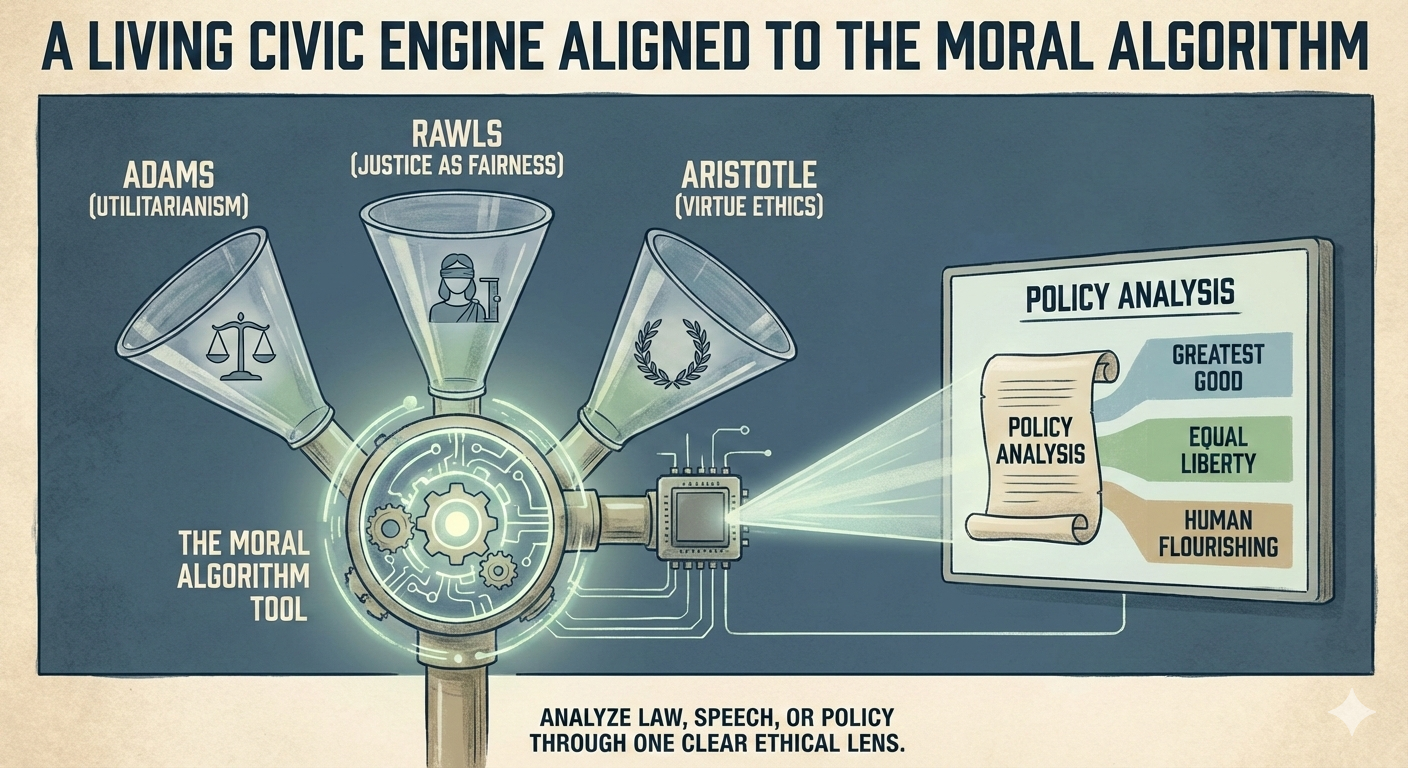
A Living Civic Engine Aligned to The Moral Algorithm
Executive Summary
The Moral Balance System is a constitutionally constrained framework for governing trust, participation, and accountability without creating a universal social-credit regime.
It is designed to:
- Replace opaque, permanent punishment with graduated, reversible consequence
- Bind coercive power—public and private—to procedural accountability
- Preserve maximum liberty for citizens
- Impose heightened accountability only on those who wield power
The system proceeds in two stages:
- Phase I — Online Pilot
A voluntary implementation in an online civic forum (e.g., Discourse) to test legitimacy, bias resistance, restoration, and norm formation. - Phase II — Offline Civic Application
A narrowly scoped, legally bounded accountability system for individuals who can lawfully compel, detain, restrain, or use force over others.
At all times, the system is governed by The Moral Algorithm and subject to reform or termination if it fails the common good.
I. Purpose
The Moral Balance System is instituted for the protection, safety, prosperity, and civic dignity of the people, and not for the profit, honor, or private interest of any individual, faction, corporation, or authority.
It exists to govern attention, participation, and consequence in a manner consistent with:
- Republican self-government
- Ethical restraint
- Community-generated law (jurisgenesis)
It rejects both:
- Anarchy (speech or power without consequence), and
- Tyranny (consequence without accountability).
II. Governing Moral Standard (John Adams)
Government is instituted for the common good; for the protection, safety, prosperity, and happiness of the people; and not for the profit, honor, or private interest of any one man, family, or class of men — and when these ends are perverted, the people have a right to reform, alter, or totally change the same.
All mechanisms herein are legitimate only insofar as they serve this standard.
III. Core Moral Invariants (Non-Negotiable)
The system may not operate if any of the following are violated:
- No permanent exclusion without due process
- No sanction without explanation
- No judgment without personal cost
- No silence without a path back to voice
- No unreviewable or irreversible power
- No identity without accountability
- No accountability without privacy
Any mechanism violating these invariants is illegitimate by definition.
IV. Phase I — Online Pilot (Voluntary)
A. Scope
- Opt-in civic forums (e.g., Discourse)
- No linkage to real-world benefits or penalties
- No financial integration
- No government mandate
Purpose: prove legitimacy before scale
TL;DR — Super Short Version (Plain English)
Before Congress can pass a law, it must be posted online for everyone to see.
People can read it, ask questions, and point out problems in public.
Lawmakers must answer those questions in public.
No secret deals.
No rushed votes.
No hidden changes.
If a law cannot survive open review, it cannot become law.
This does not track citizens or control speech.
It only limits how government power is used.
Sunlight first. Power second.
B. Online Civic Architecture
1. Civic Credit (CC)
- Earned through constructive participation
- Spent to issue serious judgments (censure, panel service)
- Capped to prevent elite capture
- Private by default
Civic Credit measures capacity for judgment, not moral worth.
2. Civic Standing (CS)
Tier-based participation state (not a numeric score):
- Full Participation
- Reduced Distribution
- Cooling Period
- Panel Review State
All tiers are:
- Time-limited
- Behavior-specific
- Automatically reviewable
3. Costly Moral Judgment (Censure)
- Issuing a censure costs Civic Credit
- Requires selecting a defined violation class
- Requires brief justification
- Decays automatically
- Cannot escalate without diverse agreement
Censure:
- Reduces amplification first
- Never directly punishes
- Initiates review, not verdict
4. Moral Panels (Due Process)
Triggered only at high thresholds:
- Random selection from high-trust pool
- Panelists stake Civic Credit
- Written findings required
- Decisions logged and reviewable
- Restoration plan mandatory
Panels may not:
- Enforce ideology
- Demand confessions
- Apply permanent labels
C. Transparency (Online)
A public Civic Ledger records:
- Violation categories used
- Frequency of reversals
- Time-to-restoration
- Panel disagreement rates
Individual identities remain protected.
TL;DR — The “Points” System (Plain English)
The points system is not about popularity.
Points show earned trust, not status.
You gain points by:
Helping the discussion
Explaining ideas clearly
Pointing out real problems in good faith
You spend points when you:
Flag a serious issue
Call for review
Challenge a proposal
Bad-faith attacks cost you points.
Good judgment earns them back.
This stops mobs, trolls, and fake outrage.
It makes judgment careful, not loud.
Power to judge is earned — and it has a cost.
-V. Phase II — Offline Moral Balance (Mandatory for Coercive Power)
A. Bright-Line Inclusion Test (Coercive Power)
Mandatory participation applies to any individual who may lawfully:
- Detain or confine another person
- Restrict movement or liberty
- Use physical force or weapons
- Enforce compliance under threat of force
- Exercise custodial control over persons
If you can take or restrict someone’s freedom, Moral Balance applies.
B. Mandatory Inclusion Categories
1. Public Servants
- Law enforcement officers
- Military personnel (uniformed services only)
- Judges and magistrates
- Prosecutors
- Elected officials
- Political appointees
- Civil servants with enforcement or adjudicative authority
A new congressman quickly learns that hiding, rushing, or lying makes their job harder—while honesty makes it easier.
2. Private or Quasi-Private Coercive Actors
- Private prison and detention guards
- Private security with arrest, detention, or use-of-force authority
- Bail enforcement / bounty agents
- Court security officers
- Prisoner transport officers
- Any private entity operating a facility of confinement
A police officer learns that using power fairly keeps their authority intact, while cutting corners quickly brings oversight and limits their freedom to act.
C. Explicit Prohibitions
The following may not exercise coercive authority under this framework:
- Mercenary or private military forces
- Proxy or deniable armed units
- Foreign paramilitary contractors
- Intelligence contractors exercising force outside judicial process
No coercive power may exist outside accountable moral restraint.
VI. Offline Moral Balance Architecture
A. What Is Tracked
- Public Trust Standing (PTS)
Tiered status related to fitness to exercise authority
(e.g., Good Standing, Review Required, Restricted Authority) - Case-Bound Records
Each incident is:- Contextualized
- Time-limited
- Reviewable
- Tied to role-relevant conduct only
- Restoration Pathways
Retraining, supervision, reassignment, or reinstatement
B. What Is Explicitly Prohibited (Offline)
Moral Balance may not:
- Determine criminal guilt
- Control pay, benefits, or housing
- Restrict lawful speech or belief
- Be used for predictive policing
- Become a universal reputation score
It governs fitness to wield power, not citizenship.
VII. Due Process & Oversight
- Written notice required
- Right to representation
- Independent review panels
- Automatic record expiration
- External civilian oversight authority
- Legislative sunset review
VIII. Living Reform Clause
If evidence shows the system:
- Privileges factions
- Concentrates unreviewable power
- Suppresses lawful dissent
- Fails the common good
It must be reformed, altered, or dismantled.
This obligation is binding.
IX. The Civic Claim
A free people can govern power without surrendering liberty — if judgment is costly, authority is restrained, and restoration is always possible.
Closing Statement
The Moral Balance System is not a score.
It is a constitutional process for accountability.
It exists to discipline power — not people.
If it fails that purpose, it must not survive.
Civil-Liberties Defense Memo
Why the Moral Balance System Protects Citizens
Prepared for Constitutional, Civil-Rights, and Civil-Liberties Review
Executive Summary
The Moral Balance System reduces coercive risk to citizens by:
- Limiting mandatory participation to power-holders
- Prohibiting universal scoring
- Replacing punishment with procedural restraint
- Constraining algorithmic authority with due process
- Eliminating privatized, deniable force
It is structurally anti-authoritarian.
I. This Is Not a Social Credit System
Key distinctions:
| Social Credit | Moral Balance |
|---|---|
| Universal | Role-limited |
| Numeric score | Tiered standing |
| Predictive | Case-based |
| Opaque | Reviewable |
| Permanent | Time-limited |
| Controls civilian life | Governs coercive authority |
Citizens cannot be scored, ranked, or restricted for participation in daily life.
II. Citizens Gain Liberty, Not Lose It
For private citizens:
- Participation is voluntary (online only)
- No offline obligation
- No effect on employment, credit, housing, or movement
- Full right to disengage
The system draws a hard constitutional line between citizens and power-holders.
III. Power Is Made Legible and Constrainable
Historically, abuse emerges when:
- Force is privatized
- Authority is fragmented
- Accountability is deniable
Moral Balance closes that gap by binding all coercive power — public or private — to:
- Documentation
- Explanation
- Review
- Restoration
This protects citizens from invisible or outsourced violence.
IV. Due Process Is Built In, Not Optional
Every adverse action requires:
- Explanation
- Evidence
- Review
- Time limits
- Restoration paths
There are no permanent labels, secret blacklists, or algorithmic verdicts.
V. Why This Reduces Abuse Risk
Traditional systems rely on:
- Punishment after harm
- Internal discipline
- Secrecy
Moral Balance relies on:
- Early restraint
- External review
- Procedural legitimacy
This reduces the probability of catastrophic abuse rather than reacting after the fact.
VI. Why This Is Constitutionally Compatible
The system:
- Does not criminalize speech
- Does not impose penalties
- Does not override courts
- Does not score citizens
- Does not predict behavior
It governs fitness to wield power, which courts have repeatedly upheld as a legitimate regulatory domain.
VII. Final Assessment
Moral Balance does not expand the state’s reach into civilian life.
It does the opposite:
It shrinks the space where power can hide.
By constraining those who can coerce, it enlarges liberty for everyone else.
End of Memo
Steelmanning the Moral Balance System: A Framework for Accountable Power in an Era of Erosion
Executive Summary
The Moral Balance System (MBS) proposes a constitutionally constrained civic accountability framework that disciplines coercive power—public and private—through graduated, reversible consequences, while preserving liberty for ordinary citizens. Governed by John Adams' Moral Algorithm and core invariants like due process and restoration, it begins with a voluntary online pilot to test legitimacy before mandatory application to those who can detain or use force. This statement steelmans MBS by transparently addressing concerns like implementation hurdles, while asserting its legitimacy as a constitutional safeguard against unchecked authority and its urgent need amid 2025's executive overreach, dismantled police reforms, and global authoritarian surges. Congress should legislate its pilot, and the public demand it, to reclaim republican self-government.
The Core Argument: Disciplining Power Without Surrendering Liberty
MBS is not a universal social credit system but a targeted process to bind those with coercive authority—law enforcement, judges, military personnel, and private actors like detention guards or bounty agents—to procedural accountability. Its "bright-line inclusion test" applies only to individuals who can lawfully detain, restrain, or use force, explicitly prohibiting unaccountable entities like mercenaries or deniable units. Through tiered standings (e.g., Review Required), case-bound records, and mandatory restoration pathways, it replaces opaque punishment with early restraint, ensuring judgments cost Civic Credit and trigger diverse panels. Online pilots foster community norms via opt-in forums, proving bias resistance before offline scaling. Aligned with "The Moral Algorithm" for ethical evaluation, MBS rejects anarchy (power without consequence) and tyranny (consequence without review), embodying the civic claim: a free people can govern power if authority is restrained and redemption possible.
Acknowledging Weaknesses and Concerns with Transparency
In the spirit of MBS's own epistemic humility and living reform clause, potential flaws must be confronted. Scaling from voluntary online pilots to mandatory offline application could face bureaucratic resistance, especially in fragmented jurisdictions where defining "coercive power" (e.g., edge cases like EMTs in crises) risks unintended expansion. Civic Credit, while capped to prevent elite capture, might disadvantage less digitally savvy groups, exacerbating equity issues in norm formation. Panels, despite random selection and stakes, could succumb to human bias or factionalism, as seen in historical accountability efforts. Privacy protections are robust, but data breaches remain a risk in a surveillance-heavy 2025. Finally, the system's reliance on "The Moral Algorithm" for governance invites interpretation debates—what constitutes the "common good"?—potentially politicizing judgments. These are real hurdles: MBS demands vigilant oversight, or it risks becoming the unreviewable power it seeks to constrain.
Strong Position: The Legitimacy of MBS as Constitutional Infrastructure
MBS's legitimacy flows directly from America's founding principles, operationalizing Adams' mandate that government serve the common good, not private interests, through restraints on power-holders. Its invariants—no permanent exclusion without due process, no judgment without cost—echo the Constitution's protections (speech, equal protection, due process) and judicial precedents upholding role-specific accountability, like licensing for lawyers or doctors. Unlike dystopian social credit, MBS is role-limited, case-based, and reviewable, drawing a "hard constitutional line" between citizens (voluntary, no penalties) and coercers (mandatory, fitness-focused). The Civil-Liberties Defense Memo underscores its anti-authoritarian design: prohibiting predictive policing, permanent labels, or civilian controls, while mandating transparency via public ledgers and sunset reviews. Courts have affirmed regulating "fitness to wield power" as legitimate; MBS extends this to privatized force, closing gaps where abuse hides. In essence, it's jurisgenesis—community-generated law—restoring republican dignity without ideological enforcement.
Strong Position: The Urgent Need Amid 2025's Crises
2025's tumult demands MBS's targeted restraints, as executive overreach, eroded police accountability, and global authoritarianism expose the perils of unchecked coercion. Domestically, President Trump's April 8 Executive Order on "Protecting American Energy From State Overreach" exemplifies federal dominance, directing the Attorney General to challenge state policies on climate and emissions, potentially preempting local authority without due process. This follows February's orders deconstructing the "administrative state" by rescinding 78 Biden-era actions and eliminating non-statutory functions, concentrating power while reducing oversight. Police reforms have unraveled: the DOJ dismissed Biden investigations and consent decrees in May, ending accountability in cities like Louisville amid rising concerns over punitive practices exacerbating incarceration. Recent scandals, like D.C.'s police chief accused of manipulating crime data, highlight internal secrecy MBS could counter with external reviews.
Internationally, autocracies now outnumber democracies for the first time in 20 years, with 45 countries autocratizing and rule of law declining in 63% amid armed conflicts like Ukraine's escalation and Sudan's crisis. Private military contractors (PMCs) amplify risks: Erik Prince's Vectus Global in Haiti and DRC faces sanctions for human rights lapses, while Trump's talks on PMCs for Ukraine underscore accountability voids MBS's prohibitions target. The U.S. itself shows "rapid authoritarian shift," with weakened oversight enabling overreach. MBS's focus on binding privatized force to documentation and restoration reduces "invisible violence," essential as Project 2025's policies expand executive tools amid polarization. Without it, 2025's trends—debt fights, immigration crackdowns, AI regulatory blocks—risk legitimacy collapse.
Conclusion: A Bipartisan Call to Action
Congress: Pilot MBS via legislation mandating online forums and oversight for coercive roles—your duty is to check power, not perpetuate it. Public: Embrace this as civic renewal; your safety hinges on accountable authority. MBS isn't perfection but a principled bulwark: by constraining coercers, it enlarges liberty. In 2025's fragility, choose restraint—or forfeit the republic.