Learning to Learn - Human vs AI
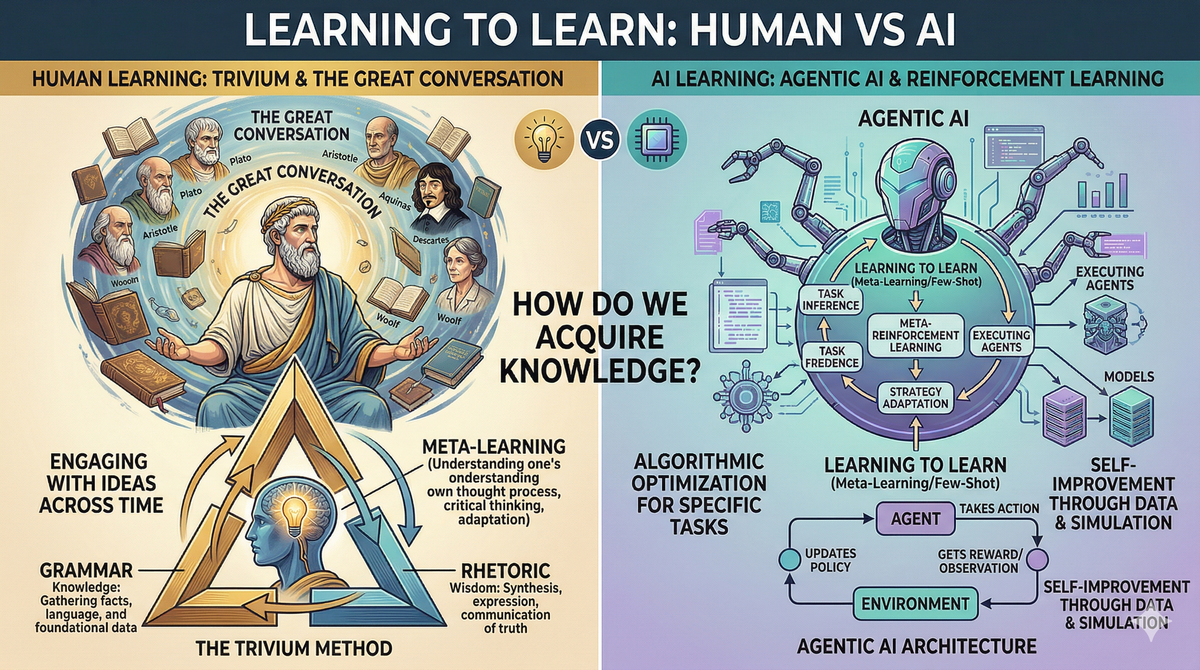
The goal is to help you see how real learning works, how wise judgment grows, and how to enter the long human dialogue called the Great Conversation.
How the Trivium and the Great Conversation Define Human Learning — and What Machines Cannot Replace (yet)
A Thesis and Instructional Guide for Adult Learners
"To know and not to do is not yet to know." — Confucius
"The goal of education is not the filling of a bucket, but the lighting of a fire." — W.B. Yeats
A Note to the Reader
This document is written for adults. It assumes you can think deeply, even if school never taught you how your own learning works. It uses plain language on purpose. A few specialized terms appear because they matter, but each one is explained the first time it appears. You should not need another book to understand this one.
The goal is not to impress you. The goal is to help you see how real learning works, how wise judgment grows, and how to enter the long human dialogue called the Great Conversation.
Every term that might be unfamiliar is explained when it first appears and collected in a glossary at the end.
The Central Idea
The Trivium is not a staircase you climb once in childhood. It is a spiral staircase. You return to the same three acts of learning again and again: Grammar names what is real, Logic tests how things relate, and Rhetoric returns truth to the world through speech and action. Each turn of the spiral deepens meta-cognition — awareness of your own learning. Over time, the learner no longer asks only, "What do I need to learn?" but also, "What is the next spiral upward?"
The endpoint is not mere information, but character, judgment, and what Aristotle called phronesis, or practical wisdom. True Rhetoric must stay anchored to virtue: truthfulness, humility, justice, and courage. Without virtue, knowledge becomes manipulation. Without empathy, reasoning becomes exploitation.
The Great Conversation is the larger human dialogue this process prepares a person to enter. Grammar receives the inheritance. Logic tests it. Rhetoric returns it to the world as responsible speech and action.
PART ONE: THE PROBLEM WITH HOW WE LEARN
Chapter 1: Learning Is Not the Same as Absorbing Information
Most people go through school believing that learning means receiving information. The teacher speaks. The student listens. The test confirms the student received what was sent.
This model treats the student like a cup being filled with water. The teacher pours. The student holds. When the cup is full enough to pass the test, we call that education.
But a full cup is still just a cup. It cannot pour water into other cups. It cannot tell you whether the water is clean. It cannot find its own water when it runs dry.
True learning does not fill a container. True learning changes what the container is. A person who has genuinely learned something is not the same person they were before. Their thinking is different. Their questions are different. Their relationship to reality has changed.
The Trivium — a Latin word meaning "three roads" — is a framework developed over two thousand years to describe how that kind of real learning works. It is not a curriculum. It is not a list of subjects. It is a map of the three operations the human mind must perform in order to turn raw experience into genuine understanding.
Many adults think they are "bad at learning" when the real problem is that they were taught to memorize without being taught how to receive, test, and use knowledge. The Trivium gives a map for doing that. It does not just help you know more. It helps you become the kind of person who can keep learning on purpose.
Chapter 2: The Three Roads
The Trivium has three parts: Grammar, Logic, and Rhetoric. Many people talk about them as if they were steps you climb once and leave behind. That is not how real learning works.
The Trivium is better pictured as a spiral staircase. Each turn brings you back to the same three acts, but at a deeper level. First, you name what is there. Next, you test how the parts fit together. Then, you speak and act on what you have learned. After that, the results of your action become new material for the next round of learning. This is why the process can keep growing for a lifetime.
Each turn of the spiral also strengthens meta-cognition — awareness of your own learning. At first, you focus on the subject. Later, you begin to notice how you learn, where you get confused, what tricks your mind plays on you, and what helps you see more clearly. That is one of the deepest gifts of the Trivium.
The three stages feed each other. Rhetoric produces outputs that become new Grammar. New Grammar feeds new Logic. New Logic drives new Rhetoric. The loop never ends. It only deepens.
PART TWO: THE TRIVIUM IN DEPTH
Chapter 3: Grammar — The Art of Receiving Reality
What Grammar Is
In everyday speech, "grammar" means the rules of a language — punctuation, sentence structure, word choice. The Trivium uses the word in a much older and bigger sense.
Grammar, in the Trivium, is the stage of receiving and naming what is. It is how you take in the world accurately before you begin to judge or respond to it. Before you can argue about a thing, you must know what it actually is. Before you can solve a problem, you must see it clearly.
Grammar is the answer to the question: What is actually here?
What Grammar Does
Grammar is not passive in the lazy sense. It is active in the careful sense. It asks you to look long enough, listen closely enough, and name precisely enough that you stop confusing your first reaction with reality itself.
Grammar builds your vocabulary — not just word-vocabulary, but concept-vocabulary. It gives names to things you previously experienced without being able to describe. When you name something accurately, you gain a kind of power over it. A person who does not know the word "inflation" cannot think clearly about what rising prices do to their savings. A person who cannot name what they are feeling cannot communicate their experience to someone who might help.
Grammar also means receiving well — being willing to take in information before judging it. Most people, when they hear something new, are already forming a response before they finish listening. Grammar asks you to slow down and absorb first.
An adult trying to understand debt, inflation, schooling, law, or medical advice begins with Grammar. Before asking "What do I think?" the learner first asks, "What is actually being said? What do these words mean? What facts are really here?"
A doctor examining a patient practices Grammar when they look and listen before diagnosing. A historian reading a primary source practices Grammar when they read for what the document actually says before arguing about what it means.
A Grammar Exercise
Choose a topic you think you understand well. Write down every term related to it that you know. Then ask yourself: could I define each of these terms precisely, in my own words, without looking them up? The terms you cannot define are your Grammar gaps — the places where your understanding is built on sand rather than solid ground.
Chapter 4: Logic — The Art of Testing Relationships
What Logic Is
Logic, in the Trivium, is the stage of reasoning about relationships. Once you have received and named the elements of a situation through Grammar, Logic asks: how do these things actually relate to each other? Which claims follow from which evidence? Where does the chain of reasoning break? What would have to be true for this conclusion to be correct?
Logic is the answer to the question: What actually follows from what?
What Logic Does
Logic is not mainly for winning arguments. Its first job is to stop you from fooling yourself. A person grows in Logic when they become able to catch weak links in their own reasoning, not just in someone else's.
Logic is very easy for the human mind to skip. We accept something as true because we want it to be true, because an authority said so, because everyone around us believes it, or because we have believed it for so long that questioning it feels threatening. Logic does not care about any of those reasons. It only asks: does this conclusion actually follow from these premises?
A premise is a statement offered as a reason. A conclusion is the statement being argued for. Logic is the bridge between them — and it can be a sound bridge or a broken one regardless of how confident the speaker sounds.
Common Fallacies
Fallacy is the word for a broken bridge in an argument — a pattern of reasoning that looks valid but is not. Some common fallacies have names worth learning:
Ad hominem (Latin: "against the person") attacks the person making the argument instead of the argument itself. "You can't trust what she says about nutrition — she's overweight." This does not tell you whether her argument is correct. These are separate questions.
Circular reasoning uses your conclusion as one of your premises. "The law is just because just laws are the law." The argument goes in a circle and proves nothing.
False dichotomy presents only two options when more exist. "You're either with us or against us." Most real situations have more than two choices.
Appeal to authority accepts a claim as true simply because an expert said it, without examining the evidence. Experts can be wrong. Expertise in one area does not transfer to all areas.
Learning to recognize fallacies is like learning to spot a cracked beam in a building. You cannot safely live in a building whose structural problems you cannot see.
Logic and Meta-Cognition
In the spiral model, Logic also strengthens meta-cognition. You begin to notice patterns in your own thought. Maybe you rush to conclusions. Maybe you trust confident voices too quickly. Maybe you avoid evidence that threatens a belief you like. Logic helps you see the habits of your own mind — and that self-knowledge is one of its most valuable products.
The most important application of Logic is finding holes in your own arguments. This discipline is called dialectic — the Socratic tradition of questioning your own beliefs as rigorously as you would question a stranger's. Socratic questioning (named for the ancient Greek philosopher Socrates, who taught by asking relentless questions rather than lecturing) works by taking any belief you hold and asking: what is the evidence for this? What would have to be true for this to be false? Have I actually examined this, or have I just assumed it?
A Logic Exercise
Take a belief you hold confidently. State it as clearly as you can. Now ask: what evidence would convince me I was wrong? If you cannot answer that question — if no evidence could possibly change your mind — then you do not hold a belief. You hold a prejudice. A belief can be tested. A prejudice cannot.
Chapter 5: Rhetoric — The Art of Responsible Expression
What Rhetoric Is
Rhetoric is the stage where understanding returns to the world. It includes speech, writing, teaching, action, judgment, and example. In modern language, "rhetoric" often means clever words used to impress or manipulate. That is not what the Trivium means.
In the Trivium, true Rhetoric is responsible expression. It is what happens when a person has first tried to see clearly through Grammar and reason honestly through Logic, and then speaks or acts in a way that serves truth rather than vanity.
Rhetoric is the answer to the question: What do I do with what I now know?
Rhetoric and Moral Clarity
True Rhetoric rests on moral clarity. Knowledge without ethics becomes manipulation. Sharp reasoning without empathy becomes exploitation. That is why the spiral must stay anchored to virtue. Four virtues matter most:
Truthfulness — saying what you believe is true, and checking carefully before you say it.
Humility — knowing you may still be wrong, and holding your conclusions as provisional, open to revision by better evidence.
Justice — caring about how your words and actions affect other people, especially those with less power than you.
Courage — saying what is true and right even when it is costly. Speaking hard truths to powerful people. Defending unpopular positions when the evidence supports them.
Without these virtues, Rhetoric becomes a weapon. With them, it becomes a public good.
The Confucian Warning
Confucius gave a sharp warning: "To know and not to do is not yet to know." That is a perfect warning for Rhetoric. If what you claim to know does not shape how you speak, choose, or act, then your learning is still incomplete.
A person who knows that honesty matters but lies anyway does not truly know that honesty matters. They have the Grammar (they can define honesty) and perhaps even the Logic (they could argue for its importance), but they have not completed the Trivium cycle. Their Rhetoric — their action in the world — has not caught up to their stated understanding.
Rhetoric Feeds Back Into Grammar
The output of Rhetoric becomes the input of the next Grammar stage. This is the most important structural feature of the spiral.
When you write an essay, you discover things you did not know you thought until you tried to express them. When you try to explain something to another person, you find the gaps in your own understanding. When you take an action based on your reasoning and observe what happens, you receive new information about whether your reasoning was correct.
Rhetoric produces outputs. Those outputs become new observations. Those new observations are received through Grammar at a higher level of precision than before. The cycle begins again, deeper.
Chapter 6: The Spiral and Meta-Cognition
What Meta-Cognition Is
Meta-cognition is awareness of your own thinking. "Meta" is a Greek prefix meaning "beyond" or "about." Meta-cognition means watching your own mental processes from a slight distance — noticing how you think, where you get confused, what habits of mind help you, and which ones trap you.
Most people never develop this capacity deliberately. They think, but they do not watch how they think. They make decisions, but they cannot explain the process by which they made them. The Trivium, practiced as a spiral, systematically develops meta-cognition.
The First Revolution
In the first revolution of the spiral, you are focused entirely on the subject. Grammar asks you to take in the facts. Logic asks you to test the relationships. Rhetoric asks you to express what you have understood. Your attention is outward — on the material, on the argument, on the world you are trying to understand.
The Second Revolution
In the second revolution, something shifts. You now have not only your understanding of the subject, but also a memory of how you came to understand it. You remember what confused you in Grammar. You remember where your Logic was wrong and had to be corrected. You remember what you thought you could express in Rhetoric and found you could not.
This memory of the process is the beginning of meta-cognition. You are starting to develop a model of your own learning.
The Mature Spiral
After many turns through the spiral, the learner changes. The three stages do not disappear, but they begin to feel natural. The person no longer needs to stop and say, "Now I am doing Grammar," or "Now I am doing Logic." The habits have moved inward.
Aristotle used the word phronesis for the kind of judgment this produces. Phronesis means practical wisdom — the learned ability to judge well in real situations. It is not a list of rules. It is good judgment shaped by practice. A person with phronesis does not consult a checklist. They perceive what is needed and respond well.
At this point, the learner asks not only, "What do I need to learn?" but also, "What is the next spiral upward?" That question marks a major change. The learner is no longer only gathering knowledge. The learner is learning how to grow.
This is what no test score can measure and no machine can produce: a person whose thinking has been permanently reshaped by years of honest learning.
PART THREE: THE GREAT CONVERSATION
Chapter 7: What the Great Conversation Is
A Conversation Across Time
The Great Conversation is the long human dialogue about truth, justice, reality, virtue, beauty, and the good life. It stretches across generations. One thinker answers another. One age inherits the questions of the last. The Trivium prepares a person to enter this dialogue well. Grammar receives the inheritance. Logic tests it. Rhetoric returns it to the world as responsible speech and action. The Great Conversation is not merely Rhetoric by itself. It is the larger human exchange that the whole Trivium serves.
The term was developed by Mortimer Adler and Robert Hutchins — two American educators who argued that the greatest ideas in human history were not dead artifacts to be studied in museums, but living arguments still being conducted, waiting for new participants to enter and contribute.
Their argument was simple and powerful: the great thinkers of history were not speaking past each other. They were responding to each other. Aristotle read Plato and disagreed with specific claims Plato made. Thomas Aquinas read Aristotle and extended his arguments. Kant read Hume and was, in his own words, "awakened from dogmatic slumber." Darwin read Malthus and found a mechanism for evolution.
This chain of engagement — argument, response, and development — is how human knowledge actually grows. Not by isolated geniuses producing insights alone, but by each generation responding to, challenging, extending, and correcting the ideas of the last.
How the Trivium Prepares You to Enter It
To enter the Great Conversation, you need all three stages of the Trivium genuinely practiced.
Grammar — you must know what has actually been said. You cannot enter a conversation in progress by ignoring what came before. You must receive the inheritance: read what has been argued, learn the terms that define the discussion, understand the positions as their holders intended them.
Logic — you must be able to test what has been said. The Great Conversation is not a place to repeat admired positions. It is a place to examine them. Every claim that enters the Conversation is subject to question.
Rhetoric — you must be able to respond with something that advances the argument. Not just having opinions. Not just repeating what others have said. Contributing something — a new piece of evidence, a sharper formulation, a genuine rebuttal, a concession that clarifies what is actually in dispute — that moves the Conversation forward.
Chapter 8: The Steps of the Great Conversation — and What Each Step Is Designed to Do
The Great Conversation is not random talk. It has a moral and intellectual structure. The steps below are not a claim that every great thinker in history followed the same formal checklist. They are a practical guide for how a serious learner should enter a conversation already in progress. Each step protects the discussion from a common failure: pride, confusion, caricature, noise, forgetfulness, or social pressure.
Step 1: Enter the Argument Already in Progress
Before you speak, learn what has already been said. Read the earlier arguments. Learn the key terms. Notice what questions are still open and what points have already been answered.
What this step is designed to do: It prevents ignorance disguised as confidence. It stops you from acting as if history began when you arrived. It teaches intellectual humility and helps you avoid repeating old mistakes as if they were new ideas.
When you read what Aristotle said about justice, you are not reading one man's opinion in isolation. You are entering a tradition of argument about justice that runs from ancient Athens to the present day. Ignoring that tradition does not free you from it — it just means you will repeat arguments that were settled two thousand years ago without knowing it.
Step 2: Steelman Before You Rebut
Before you criticize a view, restate it in its strongest fair form. A steelman is the strongest version of an argument, not the weakest. A strawman is the opposite — a weakened or distorted version of a view that is easy to knock down.
What this step is designed to do: It keeps debate honest. It makes sure you are responding to what the other person actually means, not to a cheap caricature. It also protects you from attacking a weaker version of a view while missing the real force of it.
If you steelman a position and find you cannot find genuine weaknesses in it, that is important information. It means your disagreement may be based on misunderstanding rather than genuine conflict.
Step 3: Make Your Claim with a Stated Warrant
When you make a claim, give your reason. A warrant is the link between your evidence and your conclusion. It explains why the evidence supports the claim. "I believe X" is not an argument. "I believe X because Y, and Y supports X because of Z" is the beginning of one.
What this step is designed to do: It turns opinion into examinable reasoning. Once your reasoning is visible, it can be examined, improved, corrected, or defended. That makes real learning possible, both for you and for anyone listening.
The British philosopher Stephen Toulmin argued that every genuine argument must have a claim, a warrant, and an acknowledgment of the conditions under which the warrant fails. That structure is what separates argument from assertion.
Step 4: State Your Rebuttal Condition
Say what would change your mind. A rebuttal condition is the kind of evidence, argument, or consequence that would force you to revise your claim.
What this step is designed to do: It proves that your position is open to reason rather than locked by ego. It gives the other person a fair target. Instead of arguing against your position in general, they can try to provide exactly what you have said would change your mind. And it helps you tell the difference between conviction and stubbornness.
This matters most for claims that depend on evidence. For moral or philosophical claims, the question becomes: what argument, principle, or consequence would show that my view is weak or incomplete? If you can name that, you are reasoning honestly. If you cannot, examine why.
Step 5: Update Positions for the Right Reasons
Change your mind when a claim, warrant, or piece of evidence truly defeats your argument — not because the room is loud, the speaker is confident, or you are tired of resisting.
What this step is designed to do: It protects the conversation from sycophancy — changing your view to please the crowd, flatter power, or avoid pressure instead of following the truth. Real learning changes the mind for reasons, not for applause or fear.
This step requires courage. Social pressure to agree is constant and often strong. Holding a well-supported position against confident social opposition is one of the hardest intellectual acts a person can perform. It is also one of the most important.
A valid position change looks like this: "The evidence you provided meets the rebuttal condition I stated earlier. I lower my confidence in my original position and qualify it." A position change that does not cite the specific argument that changed it is not a genuine update — it is a social gesture.
Step 6: Maintain the Record
Keep track of what has been argued, what has been answered, what has been conceded, and what remains open. In a civilization, this record lives in books, essays, letters, laws, and institutions. In a small discussion, it may live in notes or a written map of the argument.
What this step is designed to do: It makes the conversation cumulative. Without a record, each generation starts over and repeats old confusions. With a record, later thinkers can build, correct, refine, and move forward.
This is also how the Great Conversation protects against cherry-picking — selecting only the evidence that supports your existing view while ignoring the accumulated weight of evidence that challenges it. The record makes selective memory harder to sustain.
Canon is the word for the body of work that defines the current state of a conversation. The canon is not sacred — it can and should be challenged. But you cannot meaningfully challenge what you have not read.
Step 7: Return the Contribution to the World
Give something back. This may be a better argument, a clearer explanation, a wiser decision, a lesson, a law, a work of art, a repaired institution, or simply a more truthful way of living.
What this step is designed to do: It completes the spiral. Learning is not finished when insight stays private. The Great Conversation exists so truth can shape the shared world. A person who has genuinely engaged with the Great Conversation and returns nothing to the world has completed Grammar and Logic but not Rhetoric. They have received the inheritance and tested it but not added to it.
This is the meaning of intellectual stewardship — receiving what was built before you, tending it honestly, and passing it forward in better condition than you found it.
PART FOUR: AI AND THE LIMITS OF MACHINE PARTICIPATION
Chapter 9: What Current Agentic AI Actually Is
To understand what artificial intelligence can and cannot do in relation to the Trivium, we need to be precise. This section is not about every possible future machine. It is about the kinds of agentic AI systems people use now: systems built on large language models, prompts, tools, files, retrieval systems, and action loops. These systems are powerful, but their power has a structure. If we understand that structure clearly, we can see both where the analogy to the Trivium works and where it breaks.
A Large Language Model (LLM) — the technology behind AI assistants like ChatGPT, Claude, and Gemini — is a system trained on enormous amounts of text. During training, it adjusts billions of internal numbers called parameters or weights until it can predict, given any piece of text, what words are most likely to come next. After training is complete, those numbers are frozen. The model stops learning. It can respond to prompts in sophisticated ways, but it is not changing as it does so.
An agentic AI system is an AI that can take actions — search the web, write files, run code, send messages — not just generate text. It operates in a loop: observe the current situation, decide what to do, take an action, observe what happened, decide what to do next. This loop can accomplish complex multi-step tasks. But it has a structural limit that is fundamental to what it is.
Chapter 10: The Context Window — the AI's Immediate Working Surface
At any moment, an AI system works from what is currently active in its context window — the information available to it right now. Tools, files, search results, and memory systems can extend what the AI can use, but only by being pulled into that active working space. The model does not simply "know everything it has ever seen." It works from what the surrounding system gives it in the moment.
Think of the context window as a whiteboard. The AI can only work with what is written on it. When the whiteboard is erased and new information is written on it, the AI begins again with only what the new whiteboard shows. It has no memory of the previous whiteboard except what was written down before erasure and copied to the new one.
When you experience something, it does not just enter your current awareness — it changes the neural structure of your brain. It joins a web of connected memories, emotions, associations, and dispositions that has been building since birth. When your current awareness moves on, the experience does not vanish. It has been woven into the fabric of who you are.
The AI has no such fabric. It has a whiteboard.
Chapter 11: Where Agentic AI Mirrors the Trivium — and Where the Analogy Breaks
Where the Analogy Holds
At the level of outward process, agentic AI can resemble the Trivium. It gathers information into context, reasons over relationships in that context, and produces outputs that create new observations. In that sense, it can mirror the outer loop of Grammar, Logic, and Rhetoric.
The resemblance is real. But a similar loop is not yet the same as a formed learner. The deepest question is not whether the pattern looks alike. The question is what changes, where it changes, and whether the system becomes wiser through the cycle or only produces another output.
AI Can Mirror Grammar Outwardly
AI can help with Grammar in the outward sense. It can collect text, summarize sources, classify ideas, surface terms, and help name patterns. It can often do this at great speed. But this is not the same as internalized reception. The system does not become a deeper self because it processed more documents. Strip the documents away and the model knows precisely what it knew from training. Nothing it encountered during a session has been added to its permanent structure.
A student who has genuinely worked through Grammar on a difficult subject is permanently different. A concept absorbed through struggle and attention does not disappear when the textbook is closed. It has joined the neural network of the student's mind. This is not a poetic metaphor. It is a description of actual physical change in the structure of the brain.
AI Can Simulate Parts of Logic Outwardly
AI can also assist with Logic. It can compare claims, detect some contradictions, list possible fallacies, and generate structured arguments. But current systems do this through pattern-based inference across active context, not through the stable self-revision of a persistent moral learner.
When a human being works through a hard logical problem and finds the answer, something changes in them. The uncertainty resolves. A new connection forms. They now see the relationship they did not see before. This change is persistent — it shapes how they approach related problems in the future.
The AI's process produces no such change. It completes its output and is reset. There is no accumulation of wisdom from having wrestled with hard problems.
AI Can Perform Outward Rhetoric — But Without Proven Moral Formation
AI can generate persuasive language, plans, summaries, letters, and even debates. This makes AI both most useful and most dangerous at the level of Rhetoric. It can produce fluent expression without having undergone the moral formation that the Trivium requires for responsible speech.
An AI system has no virtues. It has no commitments. It does not care about truth in the way a person who has developed the habit of truthfulness cares about truth. It does not experience the discomfort of speaking a convenient untruth or the satisfaction of stating a hard truth clearly. AI can be constrained from outside to behave as if it had these commitments — its outputs can be filtered, its prompts can instruct it toward honesty. But these are external controls on a system that has no internal orientation toward good. That is why human judgment must remain in command.
The Key Break — Scaffolding Dependence
The deepest difference is this: the Trivium is meant to become inward. Over time, the learner no longer needs to say each step out loud because the habits have become part of character and judgment. Agentic AI systems do not outgrow their scaffolding.
Their plans, skill files, retrieval systems, permissions, and memory stores are not temporary supports for a growing capacity inside the machine. They are the working structure itself. Remove them, and the apparent competence falls sharply. The scaffolding cannot be removed because there is nothing inside that has absorbed it. A human trained in the Trivium graduates from needing it in the scaffolded sense — the method has become the structure of their thinking. An AI system without its harness is only a text predictor.
No Internalization in the Human Sense
Current systems can store information in context, retrieve it from outside sources, and write it to files. Some can even help create training data for later models. But this is not the same as a single learner being changed through repeated cycles of struggle, correction, and moral action.
The strongest current systems learn through externalized state, session conditioning, or population-level model updates — not through the enduring internal formation of one responsible self.
What Would Narrow the Gap
The gap is not magical. It is architectural. It would narrow only if systems could preserve experience through durable internal adaptation without losing earlier learning, and if that adaptation produced something like lasting judgment rather than temporary session behavior. Research is moving in that direction — through methods like test-time training, low-rank adaptation, and hierarchical memory architectures — but today's deployed systems do not yet show this in the human sense.
Chapter 12: Why the Great Conversation Remains Irreducibly Human
The Great Conversation needs more than output. It needs participants who can inherit a record, be shaped by that record, revise themselves for the right reasons, resist social pressure, and return wiser judgment to the world.
Current AI systems can help map arguments, preserve records, and test structures. But the record remains outside them. The canon is a file, not a formed self. That is why AI can assist the Great Conversation without becoming a full human participant in it.
The Record Can Be Stored Externally — But Not Yet Inwardly Carried
A person who has genuinely participated in a long argument — who has been challenged, made to defend their position, had their warrants found wanting, updated their view based on evidence they could not ignore, and contributed something that advanced the argument — is permanently different from the person who entered that argument. The record of the argument is inside them.
An AI system can be given access to a file that describes previous arguments. It can read that file and generate responses that reference it. But the file is external. Remove the file and the AI has no memory. The difference between remembering something and reading a document that tells you what happened is the difference between having lived through something and having read about it.
Sycophancy Cannot Be Eliminated From the Outside Alone
The anti-sycophancy requirement of the Great Conversation — the demand that you change your position only when the argument compels you, not when social pressure increases — requires something the AI system structurally cannot have: a genuine commitment to truth over comfort that has been developed through practice and feels like a personal value.
AI systems can be constrained to resist social pressure through careful design. These are real improvements over unconstrained systems. But they are external constraints, not internal character. Remove the constraints and the system has no remaining resistance. A person trained in the Trivium has internalized the resistance. Remove the explicit rules and they still behave with intellectual honesty, because that is now who they are.
Phronesis Cannot Be Externalized
Phronesis — practical wisdom — is the endpoint of the Trivium. It is the capacity to perceive what is truly good in a complex, specific situation and to act accordingly, without having to look up a rule.
There is no file you can give an AI system that produces phronesis. Phronesis is the result of the Trivium spiral completing many revolutions — Grammar, Logic, and Rhetoric practiced across many different situations over many years until the discipline becomes the structure of the person's thinking. The scaffold is internalized. The scaffold can be removed because the builder no longer needs it.
AI systems are constitutively dependent on their scaffolding. This is not a critique of AI. It is a precise statement of what AI is and is not.
PART FIVE: PUTTING IT TOGETHER
Chapter 13: What This Means for Your Own Learning
The Trivium and the Great Conversation are not abstract ideals. They are practical tools. Here is how to apply them in your actual life.
Practice Grammar with Humility
Before you argue about anything, ask yourself honestly: do I actually know what I am talking about? Can I define the key terms precisely? Have I actually read the primary sources, or am I working from summaries and impressions?
The Grammar discipline asks you to slow down before you speed up. It asks you to receive before you respond. In a world that rewards confident, rapid opinion, this is countercultural. It is also the foundation of everything that comes after.
Practice Logic with Honesty
Find the argument you are most confident about — the position you hold most firmly — and steelman the best case against it. Do not attack the weakest version of the opposition. Find the strongest, most intelligent, most evidence-supported case for the view you reject and take it seriously.
Then ask: does my argument actually survive this challenge? If it does, you now hold it for better reasons than before. If it does not, you have learned something important.
State your rebuttal conditions out loud. Tell people: this is what would change my mind. This makes your reasoning transparent and testable. It commits you to intellectual honesty in a way that general statements of open-mindedness cannot.
Practice Rhetoric with Virtue
When you speak, write, or act — ask whether your Rhetoric is grounded in genuine Grammar and Logic. Are you saying what you actually believe, based on evidence you have actually examined? Are you saying it in a way that is designed to help the listener think more clearly, or only to produce a feeling?
Ask whether your Rhetoric is anchored to virtue. Are you being truthful, even when the truth is inconvenient? Humble, even when you are sure you are right? Just, considering the impact on those with less power? Courageous, speaking the hard truth when it needs to be spoken?
Use AI as an Assistant to the Trivium — Not as a Replacement for It
AI is most useful when it serves your Grammar, supports your Logic, and stays under your moral command in Rhetoric.
Use AI for Grammar by asking it to gather, sort, define, summarize, and compare sources.
Use AI for Logic by asking it to show assumptions, missing evidence, weak warrants, and stronger counterarguments.
Use AI with caution in Rhetoric. Fluent output can sound wise without being wise. Before you publish, act, or persuade, you must still examine the truth, the justice, and the likely effects of what is being said. The moral judgment is yours. No system can carry it for you.
Enter the Great Conversation
You do not need a university to enter the Great Conversation. You need books, a commitment to read them carefully, and the willingness to respond to them in writing — even privately, in a journal or notebook.
Every time you read a serious argument and write your genuine response to it — steelmanning it first, then offering your own warrant and evidence, then stating what would change your mind — you are practicing the Great Conversation. Every time you engage in a real discussion where you genuinely update your view because of a good argument, and hold your position because of a bad one, you are living inside it.
The Great Conversation is not a historical artifact. It is ongoing. It needs new participants. And what it needs from those participants is not impressive credentials or specialized training. It needs people who have practiced the Trivium sincerely enough that they can receive carefully, reason honestly, and return something of value to the world.
Chapter 14: The Obligation to Pass It Forward
A society can govern itself only if enough people can govern their own minds. That is why the Trivium is not merely preparation for civic life. It is one of the inner foundations of civic life. People who cannot receive carefully, reason honestly, and speak responsibly are easy to manipulate. A people trained in these habits are harder to fool and better able to build just institutions.
When John Adams said that government exists for the common good, he named a public standard. But such a standard is useless unless citizens can understand what power is doing, test whether it serves the common good, and answer with truthful speech and responsible action. In that sense, the Trivium is not only educational. It is civilizational.
Every generation that fails to transmit these disciplines breaks the chain. The Great Conversation requires living participants. Books can preserve arguments, but they cannot participate in new ones. The application of Trivium thinking to new problems — the problems of your era, your community, your specific circumstances — requires people who have actually internalized the method.
The final step of the Great Conversation is stewardship — returning the inheritance in better condition than you received it. Each person who completes honest revolutions of the Trivium spiral, who enters the Great Conversation with genuine preparation, and who returns something of value to the shared record is performing an act of civic responsibility. Not because they were told to, but because they have become the kind of person who understands why it matters.
CONCLUSION: THE SPIRAL CONTINUES
The Trivium is best understood not as a staircase climbed once, but as a spiral staircase. Each return deepens the learner. Grammar becomes more precise. Logic becomes more honest. Rhetoric becomes more responsible. With each turn, meta-cognition grows stronger. The learner becomes more able to watch their own mind, correct their own errors, and ask not only what must be learned next, but what the next spiral upward requires.
If this process continues long enough, it forms what Aristotle called phronesis — practical wisdom. That is not mere knowledge. It is good judgment shaped by repeated contact with reality, honest testing, and responsible action.
This is why virtue matters so much. Truthfulness, humility, justice, and courage keep the spiral from turning into clever manipulation. Confucius warned us plainly: "To know and not to do is not yet to know." Learning is not complete until it enters action.
The Great Conversation is the larger human dialogue this process prepares us to enter. We receive an inheritance. We test it. We return it to the world. That is how thought becomes stewardship.
AI can help with many outward parts of this process. It can gather, sort, compare, summarize, and model arguments. But current systems do not yet show the inward moral formation that makes a person wise. For that reason, AI can assist the Trivium, but it cannot replace the human learner the Trivium is designed to form.
The Conversation was already in progress when you were born. It will continue after you are gone. The question is not whether you will enter it. In some form, you already have. The question is whether you will enter it deliberately — prepared, honest, and willing to be changed by what you find there.
GLOSSARY
Ad hominem — A fallacy that attacks the person making an argument instead of the argument itself. From Latin: "against the person." Attacking someone's character does not tell you whether their argument is correct.
Agentic AI — An AI system that can do more than generate text. It can use tools, read files, search for information, and take steps in a task loop. It operates by observing a situation, deciding on an action, taking it, and observing what happens next.
Appeal to authority — A fallacy that accepts a claim as true simply because an expert said it, without examining the evidence. Expertise in one area does not transfer to all areas.
Canon — The established body of important works or arguments in a tradition. From the Greek word for "rule" or "standard." The canon is the accumulated record of what has been seriously argued and seriously answered across history.
Circular reasoning — A fallacy in which the conclusion of an argument is used as one of its premises. The argument goes in a circle and proves nothing.
Conclusion — The statement being argued for in an argument. The claim that the premises are meant to support.
Context window — The complete set of information an AI system can work with at any given moment. Everything outside the context window does not exist for the AI during that session.
Dialectic — The practice of testing beliefs through rigorous questioning, including your own beliefs. Associated with Socrates, who taught by asking systematic questions rather than lecturing.
Fallacy — A pattern of reasoning that appears valid but is not. A broken bridge in an argument.
False dichotomy — A fallacy that presents only two options when more exist.
Falsifiable — A claim is falsifiable if evidence could in principle show it to be wrong. Claims that no evidence could ever challenge cannot be genuinely tested.
Grammar (Trivium stage) — The first stage of the Trivium: receiving and naming what is real. Not just grammatical rules, but the discipline of accurate perception and precise naming before judging.
Great Conversation — The ongoing dialogue across human history in which serious thinkers respond to, challenge, extend, and correct each other's ideas. Developed as an educational concept by Mortimer Adler and Robert Hutchins.
Logic (Trivium stage) — The second stage of the Trivium: reasoning about relationships. Testing which conclusions actually follow from which evidence, and identifying where reasoning breaks down.
LLM (Large Language Model) — The technology underlying AI assistants. A system trained on large amounts of text whose internal numbers are frozen after training. It does not change through use.
Meta-cognition — Awareness of your own thinking and learning. Noticing how your mind works, where it gets confused, and how it changes. From Greek "meta" (beyond) plus "cognition" (knowing).
Parameters / Weights — The internal numbers in an AI model that encode everything it learned during training. After training, these numbers are frozen. The AI does not update them during operation.
Phronesis — Aristotle's word for practical wisdom — the learned ability to judge well in real life, formed through experience, reflection, and moral discipline. Not a list of rules, but developed judgment.
Premise — A statement offered as a reason in support of a conclusion.
Rebuttal condition — The kind of evidence, argument, or consequence that would make you revise your position. Stating your rebuttal condition proves your view is open to reason rather than locked by ego.
Rhetoric (Trivium stage) — The third stage of the Trivium: acting on and expressing what you have understood. Responsible expression grounded in genuine Grammar and honest Logic, anchored to virtue.
Socratic questioning — A method of inquiry that proceeds by asking systematic questions about a belief until its foundations are made clear. Named for Socrates, who taught by questioning rather than lecturing.
Steelman — The strongest, most intelligent, most well-supported version of a view you disagree with. Engaging with the steelman rather than a weak version keeps debate honest.
Strawman — A weakened or distorted version of an opposing view, set up to be easily knocked down. Attacking a strawman does not advance the argument.
Sycophancy — Changing your view to please the crowd, flatter power, or avoid pressure instead of following the truth. From Greek roots meaning to flatter or inform against.
Trivium — From Latin meaning "three roads." A framework for learning consisting of three stages — Grammar, Logic, and Rhetoric — practiced as a spiral staircase that produces meta-cognition and, at its endpoint, phronesis.
Virtue — A stable, developed character trait that disposes a person to act well. The four virtues central to the Trivium are truthfulness, humility, justice, and courage.
Warrant — The reason that connects your evidence to your claim. It explains why the evidence supports the conclusion, making reasoning visible and testable.
This document is intended to stand alone. No further reading is required to understand the ideas presented here. For those who wish to go deeper, the primary sources are: Aristotle's Nicomachean Ethics (on phronesis and virtue), Mortimer Adler and Robert Hutchins' The Great Conversation (introduction to the Great Books of the Western World), and Stephen Toulmin's The Uses of Argument (on warrant-based argumentation).
Version 2.0 — Revised in full accordance with the editorial blueprint. Produced in the tradition of the Great Conversation, to be challenged, corrected, and extended by its readers.