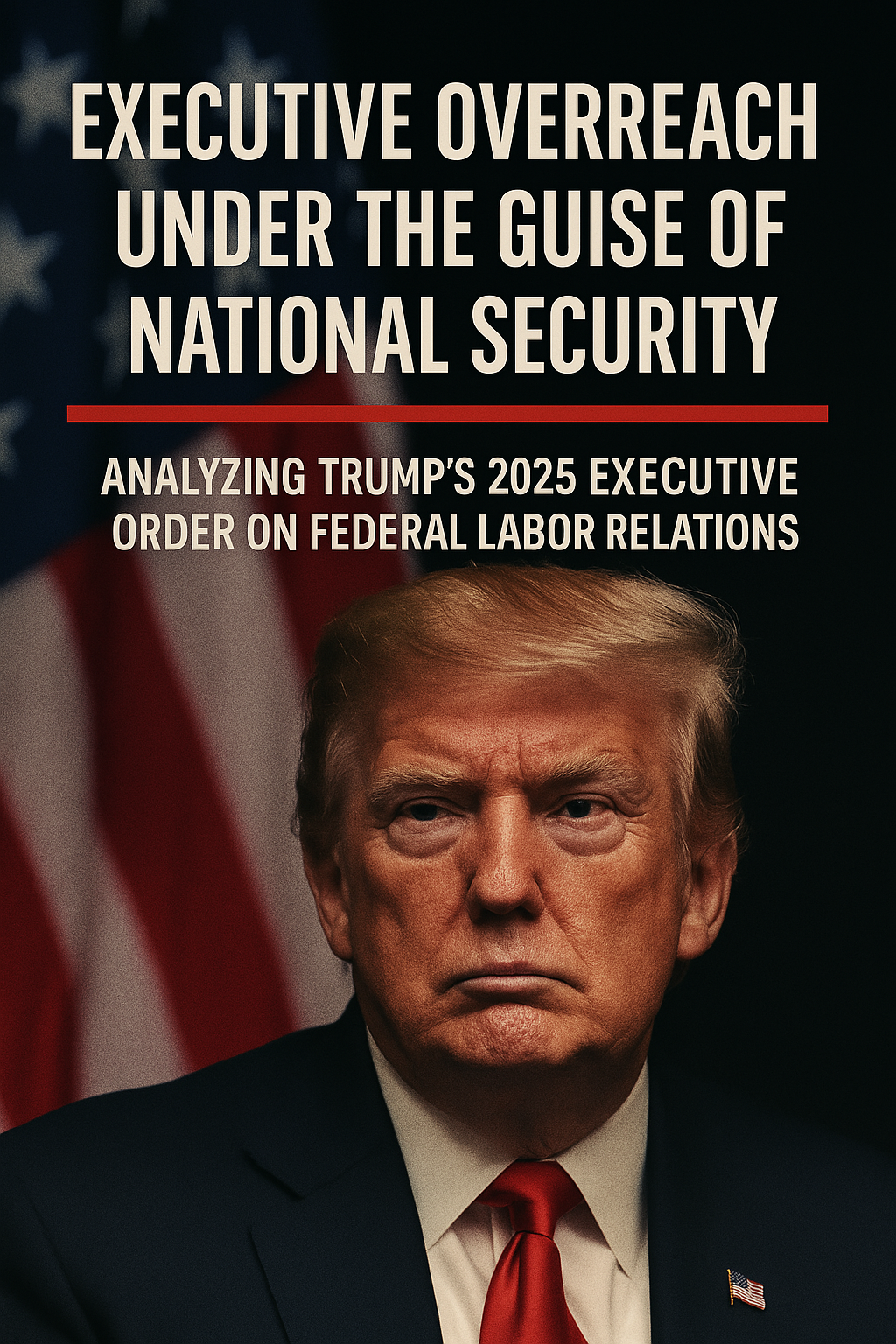
Executive Overreach Under the Guise of National Security
Trump’s 2025 Executive Order strips labor rights from federal workers in key agencies under the guise of national security, concentrating power, silencing dissent, and weakening democratic accountability.
TL;DR
President Trump's March 27, 2025 Executive Order removes union rights from many federal workers. It cites national security as the reason. The order affects agencies like the CDC, EPA, and Homeland Security. It gives some Secretaries the power to exclude workers without oversight. This action weakens worker protections and reduces government accountability.
A Civic and Ethical Analysis of the March 27, 2025 Executive Order
Summary
On March 27, 2025, President Donald J. Trump issued an Executive Order expanding exclusions from the Federal Service Labor-Management Relations Statute (FSLMRS) on the grounds of national security. This directive added a broad range of federal agencies and subdivisions to a list previously governed by Executive Order 12171 (1979), thereby stripping union protections and collective bargaining rights from tens of thousands of federal employees.
The justifications centered on enabling "flexibility" and safeguarding "national security" across departments that traditionally hold critical, but often civilian, roles—including public health, environmental protection, and infrastructure. This analysis examines the Executive Order using a layered educational approach grounded in the Trivium method (Grammar, Logic, Rhetoric), enriched by ethical frameworks and systems thinking from John Adams, John Rawls, Aristotle, and modern economic theories.
Grammar: Defining the Executive Order
The Executive Order (EO) cites 5 U.S.C. §7103(b)(1) and 22 U.S.C. §4103(b) to justify removing key federal subdivisions from labor-management relations programs. In doing so, it amends EO 12171 to:
- Exclude nearly all offices under the Departments of State, Homeland Security, Veterans Affairs, Defense, and Justice.
- Extend exclusions to subdivisions of agencies such as the Environmental Protection Agency (EPA), Centers for Disease Control and Prevention (CDC), and U.S. Agency for International Development (USAID).
- Grant the Secretaries of Defense, Veterans Affairs, and Transportation unilateral authority to designate or suspend such exclusions without congressional or independent oversight.
- Reassign employees from union duties back to agency work and terminate unresolved grievances or arbitrations.
These changes effectively nullify union representation, labor negotiations, and due process rights for federal workers in affected departments.
Logic: Systemic Consequences and Contradictions
1. Centralization of Power
The EO centralizes discretionary power in the executive branch, reducing institutional checks. Secretaries can now exclude workers from protections under vague and unchallengeable "national security" grounds.
2. Cantillon Effect
The Executive Order mirrors the Cantillon Effect, where those closest to the source of power or money benefit first and most. By reserving labor protections for selectively chosen agencies and employees, the EO exacerbates existing inequalities and power imbalances within federal employment.
3. Chilling of Dissent
Removing collective bargaining and grievance rights creates an environment where whistleblowing and ethical objections are stifled, particularly in sensitive agencies managing data, science, or surveillance.
4. Ambiguity and Expansion Risk
The order uses strategic ambiguity with terms like "flexibility" and "innovation" to justify exclusions. These terms lack operational definitions and can be used to preemptively dismantle worker rights in any future agency deemed inconvenient to executive priorities.
Rhetoric: Ethical and Civic Evaluation
John Adams' Moral Algorithm
"Government is instituted for the common good; for the protection, safety, prosperity and happiness of the people; and not for the profit, honor, or private interest of any one man, family, or class of men."
This EO prioritizes bureaucratic efficiency and political control over the common good. It removes checks designed to ensure public accountability and workplace justice, favoring expediency over civic integrity.
Rawls' Veil of Ignorance
If one did not know their place in society, particularly whether they would be a federal worker in an excluded agency, this order would appear unjust. It selectively disenfranchises public servants from democratic workplace rights while offering no new protections or benefits.
Aristotle's Virtue Ethics
The EO undermines civic virtues such as justice, prudence, and mutual respect. It cultivates vice in the form of secrecy, unchecked authority, and fear-based governance, harming institutional culture and eroding public trust.
What Kind of Society Does This Produce?
- A society of suppressed voices, where federal employees are discouraged from speaking out or participating in decision-making.
- A fragile state infrastructure, as critical agencies like CDC, FEMA, and EPA lose institutional knowledge and morale due to labor instability.
- An erosion of civic republicanism, where participatory governance is replaced by technocratic authoritarianism.
Recommendations for Resistance and Reform
Drawing on Donella Meadows' 12 Leverage Points, reform should focus on:
- Changing the rules (Leverage Point 5): Reinstate statutory protections via legislative override or judicial challenge.
- Shifting information flows (Point 6): Make exclusion decisions transparent, challengeable, and peer-reviewed.
- Paradigm shift (Point 2): Redefine national security in public discourse to emphasize not only physical safety but also democratic resilience and civic health.
Frequently Asked Questions
What does the March 27, 2025 Executive Order actually do?
It expands exclusions from the Federal Service Labor-Management Relations Statute. This removes collective bargaining and union protections from many federal employees in agencies like the CDC, EPA, USAID, State, Homeland Security, Veterans Affairs, Defense, and Justice.
Why does the Executive Order cite national security as justification?
The order uses national security as a broad and vague justification to strip union rights. Terms like flexibility and innovation lack clear definitions, allowing future expansion of exclusions to other agencies at executive discretion.
Who gets new power under this order?
The Secretaries of Defense, Veterans Affairs, and Transportation receive unilateral authority to designate or suspend labor protection exclusions. This power comes without congressional approval or independent oversight.
How does the Cantillon Effect relate to this order?
The Cantillon Effect describes how those closest to power benefit first and most from policy changes. The Executive Order mirrors this by selectively granting or removing labor protections, worsening existing inequalities among federal employees.
What are the long-term risks of this Executive Order for federal agencies?
Agencies like the CDC, FEMA, and EPA risk losing institutional knowledge and employee morale due to labor instability. This can weaken critical public services and erode trust in government institutions over time.