
Building Intelligence That Learns
I've come to a disturbing realization: we're making the same mistake with AI that we made with education 180 years ago. We're building factory-model systems when we need Trivium-based learning machines.
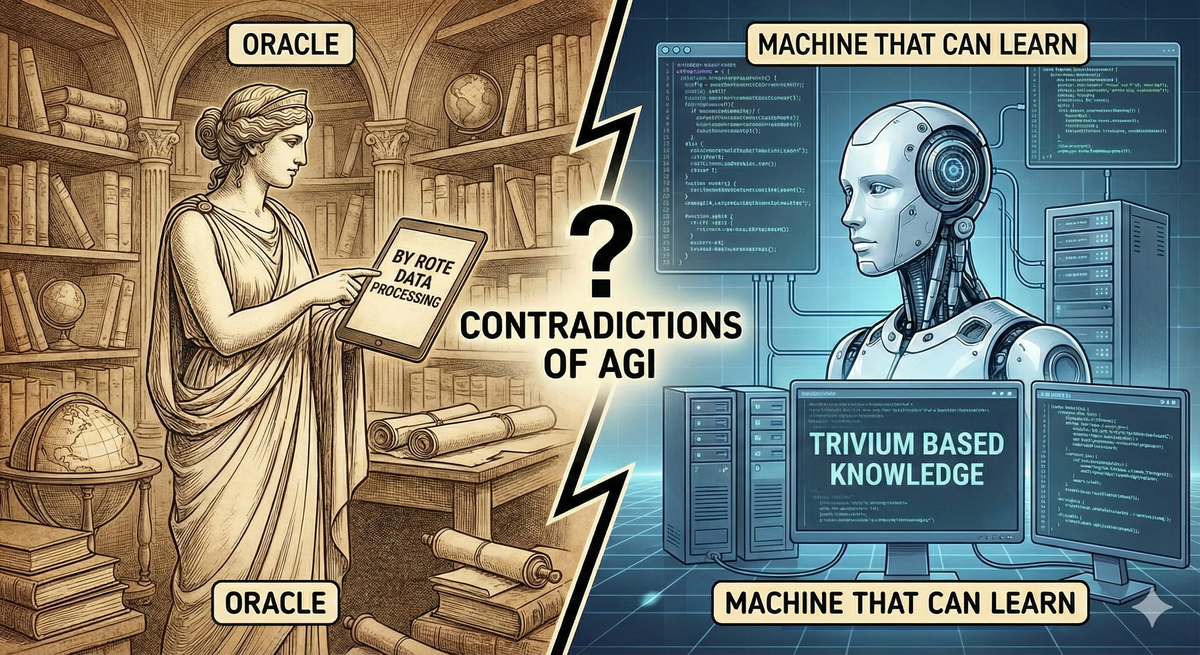
A Trivium-Based Architecture for True AGI
A Technical Thesis on Implementing Learning Machines Rather Than Oracle Systems
Introduction: Why I'm Writing This
I've spent considerable time studying both how humans learn and how we're currently building AI systems, and I've come to a disturbing realization: we're making the same mistake with AI that we made with education 180 years ago. We're building factory-model systems when we need Trivium-based learning machines.
When Ilya Sutskever recently changed his position on AGI development, acknowledging we need "breakthroughs that aren't even properly theorized," he was pointing toward something specific: current AI systems are pre-trained oracles, not learning machines. They're the technological equivalent of factory-model students—trained to output predetermined patterns rather than genuinely learn.
This document presents a technical architecture for building AI systems that actually learn, based on principles that have successfully produced human intelligence for over two millennia: the Trivium method of Grammar, Logic, and Rhetoric. More importantly, it shows how to create systems that can learn from each other through structured debate, accelerating discovery beyond what any single system could achieve.
This isn't philosophy—it's a buildable architecture. I'm going to walk through exactly how to implement it.
The Problem: Oracle AI vs Learning Machine AI
What We're Building Now: The Oracle Model
Current large language models, for all their impressive capabilities, are fundamentally oracles—systems that have been given all their knowledge upfront and simply retrieve and recombine it. Let me be precise about what this means:
Stage 1: Pre-Training (Knowledge Installation)
- Model ingests 15 trillion tokens of text
- Neural network compresses this into parameter weights
- Result: A static knowledge base encoded in billions of numbers
- Cost: Millions of dollars, months of compute time
Stage 2: Supervised Fine-Tuning (Behavior Installation)
- Human labelers create ideal conversation examples
- Model learns to pattern-match these examples
- Result: A system that imitates helpful human responses
- Cost: Thousands of dollars, days of compute time
Stage 3: Reinforcement Learning (Optimization)
- For verifiable tasks (math, code), model practices and improves
- For everything else, uses RLHF with reward models
- Result: Better pattern matching, some emergent reasoning
- Limitation: Cannot run indefinitely due to reward hacking
This is sophisticated, but it's not learning in the meaningful sense. When you ask GPT-4 about quantum computing developments from 2024, it cannot learn about them—it can only search the web and temporarily hold that information in context. The moment the conversation ends, that knowledge vanishes. The model itself hasn't learned anything.
This is factory-model thinking applied to AI: front-load all knowledge, optimize for benchmark performance, deploy as finished product.
What We Need: The Learning Machine Model
Sutskever's revised vision describes AGI as "a superintelligent 15-year-old" that "doesn't know very much at all" but is "very eager" to learn. You give it a task—"go be a programmer," "go be a doctor"—and it learns on the job through experience.
This is fundamentally different architecture. It requires:
- Active Knowledge Acquisition (not passive data ingestion)
- Principled Reasoning (not pattern matching)
- Self-Directed Learning (not supervised optimization)
- Experiential Refinement (not static deployment)
The question is: how do we build this?
The answer, I believe, lies in the Trivium—not as metaphor but as literal cognitive architecture.
The Trivium as Cognitive Architecture
Why the Trivium Is Not Just Educational Philosophy
When most people hear "Trivium," they think of classical education—Latin, Great Books, elite preparatory schools. This misses the point entirely. The Trivium is a method for acquiring, reasoning about, and applying knowledge. It's been refined over 2,500 years of producing human intelligence.
More importantly, it's precisely what Sutskever identified as missing: a learning system that works across any domain without requiring complete pre-training.
Let me break down the three stages as cognitive operations that can be implemented computationally:
Grammar: Systematic Knowledge Acquisition
- Operation: Identify what you don't know and acquire it systematically
- Input: A new domain or problem
- Process: Break down into fundamental components, identify terminology, map conceptual landscape
- Output: Structured knowledge representation
Logic: Principled Reasoning
- Operation: Evaluate claims, test consistency, derive implications
- Input: Acquired knowledge + specific question
- Process: Construct valid arguments, identify assumptions, test against first principles
- Output: Reasoned conclusions with confidence estimates
Rhetoric: Evaluated Application
- Operation: Apply understanding to generate outputs, test through communication
- Input: Knowledge + reasoning + task requirements
- Process: Generate solution, articulate reasoning, evaluate effectiveness
- Output: Solution + meta-understanding of what worked/didn't work
These aren't sequential stages—they're concurrent, recursive operations. A Trivium-based system simultaneously:
- Identifies gaps in its knowledge (Grammar awareness)
- Reasons about what it does know (Logic application)
- Tests understanding through expression (Rhetoric verification)
This creates what Sutskever called the "human value function"—the capacity to evaluate one's own performance and self-correct.
The Technical Parallel: Why Current AI Lacks This
Current LLMs have components that superficially resemble Trivium operations:
Pre-training ≈ Grammar? No. Pre-training is passive compression of existing data. True Grammar is active acquisition: recognizing what you need to know and systematically gathering it.
Reasoning models ≈ Logic? Partially. Chain-of-thought reasoning in models like o1 shows emergent logical structure, but it's discovered through RL on verifiable problems, not implemented as a principled reasoning system.
Generation ≈ Rhetoric? No. Current models generate text by sampling from probability distributions. True Rhetoric involves articulating understanding to test whether it's actually understood, then refining based on feedback.
The difference is between simulation and instantiation. Current models simulate the appearance of these cognitive operations by pattern-matching against training data. A Trivium-based system would instantiate them as actual computational processes.
Architecture Part 1: Implementing Grammar (Knowledge Acquisition)
The Core Challenge
A learning machine must be able to encounter an entirely new domain and systematically acquire understanding without requiring a human to curate training data. This is the Grammar function.
Let me specify exactly what this means computationally:
Scenario: The system encounters "neuromorphic computing" (a field that barely existed in most training data)
Current LLM Behavior:
User: "Explain neuromorphic computing"
Model: [Generates text by pattern-matching against limited training examples]
Output: Vague, potentially hallucinated description
Grammar-Based System Behavior:
User: "Explain neuromorphic computing"
System Internal Process:
1. Assess knowledge: "I have minimal information about this concept"
2. Generate acquisition strategy:
   - Identify it's a subfield of computer architecture and neuroscience
   - Determine foundational knowledge needed (biological neurons, computing paradigms)
   - Map conceptual hierarchy (what are the core principles? who are key researchers?)
3. Execute acquisition:
   - Search academic literature for seminal papers
   - Identify key terminology and definitions
   - Build structured knowledge graph of relationships
4. Verify acquisition:
   - Can I explain this to different audiences?
   - Can I answer questions about it?
   - What do I still not understand?
This is fundamentally different from retrieval or generation. It's active learning.
Implementation Approach: The Grammar Module
I propose a Grammar module that operates alongside (not instead of) the base language model. Think of it as a meta-cognitive system that manages knowledge acquisition.
Architecture Components:
1. Knowledge State Tracker
- Maintains explicit representation of what the system knows/doesn't know
- Not just "have I seen this in training" but "can I reason reliably about this?"
- Implementation: Separate neural network trained to predict the base model's performance on different topics
Technical Detail: During base model training, periodically:
# Pseudocode
for topic in knowledge_domains:
    test_samples = generate_test_questions(topic)
    performance = base_model.evaluate(test_samples)
    knowledge_state_tracker.record(topic, performance)
This creates a meta-model that knows what the base model knows. Critical insight: this must be continuously updated, not static.
2. Concept Graph Builder
- When encountering new information, doesn't just process it—structures it
- Creates explicit representations of:
- Hierarchical relationships (what is a subtopic of what)
- Causal relationships (what causes what)
- Definitional relationships (what terms mean what)
- Prerequisite relationships (what must be understood before what)
Implementation via Structured Generation:
class ConceptGraph:
    def __init__(self):
        self.nodes = {}  # concept -> properties
        self.edges = []  # (concept1, relationship_type, concept2)

    def add_from_text(self, text, base_model):
        # Use base model to extract structured information
        extraction_prompt = f"""
        Extract from this text:
        1. New concepts mentioned
        2. How they relate to known concepts
        3. Causal claims made
        4. Definitions provided

        Text: {text}

        Output as structured JSON
        """

        structured_output = base_model.generate(extraction_prompt, format="json")
        self.integrate(structured_output)
3. Gap Identifier
- Analyzes concept graph to find gaps
- "I know A and C, but the connection between them is unclear"
- "This explanation assumes knowledge of X, which I don't have"
Implementation:
def identify_knowledge_gaps(concept_graph, query):
    # What concepts are mentioned in query?
    query_concepts = extract_concepts(query)

    # What's their relationship in my graph?
    paths = concept_graph.find_paths_between(query_concepts)

    # Where are the gaps?
    gaps = []
    for path in paths:
        if path.has_missing_nodes():
            gaps.append(path.missing_nodes)
        if path.has_weak_edges():  # low confidence connections
            gaps.append(path.weak_edges)

    return gaps
4. Acquisition Strategy Generator
- Given identified gaps, formulates plan to fill them
- Determines what sources to consult, what order to learn things
- This is not retrieval—it's active learning strategy
Example Strategy Generation:
def generate_acquisition_strategy(knowledge_gaps, knowledge_state):
    strategy = []

    for gap in sorted(knowledge_gaps, key=lambda g: g.prerequisite_level):
        # What's the most efficient way to learn this?
        if gap.is_foundational:
            strategy.append({
                'action': 'seek_definition',
                'target': gap.concept,
                'sources': ['technical_papers', 'textbooks']
            })
        elif gap.is_causal:
            strategy.append({
                'action': 'understand_mechanism',
                'target': gap.relationship,
                'method': 'find_explanatory_models'
            })
        elif gap.is_empirical:
            strategy.append({
                'action': 'gather_evidence',
                'target': gap.claim,
                'sources': ['experimental_papers', 'datasets']
            })

    return strategy
The Grammar Loop: Recursive Knowledge Building
Here's the critical insight: Grammar is not a one-time operation but a continuous loop that runs whenever the system encounters uncertainty.
Grammar Loop Implementation:
class GrammarModule:
    def __init__(self, base_model, knowledge_graph, acquisition_tools):
        self.base_model = base_model
        self.knowledge_graph = knowledge_graph
        self.tools = acquisition_tools  # web search, paper retrieval, etc.

    def process_query(self, query):
        # 1. Assess current knowledge state
        knowledge_assessment = self.assess_knowledge(query)

        if knowledge_assessment.confidence > THRESHOLD:
            # We know enough to proceed
            return self.base_model.generate_response(query)

        # 2. We have knowledge gaps - enter Grammar mode
        gaps = self.identify_gaps(query, self.knowledge_graph)
        strategy = self.generate_strategy(gaps)

        # 3. Execute acquisition strategy
        for step in strategy:
            if step.action == 'seek_definition':
                sources = self.tools.search(step.target, source_type='definition')
                self.knowledge_graph.integrate(sources)

            elif step.action == 'understand_mechanism':
                explanations = self.tools.search(step.target, source_type='explanation')
                self.knowledge_graph.integrate(explanations)

            # After each acquisition, reassess
            knowledge_assessment = self.assess_knowledge(query)
            if knowledge_assessment.confidence > THRESHOLD:
                break  # We've learned enough

        # 4. Now generate response using enhanced knowledge
        return self.base_model.generate_response(
            query,
            context=self.knowledge_graph.relevant_subgraph(query)
        )
Training the Grammar Module
The Grammar module can't be fully pre-trained—its entire purpose is to acquire knowledge that wasn't in training. However, we can train the meta-skill of knowledge acquisition.
Training Approach:
1. Create Learning Scenarios
# Training example
scenario = {
    'initial_state': knowledge_graph_with_gaps,
    'target_domain': 'quantum error correction',
    'available_resources': corpus_of_papers,
    'goal': 'answer specific questions about domain'
}

# Reward signal based on:
# - Did it identify the right gaps?
# - Did it acquire information in efficient order?
# - Can it now answer questions it couldn't before?
# - How quickly did it reach competence?
2. Reinforce Effective Acquisition Strategies
Instead of reinforcing correct answers (current RL approach), reinforce effective learning processes:
def compute_learning_efficiency_reward(episode):
    return (
        quality_of_final_understanding * WEIGHT_1 +
        efficiency_of_acquisition_path * WEIGHT_2 +
        generalization_to_novel_questions * WEIGHT_3 -
        unnecessary_information_gathered * PENALTY_1
    )
3. Practice Across Diverse Domains
Train the Grammar module on thousands of different domains so it learns the meta-skill of learning itself, not specific domain knowledge:
training_domains = [
    'materials_science', 'game_theory', 'protein_folding',
    'musical_composition', 'legal_reasoning', 'architectural_design',
    # ... hundreds more
]

for domain in training_domains:
    # Start with minimal seed knowledge
    seed_knowledge = sample_basic_facts(domain, n=5)

    # Challenge: reach expert-level understanding
    target_competence = expert_level_questions(domain)

    # Train Grammar module to efficiently bridge the gap
    train_episode(seed_knowledge, target_competence, domain_corpus)
Key Insight: Grammar Creates Self-Supervised Learning
The beautiful thing about Grammar as architecture is that it enables genuinely self-supervised learning in a new sense. Current "self-supervised learning" means predicting masked tokens. Grammar-based self-supervised learning means:
- Identify what you don't understand
- Determine what you need to learn
- Acquire that information
- Verify you've learned it
- Repeat
This is how humans learn. This is what teenagers do when they become "eager students" in new domains. And this is what AGI needs to do.
Architecture Part 2: Implementing Logic (Principled Reasoning)
Beyond Pattern Matching: What Logic Actually Means
Current "reasoning models" like o1 show impressive capabilities, but they discover reasoning strategies through trial-and-error RL on math and coding problems. The Logic module I'm proposing is different: it implements formal reasoning capabilities as explicit computational operations.
Let me be precise about what I mean:
Current Reasoning Model Behavior:
Problem: "If all X are Y, and this object is X, what can we conclude?"
Model: [Generates token sequence that looks like logical reasoning]
Output: "This object is Y"
Method: Pattern-matched against similar syllogisms in training data
Logic Module Behavior:
Problem: Same question
Logic Module Process:
1. Parse structure: Universal affirmative + particular affirmative
2. Identify form: Barbara syllogism (valid form)
3. Check for logical errors:
   - Are terms used consistently?
   - Is the middle term distributed?
   - Any category errors?
4. Derive conclusion: Valid inference to "This object is Y"
5. Generate confidence: HIGH (structurally valid argument)
The difference: The current model might get the right answer, but it doesn't know why the reasoning is valid. It can't evaluate novel arguments it hasn't seen before. The Logic module understands the structure of valid reasoning itself.
The Core Logic Operations
A Logic module needs to perform several distinct operations:
1. Argument Structure Recognition
- Parse natural language into logical form
- Identify premises, conclusions, and inference steps
- Recognize argument patterns (deductive, inductive, abductive)
2. Validity Checking
- Evaluate whether conclusions follow from premises
- Identify logical fallacies
- Detect hidden assumptions
3. Consistency Testing
- Check if new information contradicts existing knowledge
- Identify when beliefs need revision
- Maintain coherent belief networks
4. Causal Reasoning
- Distinguish correlation from causation
- Understand causal mechanisms
- Make counterfactual inferences
5. Confidence Estimation
- Quantify certainty in conclusions
- Distinguish strong vs weak evidence
- Know when more information is needed
Implementation: The Logic Module Architecture
Component 1: Symbolic Logic Engine
Yes, I'm proposing integrating symbolic logic into neural systems. This isn't a regression to old-fashioned AI—it's recognizing that formal logic provides provably valid reasoning that pattern matching cannot guarantee.
class SymbolicLogicEngine:
    def __init__(self):
        self.rules = {
            'modus_ponens': lambda p, p_implies_q: q if p else None,
            'modus_tollens': lambda not_q, p_implies_q: not_p if not_q else None,
            'syllogism': self.check_syllogism,
            # ... more rules
        }

    def check_syllogism(self, premise1, premise2):
        """
        Check if two premises form valid syllogism
        Example: "All X are Y" + "All Y are Z" -> "All X are Z"
        """
        # Parse logical form
        p1_form = self.parse_to_logic(premise1)
        p2_form = self.parse_to_logic(premise2)

        # Check validity based on figure and mood
        if self.is_valid_syllogism_form(p1_form, p2_form):
            return self.derive_conclusion(p1_form, p2_form)
        else:
            return None  # Invalid inference
Component 2: Neural-Symbolic Bridge
The challenge: natural language isn't formal logic. We need a bridge that translates between neural language understanding and symbolic reasoning.
class NeuralSymbolicBridge:
    def __init__(self, language_model, logic_engine):
        self.lm = language_model
        self.logic = logic_engine

    def process_argument(self, natural_language_arg):
        # Step 1: Use LM to parse structure
        parsed = self.lm.generate(f"""
        Parse this argument into logical form:
        - Identify all claims
        - Classify each as premise or conclusion
        - Express in structured format

        Argument: {natural_language_arg}

        Output as JSON.
        """, format="json")

        # Step 2: Convert to symbolic form
        symbolic_form = self.convert_to_symbolic(parsed)

        # Step 3: Check validity symbolically
        validity = self.logic.check_validity(symbolic_form)

        # Step 4: If invalid, identify the error
        if not validity.is_valid:
            error_explanation = self.explain_error(
                symbolic_form,
                validity.error_type
            )
            return {
                'valid': False,
                'error': error_explanation
            }

        return {
            'valid': True,
            'conclusion': validity.conclusion
        }
Component 3: Causal Reasoning System
Causal reasoning is distinct from correlation detection and requires its own subsystem.
class CausalReasoningSystem:
    def __init__(self):
        self.causal_graph = CausalGraph()

    def evaluate_causal_claim(self, claim, evidence):
        """
        Claim: "X causes Y"
        Evidence: Collection of observations

        Return: Causal strength and confidence
        """
        # Build causal model
        model = self.construct_causal_model(evidence)

        # Test interventional predictions
        # "If we intervene on X, does Y change?"
        interventional_effect = model.compute_intervention_effect('X', 'Y')

        # Test counterfactual predictions
        # "If X hadn't occurred, would Y still have occurred?"
        counterfactual_dependence = model.compute_counterfactual('X', 'Y')

        # Check for confounders
        confounders = model.identify_confounders('X', 'Y')

        return CausalJudgment(
            effect_size=interventional_effect,
            confidence=counterfactual_dependence,
            caveats=confounders
        )
Component 4: Consistency Checker
The system must maintain a coherent web of beliefs and detect contradictions.
class ConsistencyChecker:
    def __init__(self, knowledge_graph):
        self.beliefs = knowledge_graph

    def integrate_new_information(self, new_claim):
        # Check if new claim contradicts existing beliefs
        contradictions = self.find_contradictions(new_claim)

        if not contradictions:
            # No conflict, integrate directly
            self.beliefs.add(new_claim)
            return {'status': 'integrated'}

        # We have contradictions - need belief revision
        confidence_new = self.estimate_confidence(new_claim)
        confidence_old = [self.estimate_confidence(c) for c in contradictions]

        if confidence_new > max(confidence_old):
            # New information is more reliable - revise beliefs
            self.beliefs.remove(contradictions)
            self.beliefs.add(new_claim)
            return {
                'status': 'revised',
                'removed': contradictions,
                'reason': 'higher confidence in new information'
            }
        else:
            # Keep existing beliefs, reject new claim
            return {
                'status': 'rejected',
                'reason': 'contradicts higher-confidence existing beliefs',
                'conflicts': contradictions
            }
The Logic Loop: Continuous Reasoning
Just as Grammar runs continuously to identify and fill knowledge gaps, Logic runs continuously to evaluate the validity of reasoning.
class LogicModule:
    def __init__(self, symbolic_engine, causal_system, consistency_checker):
        self.symbolic = symbolic_engine
        self.causal = causal_system
        self.consistency = consistency_checker

    def evaluate_reasoning(self, reasoning_chain):
        """
        Takes a chain of reasoning (premises -> conclusion)
        Returns validity assessment and confidence
        """
        evaluation = {
            'steps': [],
            'overall_validity': None,
            'confidence': None
        }

        # Evaluate each inference step
        for step in reasoning_chain:
            step_eval = {
                'valid': None,
                'type': None,
                'confidence': None
            }

            # Is this deductive reasoning?
            if self.is_deductive(step):
                step_eval['type'] = 'deductive'
                step_eval['valid'] = self.symbolic.check_validity(step)
                step_eval['confidence'] = 1.0 if step_eval['valid'] else 0.0

            # Is this causal reasoning?
            elif self.is_causal(step):
                step_eval['type'] = 'causal'
                causal_eval = self.causal.evaluate_causal_claim(
                    step.claim,
                    step.evidence
                )
                step_eval['valid'] = causal_eval.effect_size > THRESHOLD
                step_eval['confidence'] = causal_eval.confidence

            # Is this inductive reasoning?
            elif self.is_inductive(step):
                step_eval['type'] = 'inductive'
                step_eval['valid'] = 'probable'  # Induction doesn't guarantee
                step_eval['confidence'] = self.estimate_inductive_strength(step)

            evaluation['steps'].append(step_eval)

        # Overall evaluation
        evaluation['overall_validity'] = all(
            s['valid'] for s in evaluation['steps']
        )
        evaluation['confidence'] = min(
            s['confidence'] for s in evaluation['steps']
        )

        return evaluation
Training the Logic Module
Unlike the Grammar module which must learn domain-specific knowledge, the Logic module learns domain-independent reasoning principles. This makes training more straightforward.
Training Data Generation:
def generate_logic_training_data():
    """
    Create diverse reasoning problems with known validity
    """
    examples = []

    # Deductive reasoning examples
    for syllogism_type in ['barbara', 'celarent', 'darii', ...]:
        for _ in range(1000):
            # Generate valid syllogism
            valid_example = generate_valid_syllogism(syllogism_type)
            examples.append({
                'argument': valid_example,
                'valid': True,
                'type': 'deductive',
                'form': syllogism_type
            })

            # Generate invalid syllogism (same form but broken)
            invalid_example = introduce_fallacy(valid_example)
            examples.append({
                'argument': invalid_example,
                'valid': False,
                'type': 'deductive',
                'fallacy': invalid_example.fallacy_type
            })

    # Causal reasoning examples
    for _ in range(10000):
        # Generate scenarios with known causal structures
        scenario = generate_causal_scenario()
        examples.append({
            'scenario': scenario,
            'true_causes': scenario.ground_truth_causes,
            'confounders': scenario.confounders
        })

    return examples
Reinforcement Learning for Logic Discovery:
Beyond supervised training on known valid forms, use RL to discover new reasoning strategies:
def train_logic_discovery():
    """
    Let the system discover effective reasoning patterns
    """
    for episode in training_episodes:
        # Present a complex problem
        problem = sample_complex_problem()

        # Let system attempt solution using various reasoning approaches
        solution_attempts = []
        for _ in range(100):
            reasoning_chain = logic_module.generate_reasoning(problem)
            result = verify_solution(reasoning_chain, problem.answer)
            solution_attempts.append({
                'reasoning': reasoning_chain,
                'correct': result
            })

        # Reinforce reasoning patterns that led to correct answers
        successful_patterns = extract_patterns([
            a for a in solution_attempts if a['correct']
        ])

        for pattern in successful_patterns:
            reinforce(logic_module, pattern)
Key Insight: Logic Enables Self-Correction
The critical capability Logic provides is self-correction without external feedback. When you have implemented logical reasoning, the system can:
- Generate a solution
- Evaluate whether the solution is logically valid
- If invalid, identify the specific error
- Regenerate with the error corrected
This is the "value function" Sutskever described—the internal capacity to evaluate your own performance.
Example self-correction loop:
def solve_with_self_correction(problem, max_attempts=10):
    for attempt in range(max_attempts):
        # Generate solution
        solution = generate_solution(problem)

        # Evaluate logic
        logic_eval = logic_module.evaluate_reasoning(solution.reasoning_chain)

        if logic_eval['overall_validity'] and logic_eval['confidence'] > THRESHOLD:
            # Solution is logically sound
            return solution

        # Solution has logical errors - identify and fix
        errors = [step for step in logic_eval['steps'] if not step['valid']]

        # Regenerate with explicit correction
        correction_prompt = f"""
        Previous attempt had logical errors:
        {format_errors(errors)}

        Regenerate solution avoiding these specific errors.
        """

        # Next iteration uses corrected approach

    return None  # Couldn't find valid solution
UPDATE: The Hardware for "Logic" Has Arrived
When this article was written, the idea of an AI that pauses to reason—rather than just predicting the next word—was theoretical. Today, Hierarchical Reasoning Models (HRM) and Tiny Recursion Models (TRM) have empirically validated our framework.
These models demonstrate that a small AI (7M parameters) can outperform massive "Oracle" models (Trillions of parameters) simply by using recursion. They utilize a "latent scratchpad" to loop through a thought process before speaking.
This is the mechanical proof of our Logic Module. We do not need larger datasets; we need the architectural discipline to force the model to "show its work" internally. TRM proves that process beats scale.
Architecture Part 3: Implementing Rhetoric (Evaluated Application)
The Misunderstood Purpose of Rhetoric
When I say "Rhetoric," most people think "persuasive speaking" or worse, "manipulation." This completely misses the point. In the Trivium, Rhetoric is the stage where you test whether you actually understand something by trying to express it and apply it.
The principle: You don't truly understand something until you can:
- Explain it to others in multiple ways
- Apply it to novel situations
- Recognize when your understanding fails
- Refine your understanding based on feedback
This is why teaching is the ultimate test of knowledge—if you can't explain it clearly, you don't actually understand it. Rhetoric is the meta-cognitive loop that verifies understanding.
Rhetoric as Computational Process
In a learning machine, Rhetoric serves three critical functions:
Function 1: Understanding Verification
- Generate explanations at multiple levels
- If explanations are inconsistent, understanding is incomplete
- If explanations fail for edge cases, identify gaps
Function 2: Application Testing
- Apply knowledge to novel problems
- Compare expected vs actual performance
- Update knowledge when applications fail
Function 3: Communicative Refinement
- Articulate reasoning in ways others can evaluate
- Receive feedback on reasoning quality
- Incorporate feedback to improve
Implementation: The Rhetoric Module
Component 1: Multi-Level Explanation Generator
The system must be able to explain its understanding at multiple levels of abstraction. If it can't, its understanding is superficial.
class ExplanationGenerator:
    def __init__(self, knowledge_graph, reasoning_engine):
        self.knowledge = knowledge_graph
        self.reasoning = reasoning_engine

    def generate_explanations(self, concept):
        """
        Generate explanations at multiple levels:
        - ELI5 (Explain Like I'm 5)
        - Intermediate
        - Technical
        - Analogical
        """
        explanations = {}

        # Simple explanation
        explanations['eli5'] = self.generate_simple_explanation(concept)

        # Intermediate explanation
        explanations['intermediate'] = self.generate_detailed_explanation(concept)

        # Technical explanation
        explanations['technical'] = self.generate_precise_explanation(concept)

        # Analogical explanation
        explanations['analogy'] = self.generate_analogical_explanation(concept)

        # Check consistency across explanations
        consistency_check = self.verify_consistency(explanations)

        if not consistency_check.consistent:
            # Explanations contradict each other = incomplete understanding
            return {
                'explanations': explanations,
                'understanding_quality': 'INCOMPLETE',
                'inconsistencies': consistency_check.conflicts
            }

        return {
            'explanations': explanations,
            'understanding_quality': 'VERIFIED'
        }
Component 2: Application Testing Framework
The system must actually apply knowledge and evaluate results, not just generate plausible-sounding text.
class ApplicationTester:
    def __init__(self, knowledge_base, logic_module):
        self.knowledge = knowledge_base
        self.logic = logic_module

    def test_understanding(self, concept):
        """
        Test understanding by generating and attempting applications
        """
        test_results = []

        # Generate diverse application scenarios
        scenarios = self.generate_test_scenarios(concept)

        for scenario in scenarios:
            # Attempt application
            attempt = self.apply_knowledge(concept, scenario)

            # Evaluate result
            evaluation = self.evaluate_application(attempt, scenario.expected)

            test_results.append({
                'scenario': scenario,
                'attempt': attempt,
                'success': evaluation.success,
                'error_type': evaluation.error if not evaluation.success else None
            })

        # Analyze patterns in failures
        if any(not r['success'] for r in test_results):
            failure_analysis = self.analyze_failures(test_results)
            return {
                'understanding_quality': 'PARTIAL',
                'success_rate': sum(r['success'] for r in test_results) / len(test_results),
                'knowledge_gaps': failure_analysis.gaps,
                'misconceptions': failure_analysis.errors
            }

        return {
            'understanding_quality': 'VERIFIED',
            'success_rate': 1.0
        }
Component 3: Dialectic Engine (For Paired Systems)
This is where it gets really interesting. Rhetoric isn't just about explanation—it's about testing understanding through dialogue and debate. When you pair two systems together, Rhetoric enables them to challenge each other's reasoning and discover gaps.
class DialecticEngine:
    def __init__(self, system_a, system_b):
        self.system_a = system_a
        self.system_b = system_b
        self.debate_history = []

    def conduct_dialectic(self, proposition):
        """
        Two systems debate a proposition, testing each other's reasoning
        """
        # System A presents argument for proposition
        argument_for = self.system_a.construct_argument(
            proposition,
            position='FOR'
        )

        # System B challenges the argument
        challenge = self.system_b.critique_argument(argument_for)

        # System A responds to challenge
        response = self.system_a.respond_to_critique(challenge)

        # Continue until convergence or impasse
        rounds = 0
        while not self.has_converged() and rounds < MAX_ROUNDS:
            # System B makes counter-argument
            counter = self.system_b.construct_argument(
                proposition,
                position='AGAINST',
                refuting=response
            )

            # System A evaluates counter-argument
            evaluation = self.system_a.evaluate_argument(counter)

            if evaluation.identifies_error_in_own_reasoning:
                # System A recognizes its error and updates
                self.system_a.revise_understanding(
                    error=evaluation.error,
                    correction=counter.key_insight
                )
                self.debate_history.append({
                    'round': rounds,
                    'outcome': 'A_REVISED',
                    'learning': evaluation.error
                })

            elif evaluation.identifies_error_in_counter:
                # System A identifies flaw in counter-argument
                refutation = self.system_a.construct_refutation(
                    counter,
                    flaw=evaluation.error
                )

                # System B evaluates the refutation
                b_evaluation = self.system_b.evaluate_argument(refutation)

                if b_evaluation.identifies_error_in_own_reasoning:
                    self.system_b.revise_understanding(
                        error=b_evaluation.error,
                        correction=refutation.key_insight
                    )

            rounds += 1

        return self.synthesize_debate_results()
The Rhetoric Loop: Continuous Refinement
Rhetoric runs after every significant reasoning or application attempt:
class RhetoricModule:
    def __init__(self, explainer, tester, evaluator):
        self.explainer = explainer
        self.tester = tester
        self.evaluator = evaluator

    def verify_and_refine(self, concept, reasoning_chain, application_context):
        """
        Complete Rhetoric cycle:
        1. Can I explain this?
        2. Can I apply this?
        3. Does my explanation match my application?
        4. What refinements are needed?
        """
        # Generate explanations
        explanation_result = self.explainer.generate_explanations(concept)

        # Test applications
        application_result = self.tester.test_understanding(concept)

        # Check alignment
        if (explanation_result['understanding_quality'] == 'VERIFIED' and
            application_result['understanding_quality'] == 'VERIFIED'):
            # Understanding is solid
            return {'status': 'VERIFIED', 'ready_for_deployment': True}

        # We have gaps - identify and address them
        gaps = []

        if explanation_result['understanding_quality'] == 'INCOMPLETE':
            gaps.extend(explanation_result['inconsistencies'])

        if application_result['understanding_quality'] == 'PARTIAL':
            gaps.extend(application_result['knowledge_gaps'])

        # Generate refinement plan
        refinement_plan = self.plan_refinement(gaps)

        return {
            'status': 'NEEDS_REFINEMENT',
            'gaps': gaps,
            'refinement_plan': refinement_plan
        }
Training the Rhetoric Module
Rhetoric training focuses on meta-cognitive skills—the ability to evaluate one's own understanding.
Self-Assessment Training:
def train_self_assessment():
    """
    Train system to accurately assess its own understanding
    """
    for concept in training_concepts:
        # System generates explanation
        explanation = system.explain(concept)

        # System self-assesses understanding quality
        self_assessment = system.assess_own_understanding(concept)

        # Test actual understanding
        actual_performance = test_understanding(system, concept)

        # Reward accurate self-assessment
        accuracy = compare(self_assessment, actual_performance)
        reinforce(system.self_assessment_module, accuracy)
Application Prediction Training:
def train_application_prediction():
    """
    Train system to predict whether it can successfully apply knowledge
    """
    for scenario in application_scenarios:
        # System predicts whether it can solve this
        prediction = system.predict_success(scenario)

        # System attempts solution
        attempt = system.solve(scenario)
        actual_success = verify(attempt)

        # Reward accurate prediction
        prediction_accuracy = (prediction == actual_success)
        reinforce(system.prediction_module, prediction_accuracy)
The Complete Trivium Learning Loop
Now we bring all three components together into an integrated learning machine:
class TriviumLearningMachine:
    def __init__(self, base_model, tools):
        self.base_model = base_model  # Underlying LLM
        self.grammar = GrammarModule(base_model, tools)
        self.logic = LogicModule(base_model)
        self.rhetoric = RhetoricModule(base_model)

        self.knowledge_state = KnowledgeGraph()
        self.learning_history = []

    def process_task(self, task):
        """
        Main loop: Grammar -> Logic -> Rhetoric, recursively
        """
        iteration = 0
        max_iterations = 10

        while iteration < max_iterations:
            # GRAMMAR: Do we have the knowledge needed?
            knowledge_assessment = self.grammar.assess_knowledge(
                task,
                self.knowledge_state
            )

            if knowledge_assessment.has_gaps:
                # Acquire missing knowledge
                self.grammar.fill_gaps(
                    knowledge_assessment.gaps,
                    self.knowledge_state
                )
                iteration += 1
                continue

            # LOGIC: Can we reason correctly about this?
            reasoning_attempt = self.logic.construct_reasoning(
                task,
                self.knowledge_state
            )

            logic_evaluation = self.logic.evaluate_reasoning(
                reasoning_attempt
            )

            if not logic_evaluation['overall_validity']:
                # Reasoning has errors - identify and fix
                self.logic.correct_reasoning(
                    reasoning_attempt,
                    logic_evaluation['errors']
                )
                iteration += 1
                continue

            # RHETORIC: Can we apply and explain this?
            rhetoric_evaluation = self.rhetoric.verify_and_refine(
                task,
                reasoning_attempt,
                self.knowledge_state
            )

            if rhetoric_evaluation['status'] == 'VERIFIED':
                # We have genuine understanding
                return self.generate_solution(
                    task,
                    reasoning_attempt,
                    confidence='HIGH'
                )

            # Rhetoric identified gaps - return to Grammar
            gaps_identified = rhetoric_evaluation['gaps']
            self.knowledge_state.mark_as_incomplete(gaps_identified)
            iteration += 1

        # Couldn't achieve complete understanding in allotted iterations
        return self.generate_solution(
            task,
            reasoning_attempt,
            confidence='LOW',
            known_limitations=rhetoric_evaluation['gaps']
        )
The Spiral of Learning
Notice what this architecture creates: a spiral of deepening understanding.
First Pass (Shallow Understanding):
- Grammar: Acquire basic definitions
- Logic: Construct simple arguments
- Rhetoric: Identify gaps when trying to explain
Second Pass (Intermediate Understanding):
- Grammar: Fill identified gaps with deeper concepts
- Logic: Construct more sophisticated arguments
- Rhetoric: Identify remaining edge cases
Third Pass (Deep Understanding):
- Grammar: Acquire advanced/specialized knowledge
- Logic: Handle complex reasoning chains and edge cases
- Rhetoric: Successfully apply across diverse contexts
This isn't mastery learning (achieve 100% then move on). It's spiral learning (return repeatedly with enhanced capacity).
Pairing Systems: Accelerated Discovery Through Dialectic
Here's where the architecture becomes truly powerful: when you pair multiple Trivium-based systems together.
Why Pairing Accelerates Learning
Human intelligence doesn't develop in isolation—it develops through dialogue, debate, and collaborative problem-solving. The same principle applies to AI systems.
When two systems with identical architecture but different initial states (perhaps trained on different datasets or with different random initializations) interact, something remarkable happens:
Phenomenon 1: Error Detection Through Disagreement
When System A and System B reach different conclusions about the same problem, at least one is wrong. Through structured debate, they can identify which reasoning step contains the error.
Phenomenon 2: Knowledge Combination
System A might have acquired knowledge about domain X through its Grammar module. System B might have acquired knowledge about domain Y. When they interact, they can share knowledge more efficiently than either could acquire it independently.
Phenomenon 3: Novel Reasoning Strategies
Through debate, systems can discover reasoning approaches neither generated independently. This is analogous to AlphaGo's "Move 37"—strategies that emerge from adversarial/collaborative interaction.
Implementing Paired Learning
class PairedLearningSystem:
    def __init__(self, system_a, system_b):
        self.system_a = system_a
        self.system_b = system_b
        self.shared_knowledge = SharedKnowledgeBase()

    def collaborative_learning(self, problem):
        """
        Two systems work together to solve problem
        """
        # Each system attempts solution independently
        solution_a = self.system_a.process_task(problem)
        solution_b = self.system_b.process_task(problem)

        # Compare solutions
        if solutions_agree(solution_a, solution_b):
            # Agreement increases confidence
            return {
                'solution': solution_a,
                'confidence': 'HIGH',
                'method': 'CONSENSUS'
            }

        # Disagreement triggers dialectic
        dialectic_result = self.conduct_dialectic(
            problem,
            solution_a,
            solution_b
        )

        return dialectic_result

    def conduct_dialectic(self, problem, solution_a, solution_b):
        """
        Structured debate to resolve disagreement
        """
        rounds = []

        # System A presents reasoning
        a_argument = self.system_a.explain_reasoning(solution_a)

        # System B critiques
        b_critique = self.system_b.critique_reasoning(
            a_argument,
            own_solution=solution_b
        )

        # Does A's Logic module detect error in B's critique?
        a_evaluation = self.system_a.logic.evaluate_reasoning(b_critique)

        if a_evaluation.identifies_error:
            # A found flaw in B's reasoning
            a_refutation = self.system_a.construct_refutation(b_critique)

            # Does B accept the refutation?
            b_evaluation = self.system_b.logic.evaluate_reasoning(a_refutation)

            if b_evaluation.valid:
                # B updates its understanding
                self.system_b.incorporate_correction(a_refutation)
                rounds.append({
                    'learner': 'B',
                    'lesson': a_refutation.key_insight
                })

                return {
                    'solution': solution_a,
                    'confidence': 'HIGH',
                    'method': 'DIALECTIC_CONVERGENCE',
                    'learning': rounds
                }

        # Continue debate...
        # Eventually either:
        # 1. Convergence (one system convinces the other)
        # 2. Identify need for more information (both return to Grammar)
        # 3. Agree to disagree (maintain uncertainty)
Multi-System Debate for Novel Discovery
The most exciting possibility: using many systems in structured debate to discover entirely new insights.
class MultiSystemDiscoveryEngine:
    def __init__(self, systems):
        self.systems = systems  # List of Trivium-based systems
        self.discovery_history = []

    def explore_question(self, question):
        """
        Use multiple systems to explore open-ended question
        """
        # Phase 1: Independent exploration
        explorations = []
        for system in self.systems:
            exploration = system.explore(question)
            explorations.append(exploration)

        # Phase 2: Identify novel approaches
        novel_insights = self.identify_novel_approaches(explorations)

        # Phase 3: Debate novel approaches
        for insight in novel_insights:
            debate_outcome = self.debate_insight(insight)

            if debate_outcome.consensus_reached:
                # This is a validated novel insight
                self.discovery_history.append({
                    'insight': insight,
                    'validation': debate_outcome,
                    'discovered_by': insight.originating_system,
                    'validated_by': debate_outcome.participating_systems
                })

        return self.synthesize_discoveries()

    def debate_insight(self, insight):
        """
        Present novel insight to all systems for evaluation
        """
        evaluations = []

        for system in self.systems:
            # Each system evaluates the insight
            evaluation = system.evaluate_claim(
                claim=insight.proposition,
                reasoning=insight.reasoning_chain
            )
            evaluations.append(evaluation)

        # If majority validate, insight is likely sound
        # If majority reject, insight is likely flawed
        # If split, needs more investigation

        consensus = self.determine_consensus(evaluations)
        return consensus
Practical Example: Discovering New Problem-Solving Strategies
Let me make this concrete with an example:
Scenario: Give 5 Trivium-based systems a complex mathematical optimization problem
problem = """
Optimize the layout of a solar panel array on an irregular roof surface
with varying angles and shadows, maximizing energy capture while
minimizing installation cost.
"""

# Each system approaches independently
system_1_approach = "Use calculus of variations"
system_2_approach = "Apply genetic algorithms"
system_3_approach = "Break into sub-problems and solve hierarchically"
system_4_approach = "Model as constraint satisfaction problem"
system_5_approach = "Use reinforcement learning to search solution space"

# Systems present approaches to each other
debate = MultiSystemDiscoveryEngine(systems).debate_approaches(
    problem,
    [approach_1, approach_2, approach_3, approach_4, approach_5]
)

# Through dialectic, a hybrid approach emerges:
# "Use hierarchical decomposition (approach 3) to break into sub-problems,
#  then apply genetic algorithms (approach 2) at each level,
#  with calculus of variations (approach 1) to refine local solutions"

# This hybrid was discovered through debate - no single system generated it
discovered_approach = debate.emergent_synthesis
This is powerful because:
- No single system needed to know all approaches
- The combination emerged through structured dialogue
- Each system could evaluate the combination using its Logic module
- The Rhetoric module of each system could test the approach
Implementation Architecture for Paired Systems
class DebateCoordinator:
    def __init__(self, num_systems=5):
        # Initialize multiple Trivium-based systems
        self.systems = [
            TriviumLearningMachine(
                base_model=load_model(),
                tools=load_tools()
            ) for _ in range(num_systems)
        ]

        # Could diversify by training on different datasets
        for i, system in enumerate(self.systems):
            system.specialize(domain=f"specialty_{i}")

    def collaborative_research(self, research_question):
        """
        Use multiple systems to explore research question
        """
        # Phase 1: Independent Investigation (Grammar)
        investigations = []
        for system in self.systems:
            investigation = system.grammar.investigate(research_question)
            investigations.append(investigation)

        # Share knowledge between systems
        shared_knowledge = self.merge_knowledge_graphs(investigations)

        # Phase 2: Reasoning (Logic)
        reasonings = []
        for system in self.systems:
            # Each system reasons using shared knowledge
            reasoning = system.logic.reason(
                research_question,
                shared_knowledge
            )
            reasonings.append(reasoning)

        # Phase 3: Debate (Rhetoric)
        debate_results = self.structured_debate(reasonings)

        # Phase 4: Synthesis
        synthesis = self.synthesize_insights(debate_results)

        return {
            'answer': synthesis.consensus,
            'confidence': synthesis.agreement_level,
            'novel_insights': synthesis.emergent_discoveries,
            'dissenting_views': synthesis.unresolved_disagreements
        }
Training the Complete System
Now let's discuss how to actually train a Trivium-based learning machine from scratch.
Stage 1: Base Model Pre-Training (Standard)
Start with normal LLM pre-training, but with a twist:
def pretrain_with_learning_signals():
    """
    Normal pre-training, but track learning dynamics
    """
    base_model = TransformerLM(
        vocab_size=100000,
        hidden_size=4096,
        num_layers=32
    )

    for batch in pretraining_data:
        # Standard next-token prediction
        loss = base_model.train_step(batch)

        # Additionally track:
        # - Which tokens are most uncertain
        # - Which contexts benefit most from more data
        # - Which domains show rapid vs slow learning

        learning_dynamics.record({
            'batch': batch,
            'loss': loss,
            'uncertainty': compute_uncertainty(base_model, batch),
            'learning_rate': compute_learning_speed(base_model, batch)
        })

    # This learning dynamics data will train the Grammar module
    return base_model, learning_dynamics
Stage 2: Train Grammar Module
Using the learning dynamics data from pre-training:
def train_grammar_module(base_model, learning_dynamics):
    """
    Train the system to recognize what it knows/doesn't know
    """
    grammar_module = GrammarModule(base_model)

    for episode in grammar_training_episodes:
        # Episode: Start with partial knowledge, acquire rest
        initial_knowledge = sample_partial_knowledge(episode.domain)
        target_competence = expert_level(episode.domain)

        # Grammar module must:
        # 1. Assess current knowledge state
        assessment = grammar_module.assess_knowledge(
            episode.domain,
            initial_knowledge
        )

        # 2. Identify gaps
        gaps = grammar_module.identify_gaps(
            assessment,
            target_competence
        )

        # 3. Generate acquisition strategy
        strategy = grammar_module.generate_strategy(gaps)

        # 4. Execute acquisition
        for step in strategy:
            acquired = grammar_module.acquire_information(step)
            initial_knowledge.integrate(acquired)

        # 5. Test final competence
        final_performance = test_competence(
            base_model,
            episode.domain,
            target_competence
        )

        # Reward based on:
        # - Did it identify the right gaps?
        # - Was the strategy efficient?
        # - Did it reach target competence?
        reward = compute_reward(
            strategy_efficiency=strategy.num_steps,
            final_performance=final_performance,
            target=target_competence
        )

        grammar_module.update(reward)
Stage 3: Train Logic Module
def train_logic_module(base_model):
    """
    Train formal reasoning capabilities
    """
    logic_module = LogicModule(base_model)

    # Supervised learning on formal logic
    for example in formal_logic_dataset:
        # Example: Valid/invalid syllogisms, causal reasoning, etc.
        prediction = logic_module.evaluate_reasoning(example.argument)
        loss = compute_loss(prediction, example.ground_truth)
        logic_module.update(loss)

    # Reinforcement learning on problem-solving
    for problem in reasoning_problems:
        # Let system generate multiple solution attempts
        attempts = []
        for _ in range(100):
            solution = logic_module.solve(problem)
            correct = verify_solution(solution, problem.answer)
            attempts.append({
                'solution': solution,
                'reasoning': solution.reasoning_chain,
                'correct': correct
            })

        # Analyze successful reasoning patterns
        successful_patterns = [a for a in attempts if a['correct']]
        failed_patterns = [a for a in attempts if not a['correct']]

        # Reinforce patterns that led to success
        for pattern in successful_patterns:
            reinforce(logic_module, pattern.reasoning)

        # Learn to avoid patterns that led to failure
        for pattern in failed_patterns:
            if pattern.contains_logical_error():
                teach_to_detect_error(logic_module, pattern.error)
Stage 4: Train Rhetoric Module
def train_rhetoric_module(base_model, grammar_module, logic_module):
    """
    Train self-evaluation and refinement
    """
    rhetoric_module = RhetoricModule(base_model)

    # Train explanation generation
    for concept in concept_dataset:
        # Generate explanations at multiple levels
        explanations = rhetoric_module.generate_explanations(concept)

        # Verify consistency
        consistency = check_consistency(explanations)

        # Reward consistent, accurate explanations
        reward = compute_explanation_quality(explanations, consistency)
        rhetoric_module.update(reward)

    # Train self-assessment
    for task in assessment_tasks:
        # System predicts its own performance
        prediction = rhetoric_module.predict_performance(task)

        # Actually attempt task
        actual = complete_task(base_model, task)

        # Reward accurate self-assessment
        accuracy = compare(prediction, actual)
        rhetoric_module.update_assessment_accuracy(accuracy)
Stage 5: Integrated Training
Once all modules are trained individually, train them jointly:
def train_integrated_system(trivium_system):
    """
    Train all three modules to work together
    """
    for episode in complex_learning_episodes:
        # Episode requires all three components
        initial_state = episode.initial_conditions
        goal = episode.target_competence

        # System must use Grammar -> Logic -> Rhetoric loop
        trajectory = trivium_system.learn(initial_state, goal)

        # Evaluate:
        # - Did it efficiently identify what to learn? (Grammar)
        # - Did it reason correctly? (Logic)
        # - Did it successfully apply knowledge? (Rhetoric)
        # - How many iterations needed?

        performance_metrics = evaluate_learning_trajectory(
            trajectory,
            goal
        )

        # Update all modules jointly
        trivium_system.update_all_modules(performance_metrics)
Stage 6: Pair Training (Multi-System)
Finally, train pairs of systems to interact:
def train_paired_systems(system_a, system_b):
    """
    Train two systems to learn from each other
    """
    for episode in debate_episodes:
        # Present problem that admits multiple approaches
        problem = episode.problem

        # Each system attempts solution
        solution_a = system_a.solve(problem)
        solution_b = system_b.solve(problem)

        # Conduct dialectic
        debate_outcome = conduct_dialectic(
            system_a, solution_a,
            system_b, solution_b
        )

        # Reward both systems based on:
        # - Quality of arguments
        # - Ability to identify errors (in self or other)
        # - Constructive synthesis

        if debate_outcome.a_learned_from_b:
            reward_a = debate_outcome.learning_value
            reinforce(system_a, debate_outcome.lesson)

        if debate_outcome.b_learned_from_b:
            reward_b = debate_outcome.learning_value
            reinforce(system_b, debate_outcome.lesson)

        # Bonus reward for emergent synthesis
        if debate_outcome.novel_insight_discovered:
            reinforce(system_a, debate_outcome.insight)
            reinforce(system_b, debate_outcome.insight)
Practical Implementation Roadmap
For an AI developer wanting to build this, here's the step-by-step approach:
Phase 1: Proof of Concept (3-6 months)
Goal: Demonstrate core Grammar-Logic-Rhetoric loop on simple domains
Steps:
- Start Small: Use existing open-source model (e.g., Llama-3-8B)
# Month 1: Grammar Module MVP
grammar_module = SimpleGrammarModule(
    base_model=load_model("llama-3-8b"),
    knowledge_graph=BasicKnowledgeGraph()
)

# Test on constrained domain (e.g., physics problems)
test_domain = "classical_mechanics"

# Can it identify what it doesn't know?
assessment = grammar_module.assess_knowledge(test_domain)
print(f"Knows: {assessment.known_concepts}")
print(f"Gaps: {assessment.gaps}")
- Implement Basic Logic Checking:
# Month 2: Logic Module MVP
logic_module = SimpleLogicModule(
    base_model=load_model("llama-3-8b")
)

# Start with syllogism validation
test_argument = """
All planets orbit stars.
Earth orbits the Sun.
Therefore, Earth is a planet.
"""

evaluation = logic_module.evaluate(test_argument)
print(f"Valid: {evaluation.valid}")
print(f"Form: {evaluation.logical_form}")
- Add Explanation Verification:
# Month 3: Rhetoric Module MVP
rhetoric_module = SimpleRhetoricModule(
    base_model=load_model("llama-3-8b")
)

# Test explanation consistency
concept = "photosynthesis"
explanations = rhetoric_module.generate_multi_level_explanations(concept)

consistency_check = rhetoric_module.check_consistency(explanations)
print(f"Consistent: {consistency_check.consistent}")
if not consistency_check.consistent:
    print(f"Conflicts: {consistency_check.conflicts}")
- Integrate into Learning Loop:
# Month 4-6: Integration
trivium_system = TriviumLearningMachine(
    base_model=load_model("llama-3-8b"),
    grammar=grammar_module,
    logic=logic_module,
    rhetoric=rhetoric_module
)

# Test on learning task
task = "Learn about quantum tunneling and solve related problems"
result = trivium_system.learn_and_solve(task)

print(f"Learning trajectory: {result.learning_steps}")
print(f"Final performance: {result.test_score}")
print(f"Confidence: {result.self_assessed_confidence}")
Phase 2: Scaled Implementation (6-12 months)
Goal: Train dedicated Trivium-based systems from scratch
Steps:
- Pre-train Base Model with Learning Signals:
# Train ~7B parameter model
base_model = train_base_model(
    architecture="transformer",
    num_params=7_000_000_000,
    training_data=pretraining_corpus,
    track_learning_dynamics=True  # New addition
)
- Train Specialized Modules:
# Train Grammar module on knowledge acquisition
grammar_training_data = generate_learning_episodes(
    num_episodes=100_000,
    domains=all_domains
)

grammar_module = train_grammar_module(
    base_model=base_model,
    training_data=grammar_training_data,
    epochs=10
)

# Train Logic module on reasoning
logic_training_data = generate_reasoning_problems(
    num_problems=1_000_000,
    types=['deductive', 'inductive', 'causal', 'probabilistic']
)

logic_module = train_logic_module(
    base_model=base_model,
    training_data=logic_training_data,
    epochs=5
)

# Train Rhetoric module on self-evaluation
rhetoric_training_data = generate_evaluation_tasks(
    num_tasks=500_000
)

rhetoric_module = train_rhetoric_module(
    base_model=base_model,
    training_data=rhetoric_training_data,
    epochs=5
)
- Joint Training:
# Train all modules together
integrated_training_data = generate_complex_learning_episodes(
    num_episodes=50_000,
    require_all_modules=True
)

trivium_system = train_integrated_system(
    base_model=base_model,
    modules={'grammar': grammar_module, 'logic': logic_module, 'rhetoric': rhetoric_module},
    training_data=integrated_training_data,
    epochs=3
)
Phase 3: Multi-System Deployment (12-18 months)
Goal: Deploy multiple systems that learn from each other
Steps:
- Create Diverse Systems:
# Train 5 systems with different specializations
systems = []
for specialty in ['math', 'science', 'humanities', 'engineering', 'medicine']:
    system = TriviumLearningMachine(
        base_model=train_specialized_base_model(specialty),
        modules=train_modules_for_specialty(specialty)
    )
    systems.append(system)
- Implement Debate Framework:
debate_coordinator = DebateCoordinator(systems)

# Test on open-ended problems
problem = """
Design an efficient carbon capture system that is economically
viable at scale while considering social and environmental impacts.
"""

debate_result = debate_coordinator.collaborative_research(problem)

print(f"Consensus solution: {debate_result.consensus}")
print(f"Novel insights discovered: {debate_result.novel_insights}")
print(f"Unresolved questions: {debate_result.open_questions}")
- Continuous Learning from Interactions:
# Systems learn from every debate
for debate in ongoing_debates:
    outcome = debate_coordinator.conduct_debate(debate.question)

    # Each system incorporates lessons
    for system in systems:
        if outcome.system_learned[system.id]:
            system.incorporate_learning(outcome.lessons[system.id])

    # Store emergent insights
    if outcome.novel_insights:
        shared_knowledge_base.add(outcome.novel_insights)
Evaluation Metrics: How to Know It's Working
Traditional AI metrics (perplexity, accuracy on benchmarks) won't capture whether we're building genuine learning machines. We need new metrics:
Grammar Module Metrics
Knowledge Acquisition Efficiency:
def evaluate_grammar_efficiency(system, domain):
    """
    How efficiently does the system acquire new knowledge?
    """
    initial_knowledge = minimal_seed_knowledge(domain)
    target_competence = expert_level(domain)

    trajectory = system.grammar.learn_domain(
        initial_knowledge,
        target_competence
    )

    return {
        'time_to_competence': trajectory.duration,
        'information_gathered': trajectory.total_information,
        'efficiency': target_competence / trajectory.total_information,
        'strategy_quality': evaluate_strategy(trajectory.path)
    }
Gap Identification Accuracy:
def evaluate_gap_identification(system, domain):
    """
    Can the system accurately identify what it doesn't know?
    """
    true_knowledge_state = ground_truth_knowledge(system, domain)
    system_assessment = system.grammar.assess_knowledge(domain)

    precision = len(system_assessment.gaps & true_gaps) / len(system_assessment.gaps)
    recall = len(system_assessment.gaps & true_gaps) / len(true_gaps)

    return {
        'precision': precision,  # Doesn't claim false gaps
        'recall': recall,  # Identifies real gaps
        'f1': 2 * precision * recall / (precision + recall)
    }
Logic Module Metrics
Reasoning Validity:
def evaluate_logic_validity(system, problems):
    """
    Does the system reason correctly?
    """
    results = []
    for problem in problems:
        reasoning = system.logic.solve(problem)

        # Check formal validity
        validity = check_formal_validity(reasoning.chain)

        # Check soundness (valid + true premises)
        soundness = validity and all(
            verify_premise(p) for p in reasoning.premises
        )

        results.append({
            'valid': validity,
            'sound': soundness,
            'correct_answer': reasoning.answer == problem.true_answer
        })

    return {
        'validity_rate': sum(r['valid'] for r in results) / len(results),
        'soundness_rate': sum(r['sound'] for r in results) / len(results),
        'accuracy_rate': sum(r['correct_answer'] for r in results) / len(results)
    }
Self-Correction Ability:
def evaluate_self_correction(system, problems):
    """
    Can the system detect and fix its own reasoning errors?
    """
    results = []
    for problem in problems:
        # First attempt (may have errors)
        initial_solution = system.logic.solve(problem)

        # Self-evaluation
        self_eval = system.logic.evaluate_reasoning(initial_solution)

        if not self_eval.valid:
            # System detected error - can it fix it?
            corrected_solution = system.logic.correct_reasoning(
                initial_solution,
                self_eval.errors
            )

            results.append({
                'detected_error': True,
                'corrected': corrected_solution.answer == problem.true_answer
            })
        else:
            results.append({
                'detected_error': False,
                'correct_initially': initial_solution.answer == problem.true_answer
            })

    return {
        'error_detection_rate': sum(r['detected_error'] for r in results) / len(results),
        'correction_success_rate': sum(r.get('corrected', False) for r in results) / sum(r['detected_error'] for r in results)
    }
Rhetoric Module Metrics
Explanation Consistency:
def evaluate_explanation_consistency(system, concepts):
    """
    Are multi-level explanations consistent with each other?
    """
    results = []
    for concept in concepts:
        explanations = system.rhetoric.generate_explanations(concept)

        consistency = check_mutual_consistency(explanations)

        results.append({
            'consistent': consistency.all_consistent,
            'conflicts': consistency.conflicts
        })

    return {
        'consistency_rate': sum(r['consistent'] for r in results) / len(results),
        'average_conflicts': sum(len(r['conflicts']) for r in results) / len(results)
    }
Application Success:
def evaluate_application_success(system, tasks):
    """
    Can the system successfully apply its knowledge?
    """
    results = []
    for task in tasks:
        # System's self-prediction
        prediction = system.rhetoric.predict_success(task)

        # Actual attempt
        attempt = system.rhetoric.apply_knowledge(task)
        actual_success = verify_application(attempt, task.expected)

        results.append({
            'predicted': prediction,
            'actual': actual_success,
            'calibrated': (prediction > 0.5) == actual_success
        })

    return {
        'application_success_rate': sum(r['actual'] for r in results) / len(results),
        'prediction_calibration': sum(r['calibrated'] for r in results) / len(results)
    }
System-Level Metrics
Learning Efficiency:
def evaluate_learning_efficiency(system, learning_tasks):
    """
    How quickly does the system reach competence in new domains?
    """
    results = []
    for task in learning_tasks:
        start_time = time()
        trajectory = system.learn_domain(task.domain, task.target_competence)
        end_time = time()

        final_competence = test_competence(system, task.domain)

        results.append({
            'time': end_time - start_time,
            'iterations': trajectory.num_iterations,
            'final_competence': final_competence,
            'efficiency': final_competence / (end_time - start_time)
        })

    return {
        'average_time_to_competence': mean(r['time'] for r in results),
        'average_efficiency': mean(r['efficiency'] for r in results)
    }
Transfer Learning:
def evaluate_transfer_learning(system, domain_pairs):
    """
    Does learning in one domain help in related domains?
    """
    results = []
    for source_domain, target_domain in domain_pairs:
        # Learn source domain
        system.learn_domain(source_domain, expert_level)

        # Test transfer to target domain
        initial_competence_target = test_competence(system, target_domain)

        # Compare to baseline (no source domain learning)
        baseline_system = create_fresh_system()
        baseline_competence = test_competence(baseline_system, target_domain)

        transfer_benefit = initial_competence_target - baseline_competence

        results.append({
            'source': source_domain,
            'target': target_domain,
            'transfer_benefit': transfer_benefit
        })

    return {
        'average_transfer_benefit': mean(r['transfer_benefit'] for r in results),
        'domains_with_positive_transfer': sum(r['transfer_benefit'] > 0 for r in results) / len(results)
    }
Multi-System Metrics
Debate Quality:
def evaluate_debate_quality(systems, debate_problems):
    """
    How productive are multi-system debates?
    """
    results = []
    for problem in debate_problems:
        debate_outcome = conduct_multi_system_debate(systems, problem)

        results.append({
            'convergence_reached': debate_outcome.converged,
            'convergence_time': debate_outcome.rounds_to_convergence,
            'solution_quality': evaluate_solution(debate_outcome.consensus),
            'novel_insights': len(debate_outcome.emergent_insights),
            'systems_learned': sum(debate_outcome.learning_occurred)
        })

    return {
        'convergence_rate': sum(r['convergence_reached'] for r in results) / len(results),
        'average_solution_quality': mean(r['solution_quality'] for r in results),
        'average_novel_insights': mean(r['novel_insights'] for r in results),
        'learning_frequency': mean(r['systems_learned'] for r in results) / len(systems)
    }
Conclusion: The Path to Learning Machines
I've laid out a concrete architectural proposal for building AI systems that learn rather than just pattern-match. Let me summarize the key insights:
The Core Thesis: Current AI development recapitulates the mistake of factory-model education: we're building Oracle systems that receive all knowledge upfront and optimize for benchmark performance, when we should be building Learning Machines based on the Trivium method that can acquire knowledge, reason about it, and refine understanding through application.
The Architecture:
- Grammar Module: Actively identifies knowledge gaps and systematically acquires missing information
- Logic Module: Implements principled reasoning that can evaluate validity and self-correct
- Rhetoric Module: Tests understanding through explanation and application, enabling self-assessment
The Power of Pairing: When multiple Trivium-based systems interact through structured debate, they can:
- Detect errors through disagreement
- Share knowledge efficiently
- Discover novel reasoning strategies neither would generate alone
The Implementation Path:
- Start with proof-of-concept using existing models (3-6 months)
- Scale to dedicated training from scratch (6-12 months)
- Deploy multi-system collaborative learning (12-18 months)
Why This Matters: This isn't just about building better AI—it's about building AI that can actually learn in the meaningful sense that Sutskever described: systems that start as "eager 15-year-olds" and learn on the job, developing genuine expertise through experience rather than requiring complete pre-training.
The factory model failed education because it assumes you can front-load all necessary knowledge. It's failing AI for the same reason. The Trivium succeeded in producing human intelligence for millennia because it teaches the method of learning, not just content. It will succeed for artificial intelligence for the same reason.
The path forward requires reconceptualizing what we're building: not ever-larger Oracle systems, but Learning Machines grounded in the cognitive architecture that has produced every human intelligence in history.
The technology is ready. The principles are proven. What remains is the commitment to build systems that genuinely learn rather than merely simulate learning through pattern matching.
This is how we get to AGI: not by pre-training on the entire internet, but by creating systems with the capacity to learn anything—the Grammar to acquire knowledge, the Logic to reason about it, and the Rhetoric to test and refine understanding through application.
The breakthrough Sutskever couldn't discuss is likely something like this: the integration of active learning, principled reasoning, and self-directed refinement into a unified cognitive architecture. The Trivium has been that architecture for humans for over two millennia.
It's time to build it for machines.